The Immigrant’s Guide to 401ks: What Happens to Your Money if You Leave the USA?

Nobody warned me about the 401k conversation
I had been working in the United States for three years when my company’s HR representative sat me down and started explaining retirement benefits. I nodded along confidently, pretending I understood what she was saying, while internally I was lost from the first sentence.
Where I came from, retirement looked completely different. The government handled it. Or your family did. Or you just kept working until you could not anymore. The idea of voluntarily locking money away in an account for decades, with your employer matching your contributions and the government giving you a tax break for doing it, felt almost too good to be true.
It is not too good to be true. The 401k is one of the most powerful wealth building tools available to immigrants working in the United States. But it comes with a complexity that most HR departments never fully explain, especially for people who might not spend their entire career in America.
What happens to your 401k if you leave the US? Can you take the money with you? What taxes will you owe? Should you cash it out or leave it? Is there a better option?
These are the questions I spent weeks trying to answer by myself. This article is everything I found, organized clearly, so you do not have to go through what I did.
What is a 401k and Why Should Every Immigrant Pay Attention
Before we get into what happens when you leave, let me make sure we are on the same page about what a 401k actually is, because it took me longer than I would like to admit to truly understand it.
A 401k is an employer sponsored retirement savings account. You contribute a portion of your paycheck before taxes are taken out, which means your taxable income drops by the amount you contribute. Your employer often matches a portion of your contribution, essentially giving you free additional money. And your investments inside the account grow without being taxed until you withdraw them in retirement.
Here is a simple example that illustrates why immigrant retirement savings in the USA through a 401k is one of the best financial opportunities you have access to.
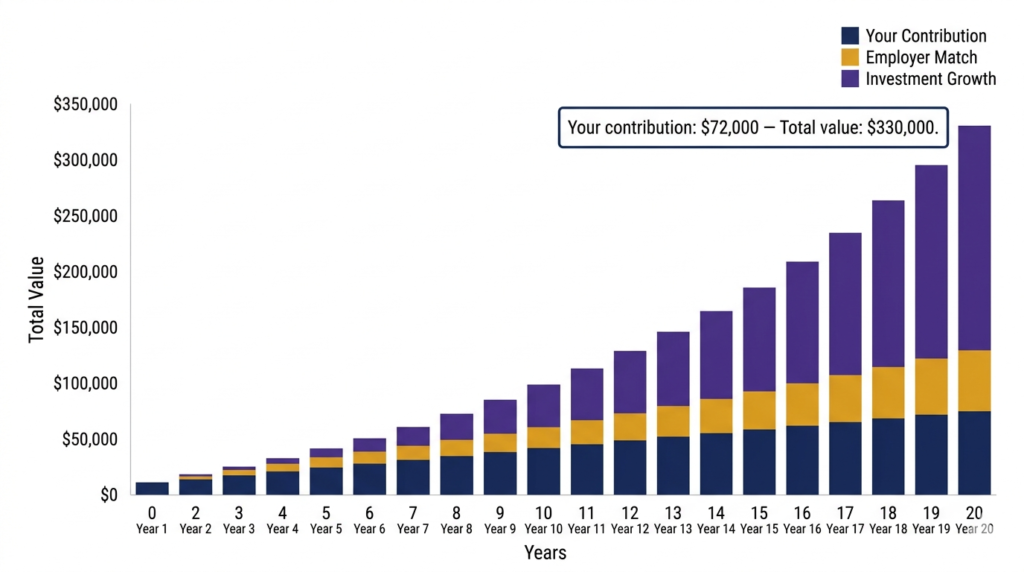
Say you earn $60,000 per year and contribute 6% of your salary to your 401k. That is $3,600 from your paycheck per year. Your employer matches 100% up to 6%, adding another $3,600. So $7,200 per year goes into your retirement account. You only felt $3,600 leave your paycheck because of the tax advantage, but $7,200 is working and compounding for your future.
Over 20 years at a 7% average annual return, that $7,200 per year becomes approximately $330,000. Your personal contribution from your paycheck was only $72,000 of that. The rest is employer match and compound growth.
This is not something you want to casually walk away from without a clear plan.
Can Immigrants Have a 401k in the United States
Yes, absolutely. And this is the first thing I want to be completely clear about because there is real confusion around this question in immigrant communities.
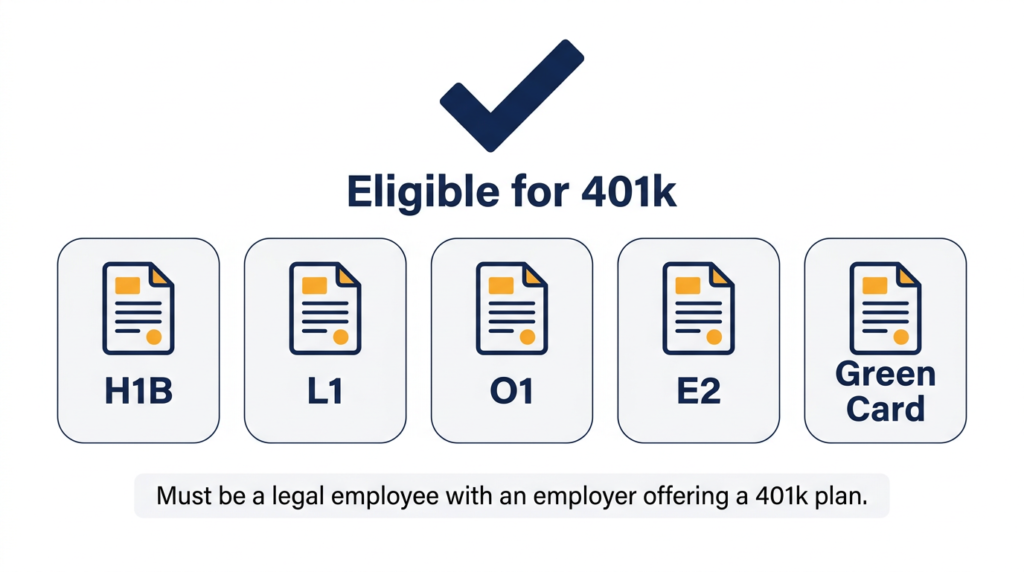
Your ability to participate in a 401k has nothing to do with your citizenship status. If you work legally in the United States and your employer offers a 401k plan, you are eligible to participate. This includes immigrants on H1B visas, L1 visas, O1 visas, TN visas, E2 visas, green card holders, and naturalized citizens.
What matters is that you are a legal employee of a company that offers a 401k plan. Immigration status beyond that is largely irrelevant to 401k participation.
The more important question, especially for immigrants on temporary visas who may not plan to stay in the US permanently, is not whether you can have a 401k. It is whether you should be maximizing it given your specific situation, and what your options are if you eventually leave.
That is what the rest of this article is about.
Understanding Vesting: The Part That Catches Most Immigrants Off Guard
Here is something that took me by surprise when I started paying attention to my 401k, and it is one of the most important concepts for immigrants to understand before making any decisions about leaving.
When your employer contributes money to your 401k, that money does not automatically become fully yours. It becomes yours through a process called vesting, which is a schedule set by your employer that determines how much of their contributions you get to keep based on how long you have worked there.
Your own contributions are always 100% yours immediately. But the employer match? That depends on your company’s vesting schedule.
The two most common types are:
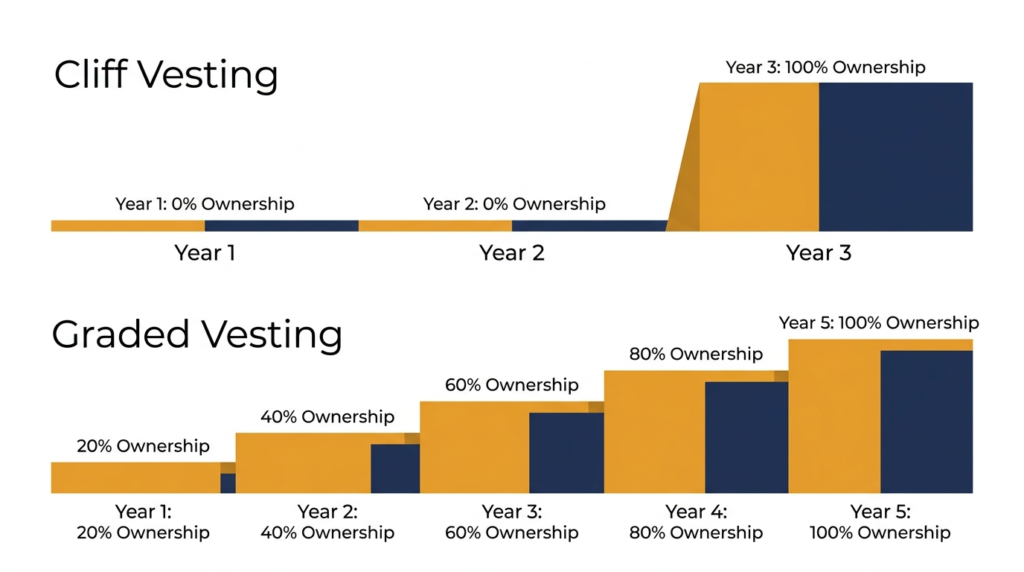
Cliff vesting: You own 0% of the employer match until you hit a specific anniversary, then you own 100% all at once. A three year cliff means you own nothing of the match until year three, then suddenly you own all of it.
Graded vesting: You earn ownership of the employer match gradually over time. A common schedule is 20% per year over five years, meaning you own 20% after year one, 40% after year two, and 100% after year five.
Why does this matter so much for immigrants? Because if you leave a job, and potentially leave the country, before you are fully vested, you forfeit the unvested portion of your employer match. That can be a significant amount of free money that simply disappears.
Before making any decision about leaving an employer or leaving the US, check your vesting schedule. It may be worth staying a few additional months to reach your next vesting milestone and keep money that is rightfully yours.
The Big Question: What Happens to Your 401k if You Leave the USA
This is the question that sits at the heart of this entire article. And the answer is: you have several options, each with different tax implications, and the right choice depends on your specific situation.
Let me walk through each one clearly.
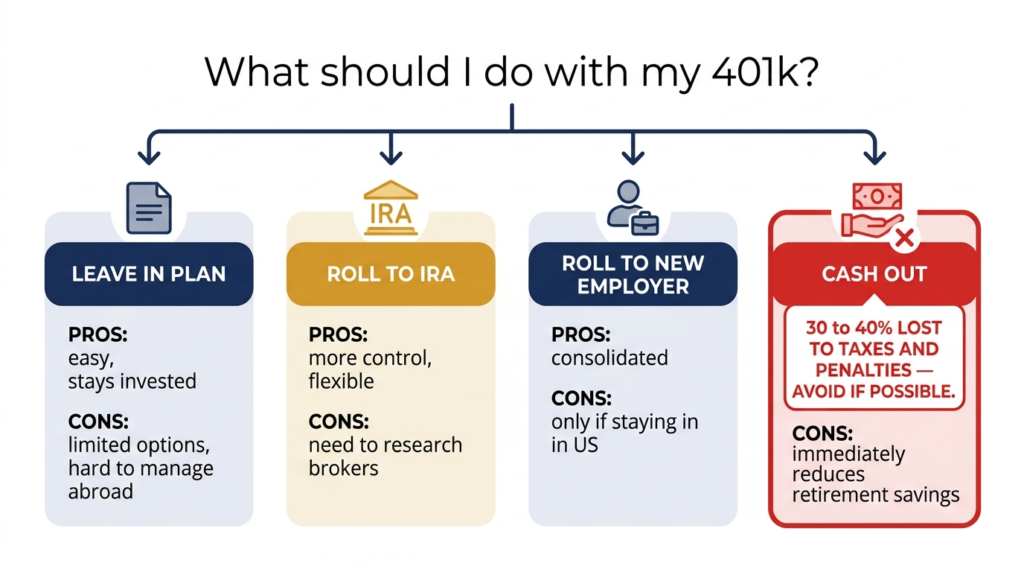
Option 1: Leave the Money in Your Former Employer’s 401k Plan
When you leave a job, whether to go to another US employer or to leave the country entirely, you are generally allowed to leave your 401k money right where it is, inside your former employer’s plan. As long as your vested balance is above $5,000, most employers are legally required to let you keep the account open.
The advantages: Your money stays invested and continues growing. You do not trigger any tax event. The administrative hassle is minimal.
The disadvantages: You may have limited investment options compared to rolling into your own IRA. You may pay slightly higher fees depending on the plan. And managing retirement accounts across multiple former employers in a country you no longer live in can get complicated over time.
My honest take: Leaving it in place is a reasonable short term option if you are uncertain about your plans. But for immigrants who have left the US permanently, it is rarely the best long term solution.
Option 2: Roll Over to an IRA
Rolling your 401k into an Individual Retirement Account (IRA) is almost always my preferred recommendation for immigrants who leave an employer. An IRA is not tied to any employer, it offers you vastly more investment options, and the tax advantages are similar to a 401k.
Rolling over to an IRA does not trigger a tax event as long as you complete what is called a direct rollover, where the money goes straight from your 401k into your new IRA without passing through your hands. If the money comes to you first (an indirect rollover), you have 60 days to deposit it into an IRA or you will owe income tax plus a 10% early withdrawal penalty.
For immigrants leaving the US who want to keep their retirement savings growing in the American market, rolling into an IRA at a trusted institution like Fidelity, Betterment, or Capitalize is often the cleanest and most flexible option.
Capitalize is a service specifically designed to help people roll over their 401k accounts to an IRA. They handle the entire process for you, for free. For immigrants navigating a complicated transition, having someone handle the rollover paperwork is genuinely valuable.
Beagle is another excellent service that helps you find old 401k accounts from former employers, consolidate them, and manage your rollover. If you have worked multiple jobs in the US, Beagle can find retirement accounts you may have forgotten about.
Option 3: Roll Over to a New Employer’s 401k
If you are leaving one US job for another US job and your new employer offers a 401k with a rollover option, you can move your old 401k directly into your new employer’s plan. This keeps everything consolidated and simple.
However, if you are leaving the US entirely, this option obviously does not apply.
Option 4: Cash It Out – The Option I Strongly Caution Against
This is the option most people think of first, especially immigrants who want to take their money back to their home country. And I understand the instinct. The money is yours. You worked for it. You want it now.
But here is what cashing out your 401k actually costs you, and I want you to read this carefully before making any decision.
When you cash out a 401k before age 59 and a half, two things happen immediately:
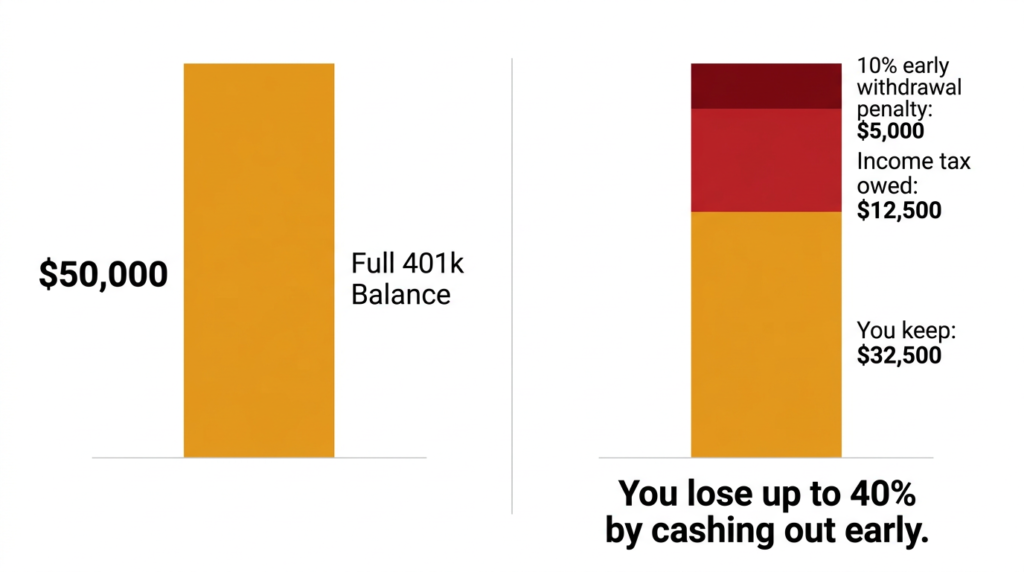
First: The entire withdrawal is treated as ordinary income in the year you take it. If you withdraw $30,000, that $30,000 is added to your taxable income for that year.
Second: You pay a 10% early withdrawal penalty on top of the income tax. So on a $30,000 withdrawal, you immediately owe roughly $7,500 in penalty alone, plus federal and potentially state income tax on the full amount.
For most people in a moderate tax bracket, cashing out a 401k early costs them 30% to 40% of the total balance in taxes and penalties combined. On a $50,000 balance, you might walk away with only $30,000 to $35,000 after everything is taken out.
That is a permanent and irreversible loss of wealth that compounding can never repair.
There are limited exceptions where the 10% penalty is waived, including permanent disability, certain medical expenses, and a few other specific situations. But for the vast majority of immigrants simply leaving the country, the penalty applies in full.
The Tax Reality for Immigrants Leaving the US With a 401k
This is where things get genuinely complicated, and where I strongly recommend speaking with a tax professional who has specific experience with international tax matters before making any decisions.
Here is what you need to understand:
If you cash out your 401k while still a US tax resident: You pay US income tax and the 10% early withdrawal penalty as described above.
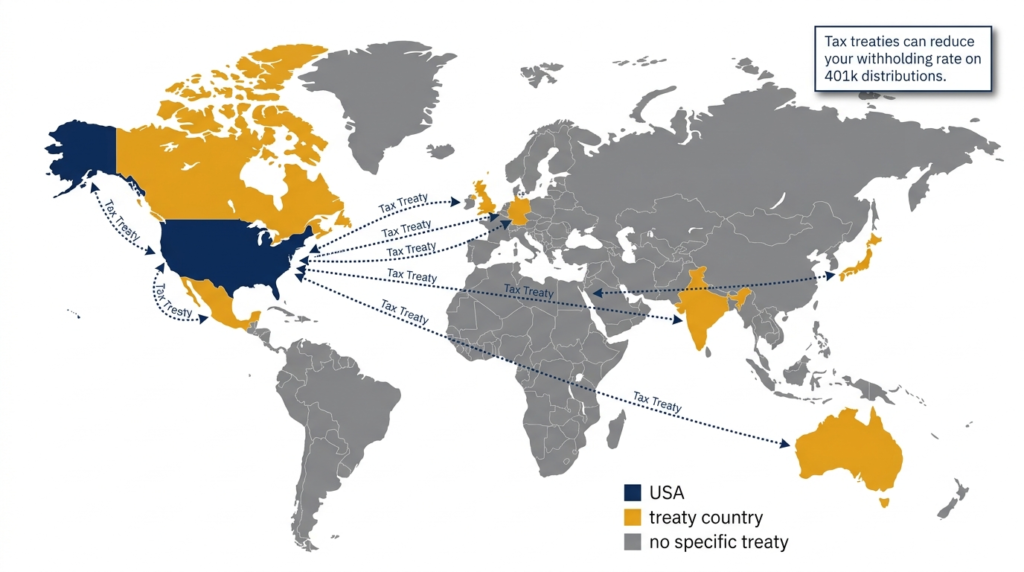
If you cash out your 401k after leaving the US and becoming a nonresident: This is where it gets complex. As a nonresident alien receiving distributions from a US retirement account, your withdrawal is generally subject to a flat 30% US withholding tax unless a tax treaty between the US and your home country reduces that rate.
The United States has tax treaties with many countries including India, Canada, the United Kingdom, Germany, Australia, Japan, Mexico, and others. These treaties sometimes reduce the withholding rate on retirement distributions to as low as 15%. Some treaties have specific provisions for 401k and IRA distributions.
The bottom line: The tax treatment of your 401k when leaving the US depends on your home country, whether a tax treaty exists, the specific provisions of that treaty, and whether you will also owe tax in your home country on the same income. In some cases, you may owe tax in both countries on the same distribution, though credits are sometimes available to reduce double taxation.
This is not a situation to navigate with a general tax software program. It requires a professional who works specifically with expatriate and international tax situations.
My Personal Take: What I Would Do With My 401k Before Leaving
I want to share something personal here because I think it is more useful than another dry list of options.
When I seriously considered returning to my home country a few years ago, I sat down and mapped out my exact 401k situation. Here is what I found and what I decided.
I had worked for two employers. The first had a graded vesting schedule and I had hit the four year mark, meaning I was 80% vested in the employer match. Leaving two months before my five year anniversary would have cost me 20% of their contributions. I waited.
The second employer had a cliff vesting schedule and I was already fully vested. No urgency there.
Once I was fully vested at employer one, I looked at my three realistic options for a potential departure: leave the money in the 401k plans, roll everything into a single IRA at Fidelity, or cash out. The math on cashing out was so clearly terrible that I eliminated it within about 10 minutes of running the numbers.
Between leaving in the old plans and rolling into an IRA, I chose to roll into a single Fidelity IRA. The reasons were simple: better investment options, lower fees, a single account to manage from abroad, and the flexibility to continue contributing if I ever returned to the US.
I also converted a portion into a Roth IRA, which I will explain in the next section, because my income that year was lower than usual due to the job transition, making it an ideal time for conversion.
I stayed in the US in the end. But having a clean, consolidated IRA ready gave me peace of mind and I have never regretted the rollover.
The Roth Conversion: A Strategy Worth Knowing About
One of the most underutilized strategies for immigrants who are considering leaving the US is a Roth IRA conversion, and I want to explain it clearly because it could save you significant money over time.
A Roth conversion means moving money from a traditional 401k or traditional IRA (both funded with pre tax dollars) into a Roth IRA (funded with after tax dollars). You pay income tax on the amount you convert in the year you do it. But after that conversion, all future growth is completely tax free forever.
Why is this relevant for immigrants leaving the US?
If you are in a lower income year — perhaps the year you leave your job, or the year you return to your home country and have lower US income — converting some or all of your 401k balance to a Roth IRA that year can dramatically reduce the total tax you pay on that money. You pay tax at a lower rate now, and never pay tax on the growth again.
If you are leaving the US permanently and plan to eventually withdraw the money, having it in a Roth IRA may result in better tax treaty treatment in some countries than a traditional 401k withdrawal would.
The tradeoff: You are paying tax now instead of later. If you are in a high income year, this strategy may not make sense. The math depends heavily on your current income, your home country’s tax treatment of Roth distributions, and how many years the money will continue to grow.
This is absolutely a decision to discuss with an expat tax professional before acting.
What About the Employer Match You Have Not Collected Yet
One of the most important practical questions for immigrants considering leaving a job is about unvested employer contributions.
Let me be direct: unvested employer contributions are gone the moment you leave. You cannot collect them later, negotiate for them, or come back and claim them after the fact.
This is why timing matters so much. If you are three months away from your next vesting milestone, and that milestone means you keep an additional $3,000 to $5,000 of your employer’s contributions, that is real money worth considering in your departure timeline.
Ask your HR department for a copy of your vesting schedule as soon as possible. Many companies have it available in their employee portal. Run the numbers on what you would lose by leaving now versus in three, six, or twelve months.
Smart Steps To Take Now, Regardless of Whether You Plan to Leave
Even if you have no current plans to leave the US, the 401k decisions you make today affect your future flexibility. Here is what I recommend doing right now:
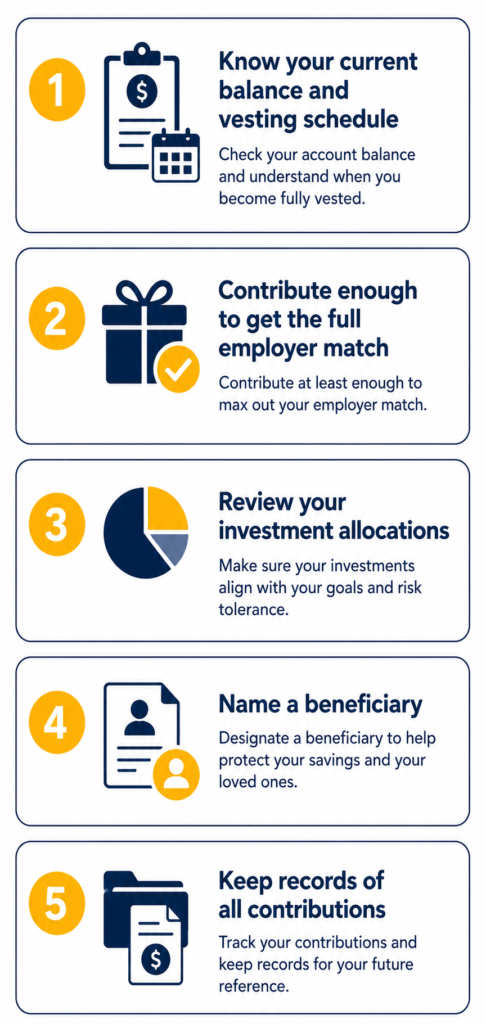
Step 1: Know exactly what is in your 401k. Log into your plan account, find your current balance, check how much is your contribution versus your employer’s contribution, and find your vesting schedule. Many immigrants have been contributing for years without ever checking these basics.
Step 2: Make sure you are contributing at least enough to get the full employer match. This is free money. If your employer matches up to 5% of your salary and you are contributing 3%, you are leaving 2% of your salary on the table every paycheck. Increase your contribution to the match limit immediately.
Step 3: Check your investment allocations. Many people accept the default investment allocation in their 401k and never change it. Default funds are often too conservative for younger investors. Log in and check that your money is invested appropriately for your timeline.
Step 4: Name a beneficiary. If you pass away, who gets your 401k? Many immigrants have never completed this step. Naming a beneficiary who is not a US citizen involves some additional complexity but is absolutely possible and important.
Step 5: Keep records of all contributions. If you ever need to manage this account from abroad, having clear records of your contributions, your cost basis for any Roth conversions, and your account history will make everything significantly easier.
Recommended Platforms for Managing Your Retirement Savings as an Immigrant
Fidelity: Best IRA for 401k Rollovers
Fidelity is where I rolled my own 401k and where I continue to manage my retirement savings. Their IRA account has no minimum balance, no commission fees on stocks and ETFs, and access to their zero expense ratio index funds — meaning you pay literally nothing in ongoing fees to hold your investments.
Fidelity also has excellent customer service and is fully capable of managing accounts for people living abroad.
Betterment: Best Automated IRA for Hands Off Investors
Betterment is a robo advisor that manages your retirement investments automatically based on your goals and timeline. For immigrants who want their retirement savings professionally managed without active involvement, Betterment is one of the most respected options available.
Betterment also offers Roth IRA accounts, traditional IRAs, and excellent tools for planning a Roth conversion strategy.
M1 Finance: Best for Building a Custom Retirement Portfolio
M1 Finance lets you build your own investment portfolio as a pie, choosing your allocation across funds and stocks, and then automates all the rebalancing and reinvestment. Their IRA accounts have no fees and no minimums.
Capitalize: Best Free 401k Rollover Service
Capitalize is a free service that handles the entire 401k rollover process for you, from contacting your former employer’s plan administrator to ensuring the funds land safely in your new IRA. For immigrants navigating a job transition or country departure, having a free service manage this paperwork is genuinely valuable.
Beagle: Best for Finding and Managing Old 401k Accounts
If you have worked multiple jobs in the US, you may have 401k accounts sitting with former employers that you have lost track of. Beagle locates them, helps you understand your vesting status, and walks you through your rollover options.
A Note on Social Security: The Other Retirement Question Immigrants Ask
While this article is specifically about 401ks, I want to briefly address Social Security because it comes up in the same conversation constantly.
If you have worked legally in the US and paid Social Security taxes, you have earned credits toward Social Security benefits. You need 40 credits (approximately 10 years of work) to qualify for full benefits. The amount you receive depends on your earnings history.
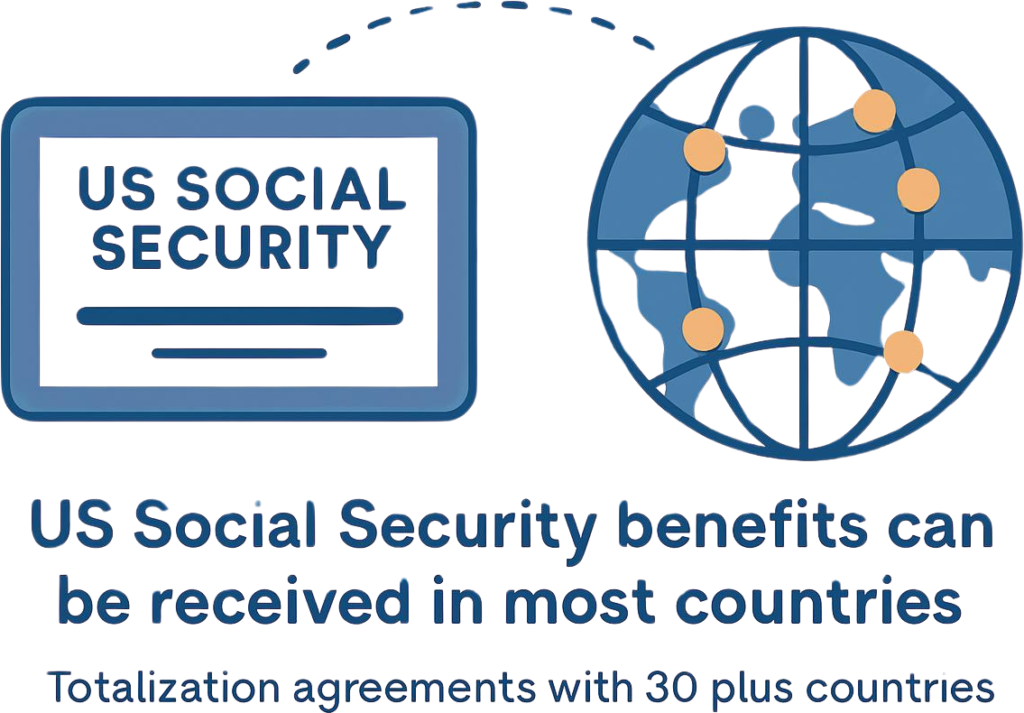
Here is what most immigrants do not know: you can collect US Social Security benefits from abroad. If you have reached the age and credit requirements, the Social Security Administration will send your benefits to bank accounts in most countries. There are some exceptions for certain countries where the US will not send payments, so check the SSA website for your specific home country.
Also worth knowing: the US has Social Security totalization agreements with about 30 countries. These agreements help prevent double taxation of your Social Security earnings and can allow work credits to be combined between the two countries. If your home country is on that list, your years of work there may count toward your US Social Security qualification.
The Bottom Line: Do Not Leave Your 401k to Chance
The 401k is one of the most valuable financial benefits available to immigrants working in the United States. It is also one of the most misunderstood, most neglected, and most poorly handled when people leave their jobs or leave the country.
Here is the simple version of everything in this article:
Do not cash out your 401k early unless you are in a genuine financial emergency. The tax and penalty cost is devastating and permanent. Roll your 401k into an IRA at Fidelity, Betterment, or M1 Finance when you leave an employer. Use Capitalize to handle the rollover paperwork for free. Check your vesting schedule before you leave any job and time your departure wisely. Consult an expat tax professional before making any decisions about your 401k if you are leaving the US, because the international tax implications are real and complex. And if you have old 401k accounts sitting with former employers, use Beagle to find them before you go.
Your retirement savings are real, meaningful wealth that you earned. They deserve to be managed with intention, not left sitting in a former employer’s plan or, worse, surrendered to the IRS in taxes and penalties.
I made the right decision with mine. You can too.
Are you navigating a 401k decision right now? Share your situation in the comments and I will do my best to help you think it through. This is exactly the kind of question the immigrant community needs to talk about more openly.
Disclaimer: This article contains affiliate links. If you sign up through these links I may earn a commission at no extra cost to you. This article reflects my personal experience and research and is not financial, tax, or legal advice. International tax situations are complex and individual. Please consult a qualified tax professional before making any decisions about your retirement accounts.