
The Immigrant Entrepreneur: How to Start an LLC and Build Business Credit with an ITIN
Many immigrants arrive in America focused on one goal:
Finding a job.
A stable paycheck creates security. It pays the bills. It helps support family members. It provides a path toward a better future.
But for many immigrants, employment eventually leads to a different question:
What if I started my own business?
Maybe you’re a nurse who wants to open a home healthcare agency.
Maybe you’re a truck driver who wants to become an owner-operator.
Maybe you clean homes, repair HVAC systems, do landscaping, provide consulting services, sell products online, or have a side hustle that’s beginning to generate real income.
At some point, the idea becomes serious.
Then the doubts begin.
Can I start a business without a Social Security Number?
Can I get a business bank account with an ITIN?
Can I build business credit if I’m still building personal credit?
Can I qualify for financing later?
The answer to all of these questions is yes.
Thousands of immigrant entrepreneurs successfully start businesses every year using only an Individual Taxpayer Identification Number (ITIN). They form LLCs, obtain EINs, open business bank accounts, build business credit, and eventually qualify for financing to grow their companies.
The challenge isn’t whether you can do it.
The challenge is knowing the correct order of steps.
This guide walks through exactly how immigrant entrepreneurs can legally start an LLC, establish banking relationships, and build business credit from the ground up.
Why Starting an LLC Matters
Many businesses begin informally.
A few clients.
A side hustle.
Money coming through Cash App, Zelle, PayPal, Venmo, or a personal checking account.
At first, everything feels simple.
Then the business grows.
Clients ask for invoices.
Banks begin questioning business-related deposits.
Tax season becomes complicated.
Personal and business expenses become mixed together.
And if something goes wrong, your personal assets could be exposed.
An LLC (Limited Liability Company) helps solve many of these problems.
An LLC creates a legal separation between you and your business. It makes your company appear more professional, simplifies record keeping, and creates the foundation needed to establish business credit.
Most importantly, it turns a side hustle into a legitimate business.
Step 1: Make Sure Your Immigration Status Allows Business Activity
Before filing any paperwork, understand an important distinction.
Owning a business and working in a business are not always treated the same under immigration law.
Depending on your immigration status, visa category, or employment authorization, there may be restrictions on what business activities you can personally perform.
Because every situation is different, consult an immigration attorney if you have questions about your specific circumstances.
A short consultation today can prevent expensive mistakes later.
Step 2: Form Your LLC
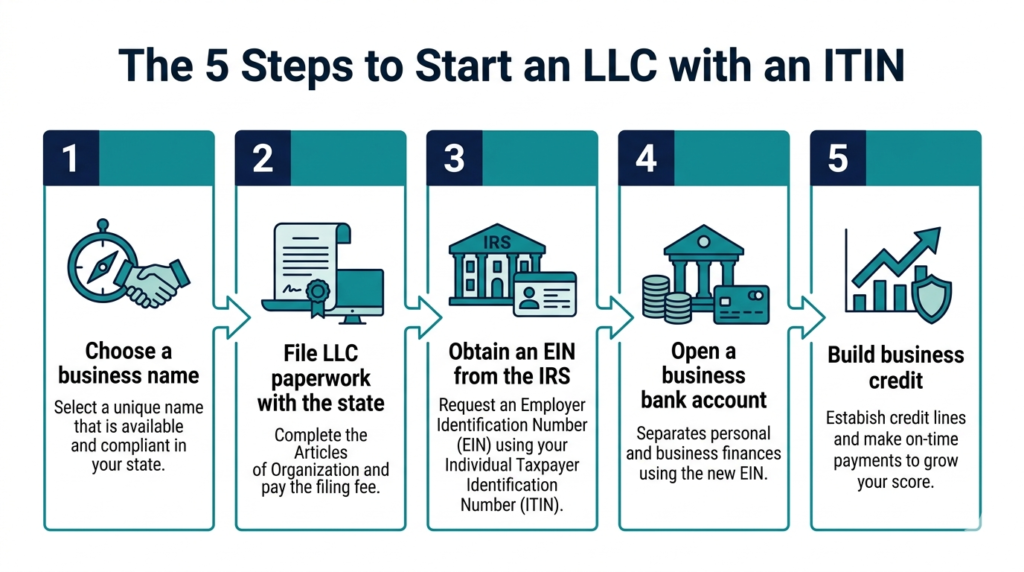
Creating an LLC is often easier than most people expect.
While requirements vary by state, the process usually involves:
Choose a Business Name
Select a name that is:
- Easy to remember
- Easy to spell
- Professional
- Relevant to your business
Before filing, verify that the name is available through your state’s business registration website.
File Your Articles of Organization
This document officially creates your LLC.
Most states allow online filing.
The filing fee typically ranges from $50 to several hundred dollars depending on the state.
In most cases, a Social Security Number is not required.
Many immigrants successfully form LLCs using an ITIN and government-issued identification.
Create an Operating Agreement
Many first-time business owners skip this step.
Don’t.
An operating agreement explains ownership structure, management responsibilities, and decision-making procedures.
Even if you are the only owner, having one strengthens the legitimacy of your business.
Step 3: Obtain an EIN
After your LLC is created, your next step is obtaining an Employer Identification Number (EIN).
Think of an EIN as a Social Security Number for your business.
You will need it for:
- Opening a business bank account
- Filing taxes
- Hiring employees
- Applying for business credit
- Working with vendors and suppliers
One of the biggest misconceptions among immigrants is that obtaining an EIN requires a Social Security Number.
It does not.
The IRS allows ITIN holders and many foreign business owners to obtain EINs for legitimate business purposes.
Once issued, your EIN becomes one of the most important pieces of your business foundation.
Step 4: Open a Business Bank Account
Many entrepreneurs make a costly mistake here.
They continue using their personal checking account.
That creates accounting problems, tax headaches, and makes it more difficult to establish business credibility.
Instead, open a dedicated business bank account immediately after obtaining your EIN.
Most banks will request:
- LLC formation documents
- EIN confirmation
- Government-issued identification
- Business address
If you’re still establishing your financial footing in the United States, our guide on How to Save Money as a New Immigrant in America can help you build a stronger personal financial foundation before expanding into business ownership.
Keeping business and personal finances separate is one of the simplest ways to improve financial organization and professionalism.
Step 5: Start Building Business Credit Immediately
Most business owners wait until they need financing before thinking about business credit.
That’s a mistake.
Business credit takes time to develop.
Just like personal credit, lenders want to see a track record of responsible financial behavior.
Business credit allows your company to establish its own financial identity separate from your personal credit profile.
The sooner you begin building it, the better.
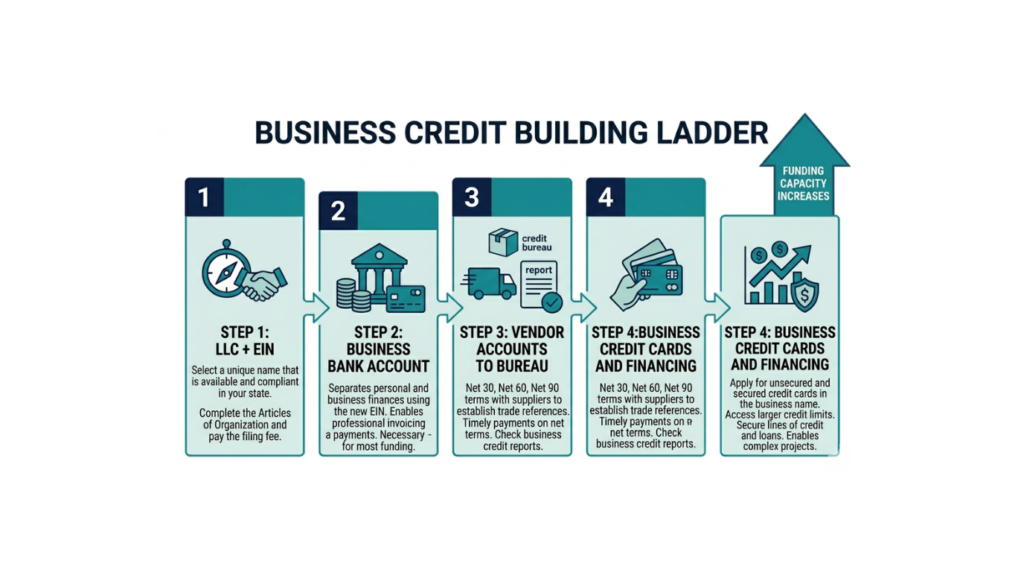
Step 6: Open Vendor Accounts
One of the easiest ways to establish business credit is through vendor relationships.
Many suppliers offer Net-30 terms.
This means you receive products or services today and pay the invoice within 30 days.
When those payments are reported to business credit bureaus, your company begins developing a business credit history.
The formula is simple:
Buy responsibly.
Pay early.
Repeat consistently.
Business credit rewards reliability.
Step 7: Establish Strong Personal Credit Too
Many lenders evaluate both your business and your personal credit history during the early stages of your company’s growth.
This means personal credit still matters.
If you’re starting from zero, our guide on Secured Credit Cards for Beginners with No Credit explains one of the fastest and safest ways to establish a positive credit history in the United States.
Strong personal credit often makes it easier to qualify for business credit cards and financing while your business credit profile is still developing.
Step 8: Keep Excellent Records
Many entrepreneurs wait until tax season to organize their finances.
By then, the damage is often done.
From day one, keep records of:
- Income
- Expenses
- Contracts
- Invoices
- Bank statements
- Receipts
Good records make it easier to:
- File taxes
- Apply for financing
- Measure profitability
- Protect your business during audits
Organization is one of the most underrated business skills.
Common Mistakes Immigrant Entrepreneurs Make
Mixing Personal and Business Finances
This creates accounting problems and weakens the legal protections offered by an LLC.
Always maintain separate accounts.
Waiting Too Long to Build Credit
Credit should be established before it’s needed.
Not after.
Missing Tax Deadlines
Late filings can create unnecessary complications with lenders and government agencies.
Stay organized.
Ignoring Banking Relationships
Banks often become future financing partners.
A strong banking relationship today can create opportunities tomorrow.
If you’ve ever been denied a bank account, our guide on Second Chance Banking: What to Do if You’re Denied a Bank Account explains how to rebuild your banking history and regain access to financial services.
How Business Credit Creates Opportunity
Strong business credit can eventually help you qualify for:
- Business credit cards
- Equipment financing
- Vehicle financing
- Lines of credit
- Commercial leases
- Supplier credit terms
- SBA-backed loans
The goal isn’t borrowing money.
The goal is having options.
Access to capital allows businesses to survive downturns, purchase equipment, hire employees, and take advantage of growth opportunities.
The Bigger Picture
Many immigrants focus entirely on earning income.
Income is important.
But ownership is different.
A business can become an asset.
An asset can create wealth.
And wealth creates choices.
The same long-term thinking discussed in our article Why Every Immigrant Needs a Roth IRA: Tax-Free Wealth for Your Future applies to entrepreneurship as well. Building wealth isn’t just about what you earn. It’s about what you own.
Unfortunately, many newcomers make financial decisions that slow their progress. That’s why our guide on The 7 Biggest Financial Mistakes Immigrants Make is worth reading before launching a business.
The most successful immigrant entrepreneurs understand a simple truth:
Businesses are built one step at a time.
First comes the LLC.
Then the EIN.
Then the bank account.
Then the credit profile.
Then the growth.
You do not need perfect English.
You do not need a Social Security Number.
You do not need investors.
You do not need a large amount of money.
You need a plan.
You need persistence.
And you need to take the first step.
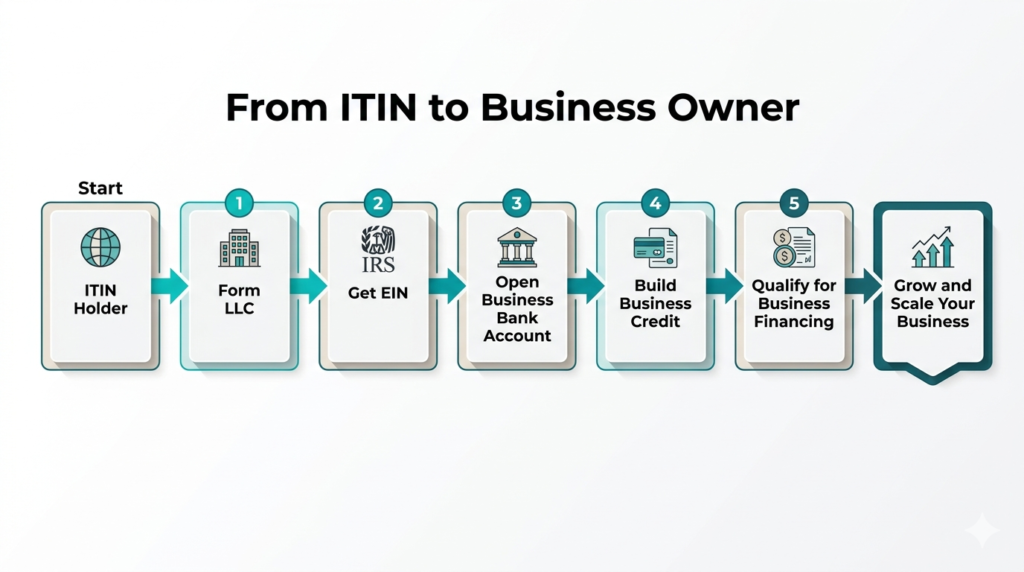
Quick Reference: From ITIN to Business Credit
| Step | Action | Goal |
|---|---|---|
| 1 | Form LLC | Create legal business entity |
| 2 | Obtain EIN | Business tax identification |
| 3 | Open Business Bank Account | Separate finances |
| 4 | Establish Vendor Accounts | Build payment history |
| 5 | Build Personal Credit | Improve financing opportunities |
| 6 | Apply for Business Credit Products | Expand credit profile |
| 7 | Maintain Good Records | Support growth and lending |
Disclaimer: This article is for educational and informational purposes only and does not constitute legal, tax, immigration, or financial advice. Business formation requirements, banking policies, and lending standards vary by state and institution. Consult qualified professionals regarding your specific circumstances.