
Safe Tax Filing: Protecting Your Privacy and Immigration Status
For decades, the IRS made a promise to immigrant taxpayers. File your taxes. Pay what you owe. Your information is confidential. We will not share it with immigration enforcement. That promise was backed by federal law. It was repeated by IRS officials at every level. It was the reason millions of undocumented immigrants paid billions of dollars in taxes every year, contributing to programs many of them will never be eligible to collect from.
In 2025, that promise was tested in a way it had never been tested before. And the story of what happened, and what the courts did in response, is something every immigrant who files taxes needs to understand before the next filing season begins.
This article tells that story honestly, explains what protections still exist, what changed, and what practical steps you can take right now to file your taxes in the safest way possible.
The Legal Foundation: What Has Always Protected Your Tax Information
Before explaining what changed, it helps to understand what has always been there.
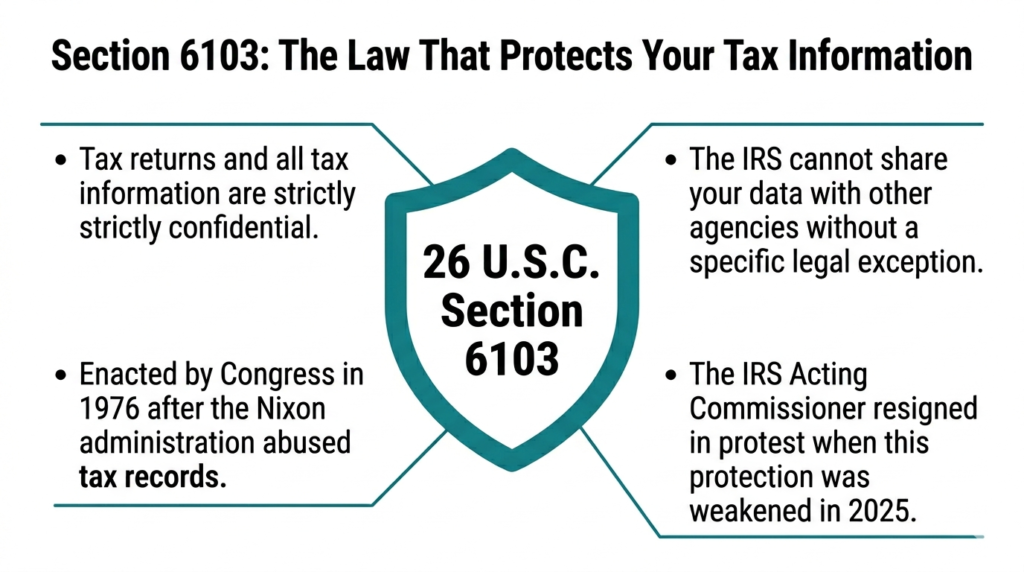
Federal law under 26 U.S.C. Section 6103 is unambiguous: tax returns and all related information must remain confidential. This law was not created arbitrarily. It was enacted by Congress in 1976 as a direct response to the Nixon administration’s abuse of IRS tax records to target political opponents. Its purpose was to prevent any administration from weaponizing the tax system against individuals.
Under Section 6103, the IRS is prohibited from disclosing taxpayer information to other agencies except in very specific, narrow circumstances, primarily for tax administration purposes and for certain non-tax criminal investigations. For decades, the IRS publicly and consistently assured undocumented immigrants that their tax information would never be shared with immigration enforcement. That assurance encouraged tax compliance and generated tens of billions of dollars in tax revenue that would otherwise never have been collected.
A 2024 study by the Institute on Taxation and Economic Policy found that undocumented immigrants paid $96.7 billion in federal, state, and local taxes in a single year, roughly $8,889 per person on average. More than a third of that went toward Social Security and Medicare, programs these taxpayers are not eligible to access.
What Changed in 2025: The IRS and ICE Data Sharing Agreement
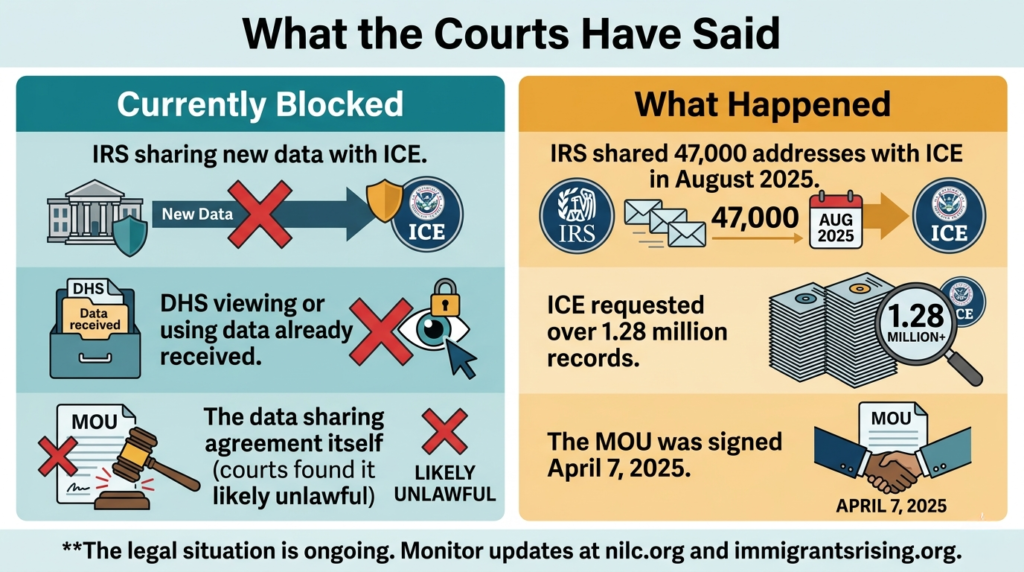
On April 7, 2025, the Internal Revenue Service and Immigration and Customs Enforcement signed a Memorandum of Understanding (MOU) creating a framework for sharing taxpayer information for immigration enforcement purposes. This was described by the National Immigration Forum as “a drastic shift away from the IRS’s longstanding commitment to taxpayer privacy.” The Acting IRS Commissioner at the time resigned in protest.
The agreement as signed permitted ICE to request confirmation of names, addresses, and certain tax data for individuals facing final orders of removal or under criminal investigation, including individuals who had remained in the country more than 90 days past a deportation order.
Here is what happened next, in order.
August 2025: ICE sent more than 1.28 million names to the IRS. The IRS matched approximately 47,000 of those names and shared address information with ICE for people who DHS said had stayed more than 90 days past a removal order.
November 21, 2025: A federal judge in Washington DC blocked the IRS from sharing any further data with ICE or DHS. The judge ruled that the data sharing agreement was likely unlawful and that the IRS had not justified abandoning decades of established privacy rules. The court order also blocked sharing with the Department of Homeland Security as a whole.
February 2026: A federal court in Massachusetts issued a broader order prohibiting DHS from further using or viewing any of the data they had already received through the agreement. The judge raised concerns that the data was unreliable and could lead to the arrest of the wrong people.
February 24, 2026: A federal appeals court in DC declined to stop the data sharing between the two agencies, suggesting the specific information being shared, names and addresses, may fall within a legal exception. The legal fight continued.
As of the time of publication: Two federal courts are blocking the IRS from sharing data with DHS and ICE, and blocking DHS from using the data already received. Both courts have found the data sharing agreement likely unlawful. The legal situation remains in active litigation, and the outcome is not yet final.
What This Means for You: An Honest Assessment
Here is the clearest, most honest summary of where things stand.
For the vast majority of immigrant tax filers, including ITIN filers, the 47,000 addresses that were shared with ICE represent a very specific and narrow group: people who had final orders of removal and had remained in the country more than 90 days past that order. The government’s own legal filings confirm that is the only category of taxpayer data that was shared.
The current court orders block further sharing and block DHS from using what they already received. Two federal courts have found the agreement likely unlawful. These are meaningful protections that are currently in place.
At the same time, it would not be honest to pretend that nothing changed. The agreement was signed. Data was shared. Court orders can be overturned on appeal. The legal battle is ongoing. Any immigrant who files taxes should understand the current landscape clearly rather than relying on the decades-long assurance that has now been legally challenged.
The practical guidance from immigration attorneys, tax clinics, and advocacy organizations is consistent: filing taxes remains the right decision for most immigrants, and the steps below can reduce your exposure to the extent possible.
Who Is Most at Risk and Who Is Not
This is the question most immigrants are actually asking. Here is a direct answer.
Low risk of data sharing exposure:
If you have lawful immigration status, including a green card, a work visa, an EAD, TPS with current validity, or a pending adjustment of status, you are not the target of the data sharing agreement and the legal protections under Section 6103 apply to you fully. File your taxes normally.
If you are undocumented but do not have a final order of removal, the data that was shared did not include you, based on the government’s own description of what was shared. The court orders currently block any further sharing.
If you are a DACA recipient, your tax information was not among the data shared, and the court orders protect against further disclosure.
Higher risk:
If you have a final order of removal that is more than 90 days old and you are still in the country, you are in the specific category that was targeted by the data sharing request. Consulting with an immigration attorney about your options before filing is strongly recommended.
Practical Steps to File Safely
Knowing the landscape, here are specific steps that reduce your exposure while keeping you in compliance with your legal obligation to file.
Use a VITA Site or Certified Acceptance Agent for In-Person Filing
VITA (Volunteer Income Tax Assistance) sites are the safest environment for most immigrant tax filers. These IRS-certified community-based tax preparation sites are operated by nonprofits, community organizations, and legal aid networks, many of which are deeply committed to immigrant privacy. Your information is used only to prepare your tax return. It is not accessible to or shared with immigration enforcement by VITA organizations.
Many VITA sites specifically serving immigrant communities are also operated by legal aid organizations that understand the current legal landscape and can answer questions about what the data sharing agreement means for your specific situation.
To find a VITA site near you, visit IRS.gov and use the VITA locator tool, or call 1-800-906-9887. Our guide on free tax filing resources every newcomer should know about covers every free option in detail including which ones serve ITIN filers.
Use a Certified Acceptance Agent for ITIN Applications
If you are applying for an ITIN or renewing one, use a Certified Acceptance Agent (CAA) rather than mailing your original documents directly to the IRS. A CAA verifies your identity locally and submits a certified copy, which means your original passport never has to leave your hands and you have a trusted intermediary handling the application. Many VITA sites have CAAs on staff.
Consider Using a PO Box or a Trusted Address for Your Tax Return
Your mailing address on your tax return is the address the IRS has on file for you. Because the data that was shared with ICE included home addresses, some immigration attorneys have recommended that undocumented immigrants with concerns about their address information use a trusted stable address, such as a community organization, a legal aid office, or a trusted family member’s address, rather than their current home address when filing.
This is not a requirement, and most filers do not need to take this step. But for those in higher risk categories, it is a practical measure worth discussing with an immigration attorney.
Use a Tax Professional or Organization You Trust
The commercial tax preparation industry is not uniformly trustworthy. Some tax preparers operating in immigrant communities take advantage of their clients, charge excessive fees, claim credits that do not apply, or store client information insecurely.
Use a VITA site, a reputable nonprofit, or a licensed CPA or Enrolled Agent who you have verified has experience serving immigrant clients. Avoid tax preparation shops that advertise in community newspapers without verifiable credentials, and never hand over your identification documents to a preparer and leave without them.
Keep a Copy of Everything You File
Keep printed or digital copies of every document you file and every form you receive. Your W-2, your 1099, your completed return, and the IRS confirmation of your e filing are your record of compliance. These documents prove you filed, when you filed, and what you reported, which matters both for tax purposes and for immigration applications where tax compliance history is reviewed.
Know What the IRS Will and Will Not Contact You About
The IRS does not contact taxpayers by phone demanding immediate payment. It does not send emails asking for your personal information. It does not contact you through social media. All legitimate IRS contact arrives by mail to the address on file.
If you receive a threatening call claiming to be from the IRS, hang up. These are scams that specifically target immigrant communities. The real IRS will mail you a notice with a specific form number and give you time to respond or dispute. If you receive a real IRS notice and are unsure how to respond, a VITA site or a qualified tax professional can help you understand it.
Why Filing Still Matters
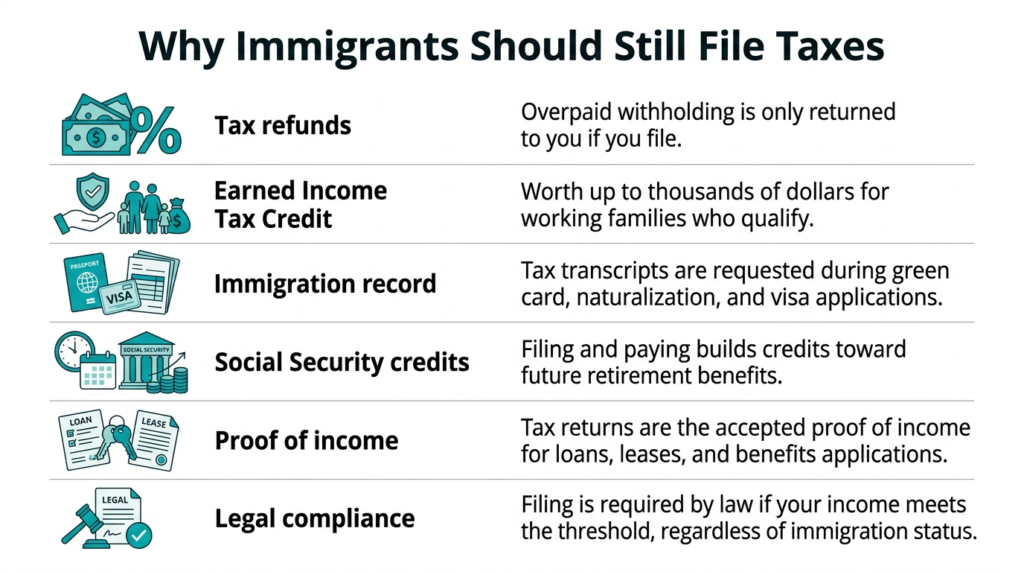
Given everything in this article, a reasonable person might ask whether it is safer to simply not file.
The answer, for the overwhelming majority of immigrants, is that not filing creates significantly more risk than filing does.
Not filing when you are legally required to creates a record of noncompliance that immigration agencies can use against you. It eliminates your right to refunds and credits you are legally owed. It breaks the chain of tax filing history that green card applications, naturalization proceedings, and many other immigration processes specifically review. It means you are not building Social Security credits toward a future benefit. And it puts you in violation of federal law.
The current court orders protecting immigrant taxpayer data are meaningful. The legal protections under Section 6103 still exist. The data that was shared represented a specific, narrow category of filers. The guidance from every major immigrant advocacy and legal organization consulted for this article is the same: the risks of not filing outweigh the risks of filing for most immigrants.
That said, if you are in a higher risk category, meaning you have a final order of removal that is more than 90 days old, speaking with an immigration attorney about your specific situation before filing is the right first step. Organizations like the National Immigration Law Center (nilc.org) and Immigrants Rising (immigrantsrising.org) maintain updated resources on this specific issue.
Monitoring the Situation
The legal battle over IRS and ICE data sharing is ongoing. Court orders can change. New agreements could be attempted. The safest thing you can do beyond the steps in this article is stay informed.
The National Immigration Law Center at nilc.org publishes updates specifically for immigrant taxpayers on this topic, including in Spanish. Immigrants Rising at immigrantsrising.org maintains a dedicated page tracking IRS, DHS, and ITIN updates as the situation develops. Both are reliable, nonpartisan sources maintained by legal experts.
For understanding the broader landscape of tax deductions and credits you are entitled to as an immigrant filer, our article on tax deductions every migrant is missing covers the financial side of filing in plain language.
And if this is your first year filing in the United States, our complete step by step guide on how to file US taxes as a newcomer]walks through every part of the process from determining your residency status to submitting your return.
The Bottom Line
Tax filing in the United States is complicated for everyone. For immigrants, it carries a weight that other filers do not face, and in 2025 that weight became heavier in a way that was not expected.
But the facts, as they currently stand, support filing. The courts have stepped in. The data sharing that occurred was narrow and specific. The legal protections under Section 6103 still exist and are being actively defended in federal courts. The consequences of not filing, for both your legal standing and your financial future, are real and lasting.
File. Use trusted, community based resources. Keep copies of everything. Monitor the situation through credible legal sources. And if your specific situation raises concerns, talk to an immigration attorney before filing rather than simply choosing not to file.
Your tax history is one of the most valuable documents you are building in this country. Protect it by creating it.
Disclaimer: This article is for educational and informational purposes only and does not constitute legal, immigration, or tax advice. The legal situation regarding IRS and ICE data sharing is in active litigation and the information in this article reflects the state of affairs as of the time of writing. Always consult a qualified immigration attorney and tax professional for advice specific to your situation. Monitor nilc.org and immigrantsrising.org for current updates.