The Beginner’s Guide to the Stock Market
The first time someone suggested I buy stocks, I changed the subject.
I did not understand what a stock was, exactly. I had a vague sense that it was something people with money did, something that could either make you rich or lose everything you had, and something that required knowledge I had never been taught. The combination of unfamiliarity and fear made the whole topic feel like someone else’s domain.
It took me longer than I would like to admit to understand that the stock market is not a casino, not a specialist system, and not reserved for people with financial backgrounds. It is a mechanism for owning a small piece of real businesses, and it is the most widely accessible wealth building tool ever created, available to almost anyone with a bank account and a willingness to learn the basics.
This article is the basics. Clear, honest, and structured specifically for someone who is starting from the beginning.
What the Stock Market Actually Is
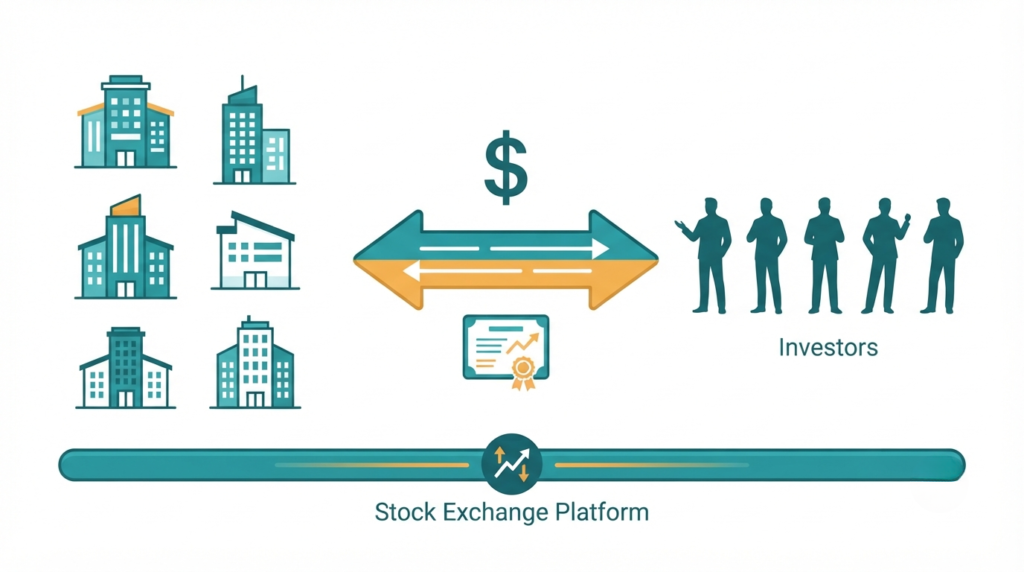
What this image shows: The stock market is a marketplace that connects companies on one side with investors on the other. Companies sell small ownership shares to raise money. Investors buy those shares and become partial owners. When the company grows in value, so does the share. A stock exchange acts as the organized platform where this trading happens.
A stock is a small ownership share in a company. When a company wants to raise money to grow its business, it can offer shares of ownership to the public. Anyone who buys a share owns a tiny piece of that company. If the company becomes more valuable over time, the shares become more valuable. If the company distributes a portion of its profits to shareholders, those payments are called dividends.
The stock market is simply the organized marketplace where shares of publicly traded companies are bought and sold. In the United States, the two major stock exchanges are the New York Stock Exchange (NYSE) and the Nasdaq. When you buy a share of Apple, Amazon, or any other publicly traded company, the transaction happens through one of these exchanges.
Stock prices change constantly throughout each trading day based on supply and demand: how many people want to buy and how many want to sell at any given moment, driven by news, earnings reports, economic conditions, and countless other factors. In the short term, these prices are noisy and unpredictable. Over long periods, they tend to reflect the underlying value and growth of the actual businesses.
This distinction between short term noise and long term value is the single most important thing to understand about the stock market before you invest a single dollar.
The Three Ways Stocks Make Money for You
When you own shares in a company, there are three ways that investment can return money to you.
Price appreciation. If the company grows and becomes more valuable, the price of your shares increases. If you bought a share for $50 and it is now worth $80, you have a $30 gain on that share. You realize that gain when you sell the shares. Until you sell, it is an unrealized gain: real on paper, but not yet cash in your account.
Dividends. Some companies distribute a portion of their profits to shareholders periodically, typically quarterly. These payments are called dividends. A company paying a 2% annual dividend yield on a $100 share pays you $2 per year per share you own, usually in four quarterly payments of $0.50 each. Dividend-paying companies tend to be older, more established businesses in stable industries.
Both simultaneously. Many investors hold shares that both appreciate in value and pay dividends over time. When dividends are automatically reinvested into additional shares, the compounding effect is significant over many years.
Individual Stocks vs. Index Funds: The Most Important Choice a Beginner Makes
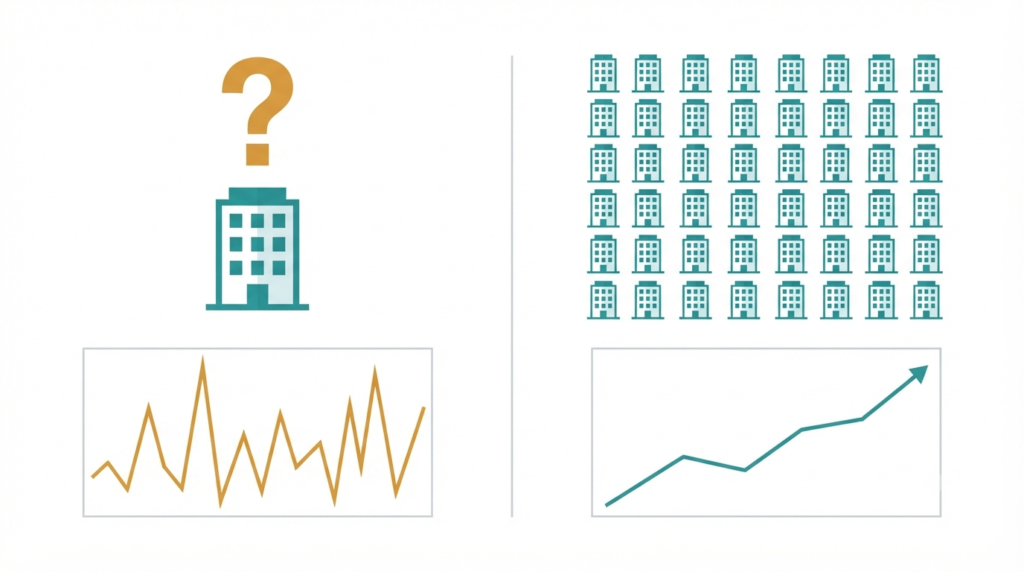
What this image shows: Buying individual stocks concentrates your risk in one company, if that company struggles, so does your investment, as shown by the volatile line graph. Buying an index fund spreads your ownership across hundreds or thousands of companies simultaneously, smoothing the individual company risk into a broader, historically more stable upward trend over time.
This is the choice that determines most of what happens next in your investing life.
Individual stocks mean buying shares in one specific company. If you buy Apple stock, your investment depends entirely on how Apple performs. If Apple does well, your investment grows. If Apple has a bad year, loses a key product, or faces regulatory trouble, your investment suffers. Picking individual stocks successfully requires research, time, and a level of expertise and information access that most individual investors, including professional fund managers, rarely have consistently enough to beat the market average over the long run.
Index funds solve the individual stock problem by spreading ownership across an enormous number of companies simultaneously. An S&P 500 index fund, for example, tracks the 500 largest publicly traded companies in the United States. When you buy one share of an S&P 500 index fund, you are effectively buying a tiny ownership stake in all 500 companies at once: Apple, Microsoft, Amazon, Google, Berkshire Hathaway, and 495 others. If one company has a catastrophic year, it represents only 0.2% of your portfolio. The other 499 companies continue.
Decades of academic research and practical evidence have consistently shown that most individual investors, and most professional fund managers, do not outperform a simple index fund over long periods. The reasons are numerous: the difficulty of consistently identifying outperforming stocks before the market prices in that information, the transaction costs of active trading, and the human tendency to buy high and sell low during moments of market stress.
For most beginners, and for most long term investors regardless of experience level, a low cost index fund is the clearest, most reliable path to stock market participation. You do not need to pick winners. You just need to own a piece of the whole.
How to Actually Buy Your First Stock or Index Fund
The practical path is shorter than most people expect.
Step 1: Open a brokerage account. A brokerage account is the account type that holds your stocks and index funds, the same way a bank account holds your cash. In the US, the three most widely recommended brokerages for beginners are Fidelity, Charles Schwab, and Vanguard. All three offer no account minimums, no trading commissions on stocks and ETFs, and access to a wide range of index funds with very low fees.
Opening a brokerage account takes approximately 15 minutes online. You will need your Social Security Number, a US address, your date of birth, and your bank account information for funding. For most lawfully working immigrants with an SSN, opening a standard brokerage account has no additional requirements beyond what any US resident would need.
Step 2: Fund your account. Link your bank account and transfer your initial investment. You can start with any amount. At Fidelity and Schwab, fractional shares allow you to invest as little as $1 in any stock or index fund. There is no minimum that makes it “real” investing. The first dollar you invest is real.
Step 3: Choose what to buy. For a first investment, a total market index fund or an S&P 500 index fund is the most widely recommended starting point for beginners. At Fidelity, FZROX (Fidelity Zero Total Market Index Fund) has a 0% expense ratio, meaning no annual fees at all. At Vanguard, VOO (Vanguard S&P 500 ETF) or VTI (Vanguard Total Market ETF) are among the most widely held index funds in the world. At Schwab, SWTSX or SCHB serve the same purpose.
Search for any of these ticker symbols in your brokerage’s search bar. Review the fund details. Enter the dollar amount you want to invest and place the order.
Step 4: Set up automatic contributions. The most powerful thing you can do after your first investment is automate the next one. Set a recurring monthly transfer from your bank account to your brokerage, and set the brokerage to automatically invest that amount in your chosen fund. Monthly contributions that happen automatically, regardless of whether the market is up or down that particular month, remove emotion from the process and take advantage of a strategy called dollar cost averaging: buying more shares when prices are low and fewer when prices are high, which improves your average purchase price over time.
Understanding Risk: What It Actually Means
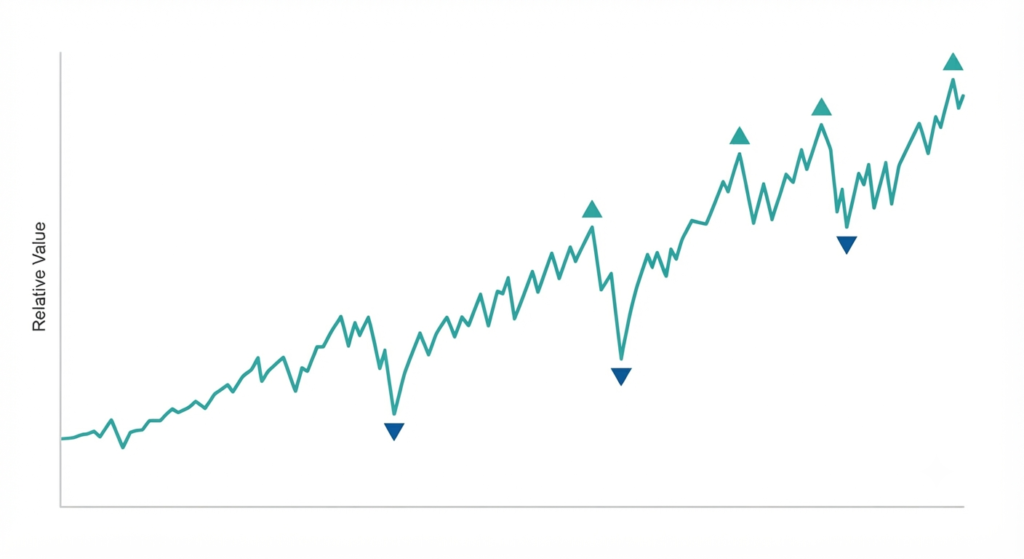
What this image shows: Over a 30-year period, the stock market experiences many significant drops, some severe. But the long term trend is consistently upward, and every major downturn in US stock market history has eventually been followed by a recovery that exceeded the previous high. Investors who stayed invested through downturns ultimately benefited from the full upward trend. Those who sold during dips locked in losses they would not have experienced if they had held.
Risk in the stock market is real. Your investments will lose value at times, sometimes significantly. The S&P 500 fell approximately 34% in early 2020 during the initial pandemic shock. It fell approximately 57% during the 2008 to 2009 financial crisis. Anyone who sold during those periods realized those losses permanently.
Anyone who stayed invested recovered fully, and then some. The S&P 500 has never had a 20-year period in its history where the index ended lower than it started.
This is why time horizon is the most important risk factor for a stock market investor. If you invest money you will not need for at least five years, ideally ten or more, the historical evidence strongly supports holding through market volatility rather than selling. If you invest money you might need next month, a stock market account is the wrong place for it, that money belongs in a savings account where it cannot lose value in the short term.
Key Terms Every Beginning Investor Should Know
Ticker symbol: The short letter code that identifies a stock or fund on an exchange. AAPL is Apple. AMZN is Amazon. VOO is the Vanguard S&P 500 ETF.
Share price: The current market price of one share of a stock or fund. This changes throughout each trading day.
Market capitalization: The total value of all shares of a company. Calculated by multiplying the share price by the total number of shares outstanding. Apple, for example, has a market capitalization above $3 trillion.
ETF (Exchange Traded Fund): A fund that holds a collection of assets, stocks, bonds, or other securities, and trades on an exchange like a stock. Unlike a mutual fund, which is priced once per day, an ETF’s price changes throughout the trading day.
Mutual fund: Similar to an ETF in that it holds a collection of assets, but priced once per day after the market closes and not tradeable intraday.
Expense ratio: The annual fee charged by a fund to manage your investment, expressed as a percentage of your assets. A 0.03% expense ratio on a $10,000 investment costs you $3 per year. A 1% expense ratio on the same investment costs $100 per year. Over decades, this difference compounds significantly.
Bull market: A period when stock prices are generally rising and investor confidence is high.
Bear market: A period when stock prices have fallen 20% or more from recent highs.
Dividend: A payment made by a company to its shareholders from its profits, usually paid quarterly.
Capital gain: The profit made when you sell a stock or fund for more than you paid. Held for more than one year, this is taxed at the preferential long term capital gains rate. Held for one year or less, it is taxed as ordinary income.
Dollar-cost averaging: The practice of investing a fixed amount at regular intervals regardless of market conditions. This strategy removes the need to time the market and tends to reduce the average cost per share over time.
The Stock Market and Your Broader Financial Plan
The stock market is one component of a complete financial plan, not the entire plan. Understanding where it fits helps you use it correctly.
Your emergency fund, three to six months of essential expenses, belongs in a high yield savings account, not in stocks. It needs to be safe and immediately accessible, which stocks are not.
Your employer’s 401(k) is almost certainly investing in the stock market through mutual funds or ETFs already. If you are contributing to a 401(k) and capturing your employer’s match, you are already a stock market investor, even if you have never bought a share directly.
A Roth IRA or traditional IRA, funded with index funds, adds tax advantaged stock market exposure on top of any employer plan.
A regular taxable brokerage account adds flexibility beyond the annual limits of retirement accounts.
For a complete picture of how to sequence these accounts, which one to fund first, how much to put where, and why the order matters, our article on what is investing and why does it matter covers the foundational framework.
And for the specific mathematical reason why time matters so much more than the amount you start with, our article on how compound interest builds wealth walks through the numbers in detail.
What to Do Right Now
If you have read this article and want to take one concrete action today, here it is:
Open a free brokerage account at Fidelity, Charles Schwab, or Vanguard. Link your bank account. Invest whatever amount you have available, $50, $100, $200, anything, in a total market index fund or an S&P 500 index fund. Set up an automatic monthly contribution for an amount you can genuinely commit to without disrupting your budget.
That is the entire first step. Everything else, learning more, increasing contributions, adding accounts, refining your strategy, happens over time as your knowledge and income grow.
The stock market has been the most reliable wealth building engine available to ordinary investors in the history of the United States. It is available to you right now. The only thing standing between you and participating in it is the decision to open an account.
Disclaimer: This article is for educational and informational purposes only and does not constitute financial advice. All investing involves risk, including the possible loss of principal. Past performance is not indicative of future results. Consult a qualified financial professional before making investment decisions.