
What Is Investing and Why Does It Matter?
For a long time, I thought investing was something other people did.
People with extra money. People who understood the stock market. People who had grown up watching a parent check stock prices at the breakfast table. I was none of those things. I was someone trying to save a little each month and hoping that was enough.
It took me embarrassingly long to understand that investing was not a separate, advanced activity reserved for people with more money or more knowledge than me. It was simply the next step after saving, available to anyone with a bank account and a small amount of money they did not need immediately. Nobody had explained that to me. I want to explain it to you now.
This article answers the most basic and most important question in personal finance: what is investing, and why should you, specifically, care about it.
Saving vs. Investing: The Difference That Changes Everything
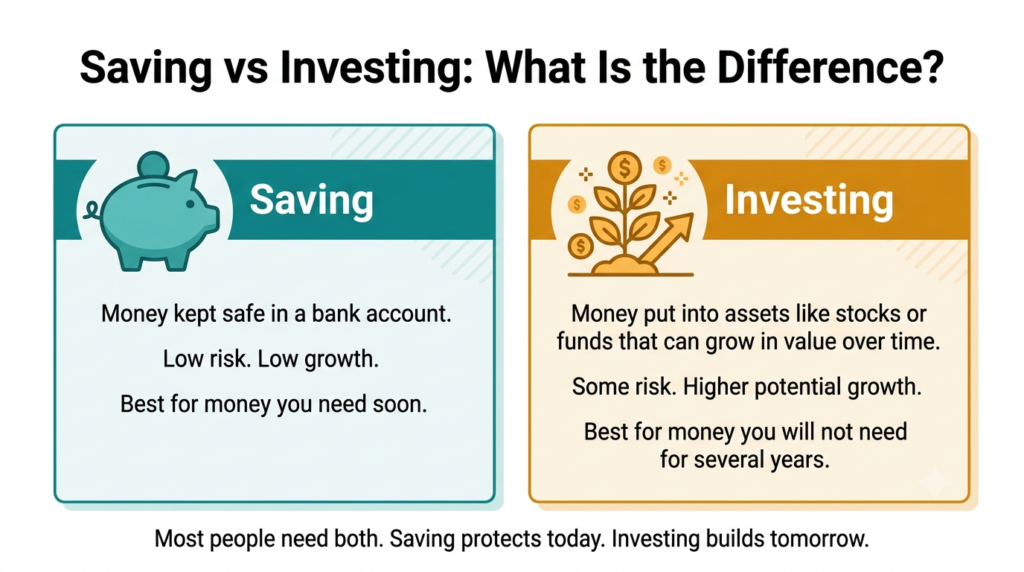
Saving and investing are often used as if they mean the same thing. They do not, and understanding the difference is the foundation for everything else in this article.
Saving means putting money somewhere safe, like a bank account, where it is protected and can be accessed quickly. The tradeoff is that it grows very slowly. A typical savings account pays a small amount of interest, sometimes less than 1% a year. A high yield savings account does better, often around 4% currently, but even that modest growth is mainly there to protect your money’s value against inflation, not to build significant wealth over time.
Investing means putting your money into something that has the potential to grow in value over a longer period: shares of a company, a fund that holds many companies, real estate, or other assets. The money is not guaranteed to grow. It can go up or down in value, sometimes significantly, especially in the short term. But historically, over long periods of time, investments in diversified assets like the stock market have grown far more than money sitting in a savings account.
Here is the simplest way to think about it: saving protects the money you already have. Investing puts that money to work so it can become more.
Most people need both. An emergency fund belongs in savings, where it is safe and accessible. Money you will not need for several years, money meant to grow toward a future goal like retirement, a home, or your children’s future, belongs, at least in part, in investments.
Why Does Investing Matter? The Power of Compound Growth
The single most important concept in investing is compound growth, and once you understand it, you understand why starting early matters more than almost anything else in personal finance.
When you invest money and it grows, that growth then earns its own growth the following year. And the year after that. And the year after that. Over enough time, the growth on your growth becomes larger than your original contribution ever was.
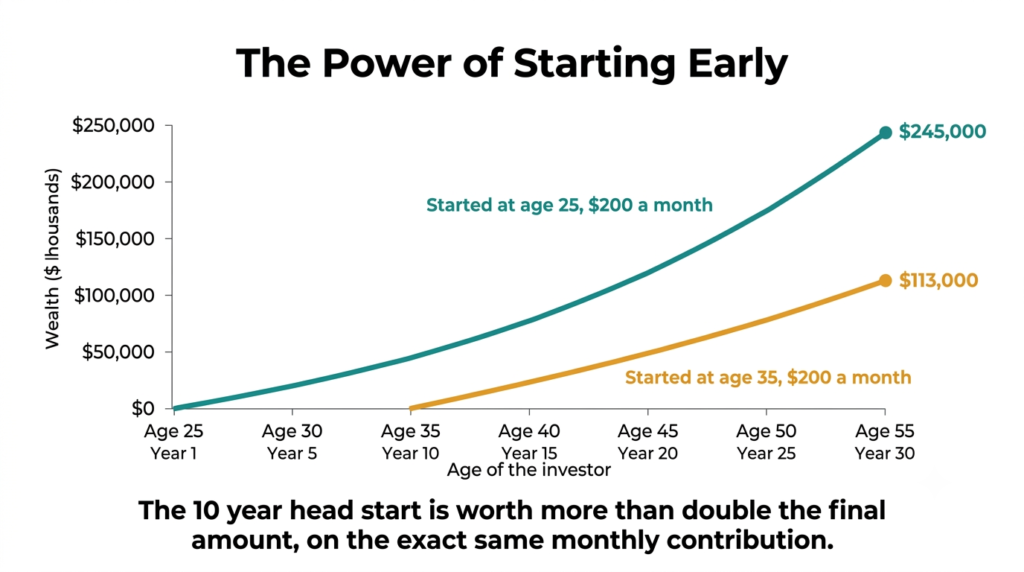
Consider a simple example. If you invest $200 a month starting at age 25 and earn an average annual return of 7%, which is roughly the long term historical average of a diversified stock market index fund, you would have approximately $245,000 by age 55.
If you wait until age 35 to start the exact same $200 a month at the same 7% return, you would have approximately $113,000 by age 55.
The person who started ten years earlier contributed exactly $24,000 more in total over those extra ten years. But the difference in their final outcome is more than $130,000. That gap is not from contributing more money. It is from giving the money more time to compound.
This is why the most common advice in investing is not “invest a huge amount” but “start now, even with a small amount.” Time is the resource that actually does the heavy lifting, and time is something you cannot make up for later no matter how much money you eventually have.
What Can You Actually Invest In?
Investing can sound abstract until you understand the actual things you are putting your money into. Here are the main categories, explained simply.
Stocks are small ownership shares in a company. When you buy a share of a company, you own a tiny piece of that business. If the company grows and becomes more valuable, your share becomes more valuable too. Companies may also pay you a portion of their profits regularly, called a dividend.
Index funds and ETFs (exchange traded funds) are collections of many stocks bundled together into a single investment. Instead of buying shares in one company and hoping it does well, you buy a small piece of hundreds or even thousands of companies at once. This spreads your risk across many businesses rather than depending on the success of just one. For most beginning investors, index funds are the simplest, lowest cost, and most reliable way to start.
Bonds are essentially loans you make to a government or a company. In exchange for lending your money, you receive interest payments over time and your original amount back at the end of the loan term. Bonds are generally considered less risky than stocks but also tend to grow more slowly.
Real estate means owning property, either directly or through investment platforms that let you own a small share of a property alongside other investors. Real estate can generate income through rent and can also grow in value over time.
Retirement accounts, like a 401(k) through your employer or an IRA you open independently, are not investments themselves but rather containers that hold your investments and give you valuable tax advantages. The money inside still needs to be invested in something, like an index fund, to actually grow.
For most newcomers building their first investment plan, a low cost, broadly diversified index fund is the simplest and most reliable starting point, and it is the foundation that most of the wealth building strategies on this site are built around.
Is Investing Risky? An Honest Answer
Yes, and it would be dishonest to tell you otherwise. The value of your investments can go down as well as up, sometimes sharply, especially in the short term. Anyone who tells you investing has no risk is either misinformed or not being truthful with you.
But risk in investing is not the same as gambling, and it is worth understanding the difference clearly.
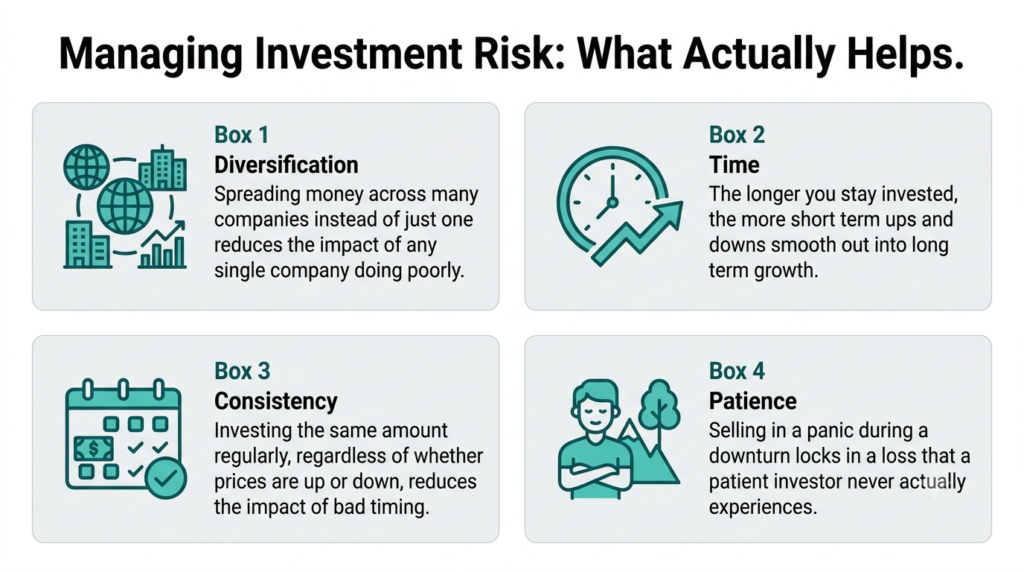
Diversification reduces risk by spreading your money across many different investments rather than concentrating it in one. If you own shares in 500 different companies through an index fund and one of them struggles, the impact on your overall investment is small. If you had put all your money into that single company, the impact would have been severe.
Time reduces risk in a different way. Stock markets go up and down regularly in the short term, sometimes dramatically. But looking at any 20 or 30 year period in US stock market history, the overall trend has consistently been upward, even accounting for serious downturns like 2008 or 2020. The longer your money stays invested, the more those short term swings average out into long term growth.
Consistency matters because nobody, including professional investors, can reliably predict the best time to invest. By investing a fixed amount regularly, whether prices are high or low that particular month, you avoid the common and costly mistake of trying to time the market perfectly and instead let the average work in your favor over time.
The riskiest thing you can do with investing is not investing at all, and then panicking and selling everything the moment values drop temporarily. Both of those behaviors, avoiding the market entirely out of fear, or pulling out during a downturn, tend to produce worse outcomes than calmly investing a reasonable amount on a consistent schedule and leaving it alone.
Why This Matters Especially for Immigrants
There is a specific reason this topic deserves extra attention for immigrant readers of this site.
Most immigrants arrive with no inherited investment portfolio, no family wealth built over generations in this country, and often very limited exposure to how investing works because the financial systems and common practices in many home countries look completely different from the US system. Saving in a bank account may have been the only tool available, or even the safest one, in a different economic environment.
That history is not a disadvantage you carry forever. It is simply a starting point. The tools available to build wealth here, low cost index funds, employer retirement plans, individual retirement accounts, are accessible to anyone with legal work authorization and a small amount of money to start, regardless of where you began or what you knew before you arrived.
The gap between immigrants who learn this and start early, and those who do not learn it until much later, often comes down entirely to information, not opportunity or ability. This article, and the rest of this site, exists to close that information gap as directly and clearly as possible.
How Investing Connects to Everything Else You Are Building
Investing does not happen in isolation. It fits into a sequence, and understanding where it sits in that sequence helps you know when you are ready to begin.
Your first priority is always an emergency fund, money kept safe and accessible for unexpected expenses, before any of it goes toward investments that could lose value temporarily right when you need cash. If you have not built this foundation yet, our guide on how to create your first budget in a new country walks through exactly how to find the room in your income to start saving and investing at the same time.
Once an emergency fund is in place, the next priority, if your employer offers it, is capturing any retirement plan matching contribution, since that is essentially free money added on top of your own. From there, opening an individual retirement account and beginning regular contributions to a simple index fund is the most accessible and effective path for most beginning investors.
If you are ready to take that next step and want a concrete starting point with an exact amount of money, our guide on how to start investing in the US with $100 picks up exactly where this article leaves off, with specific platforms and specific steps.
A Simple Summary
| Question | Simple Answer |
|---|---|
| What is investing? | Putting money into assets that can grow in value over time |
| How is it different from saving? | Saving protects money you need soon. Investing grows money you will not need for years. |
| What should beginners invest in? | A low cost, broadly diversified index fund is the simplest starting point |
| Is it risky? | Yes, but diversification, time, and consistency significantly reduce that risk |
| When should I start? | As soon as your emergency fund is in place, even with a small amount |
| Why does starting early matter so much? | Compound growth means an early start outperforms a larger but later one |
The Honest Truth
Investing is not complicated because the math is hard. It is complicated because almost nobody explains it in plain language, and the financial industry sometimes benefits from making it sound more mysterious than it actually is.
The real version is simple. Put money you do not need right away into something that can grow over time. Spread it across many companies rather than betting on one. Leave it alone and let time do the difficult work. Do this consistently, starting as early as you can, even with a small amount.
That is the entire foundation. Everything else, every specific account, every specific platform, every specific strategy covered elsewhere on this site, is simply a variation of that same basic idea, applied to your specific situation as an immigrant building a financial life in a country that did not hand you a head start.
You can build one anyway. This is where it begins.
Disclaimer: This article is for educational and informational purposes only and does not constitute financial advice. All investing involves risk, including the possible loss of principal. Past performance is not indicative of future results. Consider consulting a qualified financial professional before making investment decisions.