How To Start Investing in the US With $100

I still remember the day I realized that keeping my money in a checking account was costing me.
Not costing me in fees. Costing me in something quieter and more damaging: time. Every month that my money sat in a bank account earning next to nothing was a month where it could have been growing. A month where the gap between where I was and where I wanted to be stayed exactly the same.
I was new to the United States. I did not have much. I did not understand the American financial system. And nobody had ever sat me down and explained that you do not need to be rich to invest. You just need to start.
The number that changed everything for me was $100. That was the moment I realized this was real and accessible. Not someday when I had more. Right now with what I had.
If you are an immigrant, a newcomer, or simply someone who has never invested before and does not know where to begin, this article is the one I wish someone had handed me when I first arrived. We are going to talk about why investing matters, how the US investment system works, which platforms let you start with as little as $1, and exactly what to do with your first $100 so that it starts working for you the moment you invest it.
This is not theory. This is a practical, personal guide for real people starting from exactly where you are right now.
Why I Wish I Had Started Investing Sooner
When I first came to the US, investing felt like something other people did. Rich people. People who had figured things out. People who did not have rent to worry about, family to support back home, and a checking account that sometimes made me nervous to look at.
But here is what nobody told me: the people who build real wealth in America are not necessarily the ones who earn the most. They are the ones who started earliest.
Compound interest is the closest thing to magic that exists in personal finance. It is the process by which your investment returns generate their own returns, and those returns generate returns, and over time the growth accelerates in ways that seem almost unbelievable at first.
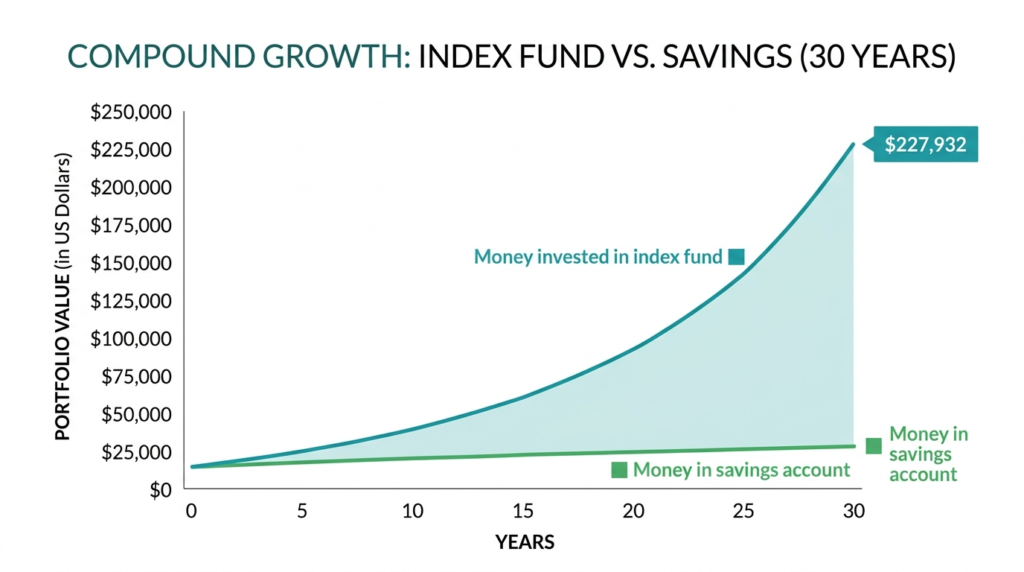
Here is a real example. If you invest $100 today and add $100 every month into an index fund that grows at the historical US stock market average of roughly 10% per year, here is what happens:
| Years Invested | Total You Put In | Portfolio Value |
|---|---|---|
| 5 years | $6,100 | $7,744 |
| 10 years | $12,100 | $20,484 |
| 20 years | $24,100 | $75,937 |
| 30 years | $36,100 | $227,932 |
You put in $36,100 over 30 years and your portfolio is worth $227,932. That extra $191,832 is compound interest doing its work while you slept, while you worked, while you sent money home to your family.
The earlier you start, the more time compound interest has to work. Starting with $100 today is worth more than starting with $1,000 five years from now.
Can Immigrants Invest in the US Stock Market
This is the question I had and was too afraid to ask for the first year I lived here.
Yes. Absolutely yes.
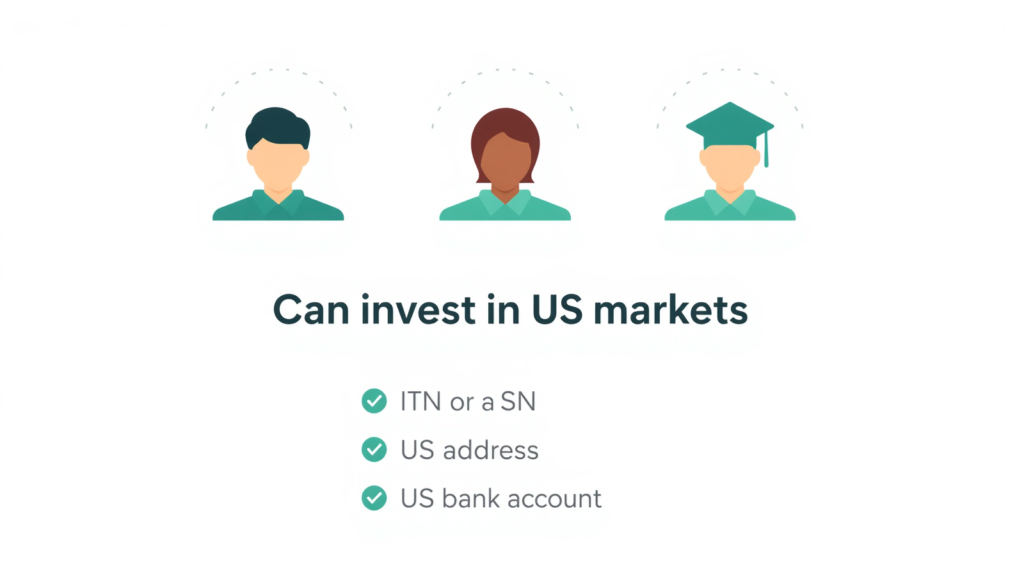
As an immigrant living in the United States, whether you are on a work visa, a student visa, a green card, or even without documentation in some cases, you have the legal right to invest in the US stock market. There is no citizenship requirement to open a brokerage account or to own US stocks, bonds, or funds.
What you do need:
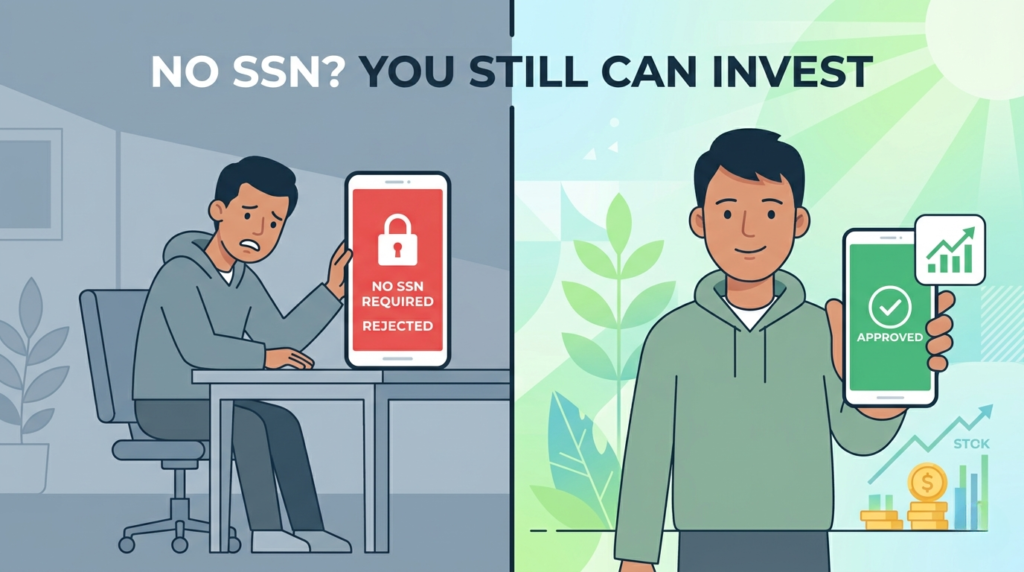
To open a standard investment account: Most major brokerages require a Social Security Number (SSN) or an Individual Taxpayer Identification Number (ITIN), a US address, and a US bank account to fund your investments. If you have an ITIN and a bank account, you can open an investment account today.
To understand your tax obligations: Investment gains are taxable in the US. As an immigrant, you may also have reporting obligations in your home country depending on your tax residency status. For most immigrants on work visas, you will file a standard US tax return that includes your investment income. It is worth speaking with a tax professional who has experience with immigrants when your portfolio grows.
To be aware of visa specific considerations: Most visa types allow investment activity with no restrictions. If you are on an F1 student visa or certain other status types, confirm with a qualified immigration attorney that your specific activities are permitted before opening a margin account or engaging in frequent trading.
For the vast majority of immigrants living and working in the US, investing is completely available to you right now.
Understanding the Basics Before You Invest Your First $100
You do not need to become a financial expert to invest successfully. But understanding a few core concepts before you put in your first dollar will save you from the most common beginner mistakes.
Stocks: Owning a Small Piece of a Company
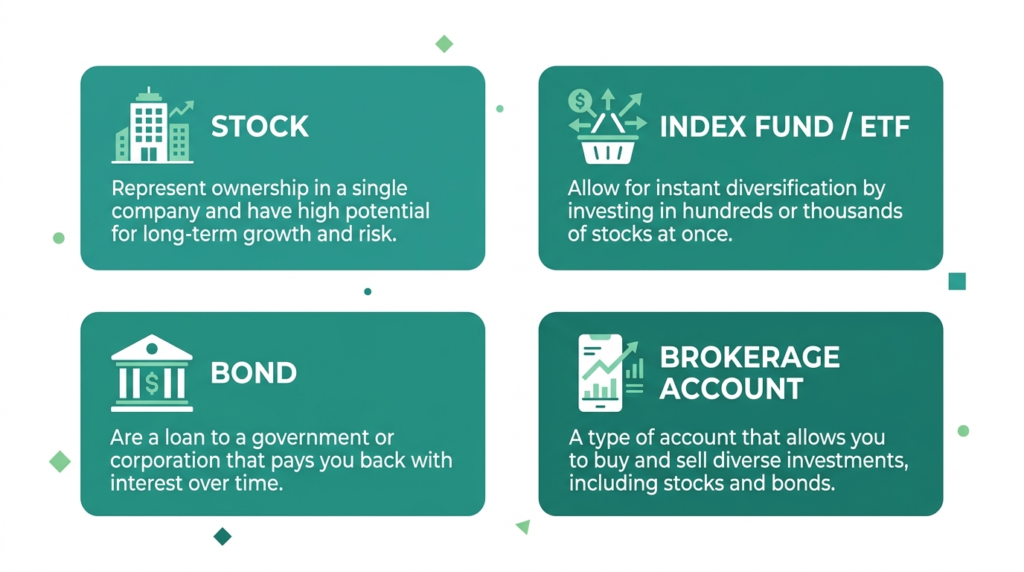
When you buy a stock, you are buying a tiny ownership stake in a company. If the company does well and grows, the value of your stake increases. If it struggles, your stake decreases. Individual stocks can be exciting but they are also volatile, a single company can lose half its value quickly if something goes wrong.
For beginners investing with $100, individual stocks are generally not the best starting point. The better approach is funds.
Index Funds and ETFs: The Beginner’s Best Friend
An index fund or ETF (Exchange Traded Fund) is a collection of dozens, hundreds, or even thousands of stocks bundled together into a single investment. When you buy one share of an S&P 500 index fund, you are essentially buying a tiny piece of the 500 largest companies in the United States simultaneously.
This is called diversification and it is the single most powerful risk management tool available to everyday investors. If one company in the fund collapses, it barely affects your portfolio because you own 499 other companies too. Index funds have historically delivered average annual returns of around 10% before inflation, making them the foundation of most long term investment strategies.
Index funds are the investment I wish someone had explained to me on day one. Simple, diversified, low cost, and historically reliable over long time horizons.
Bonds: Lower Risk, Lower Return
Bonds are essentially loans you make to a government or corporation in exchange for regular interest payments and the return of your principal at the end of the bond term. They are less volatile than stocks but also grow more slowly. For most beginners in their 20s or 30s, bonds make up a smaller portion of a portfolio, typically 10% to 30%, with the majority in stocks or index funds.
What is a Brokerage Account
A brokerage account is the account you open in order to buy and sell investments. Think of it as the investment equivalent of a bank account. You deposit money into your brokerage account and then use that money to purchase stocks, funds, or other investments. When you want to access your money, you sell your investments and transfer the proceeds back to your bank account.
Most brokerages today have no account minimums, no trading fees, and fully digital applications that take about 10 minutes to complete.
The Difference Between a Regular Brokerage Account and a Retirement Account
A regular brokerage account (also called a taxable account) is flexible, you can put money in, take money out, and invest in whatever you like whenever you like.
A retirement account like a Roth IRA or a 401(k) has tax advantages that make your investments grow faster, but comes with rules about when you can access the money without penalties.
For immigrants just starting out, a regular brokerage account is the most flexible and accessible starting point. Once you are more settled and earning a stable income, adding a Roth IRA is one of the most powerful moves you can make for long term wealth building.
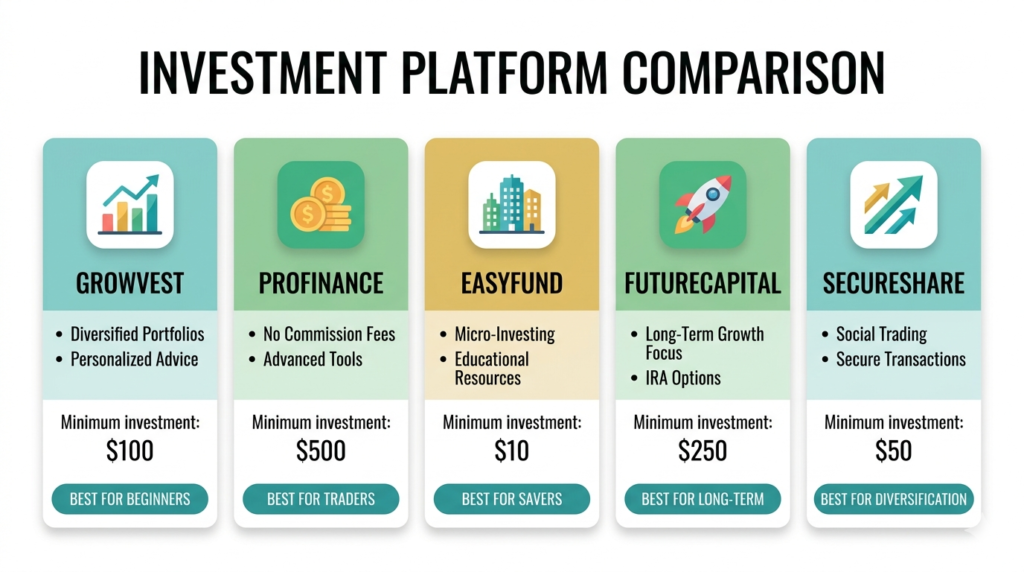
The Best Platforms To Start Investing With $100 or Less
Here are the investment platforms I recommend for beginners, specifically chosen for their low minimums, and ease of use.
Acorns: Best for Beginners Who Want to Invest Without Thinking About It
Acorns was the first investment app I used when I started. And I loved it for one reason: it made investing completely automatic so that I never had to make a decision in the moment.
Acorns works by rounding up every purchase you make on your linked debit or credit card to the nearest dollar and investing the difference. Buy a coffee for $3.60 and Acorns invests $0.40. Buy groceries for $47.23 and Acorns invests $0.77. It sounds tiny but those round ups add up to real money over time, and the habit of investing automatically is worth more than any single investment decision.
Beyond round ups, you can also set up automatic recurring investments of any amount, starting from $5. Acorns invests your money in a portfolio of diversified ETFs matched to your risk tolerance, so you never have to choose individual investments yourself.
Key features:
- Automatic round up investing from every purchase
- Recurring investments starting from $5
- Diversified ETF portfolios built and managed for you
- Found Money feature earns bonus investments when you shop with partner brands
- Banking and debit card included in higher tier plans
- No SSN required in all cases – ITIN accepted
- Plans start at $3 per month
Best for: Immigrants and beginners who want to start investing without making active investment decisions. Set it up once and let it run.
Robinhood: Best for Beginners Who Want to Choose Their Own Investments
Robinhood is where I went when I was ready to start making my own investment decisions. It was the app that made buying stocks and ETFs feel approachable for the first time,
no commission fees, no confusing interface, no minimum investment amount.
With Robinhood you can invest in individual stocks, ETFs, and options (though I recommend avoiding options as a beginner). You can buy fractional shares, meaning you can invest $10 in Amazon or Apple even if a single share costs hundreds of dollars. This makes it genuinely possible to build a diversified portfolio with $100.
Robinhood also offers a cash management account that earns a competitive interest rate on uninvested cash, and a Gold tier subscription that gives you access to research reports and additional features.
Key features:
- No commission fees on stocks and ETFs
- Fractional shares, invest any dollar amount in any stock
- No account minimum
- Instant deposit up to $1,000 for immediate investing
- Robinhood Gold subscription for additional research features
- IRA accounts now available for retirement investing
- Clean, intuitive mobile app
Best for: Beginners who want more control over their investments and are ready to learn which stocks and ETFs to buy.
Stash: Best for Beginners Who Want to Learn as They Invest
Stash sits between Acorns and Robinhood in terms of control. It is a platform that guides you through investment decisions with educational content built directly into the app, making it ideal for immigrants and newcomers who want to understand what they are investing in rather than just letting an algorithm decide.
With Stash you can invest in themed portfolios (like “American Innovators” or “Clean and Green”), individual stocks, and ETFs. There is a Smart Portfolio feature for those who want automated management, and a Stock Back debit card that earns fractional shares of companies you shop with instead of traditional cash back rewards.
Key features:
- Guided investment decisions with built in education
- Invest from as little as $1
- Themed portfolios that make choosing investments more intuitive
- Stock Back debit card that earns fractional shares as rewards
- Smart Portfolio option for automated investing
- Banking features included
- Plans start at $3 per month
Best for: Beginners who want guidance and education built into their investment experience while still having some control over their choices.
Fidelity: Best Long Term Investment Account for Serious Wealth Building
When I felt confident enough to move beyond starter apps, Fidelity is where I took my money. It is the platform I recommend for anyone who is ready to invest consistently and build real long term wealth.
Fidelity has no account minimum, no commission fees on stocks and ETFs, and offers some of the best index funds in the world at zero expense ratio,
meaning you pay literally nothing in fees to hold them. For immigrants building generational wealth in the United States, Fidelity is one of the most powerful and trustworthy tools available.
Fidelity also offers Roth IRA accounts, which are one of the best wealth building tools available to immigrants with earned US income. Contributions to a Roth IRA are made with after tax money, and all growth and withdrawals in retirement are completely tax free.
Key features:
- No account minimum
- No commission fees on stocks and ETFs
- Zero expense ratio index funds (FZROX, FZILX)
- Roth IRA and traditional IRA accounts available
- Excellent research tools and educational resources
- Fractional shares available
- ITIN accepted for account opening in many cases
- Outstanding customer service with local branch access
Best for: Immigrants who are ready to invest consistently and build serious long term wealth with one of the most trusted institutions in US finance.
M1 Finance: Best for Building an Automated Portfolio With More Control
M1 Finance is a platform I discovered later in my investing journey and immediately wished I had found sooner. It combines the automation of Acorns with the control of a traditional brokerage in a unique way: you build a portfolio “pie” by choosing your investments and their target percentages, and M1 automatically keeps your portfolio balanced and reinvests dividends without any commissions.
Key features:
- No account minimum (though $100 is recommended to start)
- No commission fees
- Automatic portfolio rebalancing
- Fractional shares of any stock or ETF
- Automated dividend reinvestment
- Borrow against your portfolio at low rates (M1 Borrow)
- Roth IRA and traditional IRA available
Best for: Investors who want to choose their own investments but want the maintenance to be completely automatic.
Exactly What To Do With Your First $100: A Personal Plan
This is the section I wished existed when I started. Not vague advice. An actual plan.
Here is what I would do with $100 if I were starting today for the very first time:
If You Want Zero Effort: Acorns
Open an Acorns account. Link your debit card. Set up a $25 automatic weekly recurring investment. Enable round ups on all your purchases. Choose the Moderate or Aggressive portfolio depending on how many years until you might need the money. Deposit your first $100. Walk away and let it grow.
Review it once a month just to watch your portfolio grow. Increase your recurring investment whenever you can afford to. That is genuinely the entire strategy for the first year.
If You Want to Learn and Build Yourself: Robinhood or Fidelity
Open an account with Robinhood or Fidelity. Deposit your $100. I am not a financial advisor but what I’d do will be to buy $80 worth of a total US stock market index fund. The Fidelity equivalent is FZROX (zero fee, Fidelity exclusive) or FSKAX. On Robinhood, look for VTI (Vanguard Total Stock Market ETF) or VOO (Vanguard S&P 500 ETF).
Invest the remaining $20 in an international stock market index fund to add global diversification. FZILX on Fidelity, or VXUS on Robinhood.
That is an 80/20 split between US stocks and international stocks. A simple, diversified portfolio that financial advisors charge thousands of dollars to build for clients who could have done it themselves in 15 minutes.
Set up a recurring monthly investment of whatever you can afford. $25. $50. $100 when you have it. The amount matters less than the consistency.
If You Want Guided Automation With More Control: M1 Finance or Stash
Open an M1 Finance account. There are multiple portfolio scenarios but you can create a pie with 70% in a US total market ETF, 20% in an international ETF, and 10% in a bond fund, just an idea, you can deposit your $100. Turn on automatic investing. Increase your contribution whenever your income allows.
Or open Stash, let their Smart Portfolio feature build your portfolio for you based on your risk tolerance, and use the Stock Back card to earn fractional shares on your everyday spending.
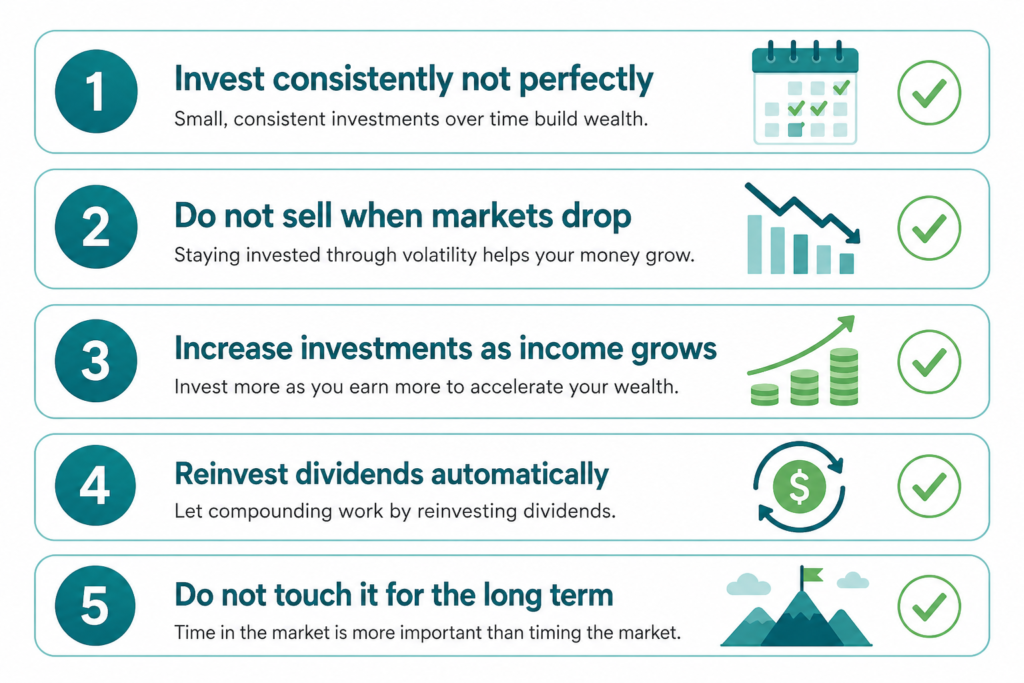
The Golden Rules No Matter Which Platform You Choose
Rule 1: Invest consistently, not perfectly. The biggest mistake beginners make is waiting for the perfect time to invest. There is no perfect time. The best time is whenever you have money to invest, because every month you wait is a month of compound growth you never get back.
Rule 2: Do not sell when the market drops. Markets go down. Sometimes dramatically. The 2020 pandemic crash wiped 34% off the S&P 500 in about five weeks. Then the market recovered and reached new highs within months. The investors who panicked and sold locked in their losses. The investors who held or bought more came out significantly ahead.
Rule 3: Increase your investment amount as your income grows. Your first $100 is the habit. As your career grows and your income increases, increase your monthly investment proportionally. Even moving from $100 to $200 per month doubles your long term outcome.
Rule 4: Reinvest your dividends automatically. Most platforms allow you to automatically reinvest any dividends you earn back into your portfolio. Turn this on from day one. It is one of the most powerful contributors to long term compound growth.
Rule 5: Do not touch it. This is the hardest rule. Investing is for long term wealth. It is not an emergency fund. Make sure you have a separate emergency savings account before you start investing, and keep your investment account untouched unless a genuine financial emergency leaves you with no other option.
What To Invest In: Simple Portfolios for Different Situations
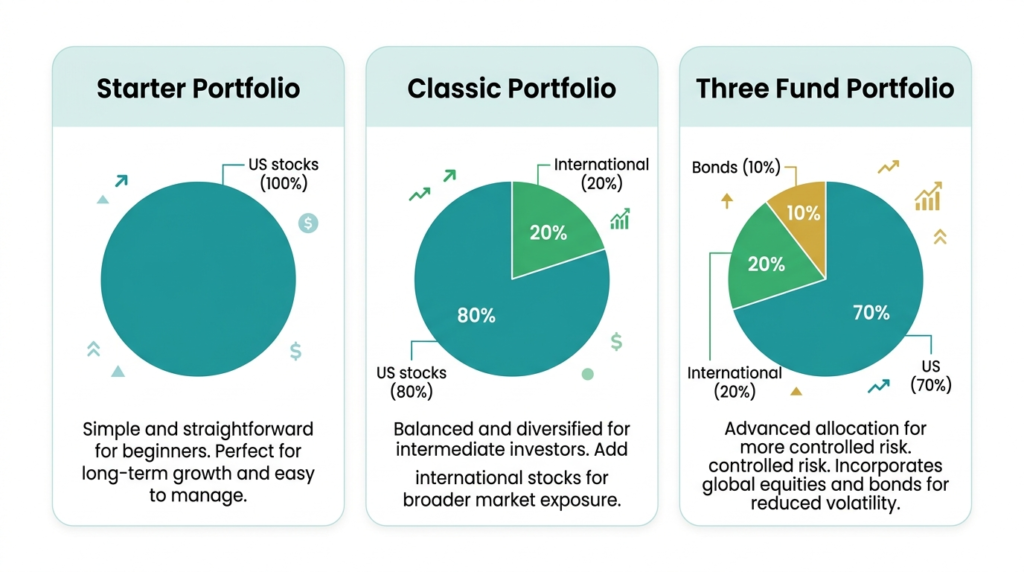
You do not need a complicated portfolio. The evidence consistently shows that simple, diversified index fund portfolios outperform most actively managed funds over long time periods. Here are three portfolio options based on where you are in life:
The Starter Portfolio (Your First Year)
100% in a total US stock market index fund
One fund. Maximum diversification. Historical average return of around 10% per year. Keep adding to it every month. Review once a quarter. This is genuinely all you need for your first year of investing.
Here are some of the funds that get the whole pie: FZROX (Fidelity, zero fees), VTI (Vanguard, 0.03% fee), SCHB (Schwab, 0.03% fee)
The Classic Beginner Portfolio (After Year One)
80% US stocks / 20% international stocks
Two funds. Broader global diversification. Captures growth from both US and international markets. Still simple enough to manage in minutes per month.
US: FZROX, VTI, or SCHB International: FZILX, VXUS, or SCHF
The Three Fund Portfolio (Your Foundation for Life)
70% US stocks / 20% international stocks / 10% bonds
Three funds. The classic recommendation of some of the most respected names in personal finance including the Bogleheads investment philosophy inspired by Vanguard founder John Bogle. This portfolio has stood the test of time across decades and multiple market cycles.
As you get older, gradually increase the bond percentage. A general rule of thumb: your bond allocation should approximately equal your age in percentage points.
The Roth IRA: The Most Powerful Investment Account for Immigrants
I want to dedicate a special section to the Roth IRA because it is the single most powerful wealth building tool available to immigrants with earned US income and it is wildly underused in immigrant communities.
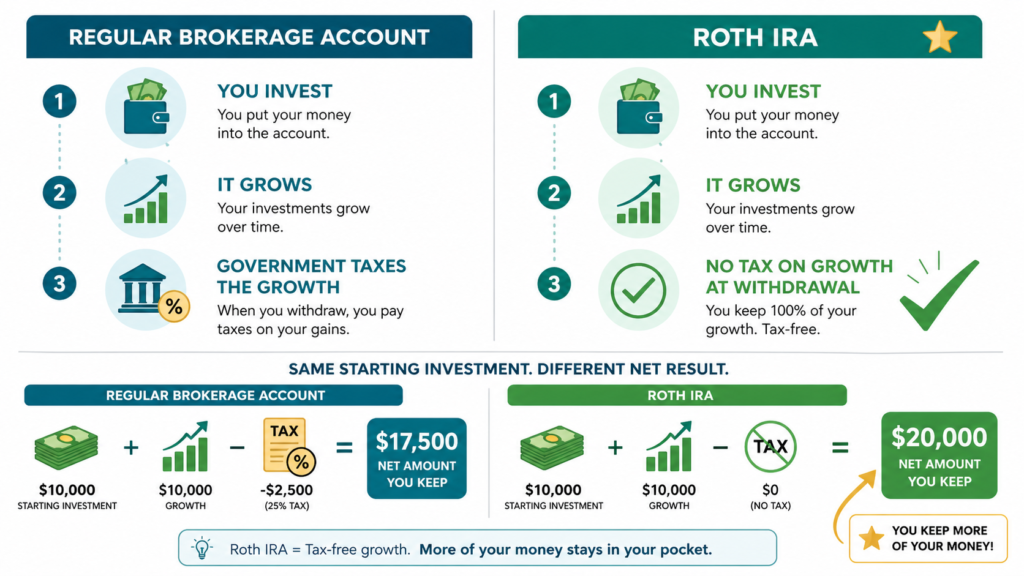
A Roth IRA is a retirement account that you fund with after tax money. The remarkable thing about it is that all the growth inside the account is completely tax free. When you withdraw the money in retirement, you pay zero taxes on it, including all the compound growth that has accumulated over decades.
Here is what that means in practice. If you invest $6,500 per year (the 2024 contribution limit) into a Roth IRA from age 30 to age 65 and it grows at the historical market average, you could have over $1.5 million in the account at retirement. Every dollar of that $1.5 million is tax free. You earned it, you invested it, and the government cannot touch the growth.
Who qualifies to open a Roth IRA: You must have earned US income. For most immigrants on work visas or green cards, this means income from your job qualifies. Your contribution cannot exceed your earned income for the year. You must also be within the income limits set by the IRS (in 2024, the ability to contribute phases out above $146,000 for single filers).
How to open one: Fidelity and M1 Finance both offer excellent Roth IRA accounts with no minimums and zero fee index fund options.
A Personal Note: What Investing Has Done for My Life
I want to be honest with you about something.
When I made my first investment, it was not the amount that changed my life. It was the identity shift.
The day I invested my first $100, I stopped being someone who was just surviving in America and started being someone who was building something here. It is a subtle shift but a profound one. I had skin in the game. I had a reason to pay attention to the economy, to learn how the markets worked, to care about my financial future in a way that felt real and tangible rather than abstract and distant.
That $100 investment grew slowly at first, then faster, and then in ways that surprised me. But the most important thing it did was change how I thought about money. From something that slipped through my fingers to something I could direct, build, and control.
I know that if you are reading this you probably have competing priorities. Rent. Sending money home. Building your credit. Surviving your first year in a new country. Investing can feel like a luxury you cannot afford right now.
But I want to share a thought that someone once shared with me: you cannot afford not to. The cost of waiting is real, invisible, and permanent. Every month you delay is a month of compound growth you never get back.
Start with $100. Start with $50. Start with $25 a month on Acorns. The amount is almost irrelevant compared to the decision to begin.

Your Investment Starter Checklist
Before you invest your first dollar, run through this checklist:
Financial foundations (complete these first):
- You have a US bank account
- You have an SSN or ITIN
- You have at least $500 to $1,000 in an emergency savings account
- Your monthly expenses are covered and stable
- You understand that invested money can lose value in the short term
Opening your first account:
- Choose a platform: Acorns (easiest), Robinhood or Fidelity (more control), Stash (guided), M1 Finance (automated control)
- Complete your account application (10 to 15 minutes)
- Link your US bank account
- Deposit your first $100
- Choose your investment (starter portfolio: 100% total US market index fund)
- Set up automatic monthly recurring investment
- Turn on automatic dividend reinvestment
- Sign up for Credit Karma or Experian to monitor your overall financial health alongside your investments
Ongoing habits:
- Check your portfolio once a month, not more
- Increase your monthly contribution whenever your income increases
- Resist the urge to sell when the market drops
- Open a Roth IRA once your income is stable
- Learn one new investment concept every month

The Bottom Line
You do not need to be wealthy to start investing in America. You need $100, an ITIN or SSN, a US bank account, and the decision to begin.
If you want zero effort, start with Acorns and let the round ups do the work. If you want to learn and build your own portfolio, open a Robinhood or Fidelity account and put your first $100 into a total market index fund. If you want automation with control, M1 Finance gives you both. And once your income is stable, open a Roth IRA and start building wealth that the government cannot tax.
The American wealth gap between immigrants and native born Americans is not mostly about income. It is about access to information and the confidence to act on it. You now have the information.
The $100 you invest today will not change your life by itself. But the habit it represents, and the identity it creates, and the compound growth it begins, that changes everything.
I started with $100. And I have never looked back.
Where are you in your investment journey? Are you just starting out or already building? Drop your story in the comments, this community is built on people sharing what they wish they had known sooner.
Disclaimer: This article contains affiliate links. If you sign up through these links I may earn a commission at no extra cost to you. All investment platform recommendations reflect my genuine personal experience and evaluation. This is not financial advice. All investments carry risk including the possible loss of principal. Please do your own research before investing.