
The Credit Card Debt That Almost Sent Me Back Home
Her name is Precious. She is a licensed practical nurse from Lagos, Nigeria, who has lived and worked in the United States for fourteen years. She works days now — a hard-won shift after a decade of nights — at a rehabilitation center in the Houston Medical Center. She has a daughter in her second year at the University of Houston. She has a savings account she does not touch unless she has to. She has a credit score of 741.
Four years ago, she had $34,000 in credit card debt and a one-way flight to Lagos bookmarked on her phone.
Not because she wanted to go back. Because she had calculated, in the particular arithmetic of desperation, that going back was the only remaining move. Her visa was tied to her employer. Her employer had cut hours. The minimum payments on six credit cards were consuming a third of her reduced income. She was sending $500 a month home to her mother and a sister in secondary school. She had $214 in her checking account on the fifteenth of the month.
She did not go back.
She told me this story over two conversations — one at a coffee shop near the medical center, one on the phone while she was driving home from a double shift. She told it carefully and without self-pity, which is the only way she knows how to tell anything.
She wants it told because she spent years believing the debt was a moral failure rather than a structural one — that it was evidence of something wrong with her, rather than evidence of a set of conditions that push a predictable percentage of immigrant workers into a predictable kind of financial collapse.
“I was ashamed for a long time,” she said. “And shame kept me from asking for help. And the longer I waited to ask for help, the worse it got. I want someone to read this and ask for help sooner than I did.”
This is her story. And it is also, as precisely as I can make it, a map of exactly how immigrant credit card debt accumulates, why it is not the same as ordinary consumer debt, and what the path out actually looks like when you are carrying obligations that mainstream financial advice does not account for.
How It Started: The First Card
Precious arrived in the United States in 2011 on a work visa sponsored by a nursing agency in New Jersey, the same pathway many internationally trained nurses use. She was twenty-nine. She had a nursing credential, a checked bag, and a money belt her mother had pressed on her at the airport with $600 inside.
The agency fee was $6,500, deducted from her paychecks in installments over the first year. She understood this going in. She did not fully understand what her take-home pay would look like after those deductions, taxes, and the cost of the shared housing the agency arranged. Her first paycheck was $612 for two weeks of work.
She needed a phone. She needed work shoes. She needed a winter coat — in New Jersey, in November, having come from Lagos. She needed a MetroCard. She needed, within her first ten days, approximately $400 in immediate necessities.
A bank near the agency’s office offered a secured credit card to new immigrants with no US credit history. The deposit was $300. The limit was $300. She put it on the card.
She paid it off the next paycheck.
“It felt responsible,” she said. “I was paying it off every time. I thought I understood how it worked.”
She did, for that card. The problem was not the first card. The problem was what happened over the following three years, as her income stabilized and her obligations multiplied and the cards became the answer to a question that kept repeating.
The Accumulation: How $34,000 Happens
There is a version of the immigrant credit card debt story that involves reckless spending, luxury goods, vacations, lifestyle inflation. That version exists. It is not Precious’s version, and it is not, in the experience of financial counselors who work with immigrant communities, the most common version.
The most common version looks like this:
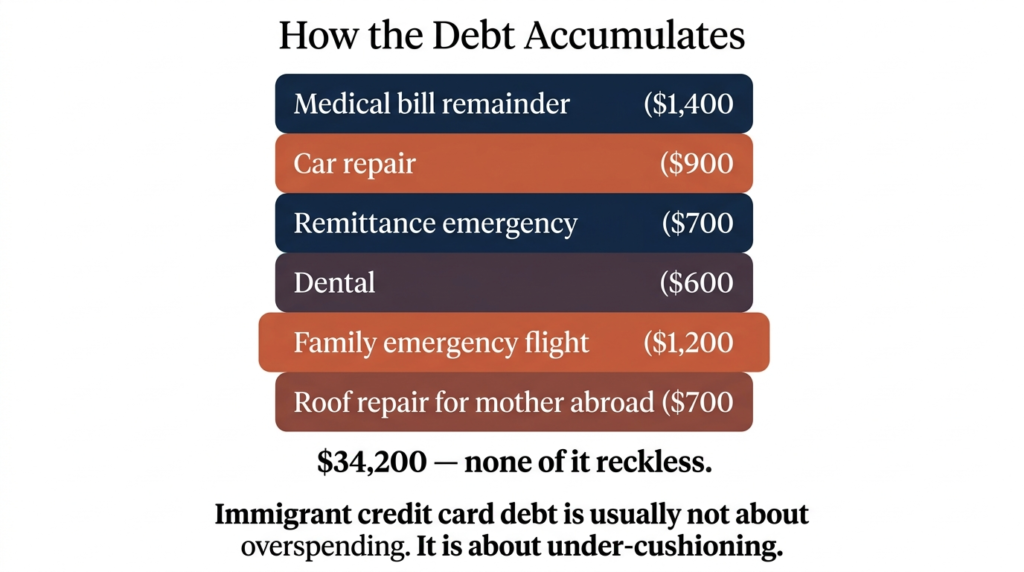
A medical bill arrives. Insurance covered part of it. The remainder, $1,400, is due in thirty days. The savings account has $800. The next remittance is due in ten days. There is a credit card with $2,000 available on it.
A car repair is needed, the car that gets her to the hospital at 5 AM when there is no bus running. The repair is $900. There is no other car. There is a credit card.
Her sister’s school fees in Lagos are due and her mother calls, twice, and the second call has a particular quality to it. She puts $700 on the card.
Each of these decisions is rational. Each of them, taken alone, is survivable. Taken together, over thirty-six months, with interest rates between 24% and 28% on cards she opened during periods when her credit was still thin and her options were limited, they compound into something that begins to feel like a physical weight.
“I never bought anything stupid,” Precious told me. “Every single charge on those cards was something I needed. The car. The dentist. The plane ticket when my father was sick. The money for my mother when the roof collapsed. Every charge was real.”
By the time she added them up, really added them up, all six cards, all six balances, on a Sunday afternoon in 2020, the total was $34,200. The minimum payments across all six cards were $940 per month. She was making $2,800 per month after taxes and agency residuals.
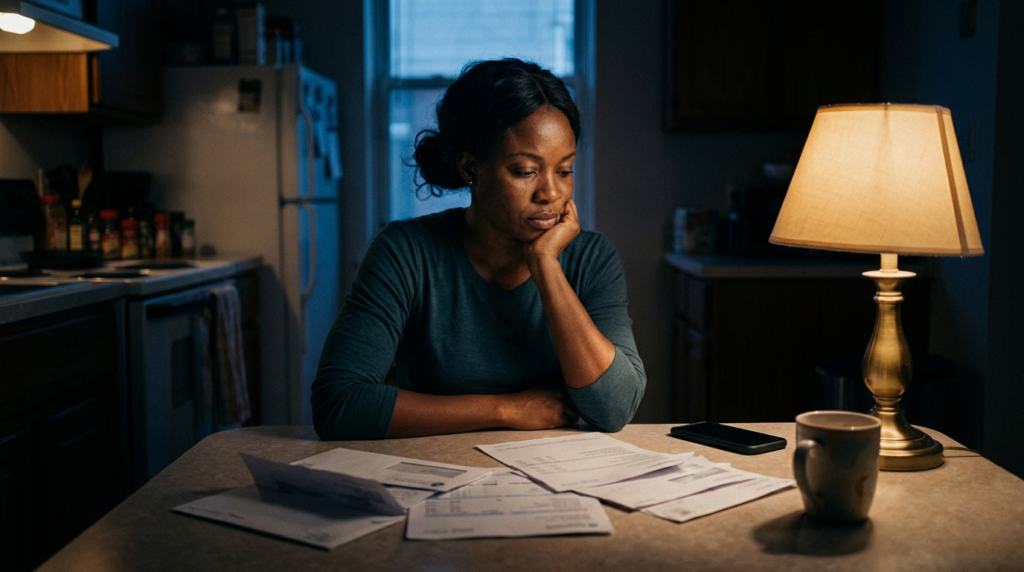
She had $214 in her checking account. She had a flight to Lagos bookmarked.
The Shame Architecture
Before she found a way out, Precious spent approximately eighteen months in what she now calls the shame architecture, the psychological structure that credit card debt builds around people who do not believe they deserve to ask for help.
She made the minimum payments every month. This cost her $940 and eliminated almost none of the principal, because at 24% to 28% interest, minimum payments on large balances are almost entirely interest. She knew this. She had read about it. Understanding the mathematics of her situation did not give her a path out of it. It gave her a clearer view of how trapped she was.
She did not call a nonprofit credit counselor because she was afraid of what they would say about her. She did not look into bankruptcy because she believed, incorrectly that bankruptcy would affect her immigration status. She did not ask her hospital’s HR department about their employee financial assistance resources because she was afraid someone would report her situation to her supervisor and it would affect her standing.
She was afraid to sleep. She was afraid to open the mail. She was losing weight from stress in a way her colleagues noticed and asked about.
“I was a nurse,” she said. “I knew what chronic stress does to a body. I was doing it to myself and I could not stop.”
She finally told one person, a Ghanaian coworker named Adjoa who had been in the US for eleven years and who Precious trusted completely. Adjoa listened to the full number without flinching. Then she gave her a phone number.
The Call That Changed Everything
The phone number was for a nonprofit credit counseling agency, a member of the National Foundation for Credit Counseling, the NFCC. Adjoa had used the same agency four years earlier for a smaller debt.
Precious called on a Tuesday afternoon, sitting in her car in the hospital parking lot, the same way you call when you do not want anyone to hear you.
The counselor she was connected with was a woman named Patricia. The call lasted ninety minutes. Patricia asked Precious to list every card, every balance, every interest rate, and every minimum payment. She asked about income, about fixed expenses, about remittance obligations, specifically. She asked about it without judgment, in the same tone she asked about the electricity bill.
“She treated the remittance like a real expense,” Precious said. “Not like something I should stop doing. Like something that had to be in the budget because it was in my life. That was the first time anyone in a financial context had done that.”
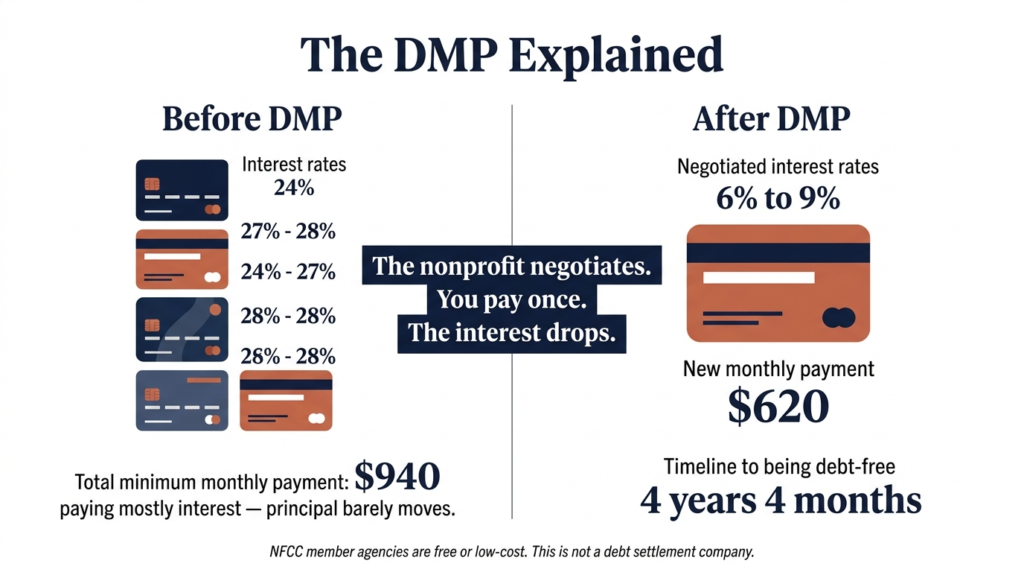
Patricia explained that Precious qualified for a Debt Management Plan, a DMP. Under a DMP, the nonprofit agency negotiates with each creditor to reduce or eliminate interest rates and consolidate all payments into a single monthly amount sent to the agency, which distributes it to the creditors. The agency charges a small monthly fee, typically $25 to $35. The creditors accept because they receive guaranteed payments and ultimately collect more principal than they would through minimum payments or default.
Precious’s six interest rates, ranging from 24% to 28%, were negotiated down to between 6% and 9%. Her monthly payment dropped from $940 in minimums, which were barely touching the principal, to $620 in DMP payments, which were eliminating it.
At the new rate, she would be debt-free in four years and four months.
She cried in her car in the parking lot. Then she went back inside and finished her shift.
What She Had to Give Up (And What She Did Not)
Entering a Debt Management Plan required Precious to close the credit cards enrolled in the plan. This was a condition she expected. What she did not expect was how it would feel, not the loss of the credit, but the loss of the psychological safety net.
“Those cards were my emergency fund,” she said. “A bad emergency fund, because of the interest. But when something happened, I knew the card was there. When I closed them, I had nothing. If the car broke down the next day, I had nothing.”
Patricia had prepared her for this. Before the DMP began, they worked together to build a small cash cushion, a $1,000 emergency fund, in a savings account Precious agreed not to touch under any circumstances except a genuine emergency. Building it took three months of extremely tight living. She reduced her remittance temporarily, a conversation with her mother that was, she said, one of the hardest she has had in her adult life.
“I told my mother I was in trouble,” she said. “She was quiet for a long time. Then she said, ‘Sort yourself out first. I will manage.’ She did not say it easily. But she said it.”
The $1,000 emergency fund was not large enough to feel safe. But it was real. It was in an account. It was not a credit card limit, it was money that existed.
Four months into the DMP, the car needed a $340 repair. She paid it from the emergency fund. She spent two weeks rebuilding it. The card was not an option. She managed.
“That repair was the moment I understood I could do it without them,” she said. “Not comfortably. But I could do it.”
The Immigration Question: What She Got Wrong
Precious had avoided bankruptcy in part because she believed it would jeopardize her immigration status. This belief, which she held with total certainty, turned out to be significantly more complicated than she understood, and the truth was both more nuanced and more reassuring than her assumption.
Bankruptcy itself is not grounds for deportation or denial of a green card application in the United States. It does not appear on a visa application. The immigration consequences of bankruptcy depend on the type of bankruptcy filed, the visa category, whether a green card application is pending, and a range of factors that vary by individual circumstance.
The critical point is not that bankruptcy is consequence-free for immigrants, it isn’t always, and anyone considering it should consult an immigration attorney alongside a bankruptcy attorney before filing. The critical point is that Precious’s certainty that it would destroy her immigration status was unfounded, and that certainty kept her from even researching her options for over a year.
Fear is not a financial strategy. And fear of specific outcomes that are not fully understood keeps immigrant workers locked in situations that have legal exits they are unaware of.
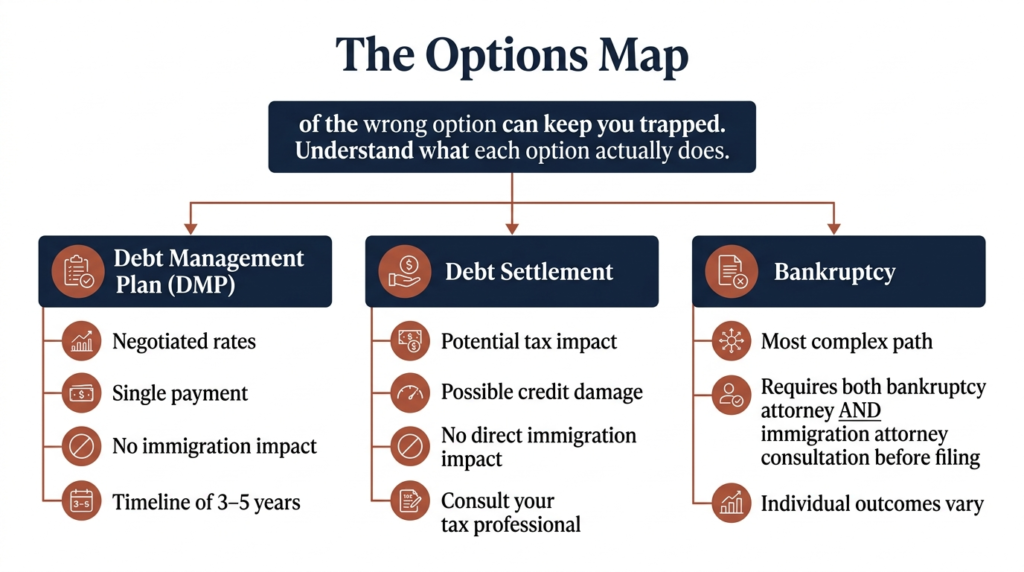
Patricia, her credit counselor, helped her understand the actual landscape of options: Debt Management Plans do not affect immigration status. Debt settlement has potential tax consequences but not immigration consequences in most cases. Bankruptcy’s immigration implications depend on type and individual circumstances and require a qualified immigration attorney to evaluate.
“She helped me see that I had options I had decided I didn’t have,” Precious said. “That was almost more important than the plan itself. I had options. I just had to understand what they actually were.”
The Four Years
The DMP ran for four years and three months. Precious made every payment. She missed none.
She describes the four years not as deprivation but as clarity, a period when her financial life was simplified to its essential structure because she had no other choice. There was the DMP payment. There was the reduced remittance. There was the emergency fund. There was rent, utilities, food, transportation. There was nothing else.
She did not go to restaurants. She did not buy new clothes unless something wore out. She brought food from home every single day she worked. She used the hospital’s employee assistance program for free counseling, for the anxiety, for the grief of her father’s death in year two of the plan, for the specific loneliness of living inside a financial problem you cannot tell most people about.
She also, in year two, did something Patricia had suggested from the beginning and which she had resisted: she opened a single new secured credit card, separate from the DMP accounts, and used it for one small monthly purchase, her streaming subscription, $15.99, paid in full every month. This was not for spending. It was to rebuild her credit score while the DMP ran, so that when she emerged, she would not be starting from zero.
Her credit score when she entered the DMP was 589. Her credit score when she made the final payment was 694. Twelve months after the final payment, it was 741.
“I watched that number go up,” she said. “Slowly. Every few months, a little more. It was the one thing I could see moving in the right direction when everything else felt frozen.”
The Moment It Ended
The final payment was a Thursday in late spring. She made it through the agency’s online portal, the same way she had made four-plus years of payments before it. The confirmation email arrived at 2:17 PM.
She was at work. She went to the bathroom and looked at the email for a moment. She did not cry. She went back to the floor.
That evening, she called her mother in Lagos. She told her that the debt was gone. Her mother was quiet. Then she started to pray, out loud, in Yoruba, on the phone, for about two minutes. Precious sat on the edge of her bed and let her.
Then her mother said: “Now you can send more again.”
Precious laughed. It was the first time in four years she had laughed about money.
What She Does Differently Now
The structural changes Precious made after the DMP ended are deliberate in the way that changes made by people who have been truly frightened tend to be deliberate.
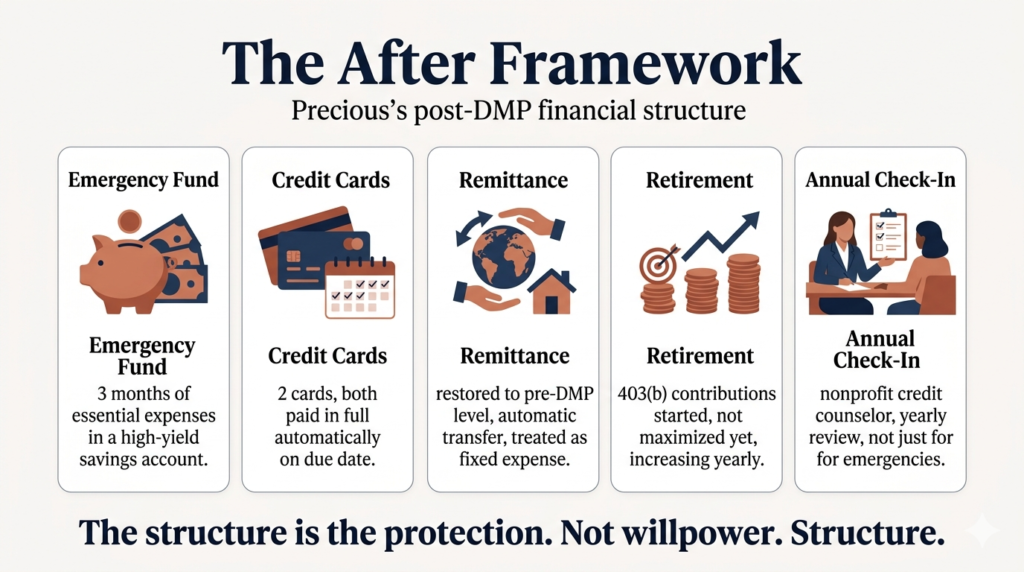
She keeps three months of essential expenses in a high-yield savings account. Not one month. Three. She built it over eighteen months after the DMP ended, using the same monthly amount she had been paying to the plan. When the DMP payment disappeared, she did not let the money disperse. She gave it its next assignment.
She uses two credit cards now, one for regular monthly expenses, one for larger purchases she wants to separate. She pays both in full every month without exception. She has set up automatic full-payment from her checking account on the due date so that the payment cannot be delayed or reduced by inattention.
She has restarted remittance at the level she sent before the DMP, plus a small additional amount to make up, she says, for the years her mother managed with less. Her mother has not told her to stop.
She has started a 403(b) through her employer, small contributions, not maximized, but started. She meets with a financial counselor from the same NFCC agency annually, not because she is in trouble, but because she has decided that relationship is part of how she keeps from being in trouble again.
“I cannot afford to not do those things,” she said. “I cannot afford to not save. I cannot afford to not check in. I know what happens when I just survive month to month and hope for the best. I know exactly what that looks like.”
The Resources She Used and How to Access Them
Precious asked me to be specific about resources because, she said, she spent too long not knowing they existed.
NFCC Member Agencies are the starting point for anyone carrying credit card debt they cannot manage. The National Foundation for Credit Counseling maintains a directory of certified nonprofit agencies at nfcc.org. The initial counseling session is free. Debt Management Plans have a small monthly fee, typically $25 to $35, which is regulated by state law and must be disclosed upfront. If an agency quotes you a fee significantly higher than this, or requires payment before providing any counseling, look elsewhere.
Important: do not confuse NFCC nonprofit credit counseling agencies with for-profit debt settlement companies. Debt settlement companies are different, frequently charge large upfront fees, may advise you to stop paying creditors, and may have tax and credit consequences that nonprofit DMPs do not. The NFCC directory is the correct starting point.
The Consumer Financial Protection Bureau maintains a debt collection and credit card guide specifically for immigrants and multilingual communities at consumerfinance.gov. The CFPB’s complaint portal can be used if you believe a creditor or debt collector is violating your rights, including contact outside permitted hours, threats, or harassment.
Legal Aid organizations in most major US cities offer free consultations on debt-related legal questions including the immigration implications of debt relief options. In Houston, Lone Star Legal Aid and Houston Volunteer Lawyers both offer services to income-qualifying immigrants. Finding a legal aid organization in your area can be done through lawhelp.org.
The 211 helpline – dialing 2-1-1 from any phone, or visiting 211.org, connects callers to local social services including emergency financial assistance, food programs, and utility assistance. In a financial emergency, this network can provide immediate support that reduces the pressure forcing debt decisions.
Hospital and employer financial assistance programs are consistently underused by immigrant workers. Most large hospital systems and many employers have employee assistance programs (EAPs) that provide free, confidential financial counseling. The confidentiality is real, EAP services are legally separated from employment records. Your supervisor does not know you called.
A Note on Interest Rates and Immigrant Credit Access
The 24% to 28% interest rates on Precious’s credit cards were not unusual. They were the predictable consequence of a credit system that assigns its highest rates to borrowers with the thinnest credit histories, and immigrant workers, by definition, begin with thin credit histories regardless of their financial responsibility in their countries of origin.
A Nigerian nurse with fifteen years of exemplary financial behavior in Lagos arrives in the United States as a credit nonentity. Her history does not transfer. She begins where an eighteen-year-old with no financial history begins, except she has adult obligations: rent, family support, work expenses, that the eighteen-year-old does not.
The credit cards she can access in her first years carry rates that would be considered predatory if applied to a borrower with an established history. She accepts them because she has no other option. When life events create expenses beyond her cash flow, as life events do, she pays those rates.
This is not a personal failure. It is a structural condition. Understanding it as structural does not make the debt disappear. But it changes the emotional relationship to it in ways that matter, because shame delays help-seeking, and delayed help-seeking turns manageable debt into unmanageable debt.
If you are carrying credit card debt accumulated from necessity, from family obligation, from the specific financial reality of immigrant life in the United States, you are not the problem. You are in a predictable situation that has predictable solutions. The solutions require action. They do not require shame.
What She Would Say to You
I asked Precious what she would say to someone reading this who recognized their own situation in hers, who has the tabs open, who knows the total, who has not yet made the call.
She thought for a moment.
“Make the call,” she said. “Today. Not tomorrow. Today. Go to nfcc.org and find the closest agency and call the number. Tell them everything. The amount. The interest rates. The remittance. Tell them all of it. They have heard it before. They will not be surprised.”
“And do not let anyone, including yourself, tell you that the money you send home is the reason you are in this. The debt and the remittance are two separate problems. Both can be solved. You do not have to choose between your family and your credit score. A good counselor will help you carry both.”
She paused.
“I almost went back to Lagos,” she said. “I had the flight bookmarked. My daughter is at the University of Houston. She is studying biology. She wants to go to medical school.”
She did not finish the sentence. She did not need to.

Precious’s surname has been withheld at her request. Her story has been shared with her knowledge and full consent. If you are carrying unmanageable credit card debt, contact an NFCC member nonprofit credit counseling agency at nfcc.org. For questions about the immigration implications of debt relief options, contact a licensed immigration attorney or your local legal aid organization at lawhelp.org. The 211 helpline is available for emergency financial assistance referrals.
This article contains no affiliate links. The resources listed were selected based on their standing, accessibility, and demonstrated service to immigrant communities — not commercial relationships.