
Index Funds vs. High-Yield Savings: Where Should an Immigrant Put Their First $1,000?

I still remember the day I received my first real paycheck in the United States. After sending part of it home and paying rent, I had exactly $1,000 left sitting in my bank account. Just sitting there. Doing nothing.
Back home, nobody in my family had ever talked about index funds, compound interest, or high-yield savings accounts. My parents kept their savings in a drawer — literally. So when I started Googling “how to grow money as an immigrant,” I felt like I had fallen headfirst into a foreign language inside a foreign country.
If you are in that same spot right now — $1,000 saved up, no credit history yet, maybe a visa status that complicates things — this guide is written for you. We are going to break down the two most beginner-friendly options available to new immigrants: index funds and high-yield savings accounts (HYSAs). By the end, you will know exactly where your first $1,000 should go and why.
Why This Question Matters More for Immigrants
Most personal finance advice is written with a very specific person in mind: someone born here, with a Social Security number since birth, a 401(k) through their employer, and parents who taught them to “invest early.” That is not most of us.
As a new immigrant, your financial situation comes with real extra layers. You may be sending money internationally, navigating ITIN numbers vs. Social Security numbers, worrying about whether your visa status affects your ability to open a brokerage account, or simply not trusting the financial system here the way people who grew up in it do. That distrust is not irrational. It is earned. Many of us come from countries where banks have failed or governments have frozen accounts overnight.
But here is the thing: the American financial system, for all its complexity, does offer tools that can build long-term wealth and financial security even on a modest starting budget. And your first $1,000 is the most important $1,000 you will ever invest — not because it is the most money, but because it teaches you how the system works.
First: Can Immigrants Even Invest in the US?
Yes, with some nuances.
Most legal immigrants – including those on H1B, F1 (with employment authorization), O1, L1 visas, and green card holders, can open brokerage accounts and savings accounts in the United States. You will typically need a Social Security Number (SSN) or an Individual Taxpayer Identification Number (ITIN), a US address, and a valid photo ID. Some platforms, like Robinhood and Fidelity, are friendlier to non-citizen residents than others. Platforms like SoFi also cater to immigrants looking for beginner-friendly banking and investing tools in one place.
Always consult a tax professional about your specific visa status before investing. Tax treatment of investment income can vary depending on your residency classification.
Option 1: High-Yield Savings Accounts (HYSA)
What Is a High-Yield Savings Account?
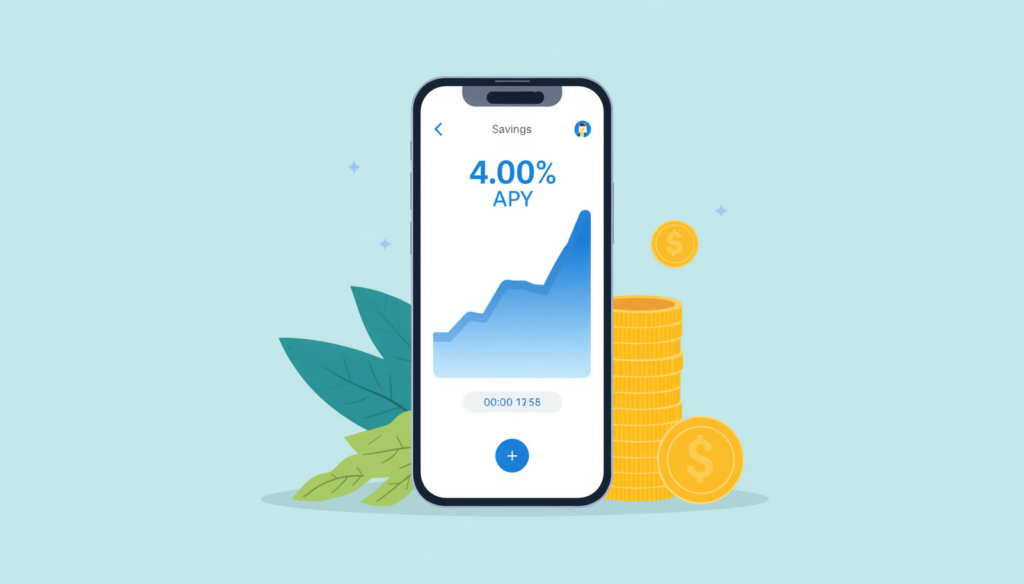
A high-yield savings account is exactly what it sounds like: a savings account that pays significantly more interest than a traditional bank savings account. While the average brick-and-mortar bank savings account pays around 0.40% APY (Annual Percentage Yield), top HYSAs are currently offering around 4.00% APY, which means your $1,000 earns roughly $40 in a year just by existing in the account. No risk, no market volatility, fully FDIC-insured up to $250,000.
This is one of the most beginner-friendly low-risk investment options available, and it is a perfect place to start building your emergency fund.
Who Should Start Here?
You should prioritize an HYSA if:
- You do not yet have 3 to 6 months of living expenses saved as an emergency fund
- You expect to need the money within the next 1 to 3 years (moving, sending money home, visa renewal fees, etc.)
- You are still new to the US and want zero risk while you get your bearings
- You are anxious about market volatility and need to build financial confidence first
Recommended HYSA Platform: SoFi
SoFi is one of the most immigrant-friendly financial platforms available. It offers a high-yield savings account with competitive APY rates, zero account fees, and a mobile-first experience designed for people who are building their financial lives from scratch. Their platform also bundles banking and investing in one place, which becomes genuinely useful when you are ready to take the next step.
Pros and Cons of HYSAs
Pros: FDIC insured, zero market risk, easy to access your money, simple to open, no experience needed.
Cons: Returns are limited and will not beat inflation long-term. Your $1,000 grows to maybe $1,040 in one year rather than potentially doubling over a decade with index funds.
Option 2: Index Funds
What Is an Index Fund?
An index fund is a type of investment that tracks a market index — like the S&P 500 — by automatically holding all (or most) of the stocks in that index. Instead of a manager picking individual stocks (and charging high fees for the privilege), the fund simply mirrors the market. This passive investing approach keeps costs extremely low and provides instant portfolio diversification.
The S&P 500, which tracks the 500 largest US companies, has historically returned an average of around 10% per year over the long term, according to Vanguard data going back to 1926. That means a $1,000 investment growing at that historical rate would become roughly $2,714 in just 10 years.
Compare that to the $1,040 you would have sitting in an HYSA.
Who Should Start Here?
You should consider putting at least part of your $1,000 into index funds if:
- You already have an emergency fund (at least a few months of expenses set aside)
- You do not need this $1,000 for at least 5 years
- You are comfortable with the idea that the value can dip temporarily (market volatility is real, but so is recovery)
- You are thinking about long-term wealth building rather than short-term safety
Recommended Platform: Robinhood or Acorns
Robinhood is commission-free, has no account minimum, and is widely accessible to legal US residents including immigrants. You can buy fractional shares of index funds and ETFs, which means you do not need hundreds of dollars to get started — even $10 is enough to begin.
Acorns is another excellent beginner option. It rounds up your everyday purchases to the nearest dollar and invests the spare change into a diversified portfolio of index funds automatically. It is one of the best micro-investing apps for people who want to start small and automate everything. Acorns does not require a funded account immediately, making it perfect for complete beginners.
The Power of Compound Interest
Here is the part nobody told me when I first arrived: the biggest advantage of starting early with passive investing is not how much money you put in. It is the compound interest, the phenomenon where your returns begin to earn their own returns. Over decades, this creates exponential growth.
A $1,000 investment in an S&P 500 index fund at age 25 could realistically be worth $45,000 or more by retirement at age 65, without you ever adding another cent, assuming historical average returns. That is the power of time in the market, not timing the market.
The Honest Answer: It Depends on Your Emergency Fund

Here is the framework I wish someone had given me on day one:
Step 1: Before anything else, figure out your monthly expenses. Multiply by 3. That is your emergency fund target.
Step 2: If your $1,000 does not cover that emergency fund target yet, put it in a high-yield savings account (like SoFi). You are not losing out — you are protecting yourself.
Step 3: Once your emergency fund is solid, start moving money into index funds through a platform like Robinhood or Acorns. Even $25 a month is enough to begin building real long-term wealth.
Step 4: If you want to split your $1,000 right now, a popular framework among beginner investors is: 70% HYSA (emergency fund building) + 30% index fund (starting to grow wealth). As your emergency fund grows, you gradually flip that ratio.
A Note on Taxes for Immigrants
This is genuinely important. Investment income is taxable in the United States, and the rules are different depending on your residency status. If you are a non-resident alien for tax purposes (common in the first year or two), you may face different withholding rules on dividends from index funds. Always keep records, and consider working with a tax professional familiar with immigrant tax situations — especially during your first tax season.
The good news: both HYSAs and index fund platforms will send you the necessary tax forms (1099 forms) at the end of each year, making it easier to report correctly.
Quick Comparison Table
| Feature | High-Yield Savings Account | Index Funds |
|---|---|---|
| Risk Level | Very Low | Medium (short-term), Low (long-term) |
| Typical Return | ~4.00% APY | ~10% annually (historical) |
| FDIC Insured | Yes | No |
| Liquidity | High (access anytime) | Medium (can sell, but should wait) |
| Best For | Emergency funds, short-term goals | Long-term wealth building |
| Minimum to Start | $0 to $1 | $0 (with fractional shares) |
| Immigrant Friendly | Yes | Yes (with SSN or ITIN) |
My Personal Take
When I got that first $1,000, I split it. Half went into a high-yield savings account because I had no safety net, no family nearby to borrow from, and one unexpected medical bill would have wiped me out. The other half went into a simple S&P 500 index fund through Fidelity. I did not touch it. I barely looked at it.
Two years later, that half in the index fund had grown considerably, through market ups and downs, without me doing a single thing. The HYSA half stayed steady and boring and available when I needed it.
That boring split decision was one of the best financial moves I ever made.
Useful Tools and Next Steps
Here are beginner-friendly resources and platforms worth exploring.
- SoFi — Best all-in-one platform for immigrants (banking + investing + HYSA)
- Robinhood — Best for commission-free index fund investing with no account minimum
- Acorns — Best for automated micro-investing and building the habit gradually
- Credit Sesame — Free credit score monitoring, critical for building US credit history as a new immigrant
- Empower (formerly Personal Capital) — Free financial tracking dashboard to see all your accounts in one place
Final Thought: The Best Investment Is Starting
There is no perfect time to invest. There is no magic amount. There is only the decision to begin, however imperfectly, with whatever you have.
You crossed an ocean, survived a visa process, learned a new language, and built a life in a country that was not designed with you in mind. Managing $1,000 in a financial system that is unfamiliar? You can absolutely do this.
Start with safety. Then build wealth. And know that every dollar you put to work today is a dollar that is working for your future — and the future of everyone counting on you.
Frequently Asked Questions
Q: Should immigrants invest or save their first $1,000?
The short answer is: both, in the right order. If you do not yet have an emergency fund covering at least 3 months of expenses, your first priority should be saving that money somewhere safe and liquid, like a high-yield savings account. Once your safety net exists, even putting $100 to $200 into an index fund begins the habit of long-term investing. The worst move is keeping $1,000 in a traditional checking account earning near zero interest while you wait for the “perfect” time to act.
Q: Can I invest in index funds without a Social Security number?
Yes, in many cases. If you have an Individual Taxpayer Identification Number (ITIN), several brokerage platforms will accept your application. Fidelity and some other major brokerages allow ITIN holders to open accounts, though the process may require additional documentation. Once you obtain a Social Security number, the process becomes significantly smoother. Always verify the current requirements directly with the brokerage before applying, as policies can change.
Q: What is safer: index funds or a high-yield savings account?
A high-yield savings account is safer in the short term. It is FDIC insured up to $250,000, meaning your money is federally protected even if the bank fails. Index funds are not FDIC insured, and their value can and does fluctuate with the market. However, over a horizon of 10 years or more, a diversified index fund has historically delivered significantly higher returns than any savings account. The right answer depends on your timeline: safety for money you need soon, index funds for money you can leave alone for years.
Q: How much should I keep in emergency savings?
Most financial professionals recommend keeping 3 to 6 months of essential living expenses in an emergency fund. For immigrants, leaning toward the higher end of that range makes sense, since unexpected costs like visa renewals, travel home for family emergencies, or gaps between jobs can arise without the safety net that some others have. Once that cushion is in place, the money you save beyond it is what you begin shifting into longer-term investments like index funds.
Disclaimer: This article is for educational and informational purposes only and does not constitute financial or investment advice. Always consult a qualified financial professional before making investment decisions. Investment values can go up and down, and past market performance is not a guarantee of future results.