How To File Taxes If You Have Foreign Income
From someone who learned what “worldwide income” means the expensive way.

I did not know the United States taxed worldwide income until I had been living here for two years.
I had a small savings account back home. I had done a few months of freelance work for a client in my home country before I left. I also still received a modest dividend from a family investment that my parents had set up years before I ever thought about moving abroad. None of it felt like “American income.” None of it felt like something I needed to tell the IRS about.
I was wrong on all three counts.
The US tax system operates on a principle that surprises almost every newcomer and every immigrant who still has financial ties to another country: if you are a US citizen or a resident alien for tax purposes, the IRS expects you to report your income from everywhere on earth, not just what you earned in the United States. That rule does not change based on whether the income was earned before you arrived, whether it was taxed in another country, or whether you ever brought the money into the US.
But here is the part that took me even longer to learn: there are specific tools, exclusions, and credits built into the tax code specifically designed to protect you from being taxed twice. You just have to know they exist and how to use them.
This guide is the thing I needed in year two.
Who Needs to Read This
This article is for anyone who files a US tax return and has any of the following:
Income earned from work performed in another country, a bank or savings account in a foreign country, investments held abroad, rental income from property in another country, freelance or consulting income paid by foreign clients, pension or retirement income from a foreign government or employer, or any other financial activity that takes place outside the United States.
If any of those apply to you, whether you are a green card holder, an H-1B visa holder, a naturalized citizen, or a long-term resident alien, this article walks through what you need to report, what you can exclude or offset, and how to stay fully compliant without overpaying a dollar more than required.
Step 1: Confirm Your US Tax Residency Status
Before anything else, you need to know how the IRS classifies you, because that classification determines the scope of your reporting obligations.
Resident aliens: Those who hold a green card or who meet the Substantial Presence Test, must report their worldwide income on Form 1040. This means income from every country, in every currency, from every source.
Nonresident aliens: Those who do not meet the green card test and do not pass the Substantial Presence Test, generally report only US-sourced income on Form 1040-NR and have more limited foreign income obligations.
Dual-status aliens: Those who changed status during the tax year, have a more complex situation that involves filing a combination of both forms, often with the help of a tax professional.
For most immigrants living and working in the US, once you have been here for a few years, you are almost certainly a resident alien and the worldwide income reporting obligation applies to you fully. IRS Publication 519 is the authoritative reference for understanding your classification in detail.
Step 2: Understand the Worldwide Income Reporting Obligation
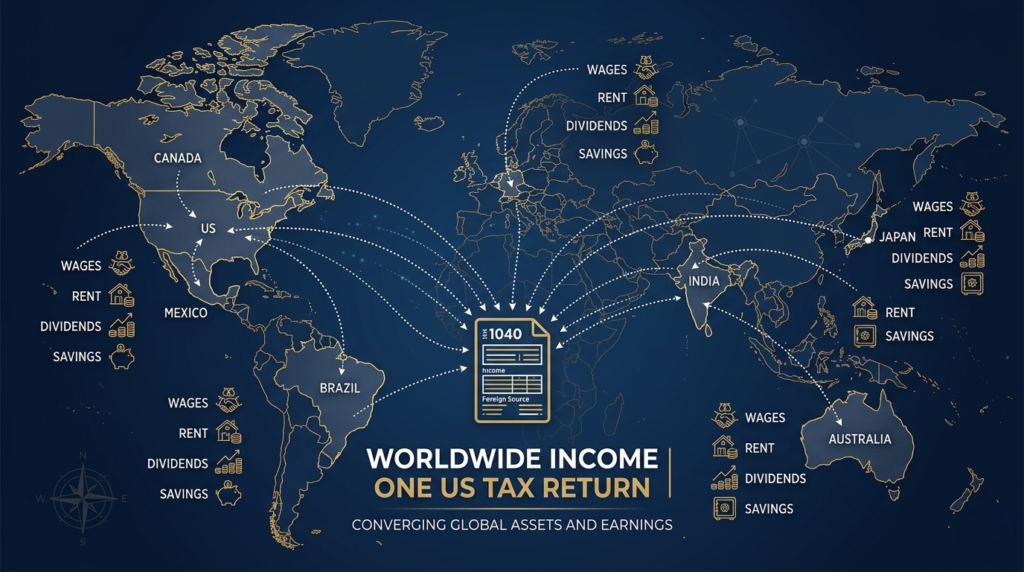
Once you are classified as a resident alien, every dollar you earn anywhere in the world is reportable on your US tax return. This includes:
Foreign employment income — Salaries, wages, bonuses, and any compensation for services performed in another country, even if you were only there temporarily and even if that income was already taxed by the foreign country.
Foreign self-employment and freelance income — If you do contract work, consulting, or any independent services for foreign clients, that income belongs on your US return. It is reported on Schedule C just like domestic self-employment income, and self-employment tax (15.3% on net earnings) applies in most cases regardless of where you earned it.
Foreign investment income — Dividends from foreign stocks, interest from foreign bank accounts, capital gains from selling foreign assets, and income from foreign mutual funds or investment accounts are all reportable. The rules for certain foreign investment structures, particularly Passive Foreign Investment Companies, known as PFICs, are especially complex and carry significant penalties for incorrect reporting.
Foreign rental income — If you own property abroad and receive rental income, that income must be reported on your US return on Schedule E, just as domestic rental income would be. You can generally deduct associated expenses like mortgage interest, property taxes, maintenance, and depreciation against that income.
Foreign pension and retirement income — Income received from a foreign government pension, an employer-sponsored foreign retirement plan, or social security equivalent payments from another country may be reportable depending on whether a tax treaty exists between the US and that country.
Foreign inheritance and gifts — Receiving a large gift or inheritance from abroad does not itself create income, but there are reporting requirements. If you receive more than $100,000 from a foreign individual or estate, you must file Form 3520. Failure to file carries steep penalties.
All amounts must be converted to US dollars using the appropriate exchange rate. The IRS generally accepts the Treasury Department’s official exchange rates, though you can also use the annual average rate published by the Federal Reserve.
Step 3: Learn Your Two Primary Tools for Avoiding Double Taxation
Here is the part that changes everything for most people with foreign income. The US tax code provides two main mechanisms to prevent you from paying tax on the same income in two countries. Understanding the difference between them, and knowing which one applies to your situation, is the core of filing foreign income correctly.
Tool 1: The Foreign Earned Income Exclusion (FEIE)
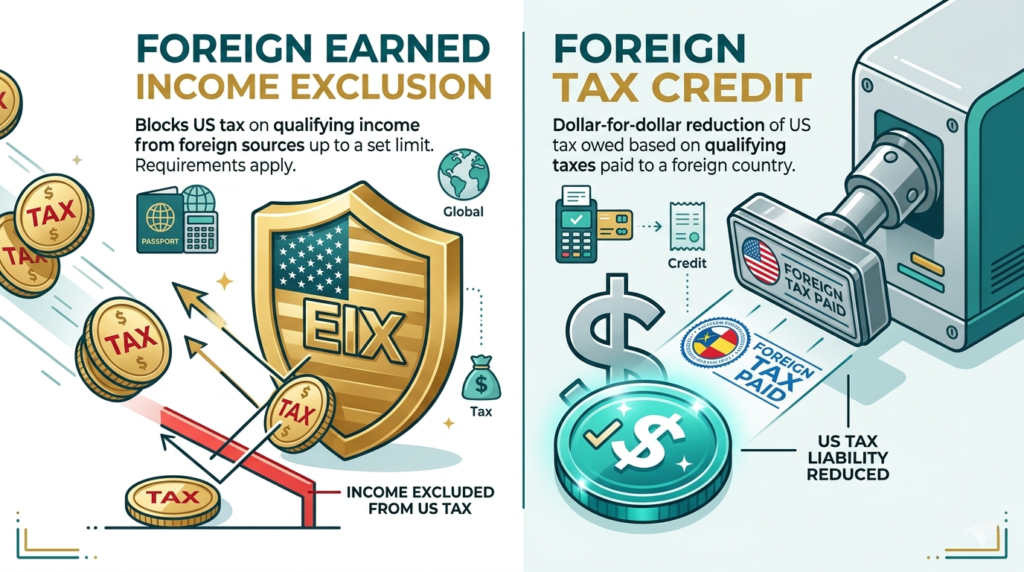
The Foreign Earned Income Exclusion allows qualifying individuals to exclude a substantial portion of their foreign earned income from US taxation entirely. For the 2025 tax year (filed in 2026), you can exclude up to $130,000 of foreign earned income. This amount increases to $132,900 for tax year 2026.
To claim the FEIE, you must meet three requirements. First, you must have foreign earned income, wages, salary, or self-employment income for work performed abroad. Investment income, pensions, and passive income do not qualify for the FEIE. Second, your tax home must be in a foreign country, meaning your regular place of business or employment is outside the United States. Third, you must pass one of two qualifying tests:
The Physical Presence Test requires you to be physically present in foreign countries for at least 330 full days during any 12-month period. This period does not have to align with the calendar year, giving you flexibility in how you structure your qualifying window.
The Bona Fide Residence Test requires you to be a genuine resident of a foreign country for an uninterrupted period that includes a full calendar year. It is based on the totality of your circumstances, your visa status, your intent, your social ties, and your tax obligations in the host country, rather than day counts alone.
The FEIE is claimed by filing Form 2555 alongside your Form 1040. One critical caution: if you claim the FEIE, you cannot also claim the Foreign Tax Credit on the same income. You also cannot claim the Additional Child Tax Credit or the Earned Income Tax Credit in years when you claim the FEIE. Additionally, the FEIE covers only earned income, if your income exceeds the exclusion limit, the excess is still taxable, and you will need to manage that remaining amount separately.
The FEIE also includes a Foreign Housing Exclusion for employees with high housing costs abroad. For 2025, you can generally exclude housing expenses up to 30% of the FEIE limit (approximately $39,000), with higher caps available in designated high-cost cities like London, Tokyo, Hong Kong, and Zurich.
Once you claim the FEIE, that choice applies to all future years unless you formally revoke it. And if you revoke it, you generally cannot reclaim the exclusion for the next five years without IRS approval. This makes the initial decision an important one to think through carefully.
Tool 2: The Foreign Tax Credit (FTC)
The Foreign Tax Credit works differently. Instead of excluding income from your US return, it reduces your US tax liability dollar-for-dollar by the amount of tax you already paid to a foreign government on that same income.
The FTC is particularly powerful in two situations. The first is when you live in a high-tax country, like the United Kingdom, France, Germany, or Canada, where local tax rates exceed US rates, meaning the foreign taxes you paid may fully offset any US tax owed on that income. The second is when your income includes types that the FEIE does not cover, like dividends, interest, and capital gains from foreign investments.
The FTC is claimed on Form 1116 and can apply to both earned income and passive income, unlike the FEIE which covers earned income only. Unused foreign tax credits can be carried back one year or forward up to ten years, giving you flexibility across tax years when your income or tax rates fluctuate.
A common and often optimal strategy for people with higher incomes is to combine both tools strategically: use the FEIE to exclude a portion of earned income up to the $130,000 limit, and use the Foreign Tax Credit on any remaining earned income above that limit and on all passive income. You cannot use both on the exact same income, but applying them to different income categories is permitted and can bring your US tax liability to near zero.
Step 4: Know Your Foreign Account Reporting Obligations
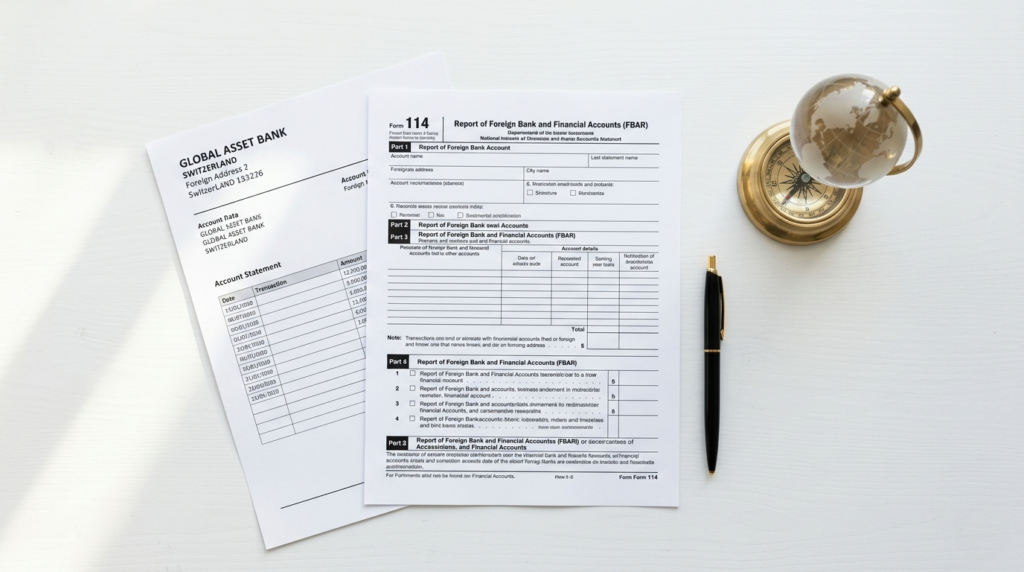
Foreign income is only half of the picture. If you have money or financial accounts outside the United States, you likely have separate reporting obligations that exist entirely apart from your tax return, and the penalties for missing them are severe.
The FBAR: FinCEN Form 114
The Foreign Bank and Financial Accounts Report, commonly called the FBAR, is required if the combined maximum value of all your foreign financial accounts exceeded $10,000 at any point during the calendar year. Not at year-end — at any point during the year. A checking account that briefly held $11,000 in March and was drawn down by April still triggers the requirement.
The FBAR is not filed with the IRS. It is filed electronically through the FinCEN BSA E-Filing System, separately from your tax return. For the 2025 tax year, the FBAR deadline is April 15, 2026, with an automatic extension to October 15, 2026. No form or request is needed to receive this extension.
The types of accounts that must be reported include foreign bank accounts, brokerage accounts, certain foreign pension accounts, and foreign investment accounts. The threshold is aggregate — meaning you add up all foreign accounts together. A savings account with $6,000 and a checking account with $5,000 cross the threshold combined.
Penalties for non-filing are not gentle. A non-willful violation can result in penalties up to approximately $16,500 per violation. Willful violations can carry penalties of up to 50% of the account balance at the time of the violation, plus potential criminal charges. Recent court rulings have expanded the definition of “willful” to include reckless disregard — meaning “I did not know about it” is an increasingly narrow defense.
If you have past years where you should have filed an FBAR and did not, the IRS Streamlined Compliance Procedures offer a path to get current without maximum penalties. Acting proactively rather than waiting to be contacted is consistently the more favorable approach.
FATCA: Form 8938
FATCA, the Foreign Account Tax Compliance Act, adds a second layer of foreign asset reporting for people with higher-value foreign assets. Unlike the FBAR which covers accounts, Form 8938 covers a broader range of foreign financial assets including foreign stocks, partnership interests, and certain foreign insurance or pension plans.
The thresholds for Form 8938 are significantly higher than the FBAR. For single filers living in the US, reporting is required when foreign assets exceed $50,000 at year-end or $75,000 at any point during the year. For single filers living abroad, those thresholds increase to $200,000 at year-end or $300,000 at any point. Form 8938 is filed with your tax return, attached to your Form 1040, unlike the FBAR which is filed separately.
Many immigrants who need to file an FBAR also need to file Form 8938. The two forms overlap but are not interchangeable, and filing one does not satisfy the obligation for the other.
Step 5: Check Whether a Tax Treaty Applies
The United States has tax treaties with more than 60 countries, and those treaties can significantly affect how specific types of foreign income are taxed, sometimes reducing withholding rates, sometimes eliminating US tax on certain income types altogether, and sometimes providing tie-breaker rules when both countries claim taxing rights.
Common treaty benefits for immigrants with foreign income include reduced or eliminated US tax on foreign pensions, different treatment for government-sourced income, and rules that determine which country has primary taxing rights when income is sourced in one country but paid to a resident of another.
Treaty benefits are not automatic. They must be claimed on your tax return, and in some cases require filing Form 8833 to disclose the treaty position you are relying on. The IRS publishes the full text of each treaty at IRS.gov, and the relevant articles differ significantly from one country to the next.
If you receive foreign pension income, social security equivalent payments from another country, or investment income with withholding in a foreign country, verifying whether a treaty applies is one of the highest-leverage steps you can take to reduce your tax bill legally.
Step 6: Choose How to File
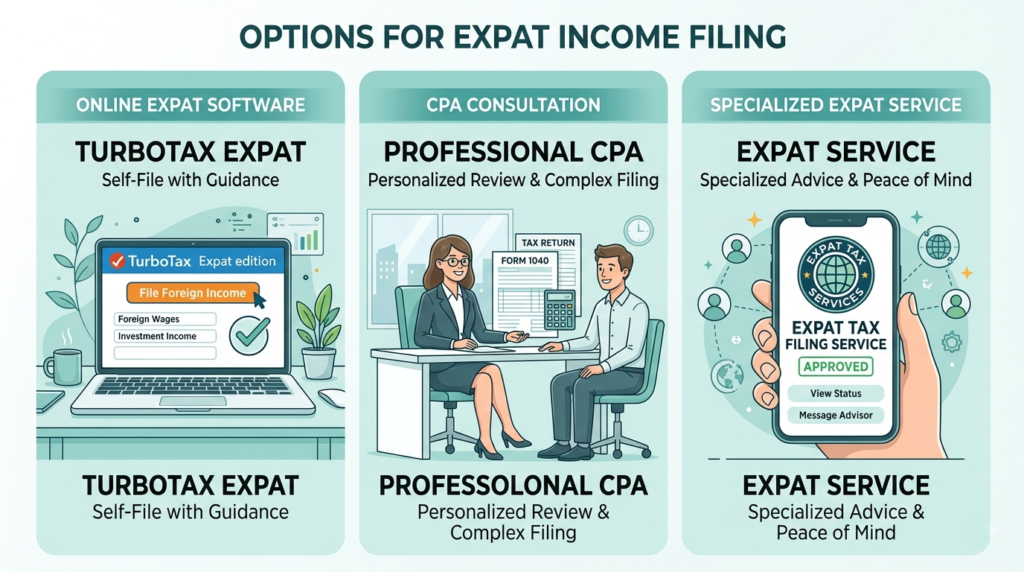
Filing a US return with foreign income is meaningfully more complex than a standard domestic filing. Your options range from tax software to specialized expat professionals, and the right choice depends on the complexity of your situation.
Tax Software for Straightforward Foreign Income
For resident aliens with relatively simple foreign income situations, one foreign employer, one foreign bank account, and no foreign business ownership, standard tax software can handle the job if it includes the relevant forms.
TurboTax supports Form 2555 (FEIE) and Form 1116 (Foreign Tax Credit) and includes a guided interview that walks you through your foreign income situation step by step. Their Live Expert option lets you connect with a CPA for real-time help if you encounter a situation you are unsure about, which is worth considering when foreign income is involved.
H&R Block also supports both Form 2555 and Form 1116, and their premium tiers include access to a tax professional for review. For people who want the security of human oversight without the cost of full professional preparation, this is a strong option.
Specialized Expat Tax Professionals
For anything involving dual-status returns, PFIC investments, foreign business ownership, multiple countries, the FBAR combined with FATCA, or significant income above the FEIE limit, working with a CPA or Enrolled Agent who specializes in expat tax and immigrant tax returns is not optional, it is the financially responsible choice.
Mistakes on foreign income returns do not just result in extra taxes. They can result in substantial penalties, FBAR violations, and complications with immigration filings, since USCIS increasingly reviews tax compliance history as part of visa and naturalization adjudications. Getting these right from the start is significantly cheaper than fixing them later.
Other Helpful Tools
Credit Sesame – Free credit monitoring to help you build and track your US financial profile while managing the complexity of your international finances.
Empower – Free financial dashboard that consolidates all your accounts, domestic and international, in one place. Staying organized throughout the year is one of the best ways to ensure you never miss a deduction or reporting requirement at tax time.
Key Deadlines
April 15 — Main filing deadline and payment deadline for most filers. Also the FBAR deadline (with automatic extension to October 15).
June 15 — Automatic two-month extension for US citizens and resident aliens whose tax home and abode are outside the United States on April 15. No form required, but interest on any unpaid taxes begins accruing from April 15.
October 15 — Extended deadline available to all filers who file Form 4868 by June 15. Also the automatic FBAR extension deadline.
Note: The extension to file does not extend your deadline to pay. If you expect to owe taxes, paying by April 15 avoids interest and penalties even if your return is not yet complete.
A Genuine Warning About What Has Changed
Tax law affecting immigrants and people with foreign income is not static, and several recent changes directly affect the 2025 filing year.
The remittance tax: Starting in 2026, certain electronic transfers of cash sent outside the US are subject to a new 1% federal tax. Transfers made through a bank account or credit card are not affected, but cash-funded wire transfers and money orders sent internationally are. If you regularly send money to family abroad, this is worth understanding before your next transfer.
FBAR enforcement: A 2026 court ruling expanded the definition of willful FBAR non-compliance to include reckless disregard, making it harder to claim ignorance as a defense. If you have unreported foreign accounts from prior years, the IRS Streamlined Compliance Procedures remain available, but acting proactively before the IRS contacts you is the right move.
FATCA thresholds: Recent legislation authorizes the Treasury Department to lower FATCA reporting thresholds in future regulations. No final rules had been issued as of early 2026, but monitoring this space is advisable if your foreign asset values are near the current thresholds.
FAQ
Q: Do I have to report foreign income if I already paid taxes on it in another country?
Yes. As a resident alien or US citizen, you must report your worldwide income on your US tax return regardless of whether it was already taxed abroad. However, you can use the Foreign Tax Credit (Form 1116) to offset your US tax liability by the amount of foreign tax paid, which in many cases eliminates any additional US tax owed on that income.
Q: What is the Foreign Earned Income Exclusion and who qualifies?
The Foreign Earned Income Exclusion (FEIE) allows qualifying individuals to exclude up to $130,000 of foreign earned income from US taxation for the 2025 tax year. To qualify, you must have a tax home in a foreign country and pass either the Physical Presence Test (330 full days abroad in any 12-month period) or the Bona Fide Residence Test (genuine residence in a foreign country for an uninterrupted period including a full calendar year). The FEIE only applies to earned income, wages, salary, and self-employment income, not passive income like dividends or interest.
Q: What is the FBAR and do I need to file it?
The FBAR (FinCEN Form 114) is a report filed separately from your tax return that discloses foreign financial accounts. You must file it if the combined maximum value of all your foreign accounts exceeded $10,000 at any point during the year. It is filed electronically through the FinCEN BSA E-Filing System and is due April 15, with an automatic extension to October 15. Penalties for non-filing can be severe, including up to 50% of account balances for willful violations.
Q: Can I use both the Foreign Earned Income Exclusion and the Foreign Tax Credit?
Not on the same income. You cannot exclude income under the FEIE and also claim the Foreign Tax Credit on that same excluded income. However, many filers with incomes above the FEIE limit use a combination approach: applying the FEIE to the first $130,000 of earned income and using the Foreign Tax Credit on earned income above that limit and on all passive income. This combination strategy can significantly reduce or eliminate US tax liability for high-income earners abroad.
Q: What happens if I have unreported foreign income from prior years?
The IRS offers programs to help people come into compliance without facing maximum penalties. The Streamlined Domestic Offshore Procedures are for US residents, and the Streamlined Foreign Offshore Procedures are for expats, both allow you to file delinquent returns and FBARs with reduced penalty exposure. Acting voluntarily before the IRS contacts you is consistently the more favorable position. A CPA or Enrolled Agent with expat tax experience can guide you through the right program for your situation.
Disclaimer: This article is for educational and informational purposes only and does not constitute tax, legal, or financial advice. Tax laws change frequently and individual situations vary significantly. Always consult a qualified tax professional — ideally one with experience in immigrant and expat tax matters — before making filing decisions.Affiliate Disclosure:Some links in this post are affiliate links. If you sign up or purchase through them, I may earn a small commission at no extra cost to you. I only recommend tools and services I genuinely trust.