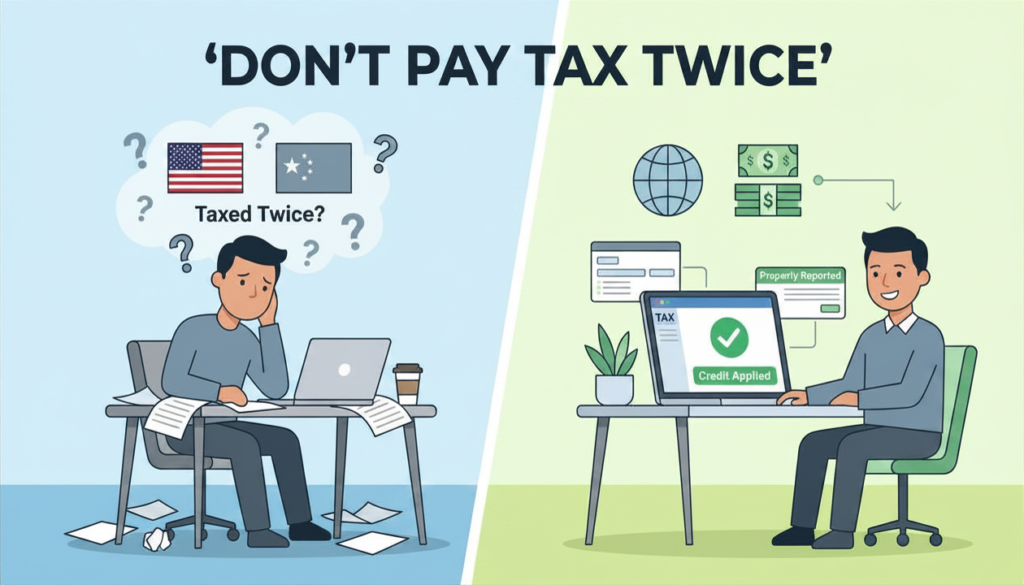
How To File US Taxes as a Newcomer Step by Step
From someone who once Googled “what is a W-2” at midnight the week before Tax Day.

My first tax season in the United States was, to put it kindly, a disaster.
Not because I did anything wrong, but because nobody told me anything. Back home, taxes were something the government calculated for you, deducted from your paycheck, and that was the end of it. Here, I was suddenly expected to gather forms I had never heard of, understand concepts like “standard deduction” and “filing status,” and submit a return to a federal agency by a deadline I nearly missed because I did not even know it existed.
If you are a newcomer navigating your first US tax return, this guide is written for you. We are going to walk through every step, from figuring out whether you even need to file, to choosing how to file, to what happens after you hit submit. No jargon. No assumptions. Just a clear, honest walkthrough from someone who has been exactly where you are standing.
Why Filing Taxes in the US Matters More Than You Think
Before we get into the steps, let us address something many newcomers quietly wonder: do I really have to do this?
Yes. And here is why it matters beyond just following the law.
Filing your US tax return creates a paper trail of your presence, income, and good standing in the country. Immigration agencies like USCIS frequently request tax transcripts during green card applications, visa renewals, naturalization reviews, and affidavits of support. A clean, consistent tax history is one of the most valuable documents you can build as an immigrant.
Beyond immigration, filing taxes, even when you owe nothing, can unlock refunds you did not know you were entitled to, access to credits like the Child Tax Credit or education credits, and a stronger financial profile in the US system overall.
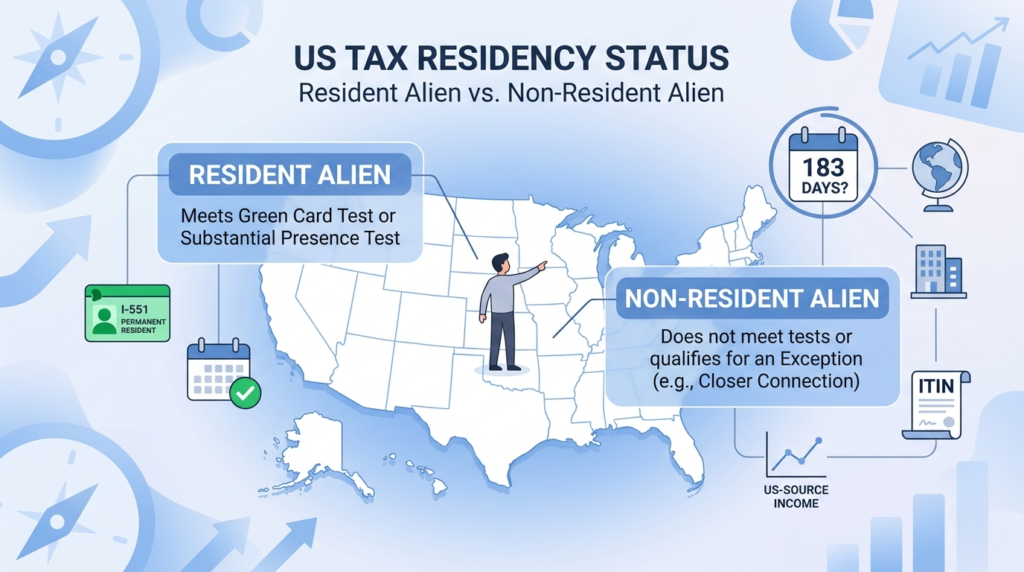
This is the most important and most overlooked step for newcomers. The form you file, and what income you must report, depends entirely on whether the IRS considers you a resident alien or a nonresident alien for tax purposes. This classification has nothing to do with your immigration visa. It is determined purely by how long you have been in the country.
The Two Tests
Green Card Test: If you were granted a green card at any point during the tax year, you are automatically considered a US tax resident from your arrival date, regardless of how many days you actually spent in the country.
Substantial Presence Test: If you do not have a green card, the IRS calculates your residency using a three-year weighted formula. You count all days in the US this year, one-third of days from last year, and one-sixth of days from two years ago. If the total exceeds 183 days, you are a resident alien for tax purposes. This catches many people who assume the rule is simply “183 days in the current year”, it is not.
What This Means for Your Filing
Resident aliens file Form 1040 and must report their worldwide income, not just income earned in the US, but income from any country on earth.
Nonresident aliens file Form 1040-NR and generally report only US-sourced income.
Dual-status aliens are in a third category, this applies when you became a resident partway through the year. For example, if you arrived in the US on May 1st on an H-1B visa and met the substantial presence test, you were a nonresident from January 1 to April 30, and a resident alien from May 1 onward. This situation requires extra care and often benefits from professional guidance.
Important: F-1 and J-1 student visa holders are generally classified as nonresident aliens for their first five calendar years in the US, even if they are physically present for more than 183 days. Different rules apply for different visa categories — always verify yours.
Step 2: Get Your Identification Number
To file a US tax return, you need either a Social Security Number (SSN) or an Individual Taxpayer Identification Number (ITIN).
Social Security Numbers are issued to people authorized to work in the US, citizens, green card holders, and certain visa holders like H-1B, L-1, and O-1. If you have work authorization and do not yet have an SSN, apply at your local Social Security Administration office with your passport, visa, and I-94 arrival record.
ITINs are issued by the IRS to people who have a federal tax filing requirement but are not eligible for an SSN. This includes nonresident aliens with US income, dependents or spouses of US citizens who are foreign nationals, and some other categories. To apply for an ITIN, you complete Form W-7 and submit it with your original passport or certified copies. A helpful tip: working with a Certified Acceptance Agent (CAA) means you do not have to mail your original documents to the IRS, they verify your identity locally and submit the application on your behalf.
Step 3: Gather Your Tax Documents

Before you open any tax software or sit down with a tax professional, collect everything you will need. Missing a document mid-filing is one of the most common sources of errors and delays.
Here is what most newcomers need to gather:
From your employer(s): Form W-2: This is the document your employer sends you by January 31 each year showing how much you earned and how much federal, state, and local tax was already withheld from your paychecks. If you worked for more than one employer during the year, you will receive a W-2 from each one.
For freelance or self-employment income: Form 1099-NEC: Clients who paid you $600 or more for freelance or contract work are required to issue you this form. If you did gig work, consulting, or any independent contracting, watch for these.
For investment income: Form 1099-DIV and 1099-INT: These report dividends from investments and interest earned from bank accounts. If you opened a high-yield savings account or invested through a brokerage, you will receive these.
Other documents you may need: Your passport and visa information, your ITIN or SSN, last year’s tax return if you filed one, records of any foreign income or foreign bank accounts, and receipts for any deductible expenses if you plan to itemize deductions rather than take the standard deduction.
Step 4: Understand the Key Concepts Before You File
You do not need to become a tax expert, but understanding a few core ideas will make the filing process much less confusing.
Standard Deduction vs. Itemized Deductions
When calculating your taxable income, the IRS allows you to subtract either a flat standard deduction or a list of specific itemized expenses, whichever is larger. For the 2025 tax year (filed in 2026), the standard deduction is $14,600 for single filers and $29,200 for married couples filing jointly. Most newcomers take the standard deduction because it is simpler and often results in a lower taxable income than itemizing.
Note: Nonresident aliens generally cannot take the standard deduction and must itemize, this is one of several important differences between Form 1040 and Form 1040-NR.
Tax Brackets and Progressive Taxation
The US uses a progressive tax system, meaning different portions of your income are taxed at different rates. In 2026 (for tax year 2025), federal income tax rates range from 10% on your lowest income tier up to 37% on income above certain thresholds. You never pay the highest rate on all of your income, only on the portion that falls within that bracket.
Filing Status
Your filing status significantly affects your tax rate and which deductions you qualify for. The main options are: Single, Married Filing Jointly, Married Filing Separately, and Head of Household. Most newcomers without a US-resident spouse file as Single. If your spouse is a nonresident alien and you choose to file jointly, you are electing to treat your spouse as a US resident for tax purposes, a decision with important consequences worth discussing with a tax professional.
Here is what most newcomers need to gather:
From your employer(s): Form W-2: This is the document your employer sends you by January 31 each year showing how much you earned and how much federal, state, and local tax was already withheld from your paychecks. If you worked for more than one employer during the year, you will receive a W-2 from each one.
For freelance or self-employment income: Form 1099-NEC: Clients who paid you $600 or more for freelance or contract work are required to issue you this form. If you did gig work, consulting, or any independent contracting, watch for these.
For investment income: Form 1099-DIV and 1099-INT: These report dividends from investments and interest earned from bank accounts. If you opened a high-yield savings account or invested through a brokerage, you will receive these.
Other documents you may need: Your passport and visa information, your ITIN or SSN, last year’s tax return if you filed one, records of any foreign income or foreign bank accounts, and receipts for any deductible expenses if you plan to itemize deductions rather than take the standard deduction.
Step 5: Choose How to File
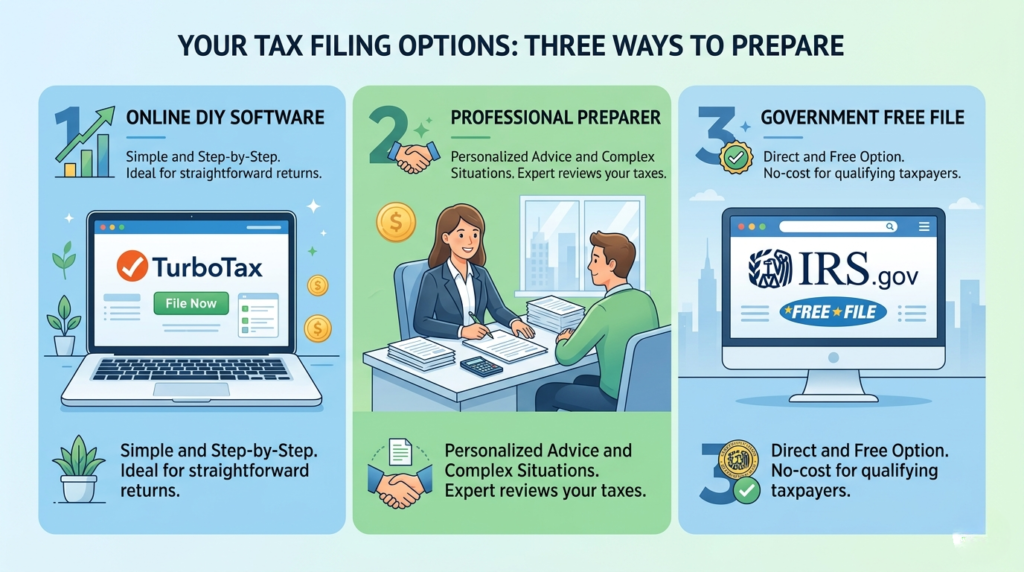
You have several options for filing your US tax return, from completely free to full-service professional help.
Option 1: IRS Free File and IRS Direct File
If your adjusted gross income is below $84,000, you may qualify for IRS Free File, which lets you prepare and file a federal return at no cost through IRS-approved software partners. IRS Direct File is a newer government-run filing option now available in 24 states for simple W-2 income situations. Both are worth checking at irs.gov before spending money on paid software.
Option 2: Tax Software (Recommended for Most Newcomers)
For newcomers with slightly more complex situations, multiple W-2s, investment income, freelance income, or uncertainty about their residency status, tax software is the most practical starting point. It walks you through every question step by step, catches common errors before you submit, and costs significantly less than hiring a professional.
TurboTax is the most widely used tax filing software in the US, known for its intuitive interview-style experience that feels like a conversation rather than a form. It guides you through your residency status, income sources, and deductions with helpful explanations at every step. TurboTax also offers access to live tax professionals if you get stuck.
H&R Block is a strong alternative that consistently offers one of the most robust free filing tiers available, covering more forms and schedules than most competitors at no cost. Their paid plans include access to tax professional support without requiring an additional upgrade, which is a genuine advantage for newcomers who want human backup available.
TaxAct is worth considering if cost is a priority. It offers a comparable filing experience to the bigger names at a meaningfully lower price point, and reader surveys consistently rate it highly for ease of use and value.
Option 3: Work with a Tax Professional
If your situation is genuinely complex dual-status filing, foreign income, business ownership, FBAR requirements, or significant uncertainty about your residency classification, investing in a CPA or Enrolled Agent who specializes in immigrant tax filing and expat taxes is worth every dollar. A mistake on a dual-status return or a missed FBAR filing can result in substantial penalties. The cost of a professional is cheap compared to fixing those errors later.
Step 6: Know the Key Deadlines
Missing a tax deadline in the US comes with real consequences, interest and penalties on any taxes owed. Here are the dates that matter for the tax year:
April 15 – This is the main filing deadline and the deadline for paying any taxes you owe. An extension to file does not extend your deadline to pay. If you expect to owe taxes, you must pay by April 15 even if you are not yet ready to submit your return.
June 15 – Newcomers and taxpayers whose tax home and abode are outside the US on April 15 receive an automatic two-month extension to file. No form is required to claim this extension, but interest on any unpaid taxes still begins accruing after April 15.
October 15 – If you need additional time beyond June 15, file Form 4868 by the June deadline to receive an extended filing deadline through October 15.
April 15 – (FBAR) – If you have foreign financial accounts with a combined maximum value exceeding $10,000 at any point during the year, you must file an FBAR (FinCEN Form 114) separately from your tax return through the FinCEN portal. This is one of the most commonly missed requirements among newcomers, and penalties for noncompliance are severe.
Step 7: File Your Return and Track Your Refund
Once you have completed your return through your chosen method, review it carefully before submitting. Check that your name, address, SSN or ITIN, and banking information for any direct deposit are all exactly correct. Errors here are the most common cause of delayed refunds.
E-filing is faster, more secure, and results in quicker refunds than mailing a paper return. The IRS typically processes e-filed returns within 21 days for straightforward situations. You can track your refund status at irs.gov using the “Where’s My Refund?” tool — you will need your SSN or ITIN, your filing status, and your expected refund amount.
If you owe taxes rather than receiving a refund, pay by April 15 through IRS Direct Pay at irs.gov — it is free, secure, and confirms your payment immediately.
A Note on Foreign Bank Accounts and FBAR

This deserves special emphasis because it is the area where newcomers most often get into trouble without realizing it.
If you have bank accounts, investment accounts, or financial accounts in your home country, or any other country, and the combined maximum value at any point during the year exceeded $10,000, you are required to file an FBAR. This is a separate report filed electronically through the Financial Crimes Enforcement Network, not through the IRS. It is due April 15, with an automatic extension to October 15.
Additionally, if your foreign financial assets exceed certain thresholds, generally $50,000 for single filers or $100,000 for married filers, you may also need to file Form 8938 with your tax return under FATCA (Foreign Account Tax Compliance Act) rules.
These requirements catch many newcomers completely off guard because nothing in their daily life prompted them to think about reporting the savings account they still have back home. But the reporting obligations exist regardless of whether you owe any tax on those accounts.
Recommended Tools and Resources
Here are the tools that can genuinely help you get through your first US tax filing season with less stress:
- TurboTax — Best user experience for walking newcomers through a complex return step by step
- H&R Block — Best free filing tier and built-in access to tax professionals on paid plans
- TaxAct — Best value alternative with strong accuracy guarantees
- Credit Sesame — Free credit monitoring tool that helps you build your US financial profile alongside your tax history
- Empower — Free financial tracking dashboard useful for keeping all income sources organized throughout the year
FAQ
Q: Do immigrants have to file US taxes?
Yes, if your income meets the filing threshold, you are required to file a US tax return regardless of your immigration status. For the 2025 tax year, that threshold is generally $14,600 for single filers under 65. Even if you earn below that threshold, filing can be beneficial — it builds a tax history that supports future immigration applications and may result in a refund if taxes were withheld from your paycheck.
Q: What is the difference between Form 1040 and Form 1040-NR?
Form 1040 is filed by US citizens, green card holders, and resident aliens who must report their worldwide income. Form 1040-NR is filed by nonresident aliens who generally report only US-sourced income. Which form you use depends on whether you pass the Green Card Test or the Substantial Presence Test — which determines your tax residency status, not your immigration status.
Q: Can I file US taxes with an ITIN instead of a Social Security Number?
Yes. An Individual Taxpayer Identification Number is issued by the IRS specifically for people who have a tax filing obligation but are not eligible for an SSN. You can use your ITIN to file a federal tax return, though certain credits — including the Earned Income Tax Credit — are not available to ITIN filers without an SSN.
Q: What happens if I miss the tax filing deadline?
If you miss the April 15 deadline without filing for an extension and you owe taxes, the IRS charges a failure-to-file penalty of 5% of the unpaid taxes per month, up to a maximum of 25%. Interest also accrues on any unpaid balance. If you are owed a refund and simply forgot to file, there is generally no penalty — but your refund clock is ticking. You have three years from the original filing deadline to claim a refund before it is forfeited.
Q: Do I need to report my bank accounts from my home country?
If the combined value of all your foreign financial accounts exceeded $10,000 at any point during the year, yes — you must file an FBAR (FinCEN Form 114) separately from your tax return. Additional reporting may also be required under FATCA if your foreign assets exceed higher thresholds. These requirements apply to resident aliens and are among the most commonly missed obligations by newcomers.
Disclaimer: This article is for educational and informational purposes only and does not constitute tax, legal, or financial advice. Tax laws change frequently and your individual situation may differ. Always consult a qualified tax professional — ideally one familiar with immigrant tax situations — before making filing decisions.