
Free Tax Filing Resources Every Newcomer Should Know About
Written by someone who paid $89 to file a return that should have cost nothing.

My second year in the United States, I paid $89 to file a tax return that was so simple it had exactly two forms: a W-2 from my employer and a bank interest statement for $14.
I used one of the big-name software companies, clicked through their prompts, added my information, and handed over my credit card details before I even realized I had options. It was not until a friend at church mentioned she had filed for free through a program at the local library that I felt that particular combination of relief and frustration that only comes from realizing you have been paying for something that was available to you at no cost all along.
If you are a newcomer to the United States trying to figure out your tax filing obligations, this article is the one I needed back then. The truth is that most newcomers with modest incomes qualify for completely free tax filing options — both online and in person — and the majority of them never find out. Not because the programs are hidden, but because no one tells you to look.
Let us fix that right now.
Why Free Tax Filing Matters More for Newcomers
Before we get into the specific resources, it is worth understanding why this topic is especially important for people who are newer to the US system.
First, many newcomers are in lower-to-moderate income brackets during their early years in the country — exactly the income range that qualifies for the most generous free tax preparation programs. Second, tax filing in the US is not optional. Whether you earn wages on a W-2, work freelance gigs, or receive income from multiple sources, the IRS requires you to file a federal tax return if your income meets the filing threshold. Missing the deadline or paying someone unnecessarily to file a straightforward return is money out of your pocket during the years when every dollar counts most.
Third, and this is the part most people do not realize, filing a tax return builds your financial record in the United States. That record matters for immigration applications, loan approvals, visa renewals, and eventually naturalization. Getting into the habit of filing correctly and on time, starting from your very first year, is one of the most important financial foundations you can lay.
Resource 1: VITA - Volunteer Income Tax Assistance
If you remember only one resource from this entire article, make it this one.
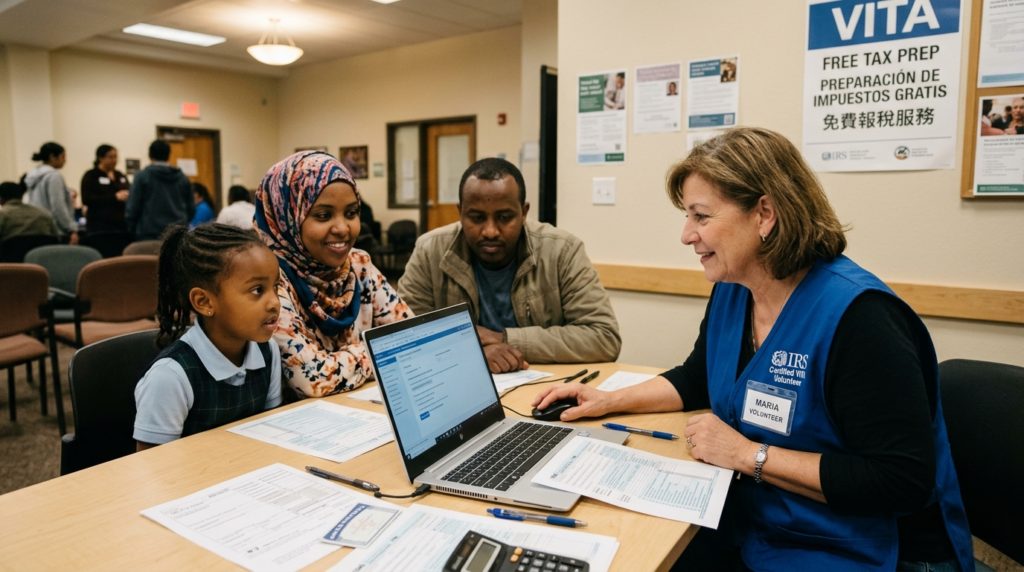
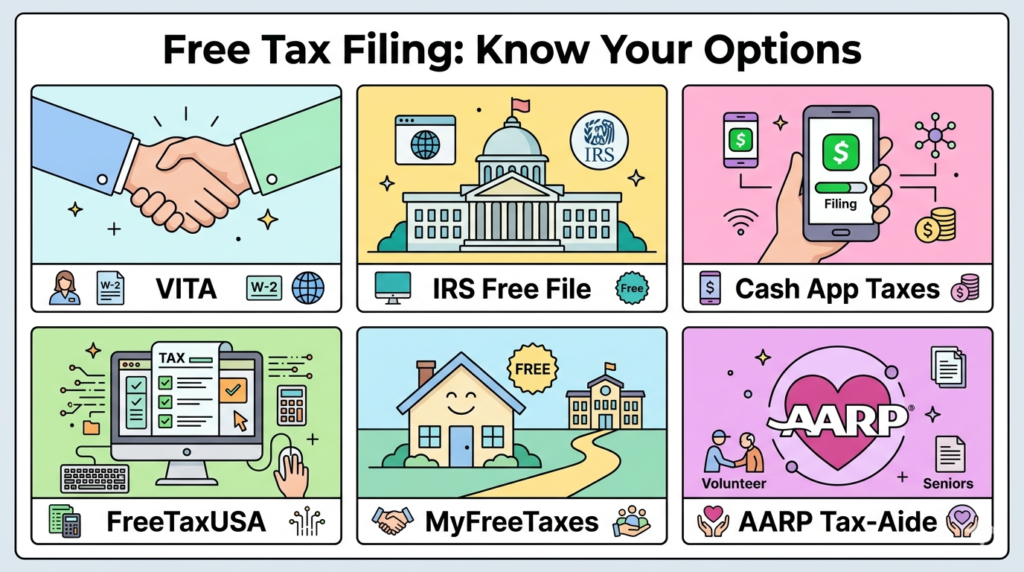
The IRS’s Volunteer Income Tax Assistance program, known as VITA, has operated for over 50 years. It offers free basic tax return preparation to qualifying individuals, staffed by IRS-certified volunteers who are trained and tested on current tax law.
For the 2026 filing season, VITA generally serves people with household income of roughly $67,000 or less, plus people with disabilities and those with limited English proficiency. That last category is critically important for newcomers. Many VITA sites operate in multiple languages and are specifically designed to serve immigrant communities. You do not need to navigate a tax system in a language that is not your first when trained bilingual help is available at no charge.
VITA volunteers can handle most common return types: W-2 income, the Earned Income Tax Credit, the Child Tax Credit, education credits, and basic self-employment income. If your situation is more complex — significant investment activity or multiple business entities — call ahead to confirm what a specific site can handle. For most newcomers in their first several years in the US, VITA covers everything.
VITA and Tax Counseling for the Elderly (TCE) sites are generally located at community and neighborhood centers, libraries, schools, shopping malls, and other convenient locations across the country. To locate the nearest VITA site, use the VITA Locator Tool at IRS.gov or call 800-906-9887.
One thing worth emphasizing: all VITA volunteers who prepare returns must take and pass tax law training that meets or exceeds IRS standards, and the IRS requires a quality review check for every return prepared at a VITA site before it is filed. These are not casual volunteers guessing at your taxes. They are trained, tested, and supervised. In many cases, returns prepared at VITA sites have lower error rates than self-prepared returns.
What to bring to a VITA appointment: Your photo ID, Social Security cards or ITIN letters for yourself and any dependents, all W-2 and 1099 forms, your bank account and routing number for direct deposit, and your prior year tax return if you have one.
Resource 2: IRS Free File
The IRS Free File program is a public-private partnership between the IRS and the Free File Alliance, a coalition of tax preparation software companies. Taxpayers whose adjusted gross income is $89,000 or less can use guided tax preparation software at no cost.
For 2026, the income limit is $89,000, a $5,000 jump from the previous year, marking one of the largest annual increases in the program’s history. That threshold covers the adjusted gross income from your 2025 tax return, meaning the vast majority of newcomers and immigrant households qualify.
Eight private-sector partners are offering guided tax software products through IRS Free File for the 2026 filing season. Each partner sets its own eligibility requirements, which may include age, income, state residency, and military status. Some partners also offer free state tax return preparation and filing.
The easiest way to find the right partner for your situation is to use the lookup tool at IRS.gov, which filters the options based on your personal details and shows you only the programs you qualify for.
One major advantage of IRS Free File is that partner companies cannot upsell you during the filing process or offer cash advances on anticipated tax refunds. What you see is genuinely what you get.
IRS Free File is focused on federal tax returns. For state returns, a few partners like OLT.com and FreeTaxUSA offer free state filing to anyone who qualifies for the free federal return.
Important note for 2026: IRS Direct File — the government-run filing tool that was piloted in 2025 — was discontinued in November 2025. It is no longer available. IRS Free File through partner software remains the primary government-supported option.
Resource 3: Cash App Taxes - Genuinely Free, No Income Limit
This is the resource that surprises people the most.
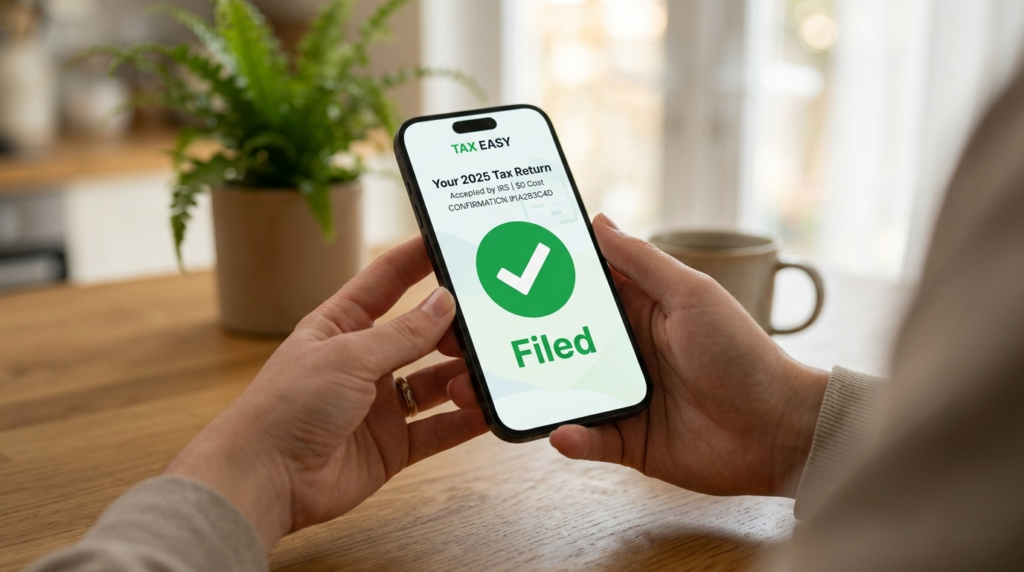
Cash App Taxes is free for all federal and state return types — Schedule C for self-employment, Schedule D for capital gains, Schedule E for rental income, and multiple W-2s. There is no income threshold and no upgrade tiers. You do not get nudged toward a paid version halfway through. It is free for everyone, full stop.
For newcomers who are freelancing, doing gig economy work, or receiving any 1099 income alongside W-2 wages, this is a meaningful advantage over other free options that restrict Schedule C filing to paid tiers.
The tradeoff is limited human support. There is very little in the way of human guidance and 1099s need to be entered by hand. If you are comfortable with your income picture and have filed before, it works very well. If you have never filed a US tax return and feel uncertain, starting with VITA or a guided software option may give you more confidence in your first year.
You will need to download the Cash App to use it. If you deposit your refund into Cash App rather than your regular bank account, you could receive it up to five days earlier than standard direct deposit — a useful option when you are waiting on a refund.
Resource 4: FreeTaxUSA - Free Federal, Affordable State
FreeTaxUSA consistently earns high marks for one straightforward reason: your federal tax return and every supported federal form is 100% free, whether you file a complex or simple federal return. That includes self-employment income, investment income, rental income, itemized deductions, and education credits. There is no basic-versus-premium split on the federal side.
State returns carry a small separate fee, typically around $14.99, though if you qualify for IRS Free File and access FreeTaxUSA through the IRS portal, state filing may be included depending on your state.
FreeTaxUSA is a strong middle-ground option for newcomers who want more guidance than Cash App Taxes provides but do not qualify for VITA. The interface walks you through each section with clear prompts, and email-based support is available. For most straightforward newcomer returns, the completely free federal filing is all you need.
Resource 5: MyFreeTaxes – United Way’s Free Filing Program
MyFreeTaxes (myfreetaxes.org), run in partnership with United Way, is another fully free filing option worth knowing about. It accepts ITIN filers alongside SSN filers, making it particularly valuable for newcomers who are not yet eligible for a Social Security Number.
Even if you are not required to file, MyFreeTaxes encourages you to check whether you are eligible for tax credits like the Earned Income Tax Credit and the Child Tax Credit — benefits that can put real money back in your pocket even in years when your income is very low.
MyFreeTaxes also provides access to a tax credit calculator so you can estimate what you may be entitled to before you start your return. This is a genuinely useful starting point for newcomers who are unsure whether filing is worth the time investment. In most cases, it absolutely is.
State returns carry a small separate fee, typically around $14.99, though if you qualify for IRS Free File and access FreeTaxUSA through the IRS portal, state filing may be included depending on your state.
FreeTaxUSA is a strong middle-ground option for newcomers who want more guidance than Cash App Taxes provides but do not qualify for VITA. The interface walks you through each section with clear prompts, and email-based support is available. For most straightforward newcomer returns, the completely free federal filing is all you need.
Resource 6: AARP Tax-Aide: Not Just for Seniors
You do not have to be elderly to use this resource, and you do not have to be an AARP member.
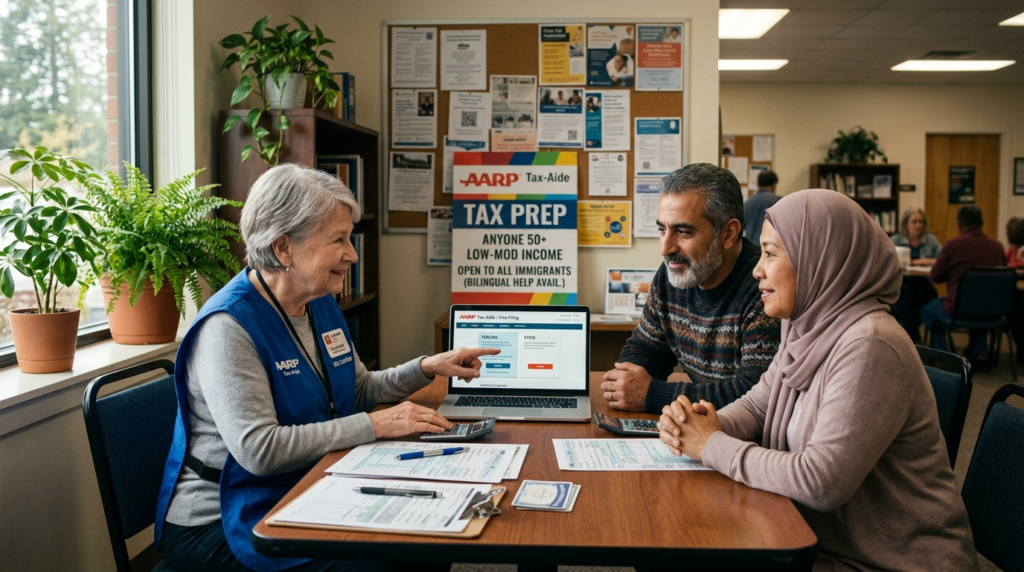
AARP runs the largest Tax Counseling for the Elderly network under its Tax-Aide program, which operates at thousands of locations and is available to anyone age 50 or older — not just AARP members. However, individual Tax-Aide sites often serve anyone who walks in regardless of age, particularly later in the tax season when they have capacity. It is always worth calling your nearest location to ask.
AARP Tax-Aide volunteers receive the same IRS certification training as VITA volunteers and follow the same quality review process. The program is free, available nationwide, and particularly strong in suburban and rural areas where VITA sites may be less accessible.
To find a location near you, use the AARP Site Locator Tool at aarp.org or call 888-227-7669.
When to Consider Paid Software
Free resources are the right choice for most newcomers, most of the time. But there are situations where investing in paid tax software or a professional preparer is worth it.
If you have significant foreign income, need to file Form 2555 for the Foreign Earned Income Exclusion, have foreign bank accounts requiring FBAR reporting, or are navigating a dual-status return for your first year as a resident alien, the complexity genuinely exceeds what free options are designed to handle. In those cases, the cost of professional help is an investment that pays for itself through accuracy and penalty avoidance.
For newcomers in that situation, TurboTax offers step-by-step guidance through complex situations including foreign income and nonresident filing, with the option to connect with a live CPA if you get stuck. H&R Block is a comparable alternative with strong multilingual support and access to tax professionals on their higher-tier plans.
Tools to Support Your Overall Financial Health
Filing correctly is just the beginning. These free tools help you stay organized and financially healthy throughout the year:
Credit Sesame — Free credit score monitoring and personalized tips for building your US credit profile. A strong credit score is one of the most valuable financial assets a newcomer can build over time.
Empower — Free personal finance dashboard that connects to all your bank, investment, and credit accounts in one place. Staying organized year-round makes tax season significantly less stressful.
What Documents to Gather Before You Start
Regardless of which free resource you choose, having your paperwork ready before you sit down saves time and reduces errors. Here is what most newcomers need:
Income documents: Form W-2 from every employer. Form 1099-NEC for freelance or contract work. Form 1099-INT for bank interest. Form 1099-DIV for investment dividends. Form 1099-G if you received unemployment payments.
Identification: Your Social Security Number or ITIN. Photo ID. SSN or ITIN documentation for any dependents you are claiming.
Banking information: Your bank account number and routing number for direct deposit of your refund — the fastest and most secure way to receive it.
Prior year return: Helps verify your prior year adjusted gross income, which some software requires to electronically sign your return.
Health coverage: Form 1095-A if you had health insurance through the Healthcare.gov Marketplace.
Key Deadlines for the 2025 Tax Year (Filed in 2026)
April 15, 2026 — Main federal filing deadline and payment deadline for most filers. An extension to file does not extend your deadline to pay.
June 15, 2026 — Automatic extension for US citizens and resident aliens whose tax home and abode are outside the United States on April 15. No form is needed, but interest on unpaid taxes begins after April 15.
October 15, 2026 — Extended filing deadline for anyone who files Form 4868 by June 15.
If you cannot pay what you owe by April 15, file your return on time anyway. An extension to file is not an extension to pay. The penalty for failing to file is significantly higher than the penalty for failing to pay. Filing on time and paying as much as you can, even if not the full amount, is always the better approach.
FAQ
Q: Can newcomers with an ITIN use free tax filing resources?
Yes. VITA sites accept both SSN and ITIN filers, and MyFreeTaxes is specifically built to accommodate ITIN holders. Some IRS Free File partners also accept ITINs, though requirements vary by partner. The VITA program is your most reliable in-person option if you file with an ITIN, as volunteers are trained on immigrant tax situations including ITIN filing and the specific credits available to ITIN filers.
Q: Is IRS Free File really free, or are there hidden costs?
IRS Free File guided software is genuinely free for federal returns if your adjusted gross income for 2025 was $89,000 or less. Partner companies in the program cannot upsell you during the filing process. The most common source of extra cost is state returns, which some partners charge for separately. Always confirm whether your state is included before you begin.
Q: What is the difference between VITA and IRS Free File?
VITA is an in-person service where an IRS-certified volunteer prepares your return for you at no charge, ideal for people who prefer face-to-face help, are filing in a language other than English, or are not comfortable using software independently. IRS Free File is an online program where you prepare your own return using guided software. Both are free, both produce complete e-filed federal returns, and both result in the same outcome. The difference is whether you want human support or prefer to go at your own pace.
Q: What if I cannot meet the filing deadline?
File for an extension using Form 4868, available for free through any of the resources in this article. This gives you until October 15, 2026 to submit your return. Remember that an extension to file is not an extension to pay. Estimate what you owe and pay as much as you can by April 15 to minimize interest and penalties even if your return is not yet complete.
Q: Do I need to file a tax return if I did not earn much?
Possibly not, but filing is often worth doing even when income falls below the filing threshold. Refunds from taxes withheld during the year, the Earned Income Tax Credit, and the Child Tax Credit can all result in money being returned to you, but only if you file. Many low-income newcomers leave refunds unclaimed every year simply because they assume filing is unnecessary when income is low. Free resources like VITA and MyFreeTaxes make it simple to check whether you are owed anything before deciding not to file.
Disclaimer: This article is for educational and informational purposes only and does not constitute tax, legal, or financial advice. Tax rules change frequently and individual situations vary. Always verify current program eligibility directly with each resource before filing, and consult a qualified tax professional for complex situations.
Affiliate Disclosure: Some links in this post are affiliate links. If you sign up through them, I may earn a small commission at no extra cost to you. I only recommend tools I genuinely trust and have researched.