
No Credit? Here’s How to Build a Budget That Works
When you arrive in the United States without a credit history, the financial system sends you a very clear signal: you are invisible.
You cannot get most credit cards. Landlords require larger deposits. Car loans come with brutal interest rates. Certain utilities make you prepay. Even some phone plans require a credit check that you do not pass.
And then, on top of all of this, most budgeting advice assumes you have credit. It assumes you have a credit card you use strategically and pay off monthly. It assumes the spending categories in your life are the same as someone who has been inside this financial system for years. It assumes you know what normal looks like here.
None of that is safe to assume about a newly arrived immigrant. And none of it needs to be true for a budget to work.
This article is a budgeting guide specifically built for the no credit reality: what you can and cannot use, how to build a system around cash and debit, and how your budget can simultaneously be the foundation that grows your credit score from zero, so that invisibility becomes a temporary condition rather than a permanent one.
What Changes When You Have No Credit
Before the framework, it is worth being specific about what having no credit actually changes in your day to day financial life.
You are likely paying cash or debit for almost everything. Without a credit card, most of your spending happens either in cash or through your debit card, which draws directly from your bank account. This is not a problem. It is actually a simpler and more direct budgeting reality than credit card use, because spending is immediate and visible: when the money leaves your account, it is gone.
Your fixed costs may be higher than average. No credit history often means larger security deposits on apartments, higher car insurance premiums in some states, prepaid utility arrangements, and phone plans with higher upfront costs. These need to be accounted for in your budget as real costs, not temporary anomalies.
You cannot rely on credit as an emergency buffer. Most people with established credit cards can absorb an unexpected expense by putting it on a card and paying it off over time. Without credit access, an unexpected $400 expense has to come from savings. This makes your emergency fund more urgent and more important than it would be for someone with a credit line available.
You are building from zero, which is actually an advantage in one specific way. You have no credit card debt. You have no revolving balances. You have no minimum monthly payments consuming your income. Your budget starts without those obligations, which gives you more control over where your money goes than someone who is managing existing debt alongside new spending.
Step 1: Build Your Budget on Net Pay Only
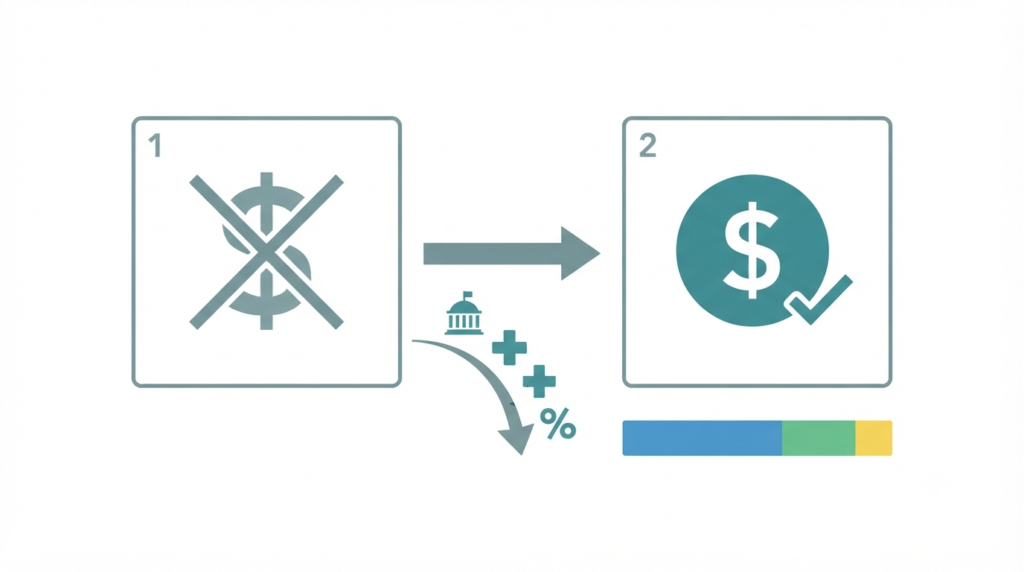
What this image shows: Your budget must be built on net pay, which is your take home amount after all deductions, not on your gross salary. The path from gross to net runs through taxes, Social Security, Medicare, and any benefits. The net amount is then divided across three budget categories. Using gross pay instead of net pay is the most common budgeting mistake newcomers make and leads to consistent shortfalls.
The most important rule in any budget, and especially in a budget without credit access, is that every number must come from your actual take home pay, not your stated salary.
If your employer told you the job pays $19 per hour, your gross monthly income at 40 hours per week is approximately $3,293. But after federal taxes, state taxes, Social Security, and Medicare, your actual monthly deposit to your bank account is closer to $2,500 to $2,700 depending on your state and your deductions.
Every decision in your budget, every commitment, every savings target, and every amount you tell yourself you can spend must be based on the lower, real number.
The place to find that number is your pay stub. Look for the line labeled “Net Pay” or “Take Home Pay” at the bottom of the earnings section. That is the number. Write it down. Everything else in this article is built around it.
If you have never read a pay stub before, our guide on your first US pay stub explained walks through every line in plain language so nothing on it feels mysterious.
Step 2: Map Your Fixed Costs First
Fixed costs are the expenses that are the same every month regardless of what you do: rent, utilities with a fixed plan, phone, internet, any loan payments, car insurance, and health insurance if it is not covered by your employer.
List every fixed cost you have. Add them up. That total is the floor of your budget: the minimum your income must cover before you make any other decisions.
For most newly arrived immigrants without credit, fixed costs represent a higher share of income than they might for someone further along in their US financial life. A larger apartment security deposit was paid upfront. A prepaid phone plan costs more than a standard contract plan. A utility company required an advance deposit. These realities show up in your monthly budget as either higher fixed costs or as one time expenses that reduced your starting savings.
Once you know your fixed cost total, subtract it from your net monthly income. What remains is your available income: the amount you have to work with for food, transportation, savings, and everything else.
Step 3: Make Your Emergency Fund Non-Negotiable
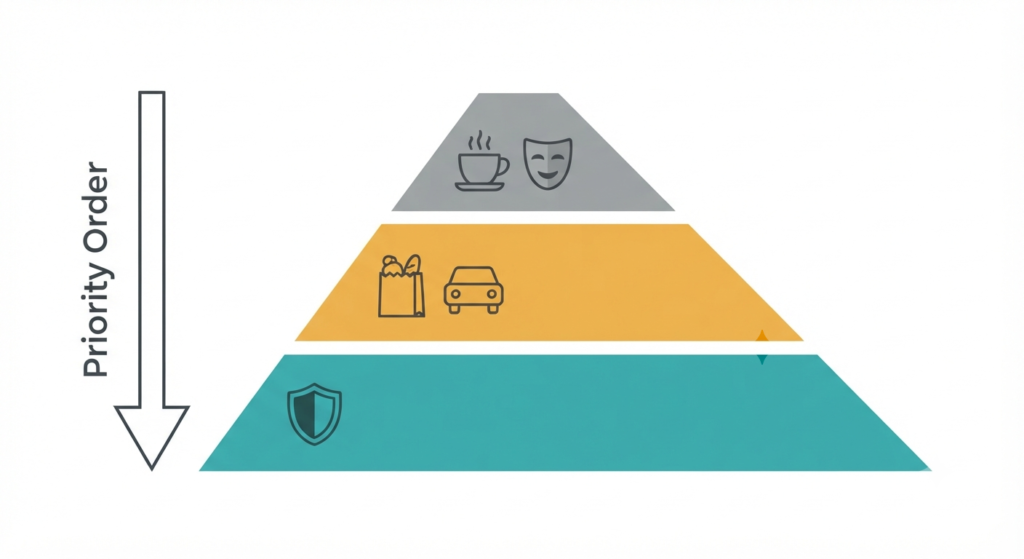
What this image shows: A budget priority pyramid for someone without credit access. The foundation and highest priority is the emergency fund (bottom bar). The middle layer is essential spending including food, transportation, and utilities. The top and lowest priority is discretionary spending like dining out and entertainment. When money is tight, the pyramid determines what stays and what gets reduced: discretionary spending is cut first, essential spending is protected, and the emergency fund contribution is treated like a fixed bill.
Without a credit card to absorb unexpected expenses, your emergency fund is your only financial cushion. It is not optional. It is the thing that stands between a difficult month and a financial crisis.
Before you budget for anything discretionary, before you think about what you can spend on wants, you must establish a small emergency fund and treat contributions to it as a fixed monthly expense rather than a leftover afterthought.
Your initial target is $500. Not three to six months of expenses immediately. Just $500. A manageable, achievable first milestone that covers most common unexpected costs: a car repair, a doctor visit, a broken appliance, an emergency trip fee.
Once you reach $500, your next target is $1,000. Then $2,000. Then eventually the full three to six months of essential expenses that represent a genuine safety net.
Decide what monthly amount you are setting aside for your emergency fund. Even $50 per month is meaningful. Write that amount into your budget as a fixed line item, not a flexible one. Move it to a separate savings account on the day your paycheck arrives, before any other spending happens.
Step 4: Budget Categories That Work Without Credit
Here is where a no credit budget looks different from a standard budgeting template.
Most budgeting advice tells you to use a credit card for most purchases, pay it off monthly, and earn rewards. That advice does not apply to you right now. Your system needs to work entirely on debit and cash, which means your categories need to reflect how spending actually happens in your life.
Category 1: Fixed expenses. The non-negotiable monthly amounts you identified in Step 2. These are paid from your checking account by bank transfer, bill pay, or automatic debit.
Category 2: Emergency fund. A fixed monthly transfer to your savings account. Treat this like rent. It is not optional.
Category 3: Groceries and household supplies. Your food and home essentials. For someone without credit access, this category is paid either in cash or by debit card at the store. Set a weekly dollar amount rather than a monthly one so it is easier to track throughout the month.
Category 4: Transportation. Gas, transit passes, parking, or any other transportation cost. If you have a car, factor in a small monthly reserve for maintenance and registration, even if those costs do not occur every month.
Category 5: Remittances. If you send money home regularly, this is a real fixed cost that belongs in your budget as a planned line item, not an afterthought. Decide how much you are sending each month and build it in deliberately. For how to send money home without paying more than necessary, our article on how to send money abroad without fees covers the lowest-cost digital transfer options available.
Category 6: Savings for upcoming one time costs. Without credit access, any larger purchase or cost, a new phone, a security deposit for a future move, a car repair, has to be saved for in advance. Create a small monthly reserve specifically for these irregular but predictable expenses. Even $50 per month creates a fund for things that would otherwise force you into a cash flow crisis.
Category 7: Discretionary. Everything else. Restaurants, entertainment, clothing, personal care beyond basics. Whatever remains after all other categories are funded. This number may be very small in your first months, and that is normal and temporary.
Step 5: Use the Envelope System or a Debit-Only Spending Tracker
Without a credit card, your spending discipline has to come from a different mechanism than the monthly statement review that credit card users rely on.
Two methods work particularly well for debit based budgets.
The envelope method. Withdraw your weekly grocery and discretionary budget in cash on the same day each week. Divide it into physical envelopes or small pouches labeled with the category. When the grocery envelope is empty, grocery spending stops until next week. When the discretionary envelope is empty, discretionary spending stops. There is no ambiguity and no possibility of accidentally overspending because the cash is physically finite.
This method feels old fashioned but works with psychological force that digital tracking does not always replicate. Handing over physical cash creates a tangible sense of spending that swiping a debit card does not.
The debit tracking method. If you prefer digital tools, set up your bank’s notification system to send you an alert after every debit transaction. Review your balance daily, not weekly. Apps like Goodbudget or the basic budgeting feature inside most bank apps allow you to set spending limits by category and track in real time.
The key principle with either method is that debit based spending requires more active monitoring than credit card based spending, because the consequences of overspending a debit card arrive immediately as a negative bank balance, with potential overdraft fees, rather than as a credit card statement at the end of the month.
For a broader guide to building a budget that fits your immigrant reality in the US, our article on how to create your first budget covers the full framework with specific tools and techniques.
Step 6: Build Credit in Parallel
Here is the connection between your budget and your credit score that most people miss: your budget is what funds your credit building, and your credit building is what eventually makes your budget more flexible.
The fastest legitimate path to a first US credit score is a secured credit card. You deposit $200 to $500 as collateral, the bank issues you a card with a credit limit equal to your deposit, you use it for one or two small routine purchases each month, and you pay the full balance before the due date every single month.
Your budget needs to accommodate this in a very specific way: you must ensure that the amount you put on the secured card is already accounted for in your budget as a regular expense, so you never reach the due date without the money to pay it in full.
For example, if you use your secured card to pay your monthly phone bill of $45, your budget should show $45 in the phone category, paid through the secured card, with a $45 payment to the card due before the billing cycle closes. The card is simply a pass through: you route an existing budgeted expense through it to build payment history, and you pay it off completely so no balance accrues interest.
This approach costs you nothing, builds payment history with all three credit bureaus, and within six to twelve months produces your first credit score without adding any financial risk to your budget.
For a full explanation of how to go from no credit to a strong score, our article on how I built my US credit score from zero covers the exact steps and timeline in detail.
Step 7: Know Your Three Numbers at All Times
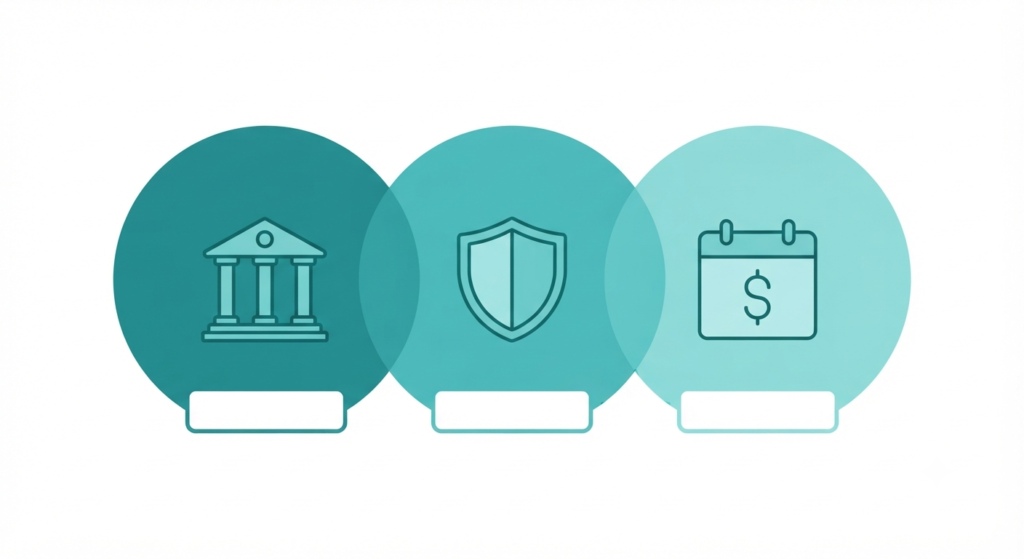
What this image shows: Three numbers define the health of a budget without credit access at any given moment. The first number is your current checking account balance, which tells you what you have available to spend right now. The second number is your emergency fund balance, which tells you how protected you are from unexpected expenses. The third number is your next fixed expense due date and amount, which tells you how much of your current balance is already committed. Knowing all three at all times is the habit that prevents shortfalls.
Without a credit card providing a buffer, real-time awareness of your money replaces month end review as your primary financial habit.
Your current checking account balance. What is in your account right now? Not what was there on payday. What is there today, after the rent automatically came out, after you bought groceries, after the phone bill cleared.
Your emergency fund balance. How many months of expenses can you cover if your income stops? Or more practically in your early months: can you cover a $300 unexpected expense without going negative?
What is coming out next and when. Rent on the first. Car insurance on the fifteenth. Phone on the twenty-second. Knowing these dates and amounts lets you see whether your current balance is actually available to spend or is already committed to upcoming fixed costs.
Checking these three numbers takes two minutes. Do it every morning when you check your phone. The habit builds the awareness that prevents you from spending money you do not have.
The Budget Is Temporary in Its Strictness
One thing worth saying clearly: the discipline required in a no credit budget is not permanent.
In six to twelve months of consistent secured credit card use with full monthly payment, you will have your first credit score. In twelve to eighteen months, your score will likely be strong enough to qualify for an unsecured credit card with a real credit limit. At that point, some of the cash-flow management challenges that make a no credit budget harder become more manageable.
That improvement does not mean abandoning the budget habits. It means the same habits applied with more financial flexibility. The people who manage money well with credit are almost always the same people who managed money well without it. The skills transfer. The discipline compounds.
Right now, the budget you build without credit is training. It is building the financial habits that will serve you for everything that comes after, including the moment when the financial system finally starts recognizing you.
Start there. Build there. The credit follows.
Disclaimer: This article is for educational and informational purposes only and does not constitute financial or legal advice. Individual financial circumstances vary significantly. Consider consulting a qualified financial professional for advice specific to your situation.