
Delivery Jobs Explained: Amazon, Uber Eats, DoorDash, and More
In my first months in the United States, I passed delivery drivers constantly. On bikes weaving through traffic with insulated bags on their backs. In compact cars double parked outside restaurants. In vans with Amazon branding pulling up to apartment buildings.
They were everywhere. And they were working independently, on their own schedule, without needing anyone to verify their work history or write them a reference letter. That looked like freedom from where I was standing.
What I did not understand at the time was the full picture of how these jobs work: what they actually pay after expenses, how taxes work for gig workers, what rights you have and do not have, and which platforms are worth joining versus which ones quietly take more than you realize.
This article gives you the complete, honest explanation. Not a recruitment pitch. Not a warning to avoid delivery work. An accurate account of what it is, what it pays, and how to use it intelligently.
What Delivery Gig Work Actually Is
Before comparing platforms, it is worth understanding the category clearly.
Delivery gig work is a form of self-employment where you use an app to receive job offers, complete them on your own schedule, and get paid per delivery or per hour depending on the platform. You are not an employee. You are an independent contractor, which is a legal classification that has significant implications for your taxes, your rights, and your financial planning.
As an independent contractor, no employer withholds taxes from your earnings. No employer pays their share of your Social Security and Medicare taxes. You do not receive unemployment benefits if your earnings drop. You are not covered by workers’ compensation if you are injured on the job. You do not receive health insurance, paid time off, or any other employee benefit.
What you do receive is flexibility: the ability to work when you want, as much or as little as you want, without a fixed schedule or a manager.
For immigrants in their first months in the US, this flexibility is genuine and valuable. You can start earning within days of signing up. You can work around other commitments. You can fit delivery hours into the gaps of a life that is still being organized.
The trade is that the income is variable, the expenses are yours, and the tax responsibility is entirely on you.
The Four Main Delivery Categories
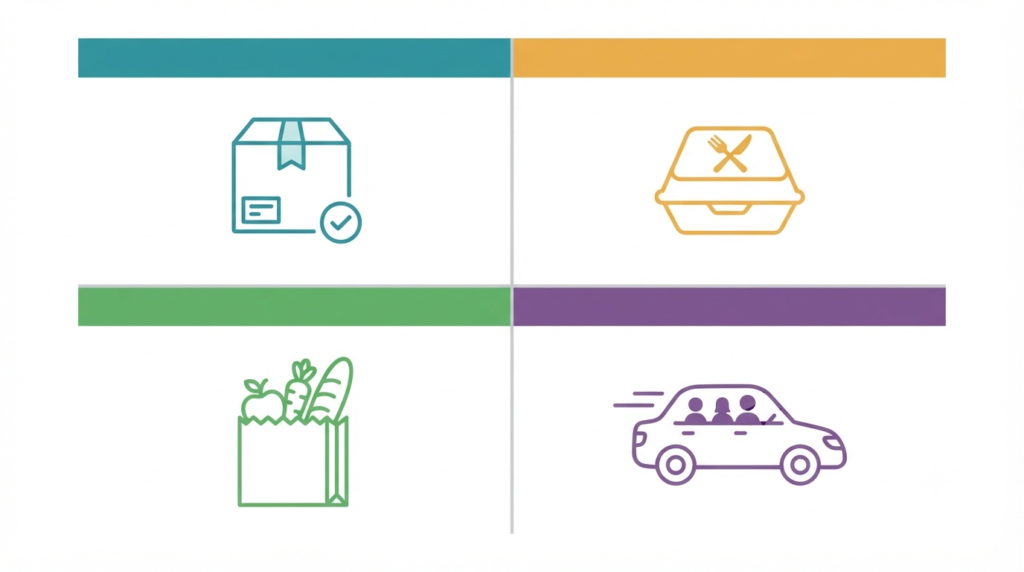
What this image shows: Gig delivery work falls into four main categories. Package delivery (Amazon Flex) involves delivering Amazon orders in your own vehicle. Food delivery (DoorDash, Uber Eats, Grubhub) involves picking up restaurant orders and delivering them to customers. Grocery delivery (Instacart, Shipt) involves shopping for and delivering grocery orders. Rideshare (Uber, Lyft) is included here because many gig workers use both delivery and rideshare apps simultaneously to maximize their earnings during a single shift.
Package Delivery: Amazon Flex
Amazon Flex is Amazon’s program for independent drivers who deliver Amazon packages using their own vehicle. You apply through the Amazon Flex app, and once approved, you pick up available delivery blocks, typically two to four hours each, at an Amazon warehouse or delivery station and complete a route of 20 to 40 packages.
Pay is stated as a guaranteed hourly rate of $18 to $25 per hour for the block, but the actual effective rate depends on how many packages you deliver and how efficient your route is. Some drivers consistently earn at the stated rate. Others find that traffic, complex delivery locations, or difficult packages push their real earnings below the advertised figure.
Amazon Flex requires a mid size or large vehicle (sedan minimum, SUV or van preferred for larger blocks), a valid driver’s license, auto insurance, and work authorization. Undocumented immigrants are not eligible. DACA recipients have historically been able to apply but should verify current eligibility with the platform directly, as policies change.
Food Delivery: DoorDash, Uber Eats, Grubhub
Food delivery platforms connect restaurants with customers who want their meals delivered. As a Dasher, delivery partner, or driver (the term varies by platform), you accept order requests through the app, pick up the food from the restaurant, and deliver it to the customer’s address.
Pay is a combination of a base payment per order, plus tips. Tips are the single largest variable in food delivery earnings, and markets where tipping culture is strong (suburban areas, higher income neighborhoods, platforms known for higher tipping rates) consistently outperform markets where tipping is sparse.
These platforms accept immigrants with valid work authorization and a Social Security Number. DoorDash and Uber Eats also accept ITIN in some markets, though this varies. Both car delivery and bicycle delivery are available on most platforms in urban areas, which removes the vehicle requirement for city-based workers.
Grocery Delivery: Instacart and Shipt
Grocery delivery is different from food delivery in one important way: you do the shopping yourself. You go to a grocery store, pick items from a customer’s list using the app, and then deliver the order to their home.
Instacart and Shipt both pay per order, with base pay supplemented by tips. Grocery delivery tends to attract higher tips than food delivery because the orders are larger and customers often leave more generous gratuities. The tradeoff is that shopping takes significantly more time than picking up a restaurant bag, which affects your effective hourly rate if you are measuring by time rather than by order.
What Delivery Work Actually Pays After Expenses
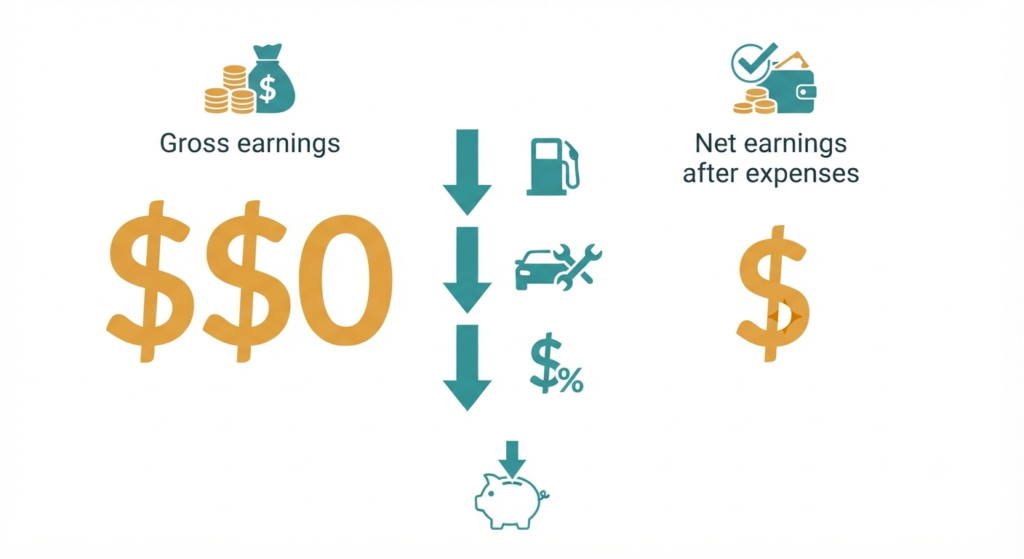
What this image shows: Delivery income consists of gross earnings from the platform, reduced by three main expense categories: fuel costs, vehicle wear and maintenance, and self-employment taxes. The amount that actually enters savings or becomes net income is significantly lower than the stated hourly rate suggests. Understanding this gap is the most important financial insight for anyone considering delivery work.
This is the section that most people skip and most platforms do not advertise clearly.
Fuel Costs
If you are delivering by car, your fuel cost is the most immediate expense. A driver completing 30 hours of driving per week in a vehicle getting 28 miles per gallon, in a market where gas averages $3.50 per gallon, spends approximately $94 per week on fuel, or roughly $375 per month. At $18 per hour gross, 30 hours of work produces $540 per week. Fuel alone reduces that to $446.
Vehicle Wear and Depreciation
Delivery driving puts significant miles on a vehicle. The IRS standard mileage deduction rate in 2025 was 70 cents per mile, which is their estimate of the full operating cost of driving a personal vehicle including depreciation, maintenance, insurance, and fuel. A driver putting 1,000 miles per week on their car is incurring approximately $700 per week in total vehicle costs by the IRS’s own calculation, which would exceed their gross earnings at most delivery pay rates.
This does not mean delivery driving is not profitable. Most drivers are not putting 1,000 miles per week on their cars. But it does mean that vehicle costs are real, significant, and must be tracked and accounted for rather than ignored.
The Self-Employment Tax
This is the expense that catches most new gig workers off guard.
When you are an employee, your employer pays 7.65% of your wages in payroll taxes (Social Security and Medicare) and withholds another 7.65% from your paycheck, for a combined total of 15.3%. As an independent contractor, you pay both halves yourself: the full 15.3% self-employment tax on your net delivery earnings.
On $30,000 in net delivery income, your self-employment tax is approximately $4,239. This is due at tax time, which means if you have not been setting it aside throughout the year, it arrives as a surprise.
The rule most financial advisors recommend for gig workers: set aside 25% to 30% of every dollar you earn in delivery income in a separate savings account, reserved specifically for taxes. This covers both federal income tax and the self-employment tax for most delivery workers in standard income ranges.
What Actually Remains
A driver earning $800 per week gross from food delivery, after fuel ($80), vehicle wear reserve ($50), and a 28% tax reserve ($224), takes home approximately $446 per week net. That is $22.30 per hour on a 20-hour week, or $11.15 per hour on a 40-hour week.
These numbers vary widely depending on your market, your vehicle efficiency, how much you earn in tips, and how strategically you choose your delivery hours. But the point is that the advertised hourly rate is not the number you should be budgeting from.
Taxes for Delivery Workers: What You Need to Know
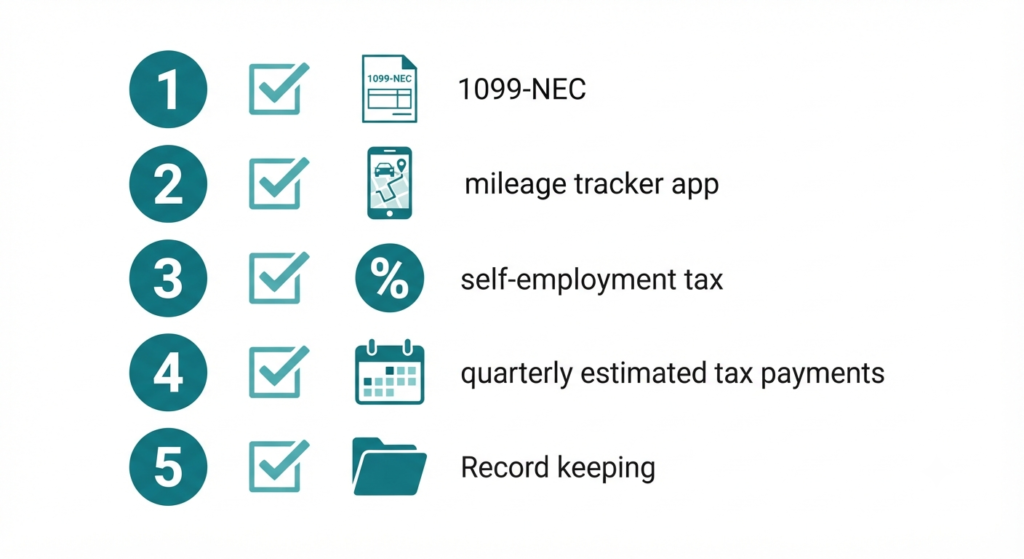
What this image shows: Five key tax responsibilities for gig delivery workers. You will receive a 1099-NEC from each platform that paid you $600 or more in the year. You should track every mile driven for delivery to claim the mileage deduction. You owe self-employment tax on top of income tax. You may need to make quarterly estimated tax payments if you expect to owe more than $1,000 in taxes for the year. Keeping records of all income and expenses throughout the year is essential for accurate filing.
The 1099-NEC Form
Any platform that pays you $600 or more in a calendar year is required to send you a Form 1099-NEC by January 31 of the following year. This form reports your gross earnings from that platform to both you and the IRS. You may receive multiple 1099-NEC forms if you work on multiple platforms.
Unlike a W-2, where taxes have already been withheld, a 1099-NEC reports gross income with no withholding. The full tax obligation is yours.
The Mileage Deduction
The IRS allows self-employed individuals to deduct the cost of business mileage from their taxable income. The standard mileage rate changes annually. For the 2025 tax year, it was 70 cents per mile for business use.
You must track your miles to claim this deduction. The easiest method is a mileage tracking app like MileIQ, Everlance, or Stride that runs in the background while you are working and automatically logs your trips. Alternatively, keep a written log of your odometer reading at the start and end of each delivery shift.
The mileage deduction is often the largest single deduction available to delivery workers and can significantly reduce your taxable income. A driver putting 10,000 business miles on their vehicle in a year deducts $7,000 from their taxable income, which at a 22% tax rate saves $1,540 in taxes.
Quarterly Estimated Tax Payments
If you expect to owe more than $1,000 in federal taxes for the year from your delivery income, the IRS expects you to pay quarterly estimated taxes rather than waiting until April. The four quarterly deadlines are typically April 15, June 15, September 15, and January 15 of the following year.
Failing to make quarterly payments when required can result in an underpayment penalty, even if you pay the full amount you owe when you file your annual return.
The IRS Form 1040-ES contains worksheets for calculating your estimated payments. Free tax preparation sites like VITA and MyFreeTaxes can help you understand your estimated payment obligations. Our article on free tax filing resources every newcomer should know about covers where to get help with self-employment tax situations at no cost.
Who Can Do Delivery Work: Immigration Status and Platform Requirements
This varies by platform and by role. Here is the honest picture for the most common situations.
Green card holders and permanent residents: Eligible for all major platforms. Apply with your green card as your work authorization document.
Work visa holders (H-1B, L-1, TN, O-1): Your visa may restrict you to working only for your sponsoring employer. Taking on independent contractor work through gig platforms may violate your visa terms. Verify with an immigration attorney before signing up. The risk of jeopardizing your primary visa status is real and is not worth the supplemental income without legal clarity.
EAD and work permit holders (pending green card, TPS, asylum): Generally eligible for gig work, since your authorization is not tied to a specific employer. Use your EAD as your work authorization document when signing up.
DACA recipients: Most platforms require a valid Social Security Number. DACA recipients with valid EADs and SSNs have historically been accepted by major platforms, though platform policies change and should be verified directly.
ITIN holders without work authorization: Major platforms require legal work authorization and a Social Security Number. ITIN holders who are not authorized to work in the US are not eligible for these platforms.
For a full breakdown of how to navigate work authorization and income questions as an immigrant, our guide on how to make enough money to survive here covers the full landscape of income options by immigration status.
How to Maximize Your Earnings if You Do Delivery Work
If you decide gig delivery is the right income source for your situation, here are the strategies that consistently separate higher earners from lower ones.
Time your hours strategically. Food delivery earnings are not consistent throughout the day. Lunch hours (11am to 2pm), dinner hours (5pm to 9pm), and weekends produce significantly higher order volumes and better earnings than mid afternoon on a Tuesday. Working during peak hours is the single most effective way to increase your effective hourly rate.
Work in higher income neighborhoods when possible. Tipping rates vary significantly by neighborhood. Areas with higher average household incomes, more experienced delivery app users, and restaurants in the $15 to $40 per entree price range consistently generate higher tips than low income neighborhoods or fast food heavy zones.
Use multiple apps simultaneously. Running DoorDash and Uber Eats at the same time, accepting the better-paying order from whichever platform offers it, reduces your idle time between orders. Most drivers who do delivery full time operate on at least two platforms.
Track every mile, every day. The mileage deduction is money you are leaving behind if you are not tracking. Start a mileage app on your first day and never stop.
Set aside 25 to 30% immediately. Every time earnings land in your account, move 25 to 30% to a separate savings account reserved for taxes. Do not touch this money until you file. The self-employment tax surprise in April is one of the most financially damaging things that can happen to a new gig worker, and it is completely preventable.
Delivery Work as a Bridge, Not a Destination
For most immigrants, delivery work is most valuable as a bridge: a source of income that starts quickly, requires no US work history, and can be scaled up or down based on your other commitments.
It works well while you are looking for your first salaried job. While you are studying for a certification. While you are waiting for a credential recognition process to complete. While you need extra income to hit a savings goal.
It works less well as a long term primary income source, because the earnings are variable, the expenses accumulate, the physical demands are significant, and unlike a salaried job, gig delivery builds no employer relationship, no institutional credit, and no pathway to promotion or benefits.
The immigrants who use delivery work most effectively are those who treat it as a deliberate, time limited income source with a specific goal in mind. Not indefinite. Not passive. A tool with a purpose and an exit.
If you are also building your US financial foundation alongside your delivery income, our guide on the first 90 days financial checklist for newly arrived immigrants covers exactly how to set up the accounts and habits that turn any income, including gig income, into lasting financial stability.
Quick Reference: The Major Platforms at a Glance
| Platform | Type | Vehicle Needed | Pay Model | SSN Required |
|---|---|---|---|---|
| Amazon Flex | Package delivery | Yes (mid size or larger) | Hourly block rate | Yes |
| DoorDash | Food delivery | Car or bike | Per order plus tips | Yes (varies by market) |
| Uber Eats | Food delivery | Car, bike, or scooter | Per order plus tips | Yes |
| Grubhub | Food delivery | Car or bike | Per order plus tips | Yes |
| Instacart | Grocery delivery | Car (full service) | Per order plus tips | Yes |
| Shipt | Grocery delivery | Car | Per order plus tips | Yes |
| Amazon Flex DSP | Package delivery | Van provided | Hourly employed rate | Yes |
Note: Amazon Flex DSP (Delivery Service Partner) routes are different from standard Flex blocks. DSP drivers work as employees of a small business contractor, not as independent contractors, which means taxes are withheld and you may receive benefits. The experience is closer to a regular job and can be a better option for immigrants who want delivery work with the protections of employment status.
Disclaimer: This article is for educational and informational purposes only. Platform requirements, pay structures, and policies change frequently. Immigration eligibility for gig platforms depends on your specific status and may change. Always verify current platform requirements directly with each app and consult an immigration attorney before beginning gig work if you are on an employer sponsored visa.