
How to Catch Up on Retirement Savings in Your 40s and 50s
There is a particular kind of financial weight that settles on immigrants in their 40s.
It arrives quietly, usually sometime between the first lease you negotiated in English and the first time you filed taxes without needing a dictionary. You have learned the system. You have survived the hardest years. You are stable, or close to it. And then you open a retirement calculator for the first time and see the number you are supposed to have saved by now.
The recommended retirement savings benchmark at age 45 is often cited as three to four times your annual salary. At age 50, five to six times. At age 55, seven times.
If you arrived in the United States in your late 30s or early 40s with nothing saved in the US system, those numbers can feel like an indictment. Like proof that you started too late, that the gap is too large, that retirement as other people experience it is simply not available to you.
None of that is true. But closing the gap does require a specific strategy, specific account mechanics, and an honest accounting of what is actually possible from where you are standing right now.
This article is that strategy.
Why Immigrants Often Start Retirement Savings Later
Before the tactics, the context matters.
Most immigrants who arrive in their 30s or 40s spend their first several years in the US in financial survival mode: building an emergency fund from zero, establishing credit from zero, navigating the cost of setting up an entire life in a new country while often sending money home, paying immigration legal fees, and managing credential recognition or job market entry in a new system.
Retirement savings require surplus. Surplus requires stability. Stability takes time to build in a new country. The sequence is logical, not irresponsible.
Additionally, many immigrants arrive with retirement savings from their home countries that are difficult or impossible to roll into US accounts. A pension from a government employer, a provident fund, or private retirement savings held in foreign accounts may have real value but cannot simply be transferred into a US 401(k) or IRA. These assets exist but do not appear in the US retirement savings picture.
And in some cases, immigrants have Social Security credits from years of work in countries that have totalization agreements with the United States, meaning those years of work can eventually count toward US Social Security benefits even though they were not earned here.
Understanding what you actually have, in every country and every account, is the starting point for any realistic retirement plan.
Step 1: Know What You Actually Have

What this image shows: Your actual retirement position includes four categories that are often tracked separately but should be viewed together. US retirement accounts (401k and IRA balances). Foreign retirement savings or pensions. US and potentially foreign Social Security credits. And home equity or real estate equity that can eventually be liquidated or used to reduce living expenses. Adding these together gives a much more accurate picture than looking at US accounts alone, which is where most immigrants dramatically underestimate what they actually have.
Before you can catch up, you need an accurate baseline. That means accounting for everything, not just your US accounts.
US retirement accounts: What is your current 401(k) balance? Do you have IRAs from previous employers you may have forgotten about? The National Registry of Unclaimed Retirement Benefits at unclaimedretirementbenefits.com can help you locate lost accounts using your Social Security Number.
Foreign retirement assets: Do you have a pension, provident fund, superannuation account, or other retirement savings in your home country? Even if you cannot move it to the US, it has value. Get a current statement and understand its projected value at your retirement age.
Social Security credits: If you have worked in the US for at least 10 years, you will qualify for US Social Security benefits. If you worked in a country that has a totalization agreement with the US before arriving, those years of work may combine with your US credits toward eligibility. Countries with totalization agreements include Canada, the UK, Australia, Germany, France, Italy, Japan, South Korea, and more than 30 others. Contact the Social Security Administration at ssa.gov to request a Social Security statement showing your current projected benefit.
Real estate equity: If you own a home in the US or your home country with significant equity, that equity is part of your retirement picture even though it does not appear in a retirement account. It can eventually become cash through a sale, a reverse mortgage in the US, or rental income.
Adding all of these together often produces a number significantly larger than what US account balances alone suggest.
Step 2: Use Catch-Up Contributions Aggressively
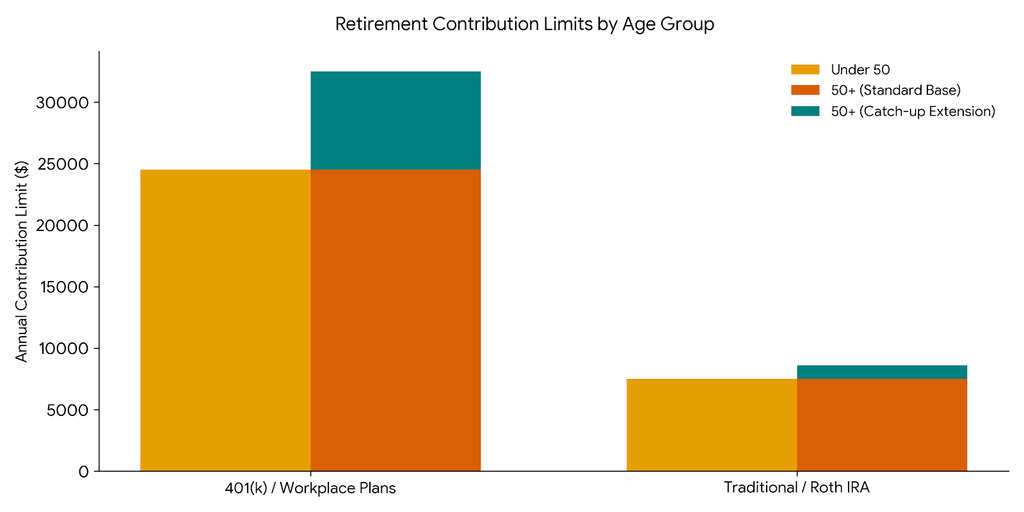
What this image shows: The IRS allows people 50 and older to contribute more to retirement accounts than younger workers through catch-up contributions. The bar chart shows that both the 401k and IRA limits are higher for workers 50 and above, with a visible additional contribution amount shown in teal. This catch-up provision exists specifically for people who are behind on retirement savings, and using it aggressively is the single most important tactical advantage available to late-starting savers.
The IRS provides a specific tool for people who are behind on retirement savings: catch-up contributions. Once you reach age 50, you are allowed to contribute more to retirement accounts than younger workers.
For 2025 and 2026, the limits are as follows.
401(k) catch-up contribution: Workers under 50 can contribute up to $23,500 per year to a 401(k). Workers 50 and older can contribute up to $31,000 per year, an additional $7,500 in catch-up contributions.
SECURE 2.0 super catch-up: Workers aged 60 to 63 have an even higher limit. Under SECURE 2.0, passed in December 2022, workers between ages 60 and 63 can contribute up to $34,750 to a 401(k), which is $11,250 above the standard limit.
IRA catch-up contribution: The standard IRA contribution limit is $7,000 per year. Workers 50 and older can contribute $8,000 per year.
Combined maximum: A worker aged 50 to 59 who maximizes both a 401(k) and an IRA can contribute up to $39,000 per year in tax-advantaged retirement savings. A worker aged 60 to 63 can contribute up to $42,750.
If you are in your 40s or 50s and have not been using these limits, this is the most important financial lever available to you. Every dollar contributed to a 401(k) or traditional IRA reduces your taxable income for the year. Every dollar in a Roth IRA grows completely free of federal income tax.
For a clear explanation of how the 401(k) works and why the employer match must come first, our article on what is a 401k and should I actually use mine covers the full mechanics including how to enroll and what to invest in.
Step 3: Prioritize the Roth IRA for Tax-Free Growth
Workers in their 40s and 50s face a specific tax planning challenge that younger workers do not: the window to Roth convert or contribute is shorter, but the tax-free growth benefit is still significant over a 15 to 25 year horizon.
A Roth IRA funded at age 45 has 20 years to grow before the standard retirement age of 65. At 7% average annual return, $8,000 contributed annually for 20 years produces approximately $348,000 in completely tax-free retirement savings. Every dollar of that is yours at withdrawal, with no income tax due.
For immigrants who are uncertain whether they will retire in the US or another country, the Roth IRA has an additional advantage: qualified withdrawals are tax-free under US law regardless of where you live when you take them. And five countries, including Canada and France, have tax treaties specifically recognizing the Roth IRA’s tax-free status at the local level as well.
If your income is above the Roth IRA contribution limit (phasing out between $146,000 and $161,000 for single filers in 2025), the backdoor Roth IRA strategy allows you to contribute through a traditional IRA and immediately convert. This is a legal and widely used approach for higher-income earners.
For the full explanation of why the Roth IRA is particularly valuable for immigrants, including who qualifies and how to open one, our article on why every immigrant needs a Roth IRA covers everything in detail.
Step 4: Reduce Expenses to Increase Contributions
At the mathematical level, there are only two ways to increase the amount you save for retirement: earn more or spend less. In your 40s and 50s, both are possible, but the spending side often has faster and more reliable levers than the income side.
Housing is usually the largest opportunity. If your children have grown and left home, or if you are carrying a larger home than you actually use, downsizing frees significant monthly cash flow. A household that moves from a $2,500 per month housing cost to $1,800 frees $700 per month, or $8,400 per year. That is more than one full IRA contribution, every year, from a single housing decision.
Remittances, if they are still significant, deserve a deliberate review. Many immigrants in their 40s and 50s are still sending money home at the same rate they established in their first decade in the US, often without adjusting for changes in their family’s situation back home or their own retirement need. A frank conversation with family about sustainability and timeline is often overdue and almost always worthwhile.
Debt elimination is retirement savings in disguise. Every dollar of high-interest debt you eliminate before retirement is a monthly payment that disappears from your retirement budget. A $300 per month car payment paid off before you retire is $3,600 per year of additional retirement income capacity. Prioritize being debt-free by retirement, not just mortgage-free.
Step 5: Delay Retirement or Social Security for a Higher Benefit

What this image shows: Social Security monthly benefits increase significantly with each year of delayed claiming. Claiming at 62 produces the smallest possible benefit. Claiming at full retirement age (67 for most people born after 1960) produces the standard benefit. Claiming at 70, the maximum delay age, produces approximately 76% more per month than claiming at 62. For immigrants who arrived late to the US system and are behind on retirement savings, delaying Social Security claiming to maximize the monthly benefit is one of the most powerful strategies available for increasing lifetime retirement income.
Two specific delays significantly improve retirement financial outcomes for people who started late.
Delaying retirement itself. Each additional year of work has three simultaneous benefits: you continue earning and saving, your existing savings have more time to grow, and you delay the date when you begin drawing down your assets. A person who retires at 67 instead of 62 has five additional years of contributions and five fewer years of withdrawals. That difference in outcomes is enormous.
Delaying Social Security claiming. For every year you delay claiming Social Security benefits beyond your full retirement age, your monthly benefit increases by approximately 8%. The maximum benefit is available at age 70. Compared to claiming at 62, claiming at 70 produces approximately 76% more per month for the rest of your life.
For immigrants who arrived in their late 30s or 40s and have fewer than 35 years of US earnings history (the basis of the Social Security calculation), working additional years adds high-earning years to the calculation while replacing any years with zero earnings, further increasing the eventual benefit.
Step 6: Consider Working With a Financial Advisor
The complexity of retirement planning for immigrants in their 40s and 50s, involving US accounts, possible foreign accounts, Social Security, potential dual-country retirement, and catch-up contribution optimization, is real enough that a one-time or annual conversation with a fee-only financial advisor is often worth the cost.
A fee-only advisor charges a flat rate for their time rather than earning commissions on products they sell you. The National Association of Personal Financial Advisors (NAPFA) at napfa.org maintains a directory of fee-only advisors searchable by location. Several advisors specifically serve immigrant clients and have experience with the specific cross-border planning questions that most advisors in the US have not encountered.
The questions worth bringing to an advisor include: what is my actual retirement readiness across all accounts and countries? Should I be using traditional or Roth contributions given my current income and expected retirement income? How do I coordinate Social Security with any foreign pension I might receive? Does it make sense to do a Roth conversion in any of the next several years given my income and tax bracket?
Even one well-prepared meeting with a qualified advisor can clarify a decade of retirement planning decisions that otherwise get made by guessing.
What Is Actually Possible: A Realistic Picture
Let us close with honesty about what catching up actually looks like for different situations.
If you are 45 with $30,000 saved and earning $65,000 annually: Contributing the maximum 401(k) catch-up limit of $31,000 plus an IRA of $8,000 per year for 20 years at 7% average return produces approximately $1.7 million by age 65. That is not a guarantee, but it shows that even a significant gap at 45 is closeable with aggressive savings over the remaining working years.
If you are 55 with $50,000 saved and earning $70,000 annually: Contributing $31,000 to a 401(k) and $8,000 to an IRA for 10 years at 7% average return produces approximately $560,000 by age 65, plus Social Security, plus any home equity or foreign pension. This is a meaningful and livable retirement position, particularly for immigrants who plan to spend some retirement years in lower-cost countries.
If you are 50 with significant home equity but little in retirement accounts: The equity in your home is not trapped. A paid-off home in retirement reduces your monthly expenses dramatically, which changes how much invested savings you actually need to sustain your lifestyle. Someone with a $300,000 paid-off home and $400,000 in retirement accounts may be in a stronger position than someone with $700,000 in accounts and a $1,500 monthly mortgage payment.
The point is not that all outcomes are equal. It is that the calculation is more complex than the simple account balance comparison that produces the panic in the first place.
The One Thing That Matters Most Right Now
If there is one action to take in the next 48 hours after reading this article, it is this: log into your employer’s HR portal and increase your 401(k) contribution by the maximum amount you can sustain. Even an increase of 3% to 5% of your salary today, automated and forgotten, produces meaningful results over a decade.
The investor who increases their contribution rate today and never touches it again will outperform the investor who spends five years researching the perfect strategy and never acts.
Start. Then optimize.
Your retirement is not ruined because you started late. It is different. It requires more intentionality and more urgency than it would have required if you had started at 25. But the accounts are open to you, the catch-up provisions exist specifically for you, and 15 to 20 years of aggressive, consistent contributions are enough to build something real.
Disclaimer: This article is for educational and informational purposes only and does not constitute financial, tax, or legal advice. Contribution limits, Social Security rules, and tax laws change annually. Individual retirement situations vary significantly. Consult a qualified financial advisor and tax professional for advice specific to your situation.