
What Is a 401(k) and Should I Actually Use Mine?
My first week at a new job in the United States, my HR representative handed me a stack of forms to complete. One of them was something called a 401(k) enrollment form. She explained it briefly, used words I did not understand, and said I had 30 days to decide. Then she moved on to the next form.
I put the 401(k) form at the bottom of the pile and forgot about it.
I did not enroll for almost two years. During those two years, my employer was offering to match 50% of any contribution I made, up to 6% of my salary. On a $45,000 salary, that was $1,350 in free money per year that I simply did not collect. Over two years, I left $2,700 on the table. Not because I could not afford to contribute. Because nobody had explained what I was looking at.
That story is not unusual. It is one of the most common financial mistakes immigrants make in their first years in the US workforce, and it is entirely avoidable once you understand what a 401(k) actually is and what it does for you.
This article is the explanation I needed on day one.
What Is a 401(k)?
A 401(k) is a retirement savings account offered by employers in the United States. The name comes from the section of the US tax code that created it: Section 401, subsection k. You do not need to remember that. What you need to understand is what the account does.
When you enroll in a 401(k), a percentage of each paycheck you choose is automatically transferred from your wages into the account before your employer calculates your income tax. That means you pay income tax on a smaller amount than you actually earned. Your contribution reduces your taxable income for the year, which lowers your tax bill right now, not someday.
The money inside the account is then invested in a mix of funds you select, typically from a list provided by your employer’s plan. It grows over time, and you do not pay income tax on the growth until you withdraw the money in retirement. The technical term for this is tax deferred growth, and it allows your investments to compound faster than they would in a regular taxable account.
When you eventually retire and start making withdrawals, usually after age 59 and a half, those withdrawals are taxed as ordinary income. By then, many people are in a lower tax bracket than they were during their working years, which makes the overall math favorable.
That is the basic structure. Contribute before tax dollars now. Invest and grow without paying taxes on the growth. Pay taxes later when you withdraw, potentially at a lower rate.
The Employer Match: The Most Important Feature You Need to Know About
If there is one thing to take from this entire article, it is this.
Many employers will match a portion of what you contribute to your 401(k). This is called the employer match, and it is the closest thing to free money that exists in the American financial system.
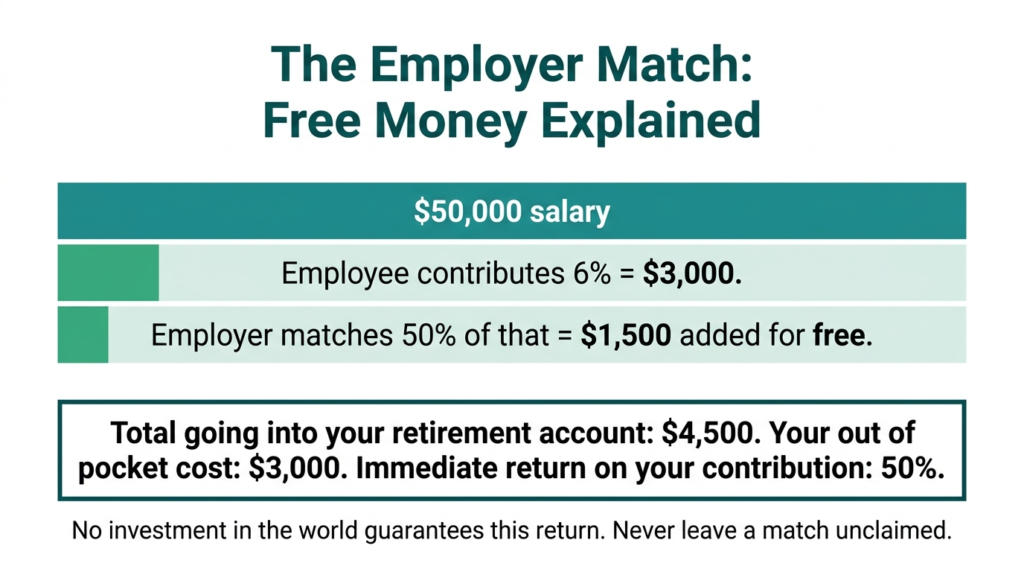
Here is how it typically works. A common match is 50% of your contributions up to 6% of your salary. In plain language: if you contribute 6% of your salary, your employer adds another 3% for free. If you earn $50,000 a year and contribute 6% ($3,000), your employer adds $1,500 directly into your 401(k) account.
That $1,500 required nothing from you except enrolling and contributing enough to trigger it. It is a 50% return on your contribution, guaranteed, before your investments earn a single dollar of growth.
If your employer offers a match and you are not contributing at least enough to receive the full match, you are declining part of your compensation. Your employer set aside that money specifically for you. Not collecting it does not save it for later. It simply disappears.
The most important question you can ask HR this week is exactly this: does this company offer a 401(k) match, and what do I need to contribute to get all of it?
That number is your minimum contribution. Start there.
How a 401(k) Shows Up on Your Pay Stub
If you are already enrolled in a 401(k), you are already seeing its effect every pay period, though you may not have recognized it.
Your 401(k) contribution appears on your pay stub as a pre tax deduction, meaning it is subtracted from your gross wages before federal income tax is calculated. This is why your taxable income on your pay stub is lower than your actual gross pay.
For example, if your gross bi-weekly pay is $2,000 and you contribute 5% to your 401(k), $100 is deducted before taxes. Your taxable income for that pay period becomes $1,900. If you are in the 22% federal tax bracket, that $100 pre tax contribution saves you $22 in federal income taxes that period. The contribution costs you $78 out of pocket, not $100, because the tax savings reduce the real cost.
If you want to understand every line on your pay stub and how your 401(k) contribution fits into the full picture, our guide on your first US pay stub explained walks through each deduction in plain language.
Who Can Contribute to a 401(k)?
This is the question many immigrants hesitate to ask because they assume the answer might exclude them. It does not.
Legal immigrants with a valid work authorization can contribute to an employer-sponsored 401(k). This includes green card holders, H-1B visa holders, L-1 and O-1 holders, TN visa holders, EAD holders, and workers with any other valid employment authorization. There is no citizenship requirement for 401(k) participation.
What you need: Your employer must offer a 401(k) plan. You must meet your employer’s eligibility requirements, which typically include a minimum period of employment (often 30 to 90 days) and minimum hours worked per week. After meeting those requirements, you are generally eligible to participate regardless of your immigration status.
ITIN holders: If you file taxes with an ITIN rather than a Social Security Number, you may still participate in your employer’s 401(k) if you have valid work authorization. However, administrative handling varies by employer and plan administrator. Ask HR directly about any documentation requirements specific to your situation.
The 2025 and 2026 Contribution Limits
The IRS sets annual limits on how much you can contribute to a 401(k). For the 2025 tax year, the employee contribution limit is $23,500. For people age 50 or older, an additional catch-up contribution of $7,500 is allowed, bringing the total to $31,000.
The employer match does not count toward your personal contribution limit. If you contribute $23,500 and your employer adds $3,000 in matching funds, your total account receives $26,500, but you have only used your $23,500 personal limit.
For most newcomers in their early working years in the US, contributing the maximum is not immediately realistic. The goal is not to hit the ceiling. The goal is to contribute at least enough to capture the full employer match, and then increase your contribution percentage incrementally as your income grows.
What Happens to Your 401(k) If You Leave the US?
This question is on the mind of many immigrants who are not certain whether the US is their permanent home, and it deserves a direct answer.
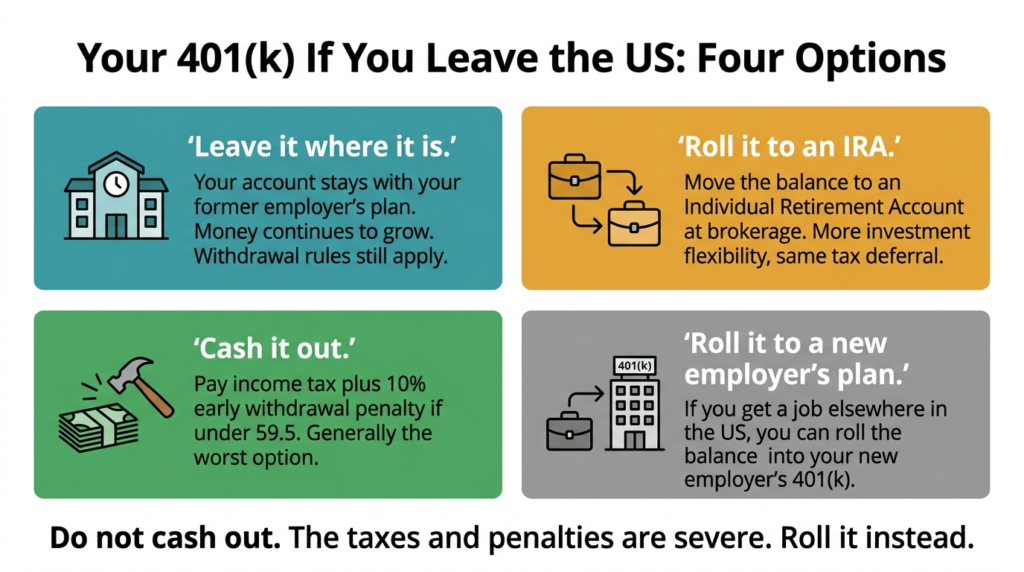
Your 401(k) does not disappear if you leave the United States. The money is yours. You have four main options when you leave an employer or the country: leave the account with your former employer’s plan, roll it into an IRA (Individual Retirement Account) at a brokerage where you have more control and investment choices, roll it into a new employer’s plan if you take another US job, or cash it out.
Cashing out is almost always the wrong choice. If you withdraw your 401(k) balance before age 59 and a half, you pay ordinary income tax on the entire amount plus a 10% early withdrawal penalty. On a $30,000 balance, that combination can consume $9,000 to $12,000 in taxes and penalties, leaving you significantly less than you saved.
Rolling to an IRA is the most flexible option for immigrants who may eventually leave the US. An IRA at a brokerage like Fidelity or Schwab stays open regardless of where you live, continues to hold your investments, and gives you full control over your investment choices without being tied to any employer’s plan.
Our full guide on what happens to your 401k if you leave the US covers every option in detail, including the tax implications of rolling over, the FBAR reporting rules that may apply to foreign retirement accounts, and what to do if you are uncertain whether your stay in the US is permanent.
Traditional 401(k) vs. Roth 401(k): Which Should You Choose?
Many employers now offer two versions of the 401(k): a traditional 401(k) and a Roth 401(k). The core difference comes down to when you pay taxes.
Traditional 401(k): Contributions are made pre-tax, reducing your taxable income today. Withdrawals in retirement are taxed as ordinary income. Best for people who expect to be in a lower tax bracket in retirement than they are now.
Roth 401(k): Contributions are made after tax, so there is no immediate tax reduction. But the money grows tax free and qualified withdrawals in retirement are completely tax free. Best for people who expect to be in a higher tax bracket in retirement, or who simply value having tax free income available later.
For most immigrants in their early US working years, the traditional 401(k) makes immediate sense: your income is lower than it will be in your peak earning years, so the tax bracket you are in now is likely lower than where you will be later. Deferring taxes through a traditional 401(k) today and paying them at what may be a similar or only slightly higher rate in retirement is generally favorable.
If your employer offers both and you are unsure, starting with the traditional 401(k) to capture the full employer match, then reconsidering once your income and tax situation are clearer, is a reasonable approach.
Choosing Your Investments Inside the 401(k)
Once you enroll in your 401(k), you will need to choose how to invest your contributions from the menu of funds your employer provides. This step is where many immigrants get stuck and either delay enrolling entirely or leave their contributions in the default money market option, which earns almost nothing.
Here is the simplest, most reliable investment approach for most newcomers.
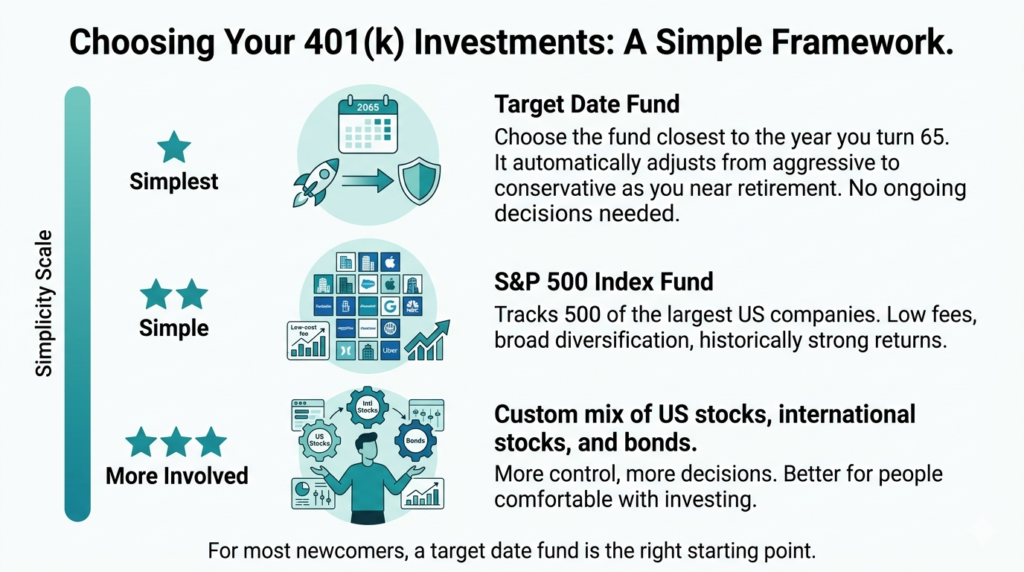
Find the target date fund closest to the year you expect to retire. If you are 35 today and plan to retire around age 65, look for a fund labeled something like “2055 Fund” or “Target Retirement 2055.” These funds automatically hold a diversified mix of stocks and bonds that gradually shifts from growth focused to preservation focused as you approach the target year. You make one decision, and the fund handles everything else.
If your plan does not offer a target date fund, look for a total market index fund or an S&P 500 index fund. These funds track broad stock market indexes, have very low expense ratios (the annual fee charged by the fund), and have historically delivered strong long term returns. An expense ratio below 0.20% is considered excellent. Anything above 1% is worth scrutinizing.
The single worst choice is leaving your contributions sitting in a money market or stable value fund indefinitely. These funds preserve your principal but earn very little, and over decades, inflation silently erodes the purchasing power of money sitting still. Time is your most powerful asset inside a retirement account. Use it.
How the 401(k) Connects to Your Broader Financial Plan
A 401(k) is not the whole picture of building wealth as an immigrant. It is one layer of it. Here is where it fits relative to everything else.
Your most urgent financial priority is always your emergency fund: three to six months of essential living expenses in a liquid, accessible account. Without that buffer, one unexpected expense forces you to choose between financial survival and your long term goals.
Once your emergency fund is in place, the 401(k) employer match is your next priority, because it is an immediate 50% to 100% return on your contribution that no other investment can match.
After capturing the full match, many financial planners recommend maxing out a Roth IRA next, because its tax free growth offers advantages the 401(k) does not. Our article on why every immigrant needs a Roth IRA explains exactly why and how to open one alongside your 401(k).
After the Roth IRA is maxed, any additional savings capacity goes back into the 401(k) up to the annual limit.
This sequencing: emergency fund, then employer match, then Roth IRA, then additional 401(k) is what most financial educators call the funding ladder, and it optimizes the order in which your money is put to work based on the returns available at each step.
The Story of Two Immigrants: Same Salary, Very Different Outcomes
Let us make the stakes concrete with a simple comparison.
Maria arrived at age 28, enrolled in her employer’s 401(k) on her first day, contributed 6% of her $50,000 salary to capture the full employer match of 3%, and invested in a target date fund. She never changed her contribution or touched the account.
David arrived at the same age with the same salary, looked at the enrollment form, did not understand it, and never enrolled. He meant to ask someone about it but never got around to it.
At age 65, assuming a 7% average annual return:
Maria’s 401(k) balance: approximately $1,140,000 David’s 401(k) balance: $0
The difference is not Maria’s income or financial sophistication. It is one enrollment form completed on the first day of work, and 37 years of compound growth doing its job quietly in the background.
David’s story does not have to be yours. If you have not enrolled yet, the enrollment form is the only thing standing between you and the version of this story that ends differently.
How to Enroll: The Practical Steps
Step 1: Ask your HR department whether your employer offers a 401(k) plan and what the employer match is. Get the specific percentage in writing.
Step 2: Ask for the enrollment form or the link to the online enrollment portal. Most large employers handle enrollment entirely through an HR portal or their plan provider’s website.
Step 3: Choose your contribution percentage. Start with whatever percentage captures the full employer match. If your budget feels tight, even a 3% contribution that captures a 1.5% match is a meaningful starting point.
Step 4: Choose your investments. Select a target date fund closest to your expected retirement year if one is available. If not, select a broad market index fund with a low expense ratio.
Step 5: Set a reminder to increase your contribution by 1% each year. Many plans allow you to automate this increase. Even incrementally raising your contribution rate over time closes the gap between where you start and where you need to be without requiring a large sacrifice at any single point.
Step 6: Keep the contact information for your plan provider. When you change jobs, you will need to decide what to do with the account. Knowing where it is and who manages it makes that transition significantly easier.
Frequently Asked Questions
Q: What if my employer does not offer a 401(k)? Then the next best tool is a Roth IRA or a Traditional IRA, which you open independently at a brokerage like Fidelity or Schwab. These accounts have lower annual contribution limits but offer similar tax advantages. Our article on how to start investing in the US with $100 covers the beginner investment landscape including what to do when an employer plan is not available.
Q: What happens to my 401(k) if I change jobs? The money is yours and goes with you. You can leave it in your former employer’s plan, roll it into an IRA, or roll it into your new employer’s plan. The rollover process is straightforward if done correctly, moving the money directly between accounts without triggering taxes. Ask your plan provider for the specific rollover instructions when you leave.
Q: Can I borrow from my 401(k)? Many plans allow 401(k) loans, where you borrow from your own balance and repay yourself with interest. This is generally not recommended because it removes money from your investment portfolio during the loan period, and if you leave your employer while the loan is outstanding, the unpaid balance may be treated as an early withdrawal, triggering taxes and penalties.
Q: Does a 401(k) affect my immigration status? No. Contributing to a 401(k) is a financial and tax decision, not an immigration one. It does not affect your visa, your green card application, or any other immigration filing.
Q: I am worried about leaving money in a US account if I have to return home. What should I do? This is a real and valid concern that many immigrants navigate. The short answer is that rolling to an IRA when you leave an employer gives you the most flexibility: the account stays open, your investments continue growing, and you can access the money in retirement regardless of where you live, subject to the tax rules of wherever you reside at the time. Our full breakdown of options is in the article on what happens to your 401k if you leave the US.
Disclaimer: This article is for educational and informational purposes only and does not constitute financial, tax, or legal advice. 401(k) rules, contribution limits, and tax treatment may change. Always consult a qualified financial professional for advice specific to your situation.