
Why Every Immigrant Needs a Roth IRA: Tax-Free Wealth for Your Future
I want to tell you about the account I wish someone had explained to me in my first year here. Not the checking account. Not the savings account. Not even the 401(k) that my employer kept mentioning during orientation while I nodded politely without understanding a word of it.
I want to tell you about the Roth IRA.
Because if you are an immigrant building your financial life in the United States, there is one account that quietly outperforms almost every other savings tool available to you. It grows completely free of tax. You can withdraw your contributions at any time without penalty. It travels with you if you ever leave. And if you never need it, it passes to your family without the IRS taking a cut.
It is called the Roth Individual Retirement Account, and most immigrants either do not know it exists or assume it is not available to them.
It is available to you. And this article explains exactly why you need one, how it works, and how to open one even if you are starting from scratch.
What Is a Roth IRA?
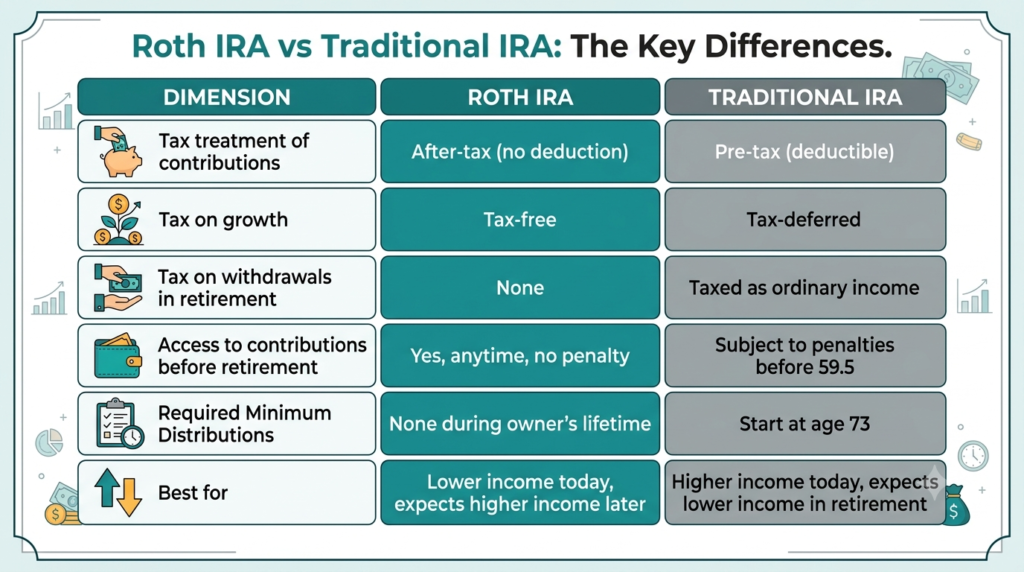
A Roth IRA is a type of individual retirement account that you open and fund yourself, completely separate from your employer. You contribute money you have already paid income tax on, it grows inside the account completely free of federal tax, and when you withdraw it in retirement, you pay no tax on any of the growth.
Read that again: no tax on the growth. Ever.
If you put $7,000 into a Roth IRA this year and it grows to $70,000 over the next 30 years, you owe the IRS zero dollars on that $63,000 in gains when you withdraw it. That tax free compounding is the core of why this account is so powerful.
Compare that to a traditional IRA or a 401(k), where your contributions reduce your tax bill today but every dollar you withdraw in retirement is taxed as ordinary income. With a Roth, you make a different deal: pay the tax now, at the rate that applies to your current income, and never pay again no matter how large the account grows.
For immigrants who are typically earning less in their early years in the US and therefore in a lower tax bracket, this deal is particularly favorable. You pay tax at today’s lower rate, and you never pay again as your wealth grows.
Who Can Open a Roth IRA?
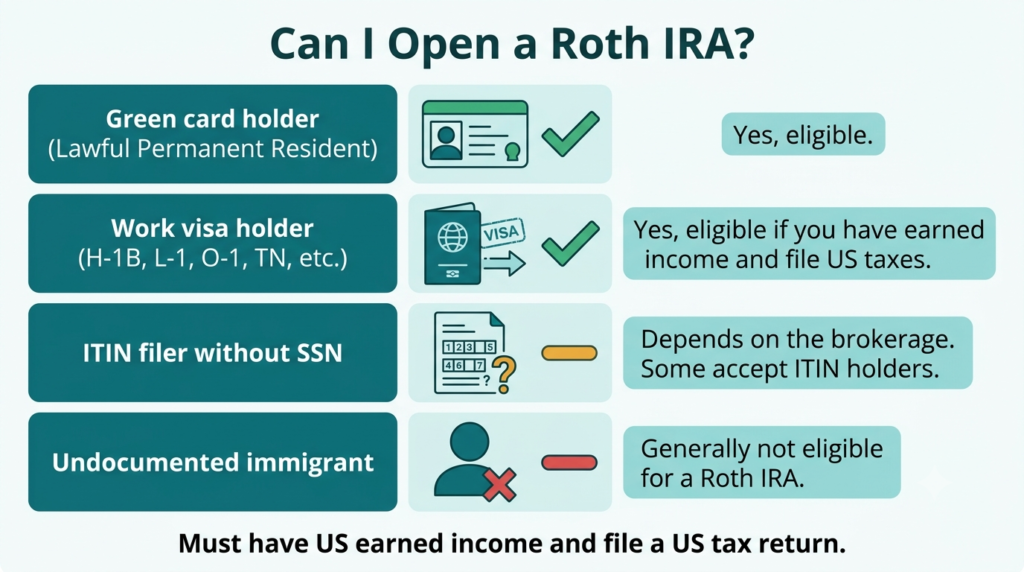
This is the question most immigrants ask first, and the answer is more encouraging than most people expect.
To open and contribute to a Roth IRA, you must meet two requirements.
First, you must have earned income from work performed in the United States during the year you contribute. Earned income means wages, salaries, tips, or net self employment income. Passive income like dividends, interest, or rental income does not count.
Second, your income must fall below the IRS annual income limits. For the current tax year, the ability to contribute phases out for single filers with a Modified Adjusted Gross Income between $146,000 and $161,000, and for married couples filing jointly between $230,000 and $240,000. If your income falls below those thresholds, you can contribute the full annual limit. Most immigrants in their early years of US employment are well below those limits.
That is it. There is no citizenship requirement. There is no green card requirement. No minimum length of US residency. If you earn income in the United States, file a US tax return, and fall below the income limits, you can open a Roth IRA.
Green card holders, H-1B visa holders, L-1 and O-1 holders, TN visa holders, and many other categories of lawfully working immigrants are all eligible. Whether you are a resident alien or working toward permanent residency, as long as you have US earned income and file taxes here, the Roth IRA is open to you.
One note on ITINs: most major brokerages require a Social Security Number to open a Roth IRA account. Some institutions, including certain credit unions and community banks, do work with ITIN holders. If you have an ITIN but not yet an SSN, ask specifically before applying.
The Numbers That Change How You Think About This
Let us talk about what this account actually does to your wealth over time, using numbers that are easy to follow.
The annual contribution limit for a Roth IRA is $7,000 per year for people under 50, and $8,000 for people 50 and older.
If you contribute $7,000 per year starting at age 30 and earn an average annual return of 7%, which is a conservative estimate based on the historical performance of a diversified stock market index fund, here is what you have by age 65:
Total contributions over 35 years: $245,000 Account value at age 65: approximately $1,040,000
Every dollar of that $1,040,000 is yours, completely free of federal income tax when you withdraw it in retirement. The IRS gets nothing.
Now consider the same numbers with a traditional IRA, where every withdrawal is taxed as ordinary income. If you are in the 22% tax bracket in retirement, you owe roughly $229,000 in taxes on those same withdrawals. The Roth account, by contrast, delivers the full million.
That difference is not hypothetical. It is the mathematical result of decades of tax free compounding, and it is available to you right now.
Why the Roth IRA Is Especially Valuable for Immigrants
The Roth IRA’s advantages matter for any investor, but several of its features make it particularly well-suited to the specific circumstances of immigrants building wealth in the United States.
You Are Likely in a Lower Tax Bracket Right Now
Most immigrants arrive and spend their first several years earning below their long term income potential. Maybe you are working in a field below your credentials while you build your US work history. Maybe your English proficiency is still growing. Maybe you are navigating credential equivalency.
Whatever the reason, if your current income is modest, you are currently in a lower tax bracket than you may be in later years. The Roth IRA lets you pay tax at today’s lower rate and lock in tax free growth from this point forward. As your income grows over your career, your future contributions may be larger, but the money you put in now grows tax free from the day you contribute it.
The Roth IRA Travels With You
Many immigrants hold open the possibility, at least in the back of their minds, that their life in the United States may not be permanent. A job change abroad, aging parents, a partner in another country, or simply a desire to return home someday are all real considerations.
The Roth IRA is yours. It is not tied to an employer. It does not disappear when you change jobs or cross a border. The account stays open at your brokerage, continues to hold your investments, and continues to grow regardless of where you live.
Five countries have tax treaties with the United States that explicitly recognize the Roth IRA’s tax free status: Canada, France, Belgium, Latvia, and Estonia. If you ever settle in one of those countries, your Roth’s tax advantages are honored locally as well. In other countries, the host country may treat your Roth as a regular taxable account for local tax purposes, but the US tax free status on withdrawals remains.
If you want to understand more about how US investments hold up when you leave the country, our article on what happens to your 401k if you leave the US covers the cross-border picture in detail.
You Can Access Your Contributions at Any Time
One concern many immigrants have about retirement accounts is locking money away they might need. The unexpected cost comes up here with a regularity that anyone who has navigated the US as a newcomer knows well: a visa fee, a family emergency back home, an unexpected medical bill.
The Roth IRA has a feature that most people do not know about: you can withdraw the money you contributed (not the earnings, but your actual contributions) at any time, for any reason, with no taxes and no penalty.
If you contribute $7,000 this year and need $3,000 in two years for an emergency, you can take it out. No form. No penalty. No tax. The earnings on that contribution stay in the account and continue growing, but your principal is always accessible.
This makes the Roth IRA something unusual among retirement accounts: a long term wealth building vehicle that also functions as a secondary emergency resource if things go badly wrong.
That said, withdrawing contributions early slows your long term growth significantly. It is a feature to know about, not a habit to build. The goal is to let the money compound for as long as possible.
The Roth IRA vs. the 401(k): Which Comes First?
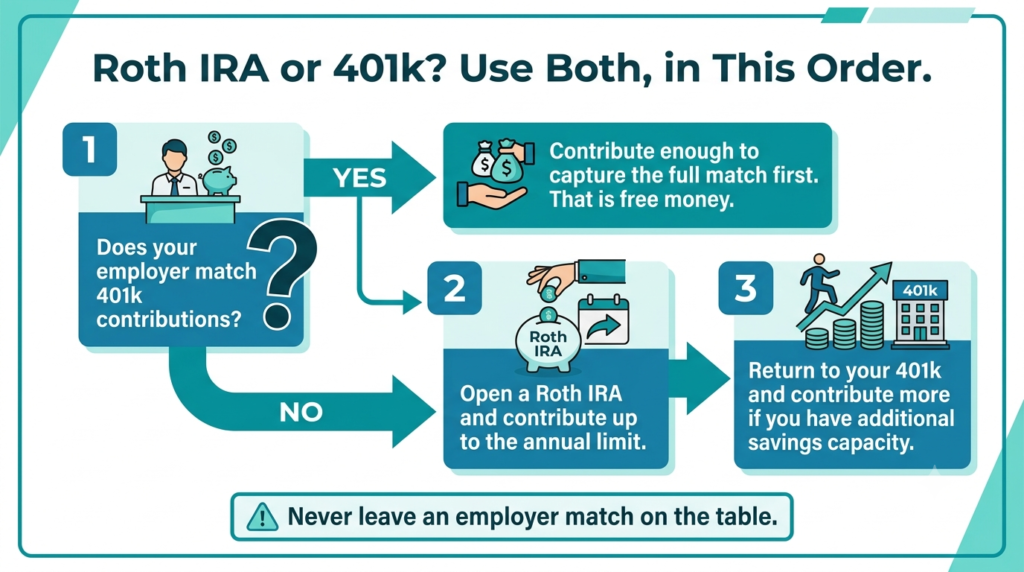
If your employer offers a 401(k) with a matching contribution, that match should always come first. An employer who matches 50% or 100% of your contributions up to a certain percentage of your salary is giving you an immediate return on your money that no investment can replicate. Capture that full match before you do anything else.
Once you have captured the full employer match, the Roth IRA is your next priority. Contribute up to the annual limit. Let it grow. If you still have savings capacity after maxing your Roth IRA, return to your 401(k) and contribute more there.
This order, which many financial planners call the funding ladder, prioritizes the accounts in order of their long term tax efficiency: free money first, then the tax free Roth, then the tax deferred 401(k).
To understand how the 401(k) fits into this picture and what its deductions look like on your paycheck, our article on the US pay stub explained breaks down every line including retirement contributions.
How to Open a Roth IRA: Step by Step
Opening a Roth IRA takes about 15 minutes. Here is what to do.
Step 1: Choose a brokerage. Fidelity, Vanguard, and Charles Schwab are the three most commonly recommended brokerages for Roth IRA accounts. All three offer no account fees, no minimum balance requirements to open an account, and access to low cost index funds. For most immigrants, any of these three is an excellent choice. Fidelity is frequently recommended for beginners because of its particularly straightforward interface.
Step 2: Open the account online. Go to the brokerage’s website and choose “Open an Account.” Select “Roth IRA” as the account type. You will need your Social Security Number, a US mailing address, your date of birth, and your bank account information for the initial funding.
Step 3: Fund your account. Link your US bank account and transfer your first contribution. You can contribute a lump sum of up to $7,000 for the current tax year, or you can set up automatic monthly contributions. Contributing $583 per month adds up to exactly $7,000 over the course of a year and spreads your investment across different market conditions rather than putting everything in on a single day.
Step 4: Choose your investments. Money sitting in a Roth IRA that is not invested in anything earns almost no return. Once your contribution lands, invest it. For most beginners, a single broad market index fund is the simplest and most effective choice. A total stock market index fund or an S&P 500 index fund at any of the three brokerages mentioned above gives you instant diversification across hundreds or thousands of companies with an expense ratio as low as 0.03%. You do not need to research individual stocks or try to time the market. Buy the index, add to it regularly, and leave it alone.
Step 5: Set up automatic contributions. The single most powerful thing you can do after opening your Roth IRA is automate your contributions so they happen without you having to decide each month. Set up a recurring transfer from your bank account to your Roth IRA on the same day you get paid. The money moves before you have a chance to spend it, and your wealth grows without requiring willpower.
What to Do If You Cannot Contribute the Full Amount
The full $7,000 annual contribution is the goal, but it is not the starting point for everyone. If your budget right now allows only $50 per month or $100 per month, start there. The habit and the account matter more than the amount.
A contribution of $100 per month at 7% average annual return over 30 years grows to approximately $122,000. A contribution of $200 per month under the same conditions grows to approximately $243,000. Neither of those requires the full annual limit. What they require is consistency and time.
Start with what you can. Increase your contribution by a small amount each time your income grows. The immigrants who build the most substantial Roth IRA balances are not the ones who invested the most in any single year. They are the ones who started early and never stopped.
For context on how this fits into your broader financial picture and what order to prioritize things when money is tight, our article on how to start investing in the US with $100 covers the sequencing from the very beginning.
The Tax Side: What You Need to Know
Roth IRA contributions are made with after tax dollars, meaning they do not reduce your taxable income in the year you contribute. There is no deduction. You simply contribute money you have already earned and paid taxes on.
Because the contributions are not deductible, there is no tax reporting required when you make them beyond the standard income reporting on your tax return. You do not need to report Roth IRA contributions separately unless you are making excess contributions above the annual limit, which triggers a 6% penalty on the excess amount.
When it comes to withdrawals, qualified distributions from a Roth IRA are completely tax free. A qualified distribution generally means you are at least 59 and a half years old and the account has been open for at least five years. If you meet both conditions, everything you withdraw, including decades of growth, is yours without any federal tax.
Each tax year, your brokerage will send you Form 5498 showing your total Roth IRA contributions for the year. Keep this form for your records even though it does not need to be filed with your return.
For immigrants who are still building their understanding of the US tax system, our guide on how to file US taxes as a newcomer step by step is a useful companion to understanding how your Roth IRA contributions fit into your overall tax picture.
A Note on the Backdoor Roth IRA
If your income is above the Roth IRA income limits, there is still a legal pathway available called the backdoor Roth IRA. It involves making a nondeductible contribution to a traditional IRA and then converting that amount to a Roth IRA shortly after. The IRS allows this conversion, and it is widely used by higher-income earners who want Roth IRA access.
The mechanics of the backdoor conversion are more involved than a straightforward Roth IRA contribution, and it requires careful attention to avoid tax complications. If your income is approaching or above the phase out threshold, consult a tax professional familiar with this strategy before proceeding.
The Roth IRA and Marisol
I want to close with a real story.
Marisol arrived from the Philippines at age 33 with two suitcases and a nursing license. She started a Roth IRA in her second year in the United States, contributing $300 per month because that was what she could spare. Over the years she increased that amount as her income grew. She never missed a year.
By the time she retired at 58, her Roth IRA held over $400,000. Every dollar of it tax free. She also had her 401(k) and her pension, but it was the Roth, the account she opened with a few hundred dollars in a year when she was still figuring everything out, that she called her favorite financial decision.
You can read her full story in our article on how she retired at 58 with nothing when she arrived in the US.
Her situation is not unique. The Roth IRA is not a secret, but it might as well be one in many immigrant communities where nobody has explained it. Consider this article the explanation.
Open the account. Start small if you have to. Let time and tax free compounding do the work.
Your future self will be grateful.
Disclaimer: This article is for educational and informational purposes only and does not constitute financial, tax, or legal advice. Roth IRA eligibility rules, contribution limits, and tax treatment may change. Always consult a qualified financial professional before making investment decisions.