
Become a Landlord with $100: Passive Real Estate Investing

When I moved to the United States, the idea of owning real estate felt like a punchline.
I was renting a room in a three-bedroom apartment I shared with two other people I had found on Facebook Marketplace. My bed was next to the window. In the winter, I could feel the cold coming through the frame. I was making $18 an hour at a job that was technically below my education level, sending money home every month, and watching my savings account grow by about $200 a month if I was disciplined and the month had no surprises.
Real estate was something other people did. People with down payments. People with credit history. People who had parents who could co-sign. Not me. Not yet.
It took a conversation with a colleague — a fellow immigrant, five years ahead of me in the process of figuring this country out — to learn that the landscape had shifted. That you could now own a piece of a rental property in Nashville or Phoenix or Atlanta for $100. That the passive income from that property would be deposited into your account like clockwork, without you managing a single tenant or fixing a single broken pipe.
That conversation changed how I think about wealth. This article is that conversation, written down for you.
Why Real Estate Has Always Built Wealth, and Why It Was Out of Reach
Real estate has been one of the most reliable wealth-building vehicles in American history. It appreciates over time, generates monthly rental income, offers tax advantages that most other investments do not, and can be leveraged using other people’s money in ways that stocks and bonds cannot. Over the past century, US real estate has returned an average of roughly 10% annually when you factor in both appreciation and rental income.
The problem was access.
Buying a rental property traditionally required a 20% to 25% down payment, that is $60,000 to $75,000 on a $300,000 home, before you even account for closing costs, repairs, property management fees, and the months where the unit sits vacant. Then there was the credit history requirement, the debt-to-income calculation, the landlord responsibilities, and in many states, the need to be a US citizen or permanent resident to access certain financing structures.
For most new arrivals, those barriers were simply not surmountable in the first several years of building a life here.
The democratization of real estate investing changed that equation. Starting around 2012 with the passage of the JOBS Act, which loosened restrictions on securities offerings and made crowdfunding platforms legally viable — a new category of investment became possible: fractional real estate ownership and real estate crowdfunding. Today, over $225 billion in US real estate is accessible to everyday investors without them owning a single brick, handling a single repair, or meeting an accredited investor threshold.
How Passive Real Estate Investing Actually Works
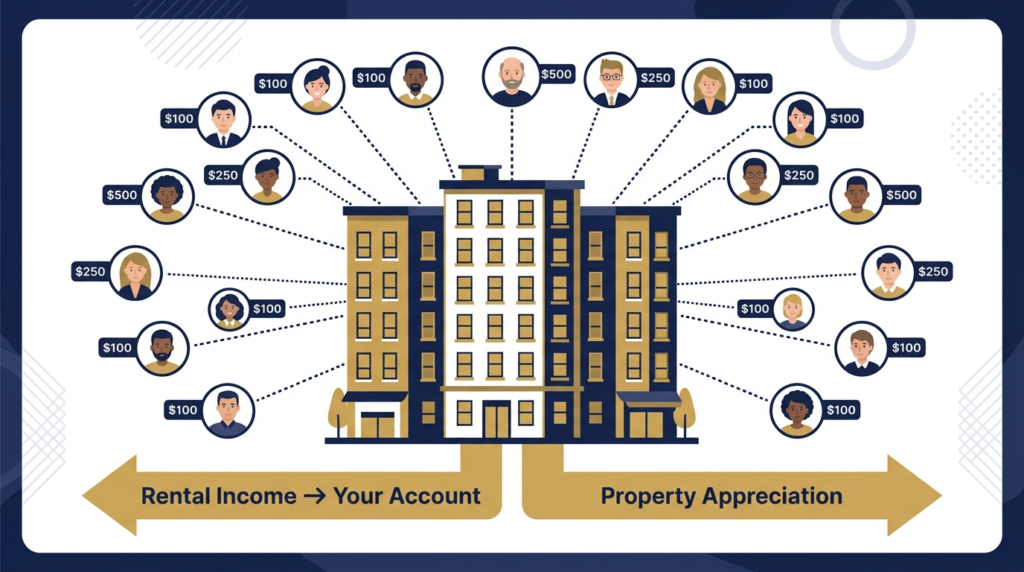
Before we get into the specific platforms, it is worth making sure the underlying concept is clear — because once you understand it, the idea of owning real estate with $100 stops feeling like a gimmick and starts feeling like exactly what it is: a structural shift in how investing works.
REITs: The Original Passive Real Estate Investment
A Real Estate Investment Trust, or REIT, is a company that owns, operates, or finances income-producing real estate, apartment complexes, office buildings, warehouses, shopping centers, hospitals, data centers, and more. When you buy shares in a REIT, you are buying a fractional stake in that company’s entire real estate portfolio.
By law, REITs must distribute at least 90% of their taxable income to shareholders as dividends. That means regular cash payments to you, simply for holding shares, no tenants, no repairs, no 3 am calls about a leaking ceiling. Publicly traded REITs can be bought and sold on the stock market exactly like shares of Apple or Amazon, which means they offer something traditional real estate almost never does: liquidity. You can exit your position in minutes if you need the money.
REIT ETFs, exchange-traded funds that hold a diversified basket of REIT shares, take the concept even further. Instead of picking one REIT, you own a slice of dozens simultaneously, spreading your risk across property types and geographies with a single purchase. Through platforms like Robinhood or Fidelity, you can buy fractional shares of REIT ETFs like VNQ (Vanguard Real Estate ETF) or SCHH (Schwab US REIT ETF) for as little as $1. This is the simplest, most liquid entry point into passive real estate income available to any investor, including new arrivals.
Real Estate Crowdfunding and Fractional Ownership
Real estate crowdfunding takes a different approach. Instead of buying shares in a company that owns properties, you pool money with other investors to buy into specific properties, or funds that hold a portfolio of properties, through an online platform.
When you invest through a crowdfunding platform, you are essentially buying a share of a property or a real estate investment trust that owns multiple properties. Returns come from two sources: rental income distributed to investors periodically, and appreciation in the property’s value when it is eventually sold.
The trade-off compared to public REITs is liquidity. Most crowdfunding investments lock up your capital for a defined period, often three to seven years, and cannot be sold instantly the way publicly traded shares can. In exchange, they typically offer access to private real estate deals with higher return potential than public REITs, and a more direct connection to the underlying properties.
Can New Arrivals and Immigrants Actually Use These Platforms?
This is the question I had to dig into, because the answer matters enormously.
Most fractional real estate platforms and publicly traded REIT brokerages are open to legal US residents regardless of citizenship status, provided you have the following: a valid SSN or ITIN, a US address, a US bank account, and a government-issued photo ID. You do not need to be a US citizen. You do not need to be an accredited investor for the platforms covered in this article. You do not need a high credit score, because you are investing, not borrowing.
Tax treatment is worth understanding, however. Dividend income from REITs is taxable in the United States, and if you are classified as a resident alien, it will appear on your annual tax forms just like any other investment income. Platforms issue 1099-DIV forms at year-end. If you are a nonresident alien, different withholding rules may apply. As always, verifying your specific situation with a tax professional familiar with immigrant investing is worth the time investment.
How to Think About Passive Real Estate as Part of Your Overall Plan
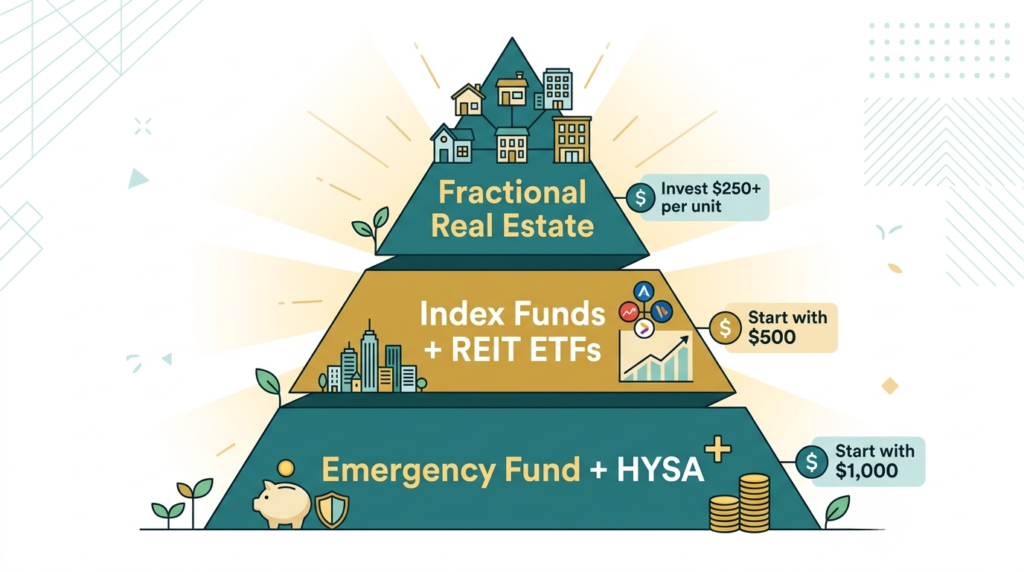
Passive real estate investing is not a replacement for the financial foundation we have discussed in earlier articles. It is an addition to it. Here is how I think about sequencing these decisions:
Step 1: Emergency Fund First Before you put a dollar into any investment — real estate or otherwise — you need 3 to 6 months of essential living expenses in a liquid, accessible account. A high-yield savings account through SoFi is the right vehicle for this. This is non-negotiable, because an investment you are forced to exit early due to a financial emergency is an investment that may cost you money.
Step 2: Index Funds as Your Core Investment Broad-market index funds — tracking the S&P 500 through platforms like Robinhood or Acorns — remain the most reliable, lowest-cost, most liquid foundation for a long-term investment portfolio. They should form the majority of your investment allocation, especially in your early years.
Step 3: Add Real Estate Exposure Once you have an emergency fund and a growing index fund position, adding real estate diversifies your portfolio into an asset class that behaves differently from stocks, generates income from a different source, and offers tax advantages that can further compound your returns over time.
A reasonable starting approach for a new arrival: REIT ETFs for liquid real estate exposure that you can access quickly if needed, and a small fractional position in Arrived or Fundrise for longer-term real estate income once you are confident you will not need that capital for at least three to five years.
Step 4: Scale as Your Financial Life Grows As your income grows, your credit history develops, and your US financial foundation solidifies, the options available to you expand. More capital means access to larger positions in better deals. A stronger credit profile opens conventional real estate financing. Time in the country builds the knowledge and network that make direct property ownership realistic.
The $100 you put into Arrived today is not just a $100 investment in a rental property. It is the beginning of understanding how real estate works, how passive income accumulates, and how wealth compounds over time — all of which position you for larger moves down the road.
The Tax Side of Passive Real Estate Income
One thing worth understanding before you start: passive real estate income is taxable. Dividend income from REIT ETFs and distributions from crowdfunding platforms will generate tax forms at the end of each year, typically a 1099-DIV or a K-1 depending on the platform structure.
For most new arrivals classified as resident aliens, this income is reported on your Form 1040 and taxed as ordinary income or qualified dividend income depending on the type of distribution. Platforms like Fundrise and Arrived send annual tax documents directly to your account.
The good news: real estate investment structures also come with tax advantages, including depreciation deductions that can offset some of the income you receive, and the ability to hold investments inside a Roth IRA on some platforms. Fundrise, for instance, supports IRA accounts with a $1,000 minimum, which allows your real estate returns to compound entirely tax-free inside a retirement account.
Keeping all your financial accounts organized throughout the year, not just at tax time, makes this manageable. A free tool like Empower connects to all your investment accounts, tracks your income, and gives you a real-time picture of your growing net worth, which is particularly useful when you start adding less familiar asset classes like real estate.
What I Would Tell My Earlier Self
If I could go back to the version of me sleeping next to a drafty window in a shared apartment, I would tell him this:
You do not need a down payment to start building your real estate position. You need $100 and a phone. You do not need perfect credit or citizenship papers or a financial advisor. You need a platform with a low minimum and a willingness to leave the money alone for a few years.
The American wealth gap is real. The systems that created it are real. But the tools available to close it, fractional investing, REIT ETFs, real estate crowdfunding, have never been more accessible than they are right now in 2026, and they are available to you from wherever you are starting.
Start small. Stay consistent. Let time and compound growth do the work that the old system would have required millions to do.
You deserve to be a landlord.
Disclaimer: This article is for educational and informational purposes only and does not constitute financial or investment advice. All investing involves risk, including the possible loss of principal. Past performance is not indicative of future results. Platforms, fees, and eligibility requirements may change. Always conduct your own due diligence and consult a qualified financial professional before making investment decisions.