
How Do I Make Enough Money to Survive Here?
There is a question that almost every immigrant asks at some point during their first year in the United States, usually somewhere between midnight and 2am when the numbers are not adding up.
It sounds simple. It is anything but.
How do I make enough money to survive here?
Not thrive. Not invest. Not send money home. Just survive. Cover the rent. Keep the lights on. Put food on the table. Get through this month without the math turning catastrophic.
If that is where you are right now, I want you to know two things. First, what you are feeling is real and valid — the cost of living in most American cities is genuinely brutal, and the gap between what entry-level work pays and what a dignified life costs here is a real structural problem, not a personal failure. Second, there are concrete, practical moves you can make, some that start working this week, some that set you up to breathe easier in three to six months, and some that change your trajectory over the next year or two.
This article covers all three timelines. No product pitches. Just the actual information.
Start Here: Know Your Real Number
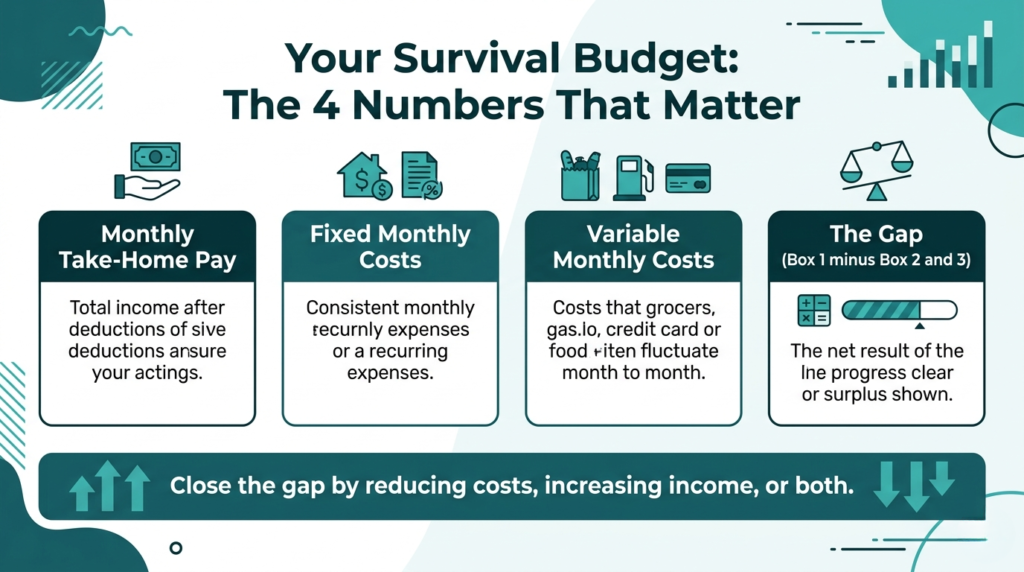
Before you figure out how to make more money, you need to know exactly how much you need. This sounds obvious, but most people are carrying a fuzzy number in their head, a vague sense that things are tight, rather than a precise monthly figure they are working toward.
Sit down, in whatever quiet moment you can find, and write out your actual monthly expenses:
Fixed costs: Rent or your share of rent. Electricity, gas, water. Phone. Internet. Transportation (car payment, insurance, transit pass, gas). Any debt payments, credit card minimums, student loans.
Variable necessities: Groceries. Household supplies. Laundry. Medical expenses or prescriptions.
Other obligations: Money sent home. Childcare. Any other regular commitments.
Add everything up. That total is your survival number, the minimum monthly income you need before life stops being a crisis. Write it down and keep it somewhere you can see it.
Now look at what you are currently earning after taxes. The gap between those two numbers is the problem you are solving. Knowing the exact gap means you can make strategic decisions instead of just feeling overwhelmed.
The Two Levers: Spend Less or Earn More
When your income does not cover your costs, you have two levers to pull: reduce costs or increase income. In reality, you probably need to do both at once, at least in the short term.
On the spending side, the biggest opportunities are usually in the three largest categories: housing, transportation, and food.
Housing is typically the biggest cost and the hardest to change quickly. But if you are renting a one-bedroom alone, sharing with a roommate is often the single fastest way to reduce your monthly deficit. Moving to a different neighborhood or city is a bigger decision but sometimes the right one, the cost of living difference between cities in the same state can be dramatic.
Food is the area where small habits compound into real savings. Cooking at home instead of ordering out can save $400 to $600 a month for a single person in most cities. Ethnic grocery stores, often the stores your community has been shopping at for years, typically carry staples at significantly lower prices than chain supermarkets. Buying in bulk for things you use constantly stretches every dollar further.
Transportation deserves a hard look. If you own a car, calculate what it actually costs per month: payment, insurance, gas, parking, occasional maintenance. For many immigrants in cities with decent public transit, eliminating the car payment and using transit passes or rideshare for occasional trips is meaningfully cheaper. If a car is essential where you live, consider whether refinancing or trading for a lower-cost vehicle is possible.
These are not fun conversations to have with yourself. But closing even part of the gap through spending cuts buys you time to grow your income without the pressure of an emergency at your back every single month.
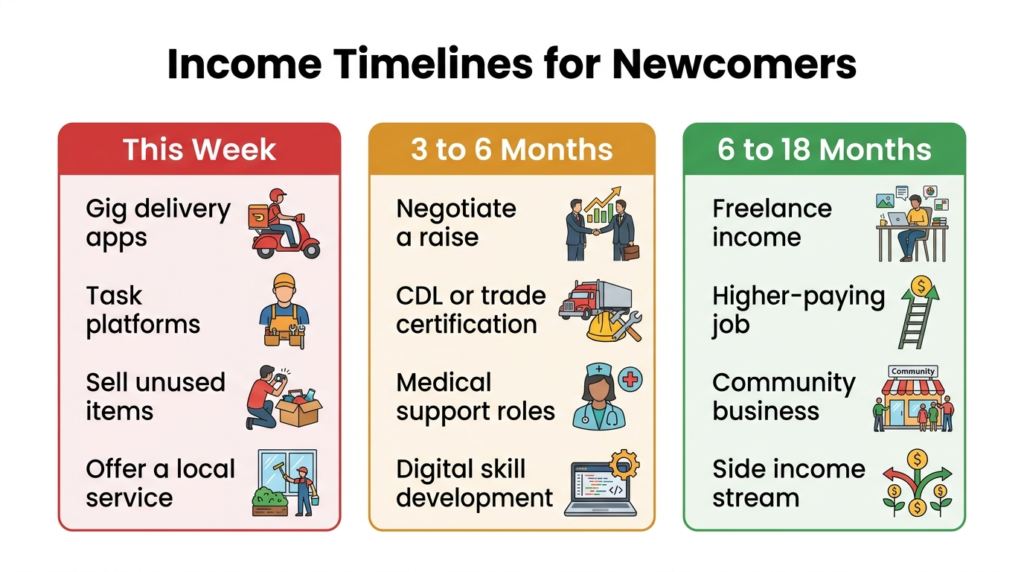
Timeline 1: Income You Can Start This Week
These are options that require almost no startup time, no special credentials, and no waiting period. They pay quickly and can be started while you are still working your main job.
Gig Work and On-Demand Platforms
The gig economy is not a perfect system, the income can be inconsistent and you are responsible for your own taxes on what you earn, but for a newcomer who needs money quickly and has a flexible schedule, it can be a meaningful bridge.
Delivery work through apps like DoorDash, Uber Eats, Instacart, or Amazon Flex requires a valid driver’s license, a vehicle, and the right work authorization. Income is variable depending on your city, the time of day, and how many hours you put in, but drivers in busy urban areas can realistically earn $15 to $25 per hour including tips during peak hours. These apps pay weekly or even daily, which helps when cash flow is the immediate problem.
Rideshare driving through Uber or Lyft follows a similar model. You need a car that meets their requirements, a valid license, insurance, and work authorization. Earnings vary widely by city and time of day. Peak hours — early mornings, evenings, and weekend, produce the most income per hour.
Task-based work through platforms like TaskRabbit connects you with people who need help with moving, furniture assembly, yard work, cleaning, handyman tasks, and general labor. If you have physical skills and are reliable, this can generate immediate income with no formal employer relationship. TaskRabbit is currently available in most major US cities.
One important note on gig work: because you are an independent contractor, not an employee, no taxes are withheld from what you earn. You are responsible for setting aside roughly 25 to 30% of your net gig income for federal and state taxes, or you may face an unexpected tax bill at the end of the year. Set that money aside in a separate account from the moment you start earning.
Sell What You Already Have
This is the fastest money available to most people and requires zero work authorization: sell things you own that you no longer need. Facebook Marketplace, OfferUp, and Craigslist are free to use and connect you directly with buyers in your area. Electronics, furniture, clothing, kitchen items, and tools sell reliably. Many newcomers arrive with more than they realize and live in apartments with items they never actually use.
This is not a long-term income strategy. But in a month where the gap is critical, converting $200 to $400 worth of unused possessions into cash can make a real difference.
Offer a Service in Your Community
Think honestly about what you can do that other people need. Cleaning homes. Cooking meals for busy families. Childcare. Dog walking. Tutoring children in a subject you know well. Helping people move. Yard work. Haircuts if you have that skill.
Every one of these services can be offered immediately, priced by you, paid in cash or through apps like Venmo or Zelle, and built into a small recurring income stream without any formal business structure in the beginning. Post in local Facebook groups, neighborhood apps like Nextdoor, or just let people in your building and community know what you offer.
Word of mouth is still the most powerful marketing tool available to a newcomer, and the trust that comes from being a known face in your community often converts into steady, recurring work faster than any app.
Timeline 2: Income That Grows Over Three to Six Months
These strategies take a little longer to gain traction but tend to produce more stable, better-paying work than gig platforms.
Maximize Your Current Job
This sounds almost too simple, but it is frequently the most overlooked opportunity. Many immigrants in survival mode are working below their actual skill level, taking whatever job was available when they arrived, and have not yet had a conversation with their employer about moving up.
If you have been at your current job for six months or more, you have information that matters: you know how the workplace operates, you have relationships with your manager and colleagues, and you have likely demonstrated reliability. These are valuable things employers pay for. A direct, professional conversation about your performance and whether a raise or promotion is possible is worth having. The answer is not always yes, but it is yes more often than people expect when they ask clearly and professionally.
Even without a promotion, picking up extra hours or overtime if they are available is the fastest way to increase income from a job you already have without adding the complexity of managing separate self-employment income and taxes.
Develop a Marketable Skill
The job market in 2026 rewards specific skills more than credentials. Employers are increasingly focused on what you can do rather than where you studied. This creates a real opening for immigrants who are willing to invest time in learning something that the market needs.
The skills with the strongest demand and lowest barriers to entry for newcomers include:
Customer service and call center work. If your English is solid, this is one of the most accessible entry points into stable employment with benefits. Many companies hire remotely, which expands your options beyond your immediate city.
Commercial driving. A Commercial Driver’s License (CDL) opens access to one of the most consistently in-demand labor markets in the country. Truck drivers and bus drivers earn significantly more than most entry-level jobs, and there is a genuine shortage of licensed commercial drivers nationwide. CDL training programs typically run four to eight weeks and cost between $3,000 and $7,000, though some employers offer paid training in exchange for a work commitment. If you can finance the training, this is one of the most reliable income upgrades available.
Trade skills. Electricians, plumbers, HVAC technicians, and construction workers are in high demand across the US. Apprenticeship programs, many of which pay you while you learn, are available through unions and trade organizations. The earning potential for licensed tradespeople significantly exceeds most service-sector wages, and the path from apprentice to journeyman to licensed contractor is a realistic long-term wealth-building trajectory.
Medical support roles. Certified Nursing Assistants (CNAs), home health aides, and medical interpreters are consistently in demand. CNA certification programs typically take four to twelve weeks and can often be completed for under $1,500. Healthcare employers in most states are actively recruiting, and the work is steady regardless of economic conditions.
Digital skills. Data entry, social media management, basic graphic design, and virtual assistance are learnable through free or low-cost platforms like Coursera, YouTube, and Google’s free certificate programs. These skills open doors to remote work, which dramatically expands your job market beyond your city.
The principle is the same across all of these: identify one skill that is in genuine demand where you live, find the fastest legitimate path to competency in that skill, and pursue it with whatever hours you can carve out.
Look for Jobs That Pay More Than Yours Right Now
If your current job is not paying enough to cover your survival number, it is reasonable to treat your job search as ongoing. You do not have to quit what you have, but spending a few hours a week applying to positions that pay better is not disloyal. It is practical.
In most US cities, the jobs that are consistently accessible to immigrants without specialized credentials and that pay above average for that category include: warehouse and fulfillment center work (Amazon, UPS, FedEx, and others pay $18 to $24 per hour in most markets), hospital and healthcare support roles, construction labor, commercial cleaning contracts, food production and processing, and hotel operations.
LinkedIn, Indeed, and ZipRecruiter are free to use. Your local American Job Center, a federally funded employment resource available in every state, offers free job placement assistance, resume help, and skills training referrals specifically designed for immigrants and job seekers. You can find your nearest location at careeronestop.org.
Build a Community Network
An enormous amount of job opportunity in the US is never posted publicly. It is filled through word of mouth, through relationships, through someone knowing someone who is hiring.
In immigrant communities especially, this network is often the fastest path to better work. The person at your church who knows the restaurant owner who is looking for a reliable worker. The neighbor who mentions that the cleaning company she works for is hiring. The WhatsApp group for people from your home region where someone posts a job lead.
Invest in your community relationships not just as a social act but as a professional strategy. Showing up reliably, helping others when you can, and being known as someone trustworthy are assets that translate directly into opportunities.
Timeline 3: Income That Can Change Your Financial Life Over the Next Year or Two
These are not shortcuts. They take sustained effort. But they represent the strategies with the highest long-term upside for immigrants who are willing to play a longer game.
Freelancing Your Skills
If you have a professional skill from your home country, accounting, engineering, graphic design, writing, translation, teaching, software development, marketing, there is likely a freelance market for it in the United States. Platforms like Upwork, Fiverr, and Toptal connect freelancers with clients globally, and your professional background is an asset regardless of where you earned it.
The challenge with freelancing is that it takes time to build a client base and reputation. Your first few months of earnings may be modest as you develop reviews and a portfolio. But for someone with genuine professional skills, freelancing can ultimately pay more than a traditional employer and provide more flexibility.
Translation and interpretation are particularly worth mentioning specifically for immigrants who are bilingual. The demand for qualified translators and interpreters in Spanish, Portuguese, Mandarin, Arabic, Tagalog, Vietnamese, and many other languages is high and growing. Medical interpreters in particular can earn $25 to $60 per hour depending on their specialization and certification level. The American Translators Association (ata-divisions.org) is a useful starting point for learning about professional certification.
Start Something Small
A small business does not have to be a grand entrepreneurial vision. It can simply be a formalized version of the service work you are already doing.
If you are cleaning houses, register as a sole proprietor, get a basic liability insurance policy, create a simple online presence, and begin marketing systematically. A cleaning service with five regular clients paying $120 each per visit, done twice monthly, generates $1,200 per month — more than many full-time minimum wage jobs, done on your own schedule.
The same logic applies to food businesses (many cities have cottage food laws that allow home-based food production), landscaping, childcare, alterations and sewing, pet care, and dozens of other services.
The Small Business Administration (sba.gov) offers free resources for starting a business, including guidance on legal structure, taxes, and funding. SCORE (score.org) provides free mentorship from retired business professionals and is available in Spanish and other languages. Both resources are genuinely useful and genuinely free.
One Thing Nobody Tells You: Your Immigration Status and Work Authorization
Work authorization in the United States is not one-size-fits-all, and what you are legally allowed to do to earn income depends on your specific status.
If you have a work visa (H-1B, L-1, O-1, TN), your employment authorization is generally tied to a specific employer. Taking on independent contractor work or a second job may violate your visa terms, verify with an immigration attorney before doing so.
If you have an Employment Authorization Document (EAD) or work authorization through DACA, TPS, or a pending green card, you have more flexibility to work for any employer or work independently as a contractor.
If you are in a different immigration situation, understanding exactly what income-generating activities are permitted under your status is important before you pursue them. Local legal aid organizations and nonprofit immigration law centers can provide this guidance at low or no cost.
Everyone, regardless of immigration status, can generate income through self-employment and entrepreneurship in many forms. But the specific rules depend on your specific situation, so getting clarity on this is worth the effort.

The Honest Middle of This Journey
Here is something worth saying directly: surviving in America as a newcomer is genuinely hard in a way that is not proportional to how hard you work or how much you deserve to succeed. The cost of housing, healthcare, childcare, and transportation in most US cities has outpaced wages significantly, and that gap falls harder on people who are newer to the system.
What keeps many immigrants going is not a perfect financial plan. It is a combination of community, resourcefulness, a clear picture of where they are going, and the willingness to take the next concrete step even when the whole path is not yet visible.
The steps in this article are not magic. They will not solve everything this month. But each one is a real move in the right direction, and the compounding effect of making several right moves in a row, month after month, is what eventually turns survival into stability and stability into something that looks like a real life here.
You are not behind. You are at the beginning.
Disclaimer: This article is for educational and informational purposes only. Work authorization rules vary by immigration status. Always verify what income-generating activities are permitted under your specific visa or immigration status before pursuing them. Consult an immigration attorney or accredited representative for guidance specific to your situation.