
Give Your Kids a Head Start: How to Open a Custodial Investment Account for Your Children
My parents worked their whole lives. Every dollar they earned went to survival, then to building something small, then to us. By the time they were done working, they had nothing left to pass down. Not because they failed. Because nobody had ever handed them a tool that could grow money while they slept.
I think about that when I look at my children. I do not want them to start from zero the way I did. I do not want them to arrive at 22 with no savings, no financial foundation, and no head start. I want the years between now and when they leave home to be working for them in the background, quietly and consistently, the way compound interest works when you give it enough time.
That is what a custodial investment account does. And most immigrants have never heard of it.
This article explains what a custodial account is, how it works, what you need to open one, how much you need to start, and exactly how to set one up for your child today, even if you are new to investing and even if you are starting with a small amount.
What Is a Custodial Investment Account?
A custodial investment account is a brokerage account that you open and manage on behalf of a child. You are the custodian, meaning you make all the investment decisions and contributions until the child reaches adulthood. At that point, the account and everything in it transfers automatically to the child in their own name.
Unlike a savings account, a custodial investment account can hold stocks, index funds, exchange traded funds, bonds, and other investment assets. This means the money inside it is not just sitting still earning a small interest rate. It is invested in the market and growing over time at a rate that, historically, has significantly outpaced both inflation and savings account interest rates.
The two most common types of custodial accounts in the United States are the UGMA and the UTMA.
UGMA (Uniform Gifts to Minors Act): Covers financial assets including cash, stocks, bonds, mutual funds, and other securities. Available in all 50 states.
UTMA (Uniform Transfers to Minors Act): Covers everything UGMA covers, plus it can also hold real estate, art, patents, and other property in states that allow it. The UTMA is available in most states and is the more commonly used of the two at major brokerages.
For most families opening a custodial account at a standard brokerage, the practical difference between UGMA and UTMA is minimal. Your brokerage will tell you which type applies in your state. At Fidelity, Charles Schwab, and Vanguard, the account is typically labeled as a UGMA/UTMA custodial account, and you choose the type during the opening process.
Why This Account Matters for Immigrant Families Specifically
There is a specific reason this topic matters more for immigrant families than it does for families who have been in the United States for generations.
Most immigrant parents arrive with no inherited financial foundation. No savings accounts opened by grandparents. No family investment portfolios to be added to. No trust fund. No head start. The work of building intergenerational wealth begins from scratch with the first generation that gets here.
A custodial account, opened when your child is young and contributed to consistently, is one of the most direct and accessible ways to change that trajectory. It breaks the cycle not in your lifetime, but in theirs, by giving them a financial starting point that you never had.
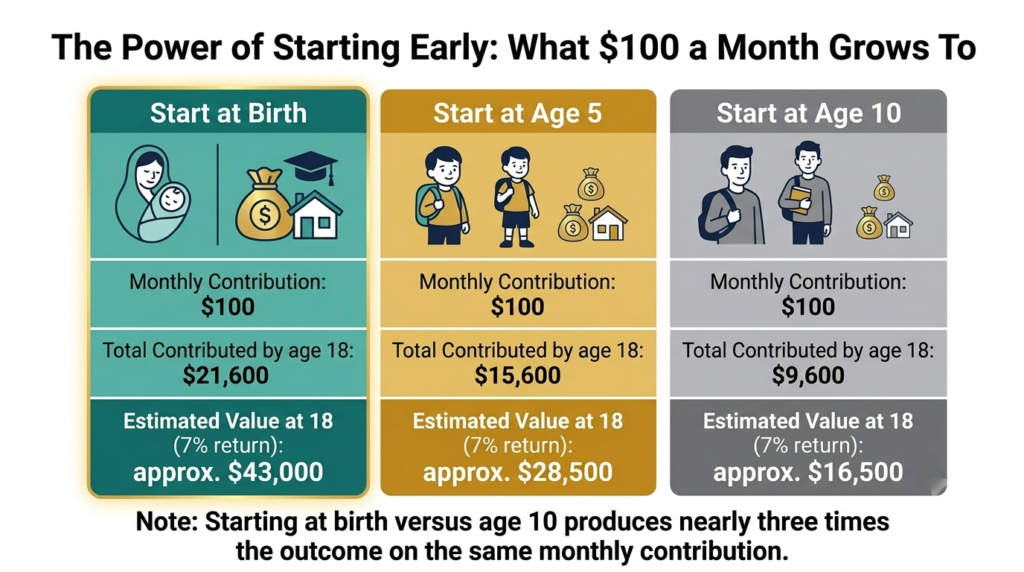
And it does not require a large income or significant financial expertise. A $50 monthly contribution started at birth grows to approximately $22,000 by age 18, assuming a 7% average annual return. That is the historical long term average of a diversified stock market index fund. That $22,000 is $22,000 more than most immigrant children start their adult lives with.
The Key Rules Every Parent Needs to Know
Before opening an account, there are four important rules that distinguish custodial accounts from other savings options.
The contribution is irrevocable. Once you put money into a custodial account, it belongs to the child. You cannot take it back. You cannot use it for your own expenses. You can withdraw funds from the account before the child reaches adulthood, but only if the withdrawal is for the direct benefit of the child, such as paying for their education, their healthcare, or their extracurricular activities. If you withdraw for other purposes, you may face tax consequences and legal issues.
The child gains full control at the age of majority. In most states, that is age 18 or 21 depending on the state and the account type. In some states with UTMA accounts, the custodian can specify a later transfer age, sometimes up to 25. When that date arrives, the account becomes theirs to do with as they choose. They can invest it, spend it, or give it away. They do not need your permission. This is both the power and the risk of a custodial account, which is why teaching your child about money alongside building the account matters enormously.
Contributions may have gift tax implications above a threshold. For 2025 and 2026, any individual can contribute up to $19,000 per year to a custodial account per child without triggering gift tax reporting ($38,000 for a married couple filing jointly). Contributions above those amounts may require filing a gift tax return, though actual gift tax is rarely owed unless your lifetime gifts exceed the federal exemption threshold.
The account affects financial aid calculations. Because the account is legally owned by the child, it is treated as a student asset in financial aid calculations. Under the federal financial aid formula, student assets are assessed at a higher rate than parent assets. This means a custodial account may reduce your child’s financial aid eligibility more than a 529 college savings plan would. This is a real consideration if you expect your child to apply for need based financial aid for college.
UGMA/UTMA vs. 529: Which Should You Choose?
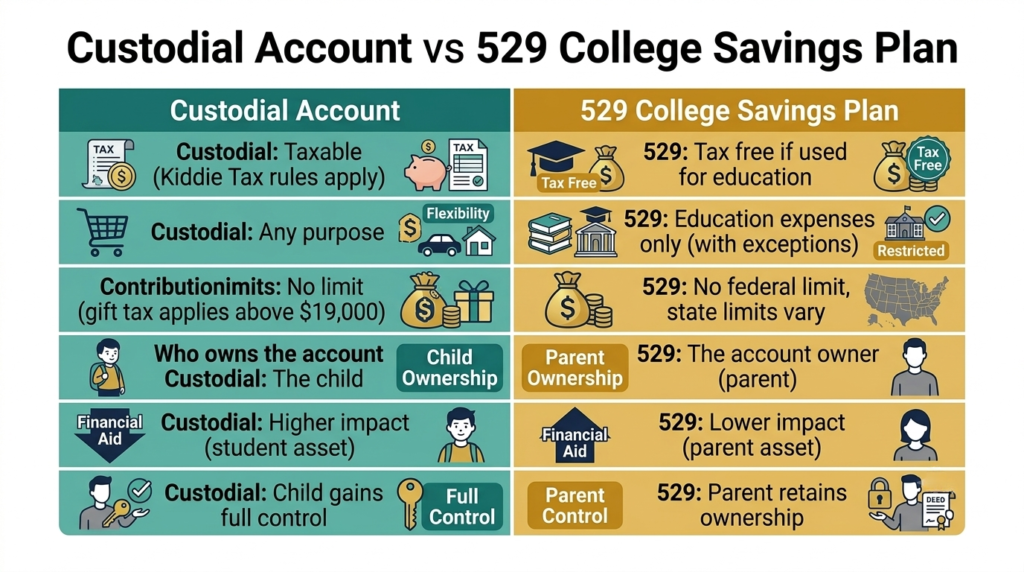
This is the question most parents ask once they discover that both accounts exist. Here is the honest answer: it depends on your goals.
Choose a 529 if: You are saving specifically for college expenses and you want maximum tax advantages on the growth. A 529 grows tax free, and withdrawals for qualified education expenses are also tax free. It has a lower impact on financial aid calculations. And the account owner, typically a parent, retains control and can change the beneficiary if the child does not attend college or receives a scholarship.
Choose a custodial account (UGMA/UTMA) if: You want the money to be available for any purpose, not just education. You want to invest in a broader range of assets. You want to use the account to teach your child about investing by letting them see the portfolio grow and eventually participate in decisions. You are not certain whether college will be the primary use of the funds. Or you want to build general wealth for your child rather than restricting the funds to education.
Many families do both. A 529 for college savings with tax advantages, and a custodial account funded separately for the broader goal of giving a child a financial foundation they can use for anything when they reach adulthood.
The Kiddie Tax: What You Need to Know
Custodial accounts are taxable accounts. The investment growth inside them is not sheltered from taxes the way a 529 or Roth IRA would be. Here is how the taxes actually work.
The IRS applies what is called the “Kiddie Tax” to investment income in custodial accounts. Under the Kiddie Tax rules for the 2026 tax year:
The first $1,350 of a child’s unearned income (interest, dividends, and capital gains from the custodial account) is exempt from federal income tax.
The next $1,350 of unearned income is taxed at the child’s own tax rate, which is typically very low because most children have little or no other income.
Any unearned income above $2,700 is taxed at the parent’s marginal tax rate.
For most families contributing modest amounts to a custodial account, the Kiddie Tax has minimal practical impact in the early years. A $50 per month contribution generating an estimated 7% annual return will not produce taxable investment income that exceeds these thresholds for many years. As the account grows larger over time, tax planning around the account becomes more relevant.
When the child reaches age 19 (or age 24 if a full time student), the Kiddie Tax rules no longer apply, and the investment income is taxed at the child’s own rate rather than the parent’s rate.
How to Open a Custodial Account: Step by Step
Opening a custodial account takes less time than most people expect. Here is the exact process.
Step 1: Choose a Brokerage
Fidelity is consistently recommended as the best overall custodial account for most families. There is no minimum to open, no account maintenance fees, and no commissions on stock or ETF trades. Fidelity offers fractional shares, meaning you can invest in funds for as little as $1. Their educational resources for teaching children about investing are also among the best available. As a legal immigrant with a SSN and a US address, opening an account at Fidelity is straightforward.
Charles Schwab is a strong alternative with no account minimum, no maintenance fees, and excellent index fund options. Schwab offers custodial accounts online and provides access to stocks, bonds, ETFs, and mutual funds. Their customer service for account-related questions is highly rated.
Vanguard is particularly well suited for families who specifically want low cost index funds. Vanguard is the pioneer of index fund investing and offers some of the lowest expense ratios available. Their custodial account is straightforward, though their platform is less modern than Fidelity or Schwab.
Acorns Early (formerly Acorns Early for kids) is worth considering for families who want a simplified, automated approach. It allows round-ups from everyday purchases to be automatically invested in a custodial portfolio on behalf of a child. For parents who want to start investing for their children without making active investment decisions, Acorns Early reduces the complexity significantly.
Step 2: Gather the Information You Need
To open a custodial account, you will need the following for yourself as the custodian: your Social Security Number, your date of birth, a US address, and your bank account information for the initial funding.
For the child, you will need their full legal name, their date of birth, and their Social Security Number.
A note for immigrants: Most major brokerages require an SSN for both the custodian and the child to open a custodial account. If you have an ITIN rather than an SSN, opening a custodial account at a major online brokerage may not be immediately possible. Some credit unions and community banks offer custodial savings accounts for ITIN holders, though these are typically savings accounts rather than brokerage accounts. As you progress toward obtaining an SSN, either through a change in immigration status or by ensuring your child gets their SSN at birth if they are born in the US, the full range of custodial account options becomes available.
Step 3: Open the Account Online
Go to the brokerage’s website and navigate to the account opening section. Select the custodial account option, usually labeled UGMA/UTMA. Complete the application with your information and the child’s information. Link your bank account for the initial funding.
Most major brokerages can complete the application process entirely online. Fidelity and Schwab typically open accounts within one business day. You will receive a confirmation by email.
Step 4: Fund the Account
Make your initial deposit, which can be as small as $1 at Fidelity or Schwab. Set up automatic monthly contributions if your budget allows. Even $25 or $50 per month is a meaningful starting point. The habit and the timeline matter more than the amount in the early years.
You can also invite family members to contribute. Grandparents, aunts, uncles, and close friends can contribute directly to the account as gifts, subject to the annual gift tax limit of $19,000 per person. For many immigrant families, this creates an opportunity to involve extended family in building the child’s financial foundation, even family members back home who may want to contribute something meaningful for the next generation.
Step 5: Choose Your Investments
Money sitting in a custodial account that is not invested in anything earns almost nothing. The moment your deposit lands, invest it.
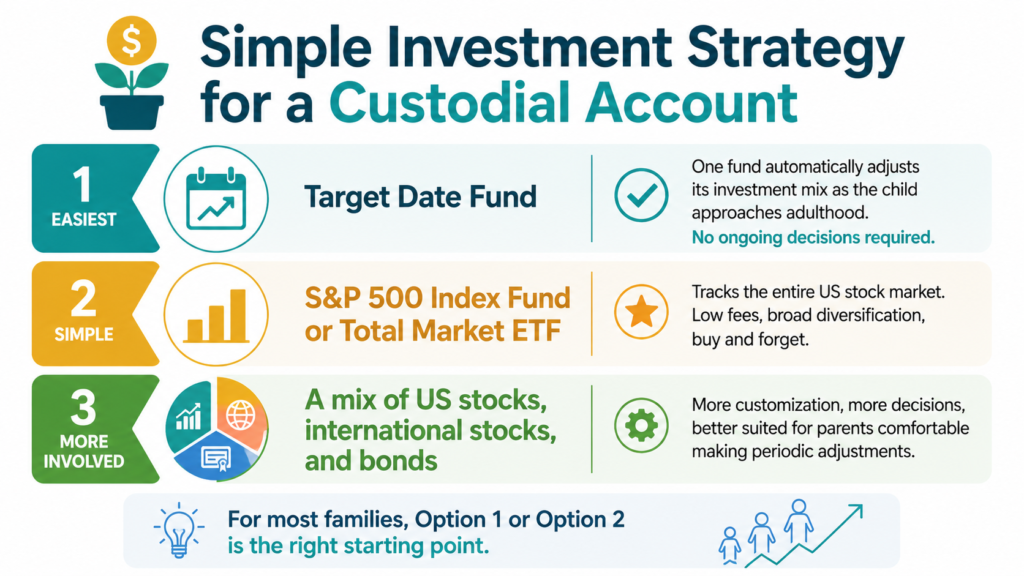
For most families opening a custodial account, the simplest and most effective investment strategy is a single low cost, broadly diversified index fund.
A total stock market ETF or S&P 500 index fund tracks the entire US stock market or the 500 largest US companies. At Fidelity, the FZROX (Fidelity Zero Total Market Index Fund) has a 0% expense ratio, meaning no annual fees at all. At Vanguard, the VTI ETF and the VTSAX mutual fund are among the most widely used index funds in the world. At Schwab, SWTSX is a comparable option.
A target date fund automatically adjusts its investment mix over time, starting more aggressively (higher stock allocation) when the child is young and gradually shifting to a more conservative mix (higher bond allocation) as they approach adulthood. These funds require no ongoing decision-making on your part. You choose the fund closest to the year your child will turn 18 or 25, and the fund manages itself.
Set up automatic dividend reinvestment. Most brokerages allow you to set the account to automatically reinvest any dividends paid by your holdings back into the same fund. This is free, requires no action on your part, and accelerates the compound growth of the account over time.
Teaching Your Child Alongside the Account
A custodial account is not just a financial tool. Used well, it is one of the best financial education tools available to a parent.
As your child grows old enough to understand money, involve them in the account. Show them the balance. Explain what an index fund is. Talk about what the companies inside the fund actually do. Let them see the account grow when the market rises and learn not to panic when it falls.
The immigrants who consistently build lasting family wealth are not just the ones who save and invest. They are the ones who pass the knowledge forward alongside the money. A child who understands how compound interest works and has watched their own portfolio grow for fifteen years before they gain control of it is far less likely to squander it than a child who receives a financial windfall they have no context for.
Start early. Contribute consistently. And make the account part of the ongoing conversation about money in your household.
A Simple Summary
| Question | Answer |
|---|---|
| What is the minimum to start? | $0 to $1 at Fidelity or Schwab |
| Do I need an SSN? | Yes, for both custodian and child at most brokerages |
| Can I withdraw early? | Yes, but only for the child’s direct benefit |
| When does the child gain control? | Age 18 to 21 depending on state and account type |
| What is the annual gift tax limit? | $19,000 per person in 2025 and 2026 |
| Will it affect college financial aid? | Yes, as a student asset it has more impact than a 529 |
| What should I invest in? | A broad market index fund or target date fund |
| Can grandparents contribute? | Yes, up to $19,000 per person per year |
Disclaimer: This article is for educational and informational purposes only and does not constitute financial, tax, or legal advice. Tax rules, contribution limits, and financial aid treatment of custodial accounts may change. Always consult a qualified financial professional before making investment decisions.