
I Just Lost My Job. What Do I Do as an Immigrant?
Take a breath, This is not the end of your story. It does not have to be the end of your time here either. But the next few days and weeks matter enormously, and what you do, and in what order, can make a real difference in how this chapter turns out.
Losing a job is hard for anyone. For an immigrant, it carries layers that most people around you may not fully understand: the worry about visa status, the fear about health insurance, the question of what to tell your family back home, the pressure of obligations that did not pause just because your paycheck did.
This guide walks through all of it. Not in a way that assumes you have an attorney on speed dial or savings to cover three months of expenses. In a way that meets you where you actually are.
The First 24 Hours: What to Do Right Now
Before anything else, there are three things to do in the immediate aftermath of losing your job, whether you were laid off, let go, or your contract ended.
Do not sign anything immediately. If your employer hands you a severance agreement or separation document and asks you to sign it on the spot, you have the right to take time to review it. In most states, employers are legally required to give you at least 21 days to consider a severance agreement (and 45 days if it is part of a group layoff). Ask for the document in writing and take it home. A signature you regret is much harder to undo than a delay.
Ask what your last day of health insurance coverage is. This is urgent because a gap in health coverage can have serious financial consequences. Many employer plans end on your last day of work. Some extend through the end of the calendar month. You need to know this number before you can plan your next steps on healthcare.
Request your final paycheck timeline. Each state has laws about when your final paycheck must be paid after termination. In California, it must be paid immediately. In Texas, it must be paid within six days. Do not assume it will come automatically on the next regular pay cycle. If it does not arrive on time, your state labor board handles wage complaints at no cost to you.
Step 1: Understand What This Means for Your Immigration Status
This is the most urgent question for many immigrants, and the answer depends entirely on your specific visa or immigration status. Do not guess. Do not assume. Know your situation.
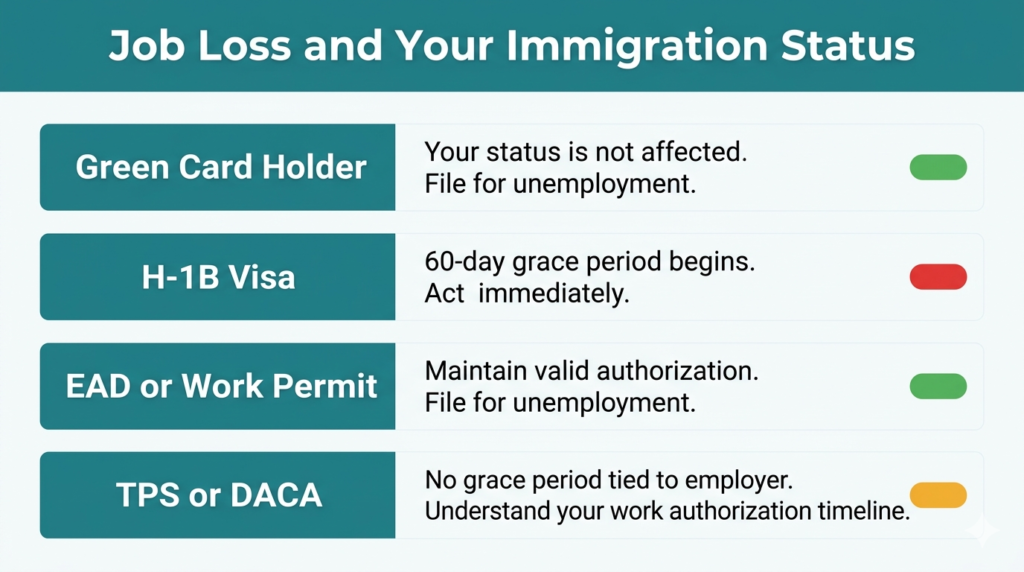
Green Card Holders (Lawful Permanent Residents)
Your immigration status is not tied to your employer. Losing your job does not affect your green card or your right to remain in the United States. You are free to look for any job you choose without needing a new visa petition. File for unemployment benefits as soon as possible, you are eligible under the same terms as US citizens as long as you meet your state’s work history requirements.
Receiving unemployment insurance does not affect your immigration status. The US Citizenship and Immigration Services (USCIS) does not count unemployment insurance as a public benefit for public charge purposes because it is an earned benefit, one you paid into through payroll taxes during your employment.
H-1B Visa Holders
Your situation is the most time sensitive on this list. When you lose your H-1B job, a 60 day grace period begins automatically. During those 60 days, you are still considered to be in lawful status, but you cannot legally work. You must use that time to do one of the following: find a new employer willing to file an H-1B transfer petition on your behalf, apply to change your visa status to another category, or apply to adjust your status if you have a pending green card application.
Contact an immigration attorney as quickly as possible, ideally within the first week. The American Immigration Lawyers Association (AILA) can help you find qualified attorneys at aila.org. If you cannot afford private counsel, nonprofit legal aid organizations serve immigrants in most major cities.
On unemployment benefits: H-1B holders are generally not considered “able and available” to work in the eyes of state unemployment agencies because your work authorization is tied to a specific employer. Eligibility is complicated and varies by state. Some states will approve claims if a new employer has already filed a transfer petition on your behalf. Consult with an immigration attorney before filing for unemployment on an H-1B.
If your employer sponsored your H-1B and terminated you, they are legally required to pay for your return transportation to your home country if you choose to leave. Keep that in writing.
Employment Authorization Document (EAD) Holders
If your work authorization comes from an EAD, which includes spouses of H-1B workers, pending adjustment of status applicants, asylum applicants who have waited the required period, and certain other categories, your work authorization is generally not tied to a single employer. You can look for any job and are typically eligible for unemployment benefits under the same terms as green card holders, as long as your EAD remains valid during the benefit period.
Watch your EAD expiration date carefully. If your card is close to expiring, file for renewal immediately. USCIS processing times can run several months, and a lapse in your EAD means a lapse in your work authorization.
TPS (Temporary Protected Status) and DACA Holders
Your work authorization is not tied to your specific employer, so losing your job does not immediately threaten your status in the same way it does for H-1B holders. However, the legal landscape for both TPS and DACA has shifted significantly under the One Big Beautiful Bill Act signed in July 2025.
DACA recipients lost eligibility for ACA Marketplace health coverage as of August 25, 2025. TPS holders are scheduled to lose federal Medicaid eligibility and ACA premium tax credit subsidies on December 31, 2026. These changes mean the safety net available to TPS and DACA holders after a job loss is narrower than it was before. Knowing what you are still eligible for, and acting quickly, matters more than ever.
On unemployment: TPS holders with valid work authorization are generally eligible for unemployment benefits. DACA recipients with valid EADs are also generally eligible, though this varies by state. File promptly.
L-1, O-1, and Other Employer Sponsored Visa Holders
Like H-1B holders, your status is tied to your sponsoring employer. The 60 day grace period also applies to L-1 and several other employer-sponsored nonimmigrant categories. Contact an immigration attorney immediately and begin exploring your options within the first week.
Step 2: File for Unemployment Benefits Right Away
If your immigration status makes you eligible for unemployment insurance, file as soon as possible. Do not wait. Benefits are not retroactive to the date you lost your job, they begin from the date you file your claim. Every week you delay is a week of benefits you cannot recover.
Unemployment insurance is administered by each state individually. The amount you receive and the duration of benefits vary depending on where you live and your recent earnings history. In most states, you can expect to receive roughly 40% to 50% of your previous weekly wages, up to a state-set maximum.
To file, go to your state’s unemployment agency website. Most states allow online filing and some offer Spanish language and multilingual portals. You will need your Social Security Number or ITIN, your employer’s information, your last day of work, and your recent earnings history. Your last few pay stubs will have most of this information.
You can find your state’s unemployment office at careeronestop.org/LocalHelp/UnemploymentBenefits/find-unemployment-benefits.aspx.
Once approved, most states require you to certify your job search activity weekly or biweekly to continue receiving benefits. Keep records of every job application you submit.
A note on public charge: Receiving unemployment insurance does not make you a public charge and does not affect your green card renewal, naturalization application, or future immigration filings. USCIS distinguishes between earned benefits (like unemployment insurance, which you paid into through taxes) and means-tested public benefits. Unemployment insurance falls in the earned category.
Step 3: Handle Your Health Insurance Immediately
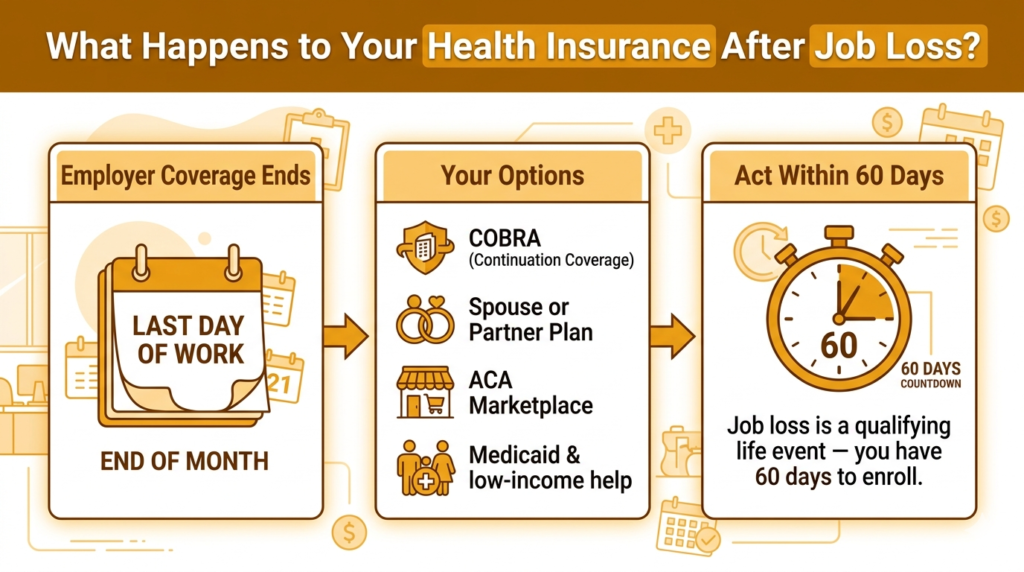
Health coverage is the second most urgent issue after immigration status. A medical emergency without insurance can wipe out years of savings in a single hospital visit. Do not let your coverage lapse without a plan in place.
COBRA Continuation Coverage
Under the federal COBRA law, you have the right to continue your employer-sponsored health insurance for up to 18 months after losing your job. Your employer must send you a COBRA election notice within 14 days of your coverage ending. You then have 60 days to decide whether to enroll.
The catch: COBRA is expensive. When you were employed, your employer paid a portion of your premium, often 70% to 80% of the total cost. Under COBRA, you pay the full premium yourself, plus a 2% administrative fee. For a single person, this can run $400 to $600 per month. For a family, it can exceed $1,500 per month.
COBRA makes the most sense if you expect to find new employment quickly, if you have ongoing medical needs or prescriptions that require continuity of care, or if you are mid-treatment for a condition and switching plans would be disruptive.
ACA Marketplace Coverage
Job loss is a qualifying life event, which means you have a 60 day special enrollment window to sign up for a health insurance plan through the ACA Marketplace at healthcare.gov. You do not have to wait for the annual open enrollment period.
Depending on your income during the gap in employment, you may qualify for premium tax credits that significantly reduce your monthly cost. Marketplace plans are available to most lawful immigrants including green card holders, H visa holders, EAD holders, TPS holders, and many others. DACA recipients are no longer eligible for Marketplace coverage as of August 25, 2025.
If your income drops to below 138% of the federal poverty level in a state that expanded Medicaid, you may qualify for Medicaid rather than a Marketplace plan. Medicaid is free or very low cost and provides comprehensive coverage.
Your Spouse or Partner’s Plan
If your spouse or domestic partner has employer-sponsored health coverage, losing your job qualifies you to be added to their plan outside of the annual enrollment window. Contact their HR department as soon as possible.
Step 4: Protect Your Money Right Now
The week you lose your job is the week to get ruthlessly clear about your finances. Not panicked. Clear.
Pull up your bank account and identify your exact monthly expenses. Separate the non-negotiables, rent, utilities, groceries, transportation, minimum debt payments, from everything else. This is your survival number, and it tells you how many weeks or months your current savings can cover your basic needs. If you have never sat down and mapped this out before, our guide on how to make enough money to survive here walks through exactly how to find your number and what to do when it does not add up.
Then contact the providers of your non-negotiable expenses and let them know your situation before you miss a payment. Most utility companies have hardship programs. Many landlords will negotiate a temporary arrangement rather than begin an eviction process. Federal student loan servicers offer income-driven repayment plans and deferment options. Credit card companies often have hardship programs that temporarily reduce your minimum payment or interest rate. None of these options disappear if you ask for them proactively, they often do disappear once you have already missed payments and gone into collections.
Understanding what is actually leaving your account each month, including the payroll deductions you may never have examined closely, is a foundational step. If you have not looked carefully at how your pay was broken down before now, our guide on your first US pay stub explained walks through every deduction line and what it means.
Step 5: Find Emergency Financial Help
You do not have to survive this entirely on savings and unemployment benefits. There are real resources available to people in exactly your situation.
211.org is the fastest way to find emergency assistance near you. Dial 2-1-1 from any phone or go to 211.org and enter your zip code. The service connects you with local nonprofits and government programs covering rental assistance, utility help, food assistance, and more. It is available 24 hours a day and in multiple languages including Spanish.
Local food banks and food pantries serve anyone in need regardless of immigration status. You do not need to show documents. You do not need to be at a certain income level. Feeding America’s food bank locator at feedingamerica.org can find the nearest location.
SNAP (food stamps) may be available to you depending on your immigration status. Green card holders who have been residents for at least 5 years are generally eligible. Some states have removed the 5 year waiting period for children and pregnant women. DACA recipients and undocumented immigrants are not eligible for federal SNAP, though some states fund their own versions of food assistance for those groups.
Community organizations are often the fastest and most culturally familiar source of help. Many immigrant communities have churches, mosques, temples, ethnic associations, and mutual aid networks that provide emergency assistance to members. These networks exist outside the formal benefit system and often reach people who do not qualify for government programs.
Step 6: Start Your Job Search Strategically
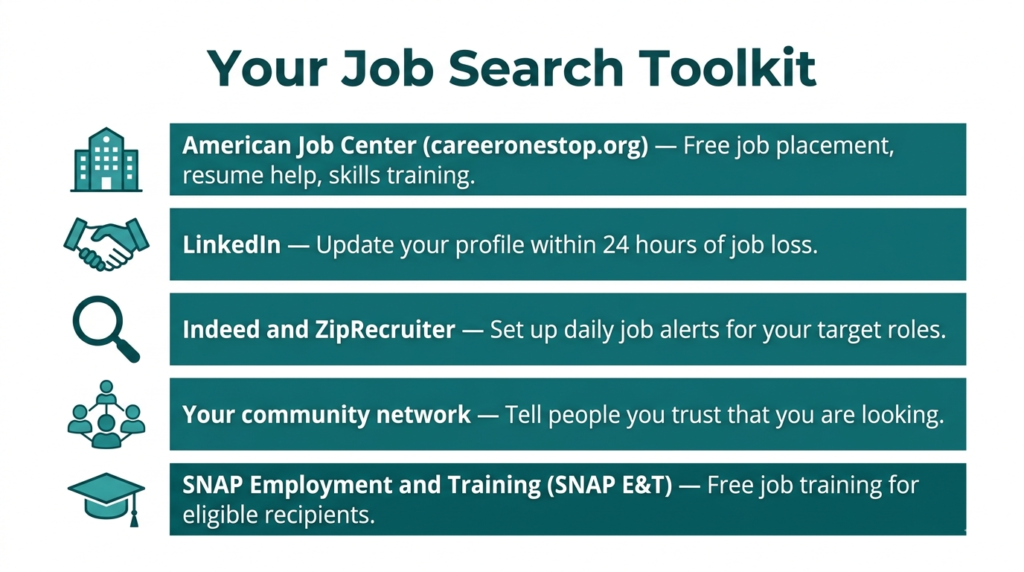
Looking for work as an immigrant in 2026 comes with the same tools as anyone else, plus a few that are specifically useful for navigating work authorization questions.
Update your LinkedIn profile immediately. Change your status to “Open to Work” and make sure your most recent role is current. Recruiters actively search LinkedIn, and an outdated profile is a missed opportunity.
The American Job Center network (careeronestop.org) offers free job placement assistance, resume help, skills training referrals, and information about local labor market conditions. Centers are available in every state and many offer services in Spanish and other languages. This is a federally funded resource most immigrants never use.
Be clear about your work authorization on applications. Do not overstate or misrepresent your status. Employers who sponsor visas will ask directly. Employers who do not require sponsorship will also ask. Being honest early saves everyone time and protects you from offers that fall apart during onboarding verification.
Your community network is still your fastest path to employment. Research consistently shows that a significant majority of jobs are filled through personal connections rather than job boards. Tell people in your community, neighbors, fellow congregation members, former colleagues, friends of friends, that you are looking and what kind of work you do. Someone always knows someone.
If you are thinking about this period as an opportunity to earn differently, whether through gig work, a service you can offer your community, or a skill you want to develop, our guide on how immigrants can make money and build income from scratch covers realistic options by timeline.
A Note on What Is Different in 2026
The safety net for immigrants after a job loss has changed meaningfully in the past year. Several key updates are worth knowing:
The One Big Beautiful Bill Act, signed in July 2025, tightened eligibility for several federal programs. TPS holders will lose Medicaid eligibility and ACA subsidy access by the end of 2026. DACA recipients already lost ACA Marketplace eligibility in August 2025. Lawfully present immigrants earning below the federal poverty level can no longer access premium tax credits for ACA plans.
These changes mean the window for accessing certain forms of assistance is narrower than it was in previous years. Acting quickly after a job loss, filing for unemployment immediately, securing health coverage within the 60 day window, connecting with community resources before savings run out, is more important than ever.
The Emotional Side Nobody Talks About
Job loss is a financial emergency. It is also an emotional one.
For immigrants especially, the identity and status that come with steady employment are deeply tied to why many of us came here in the first place. Losing a job can feel like losing the justification for everything you sacrificed, the distance from family, the years of building from nothing, the proof that the move was worth it.
It was worth it. And this moment does not change that.
The practical steps in this guide will help you stabilize your situation. But stabilizing your situation takes time, and in that time, it is okay to feel what you feel. Lean on your community. Be honest with people you trust about what is happening. Many of them have been through something similar. You are not the first immigrant to lose a job, and you will not be the last. What defines this chapter is not that it happened but what you do next.
You have already done harder things than this.
Quick Reference Checklist
Use this in the first 7 days after losing your job:
Day 1: Do not sign any separation documents immediately. Ask for time to review. Find out your last day of health insurance coverage. Check your savings and calculate how many months of basic expenses you can cover.
Days 1 to 3: If on an H-1B, L-1, or other employer-tied visa: contact an immigration attorney immediately. File for unemployment benefits at your state’s unemployment agency website. Start the process for health coverage through COBRA or the ACA Marketplace.
Days 3 to 7: Contact your landlord, utility companies, and loan servicers proactively. Call 2-1-1 to identify local emergency assistance programs. Update your LinkedIn profile and begin your job search. Reach out to your community network.
Disclaimer: This article is for educational and informational purposes only and does not constitute legal, immigration, or financial advice. Immigration rules, benefit eligibility, and program requirements change frequently. Always consult a qualified immigration attorney for advice specific to your visa status and situation, and verify current program eligibility directly with the relevant agencies.