
Remittance Scam Cost Me $12,000: Avoid This Mistake
Her name is Claudia. She is a registered nurse from El Salvador who has lived and worked in Houston for eleven years. She works night shifts at a community hospital in the medical center. She sends money home to her mother every two weeks without fail, the way some people pay a mortgage — not as an obligation exactly, but as something so woven into the structure of her life that she cannot imagine a version of herself that does not do it.
She lost $12,000 to a remittance scam in four months.
Not to a stranger who called her out of nowhere. Not to an obvious con. To a service that had a professional website, a customer support phone number that someone answered, a social media presence with hundreds of followers, and referrals from two people in her church community who had used it successfully before she did.
She gave me permission to tell this story using her first name. She wants it told, she said, because she spent nine months after it happened feeling ashamed of something that was not her fault, and she does not want anyone else to spend nine months in that same silence.
This is her story. And it is also a map of exactly how these operations work, so that you can recognize one before it takes something from you.

How It Started: A Recommendation at Church
In immigrant communities, word of mouth is the most trusted currency there is. When a bank does not know you, when a lender does not recognize your documents, when the formal channels of the American financial system feel inaccessible or indifferent, you rely on the network of people who share your language and your experience and your situation.
This is not naivety. This is rational behavior that has kept communities functioning for generations.
The woman who mentioned the service to Claudia was a member of her church choir. A Salvadoran woman she had known for three years. Reliable, warm, cautious in the way that people who have worked hard for everything they have tend to be cautious.
“She said the rate was better than anything else she had found,” Claudia told me. “She said her family in San Salvador had received the money within an hour every single time.”
A second woman in the same community confirmed it. She had used the service four times. It was fast. The exchange rate was genuinely excellent. The fees were low. There was a phone number.
Claudia downloaded the app.
The First Few Months: Everything Worked
This is the part that most people do not understand about sophisticated financial scams targeting immigrant communities. They work first.
The first transfer Claudia made was $800. Her mother received it within two hours. The exchange rate was better than what she had been getting through the service she previously used. The fee was $3.99. She received a text confirmation. Her mother sent a voice message laughing with relief at how quickly it arrived.
She used the service again two weeks later. Then again. Over the first three months, she made eight transfers totaling just over $4,000. Every single one was delivered. Every single one arrived faster than expected.
During this period she mentioned the service to three other people in her community. Two of them started using it. This is how the operation sustains itself in its early phase — it delivers reliably to real recipients, building genuine word of mouth that funds its own expansion.
“I trusted it completely,” she said. “More than I trusted the big companies. Because real people I knew told me it was real.”
The Warning Signs She Missed (That You Need to Know)
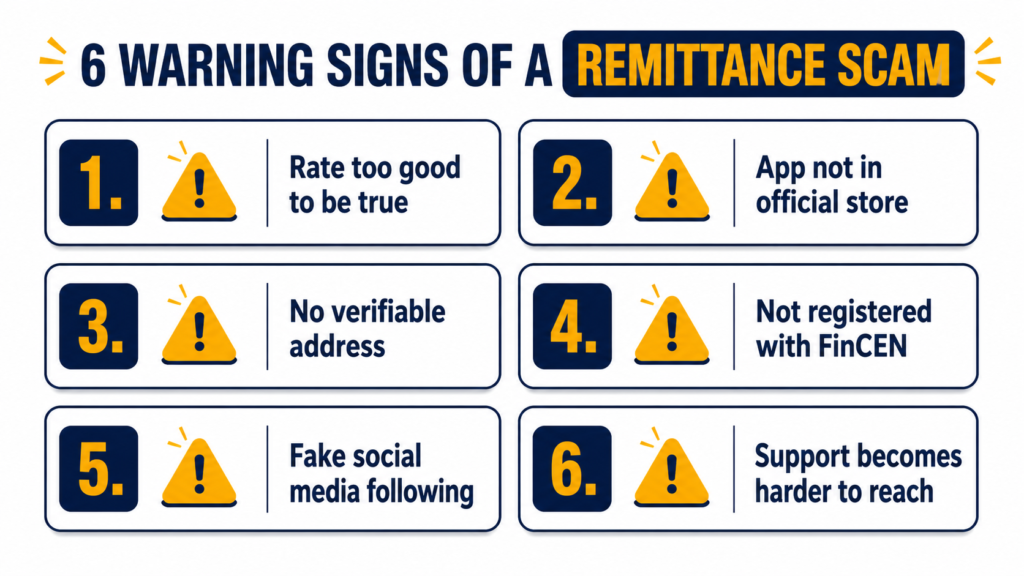
Looking back, Claudia can identify six warning signs that she did not recognize at the time. She asked me to list them plainly because she wants this to be the section that saves someone else.
Warning sign one: the exchange rate was too good.
The service consistently offered an exchange rate 2% to 3% better than the mid market rate available through legitimate services. At the time, Claudia interpreted this as simply a more competitive business. In reality, exchange rates significantly above market rate are a consistent feature of fraudulent remittance services. The profit model of legitimate services depends on a small margin on the rate. When that margin disappears, something is wrong.
Warning sign two: the app was not in any major app store.
She downloaded it through a link sent to her by the woman from church, not through the Google Play Store or Apple App Store. She did not notice the difference at the time. Legitimate financial services operate through regulated app distribution channels because those channels enforce compliance standards. A transfer service that distributes its app through a direct link is operating outside that accountability structure for a reason.
Warning sign three: the company had no verifiable physical address.
The website listed an address in Miami. When Claudia eventually searched for that address after everything fell apart, she found it was a virtual mailbox service that anyone can rent for $29 a month. The customer support phone number was answered by a person, but that person could not provide a license number, a state registration, or any regulatory information when asked directly.
Warning sign four: the service was not registered with FinCEN.
Every legitimate money transfer business operating in the United States is required to register with the Financial Crimes Enforcement Network, a bureau of the US Department of the Treasury. You can search the FinCEN MSB (Money Services Business) registrant database for free at fincen.gov. The service Claudia used did not appear in that database. She did not know this check existed.
Warning sign five: social media followers were mostly inactive accounts.
When Claudia later examined the service’s social media presence more carefully, she found that the hundreds of followers were accounts with no photos, no posts, and no activity. They were purchased followers created to simulate legitimacy. At the time, the number alone had been enough to reassure her.
Warning sign six: the customer support became harder to reach over time.
In the final month before the collapse, Claudia noticed that calls to the support number were ringing longer before being answered. Response times to her messages slowed. She attributed this to the service growing quickly. It was actually the early signal of an operation beginning to wind down.
The Month Everything Changed
In the fourth month of using the service, Claudia received a message through the app from what appeared to be the company’s customer support team.
Her account had been flagged for verification, the message said. This was a routine compliance process required by new anti money laundering regulations. To continue using the service without interruption, she needed to complete enhanced verification within 72 hours.
The verification process required her to transfer a larger amount as a “verification deposit”, $3,000 – which would be used to confirm her identity as a legitimate sender and would be fully refunded to her account within 24 hours of verification completion, available to use for future transfers.
She hesitated. She called the support number. Someone answered, confirmed the process, assured her the amount would be returned, and told her this was required by new FinCEN regulations.
She transferred $3,000.
The money was never returned.
When she called the following day to ask about the refund, the call was answered initially, then began to ring without answer, then went to a generic voicemail. When she tried to access her account to contact support through the app, she received an error message telling her the app was temporarily unavailable for maintenance.
Three days later, the app stopped loading entirely.
She contacted the two women from her church who had referred her. Neither had received the verification message. The operation had not targeted them, or not yet. Claudia had been selected, likely because her transfer history showed a consistent pattern of larger amounts, making her a higher value target for the final extraction.
The $12,000 Accounting
The total loss was not the $3,000 verification deposit alone.
Over the four months she had used the service, she had also deposited what the platform called a “loyalty balance” — an optional feature that allowed users to pre load funds to make transfers faster. She had deposited $9,000 into this balance over three months, which the platform had used to fund her individual transfers while her actual deposits accumulated. When the platform disappeared, that entire pre loaded balance disappeared with it.
The final accounting: $9,000 in loyalty balance deposits plus $3,000 in the fraudulent verification extraction. Twelve thousand dollars.
Eleven years of night shifts. Money she had been setting aside specifically for a home down payment. Money that represented, by her calculation, approximately 600 hours of patient care delivered in the ICU of a Houston hospital.
“I sat in my car in the hospital parking garage for a long time,” she said. “I did not go inside for maybe two hours. I just sat there.”
What She Did Next
Claudia filed a police report. She submitted a complaint to the Federal Trade Commission through ReportFraud.ftc.gov. She filed a complaint with the Consumer Financial Protection Bureau. She submitted a tip to the FBI’s Internet Crime Complaint Center at ic3.gov. She contacted her bank to report the transactions as fraud.
She received a case number from the FTC. Her bank was unable to reverse the transfers because she had authorized them voluntarily. The FBI opened a file. She has not heard back.
The honest truth, which Claudia knew and which I am not going to soften, is that the recovery of funds lost to international remittance fraud is rare. The operations are often run from outside US jurisdiction, the money moves quickly through multiple layers, and law enforcement resources devoted to small scale international wire fraud are limited compared to the volume of fraud occurring.
She did not get her money back.
But she filed every report anyway because, she said, each report contributes to the dataset that helps investigators eventually identify and disrupt the operations behind these schemes. Her $12,000 might not come back. The information in her report might help prevent someone else’s.
How She Rebuilt
The practical rebuilding was slow and methodical in the way that recovering from a financial setback always is when you are doing it on a nurse’s salary while still sending money home.
She opened a savings account specifically designated for rebuilding the down payment fund and set up an automatic transfer on every payday. She reduced her monthly remittance amount temporarily, an extraordinarily difficult conversation with her mother that involved explaining, in broad terms, what had happened. Her mother cried. Then her mother told her to stop sending anything at all until she was stable.
She sends less now than she used to. The wound of that is still present. But it is healing.
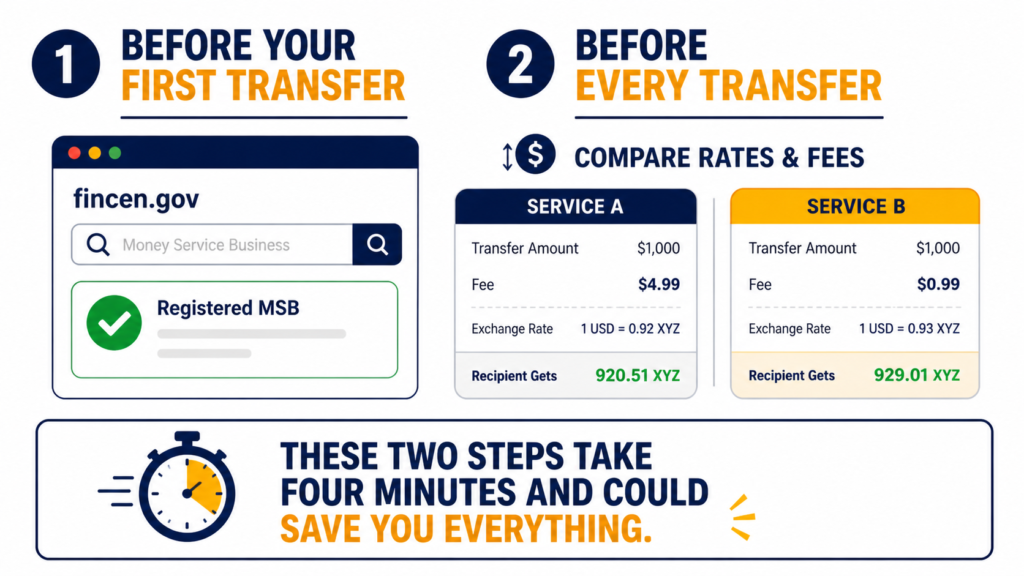
For her actual transfers, she moved to Wise, which she verified through the FinCEN database before her first transaction and which uses the real mid market exchange rate with a transparent flat fee shown before you confirm. She also compared it on Monito, a free comparison tool that shows the real total cost of a transfer across multiple legitimate services. These two steps, database check and rate comparison, take about four minutes total and have become non negotiable parts of her transfer process.
“I check FinCEN every time now,” she said. “Even for services I have been using for a year. It takes one minute. I do not know why I did not know this existed before.”
The Mechanics of How These Scams Work
I want to step outside Claudia’s story for a moment and explain the operational structure of remittance scams targeting immigrant communities, because understanding the pattern helps you see it more clearly when you encounter it.
Remittance fraud operations targeting immigrant communities typically follow one of three models:
The slow burn model is what happened to Claudia. The operation delivers real transfers for weeks or months, building genuine trust and real word of mouth. It then either extracts a large final payment through a fake verification or compliance requirement, or simply disappears with any pre loaded balances on the platform. The longer it delivers reliably, the larger the community of trusted referrers it builds, and the larger the eventual extraction.
The phantom exchange model takes money from senders in the US and simply never transmits it to recipients abroad. Senders believe the transfer was made. Recipients have no expectation of money. By the time the disconnect is discovered, the operation has already collected from dozens of additional senders.
The identity harvest model is primarily designed to collect financial and personal information. The transfer itself may actually work, but the platform is logging your bank account details, your ITIN or SSN, your address, and your transfer history for use in future identity theft or account takeover operations.
All three models share common operational features: professional surface presentation, initial delivery to build trust, referral reliance to expand reach, and an exit that happens before regulatory attention becomes focused.
How to Send Money Home Safely
This is the section Claudia specifically asked me to include, because she wanted something actionable to come out of her story.
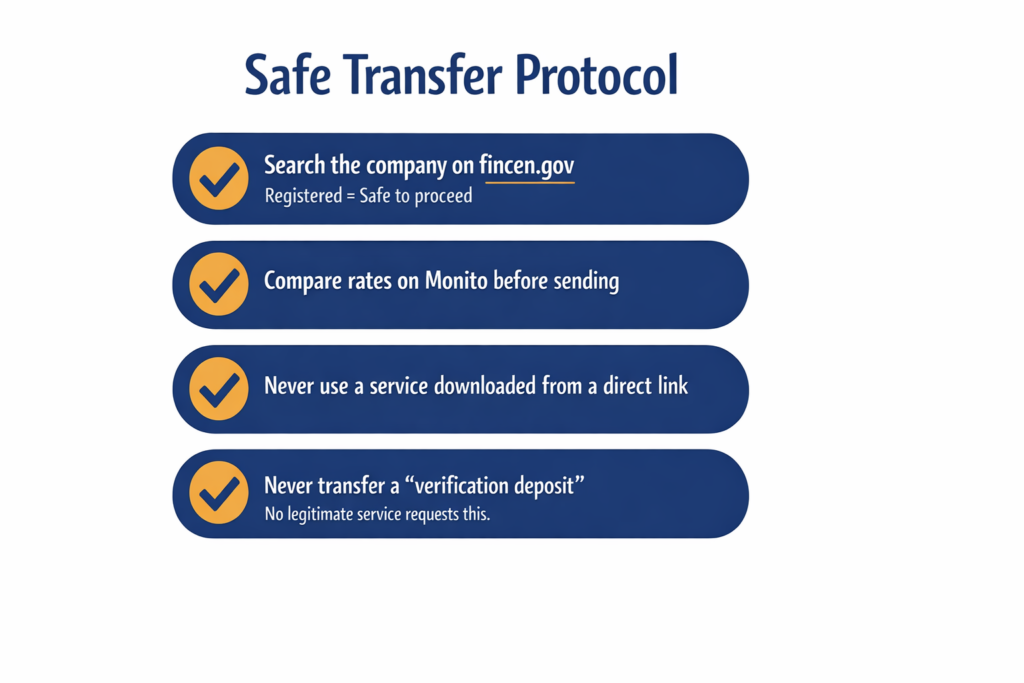
The single most important protective step is the FinCEN MSB registration check. Before using any money transfer service for the first time, go to fincen.gov and search their MSB registrant database for the company name. If the company is not listed, do not use it. This is a free, two minute check that eliminates the vast majority of fraudulent operations because legitimate registration is a legal requirement that fraudulent services cannot fulfill.
The second step is using the Monito comparison tool to check exchange rates and fees across verified legitimate services before each transfer. The services that consistently appear at the top of Monito comparisons for most corridors are Wise, Remitly, and WorldRemit for most destinations.
Wise operates on the real mid market exchange rate and charges a transparent flat fee shown in full before you confirm. You can see exactly what your recipient will receive before you send anything.
Remitly is built specifically for immigrant senders and offers a delivery guarantee — if your transfer arrives late, the fee is refunded. They also have a track record of reliable delivery to corridors including El Salvador, Mexico, the Philippines, Nigeria, Guatemala, Honduras, and dozens of others.
WorldRemit covers destinations that Wise and Remitly sometimes do not, particularly in parts of Africa and Central America, and offers mobile money delivery options for recipients who do not have bank accounts.
None of these services have perfect records. But all of them are regulated, registered, and operating within a framework that provides some recourse if something goes wrong. That framework is what Claudia did not have.
What the Authorities Want You to Know
The Federal Trade Commission, the Consumer Financial Protection Bureau, and the FBI have all issued guidance on remittance scams targeting immigrant communities. The consistent messaging across all three agencies includes the following:
No legitimate money transfer service will ever ask you to make a deposit to verify your identity. If a service asks you to transfer money in order to unlock a refund, receive a transfer, or complete a compliance process, stop immediately. This is the defining characteristic of extraction fraud.
No legitimate service will pressure you to act within a short time window on a large financial decision. Urgency is a deliberate tool used by fraud operations to prevent you from pausing long enough to verify what you are being told.
If you have lost money to a remittance scam, report it even if you believe recovery is unlikely. Go to ReportFraud.ftc.gov. Submit a complaint to the CFPB at consumerfinance.gov/complaint. File a tip at ic3.gov. These reports build the investigative record that allows authorities to identify and disrupt operations before they take more from more people.
A Note on Community Trust and How Scammers Exploit It
I want to say something directly about the dynamic that made Claudia’s situation possible, because I think it deserves to be named plainly.
The remittance scam operations that target immigrant communities are specifically designed to exploit the trust networks that those communities depend on for survival. They seed referrals by delivering real service in the early phase, knowing that the referral from a trusted community member is worth more than any advertising. They use the specific vulnerabilities of immigrant financial life — limited access to mainstream financial services, reliance on informal networks, the urgency of family obligation — as the mechanism of harm.
Claudia was not foolish. She was trusting people she had real reason to trust, operating in a financial landscape where that trust network had historically been a source of protection rather than risk.
The scam worked not because she made a naive decision but because the operation was specifically built to pass the tests that a careful, experienced person in her community would naturally apply.
Understanding this does not make the money come back. But it might make the nine months of silence that followed feel less deserved.
A Final Word From Claudia
I asked her what she wanted someone reading this to do immediately after finishing it.
She said: look up FinCEN. Right now, before you close this page. Go to fincen.gov and search the name of the service you currently use to send money home. Confirm that it is registered. It takes less than two minutes. Do it today.
Then check Monito or a similar comparison tool the next time you are ready to send. Compare the total amount your family will receive across three or four services. The difference between services on a $500 transfer can be $20 to $40. Over a year of regular transfers, that adds up.
And if anyone, anywhere, through any channel, asks you to make a transfer in order to receive a transfer, hang up, close the app, and report it immediately to the FTC.
“I want one person to read this and do the FinCEN check,” she said. “Just one. And then I want them to tell the person next to them. Because that is how it would have been stopped for me, one person in that chain knowing what to look for.”

Claudia’s surname has been withheld at her request. Her story has been shared with her knowledge and consent. If you believe you have encountered a fraudulent remittance service, report it to the FTC at ReportFraud.ftc.gov, the CFPB at consumerfinance.gov/complaint, and the FBI at ic3.gov.
Claudia was not compensated for sharing her story. The services recommended here were chosen based on their regulatory standing, transparency, and track record — not their affiliate terms.