
Your First US Pay Stub Explained: What All Those Deductions Mean
The first time I looked at an American pay stub, I genuinely thought there had been a mistake.
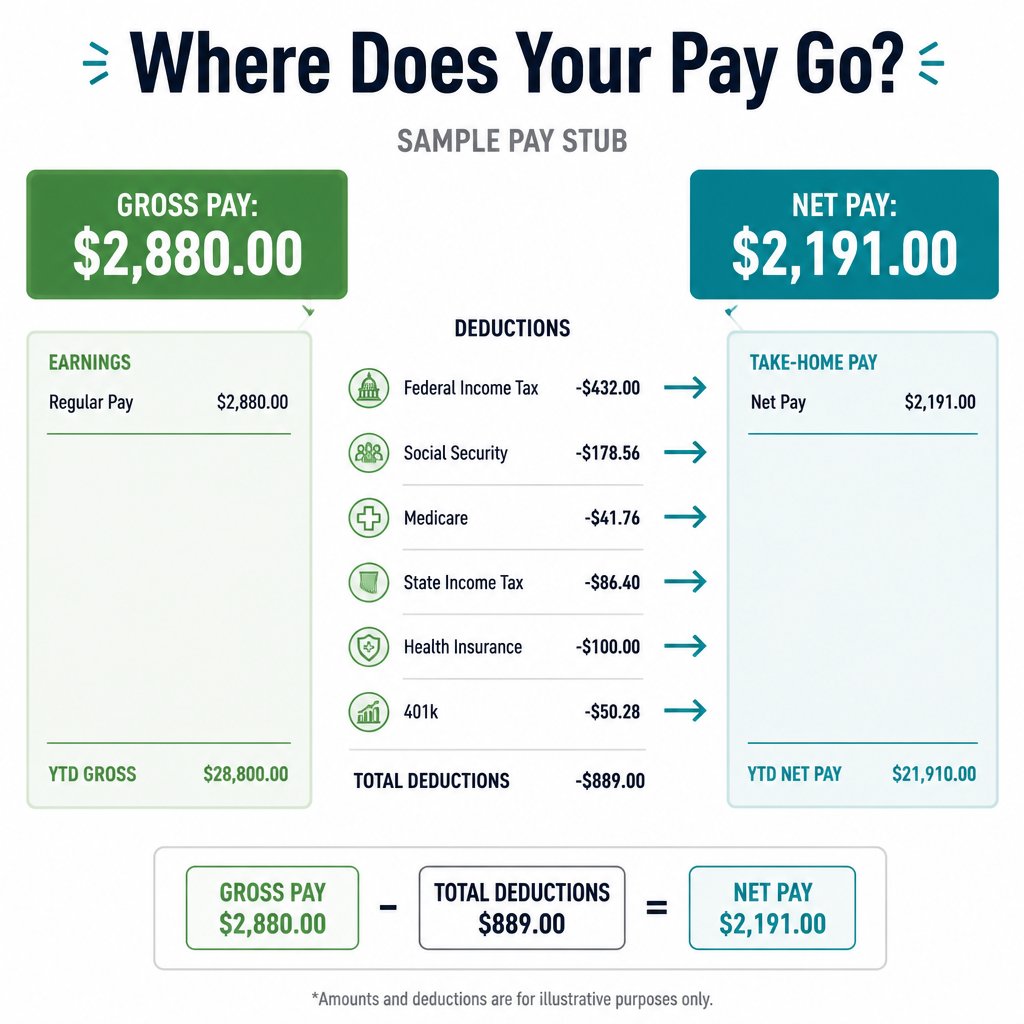
I had accepted a job at $18 an hour. I had done the math. Forty hours a week, four weeks in a month, that was supposed to be $2,880 before anything. But the number on the check sitting in my hand was $2,191. Nearly $700 had disappeared before I ever touched it, taken by a list of acronyms I had never seen in my life: FWT, FICA, OASDI, SWT, SDI.
I called my supervisor. She laughed, not unkindly, and said, “Welcome to America.”
Nobody explained it. I just had to figure it out.
If you are holding your first US pay stub right now and feeling that same quiet confusion, this article is what I needed then. We are going to go through every single line, in plain language, so that by the time you finish reading you know exactly where your money is going and why.
The Big Picture First: Gross Pay vs. Net Pay
Before we get into individual lines, the most important concept on any pay stub is the difference between two numbers.
Gross pay is what you earned before anything is taken out. If you work 40 hours at $18 an hour, your gross pay is $720 for that week. This is the number your employer agreed to pay you. It is the number on your offer letter. It is not, however, the number you will see deposited into your bank account.
Net pay is what you actually receive after all deductions have been subtracted. This is the real number. The money that hits your account. The money you can spend.
The gap between those two numbers is the thing this article explains.
Section 1: Your Earnings
The top section of most pay stubs shows how your gross pay was calculated. Depending on how you are paid, this section might look different.
Hourly employees will see their hourly rate multiplied by hours worked. If you worked 40 regular hours and 3 overtime hours, you will typically see two lines: one for regular hours at your base rate, and one for overtime hours at 1.5 times your base rate.
Salaried employees will typically see one flat gross pay line per pay period regardless of hours worked, since salaried pay is fixed.
Year-to-date (YTD) figures appear on most pay stubs next to the current period amounts. These show the running total of what you have earned, and what has been deducted, since January 1st of the current year. These numbers matter when you file your taxes, so do not throw away old pay stubs.
Section 2: Federal Tax Deductions
This is where most of the deductions come from, and where most of the confusion begins.
Federal Income Tax (FIT or FWT)
This is the tax you pay directly to the federal government on your earnings. The amount withheld from each paycheck depends on two things: how much you earn and what you put on your Form W-4.
When you started your job, your employer gave you a Form W-4 to complete. This form tells your employer how much federal income tax to withhold from each check. If you filled it out incorrectly, which is easy to do when you are new and nobody explains it, you may be having too much or too little withheld. Too much and you get a large refund at tax time but you were lending the government your money all year for free. Too little and you owe a tax bill in April that can surprise you badly.
The United States uses a progressive tax system, meaning different portions of your income are taxed at different rates. In 2026, those rates range from 10% on your lowest income tier up to 37% on income above certain thresholds. You never pay the highest rate on all of your income, only on the portion that falls in each bracket.
If you want to understand how your total annual federal tax bill is calculated, our guide on how to file US taxes as a newcomer step by step walks through exactly how the filing process works and what these withholdings add up to at year-end.
Social Security Tax (OASDI or SS)
OASDI stands for Old-Age, Survivors, and Disability Insurance. You will also see this labeled simply as Social Security on some stubs. The rate is 6.2% of your gross wages, up to an annual earnings cap of $176,100 for 2025. Once you earn above that cap in a year, Social Security withholding stops for the remainder of that year.
This money goes toward the federal Social Security retirement program. Every paycheck where you pay into Social Security is building credits toward your future retirement benefits. You need 40 lifetime credits, roughly 10 years of work, to qualify for Social Security retirement benefits when you reach retirement age. As an immigrant, those credits belong to you even if you eventually leave the United States, and some countries have totalization agreements with the US that allow you to combine work credits from both countries.
Medicare Tax (MED or Medicare HI)
This is a separate tax from Social Security, also part of FICA (Federal Insurance Contributions Act). The rate is 1.45% of your gross wages with no earnings cap, meaning unlike Social Security, every dollar you earn all year is subject to Medicare tax. If your annual income exceeds $200,000 as a single filer, an additional 0.9% Medicare surtax applies, but that affects very few newcomers in their early years.
Medicare funds the federal health insurance program for people 65 and older. Like Social Security, you are building eligibility credits as you pay into it.
Together, Social Security and Medicare taxes (6.2% + 1.45%) equal 7.65% of your gross wages. Your employer pays an identical 7.65% on top of your wages, you each contribute the same amount. This is something most employees never realize.
Section 3: State and Local Tax Deductions
State Income Tax (SWT or SIT)
Most US states charge their own income tax on top of federal income tax. The rate and structure vary significantly by state. California has a progressive state income tax with rates up to 13.3%. Texas, Florida, Nevada, Washington, Wyoming, South Dakota, and Alaska have no state income tax at all, meaning if you work in one of those states, this line will either not appear or show zero.
If you live in a high-tax state like California or New York, state income tax can be a substantial portion of your deductions, sometimes 5% to 10% of your gross pay depending on your income level.
State Disability Insurance (SDI) and Other State Programs
Several states require contributions to state programs that provide short-term disability benefits, paid family leave, or unemployment insurance. California’s SDI is one of the most common examples, deducted at a rate of 1.1% of gross wages in 2025. New York, New Jersey, Hawaii, and Rhode Island have similar programs.
If you see a line on your stub you do not recognize, search the abbreviation along with your state name, most state tax agencies have plain-language explanations of every deduction on their websites.
Local Income Tax
Some cities and counties charge their own local income tax on top of state tax. New York City, Philadelphia, and Detroit are among the most well-known examples. If you live or work in one of these cities, you will see a local tax line on your stub. If you live in a city without local income tax, this line will not appear.
Section 4: Benefits and Voluntary Deductions
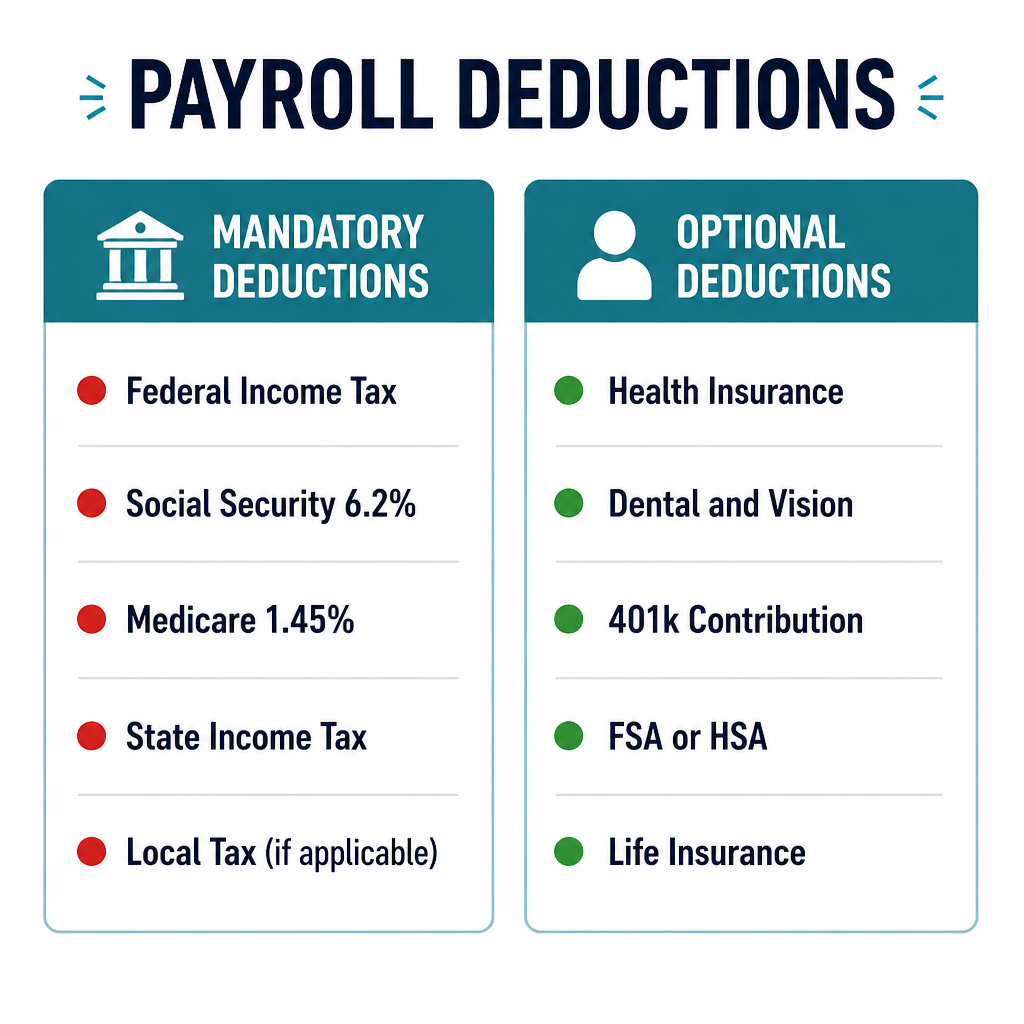
These deductions are different from taxes in one important way: they are either chosen by you or negotiated as part of your employment. They reduce your taxable income in many cases, which means they actually lower the amount of tax you owe.
Health Insurance Premiums
If your employer offers health insurance and you enrolled, your portion of the premium is deducted from each paycheck. This is typically the largest voluntary deduction for most employees. The amount depends on the plan you chose, whether you added dependents, and how much your employer contributes.
Health insurance premiums deducted pre-tax reduce your taxable income, meaning you pay tax on a lower number, which is a genuine benefit even though you are seeing money leave your check.
If your employer does not offer health insurance, or if you are between jobs, you may need to explore options through the Healthcare.gov marketplace.
401(k) or Retirement Plan Contributions
If you enrolled in your employer’s retirement plan, your contribution comes out of your paycheck before federal income tax is calculated. This is called a pre-tax contribution and it is one of the most valuable financial tools available to you as a working immigrant.
For 2025, you can contribute up to $23,500 per year to a 401(k). Every dollar you contribute reduces your taxable income by that same dollar, meaning it lowers your tax bill while simultaneously growing your retirement savings.
If your employer offers a matching contribution, for example, matching 50% of your contributions up to 6% of your salary, that match is essentially free money added to your account. Not contributing enough to capture the full match is one of the most common and most costly financial mistakes immigrants make in their first years of US employment.
Flexible Spending Accounts (FSA) and Health Savings Accounts (HSA)
These are optional accounts that let you set aside pre-tax money for healthcare or dependent care expenses. Contributions reduce your taxable income, and withdrawals for qualifying expenses are tax-free. FSAs are use-it-or-lose-it within the plan year for most expenses. HSAs are only available with certain high-deductible health plans but carry over indefinitely and can be invested.
Dental, Vision, and Life Insurance
If your employer offers these benefits and you enrolled, the premiums appear as separate lines. Like health insurance premiums, these are typically deducted pre-tax.
Section 5: The Lines That Confuse People Most
A few specific items trip up nearly every newcomer the first time they see them.
Imputed Income
If your employer provides certain non-cash benefits, like life insurance coverage over $50,000, or health coverage for a domestic partner, the IRS requires that the value of those benefits be included in your taxable income. This shows up as an addition to your gross income on your pay stub even though you never received any actual cash. It means you pay tax on the value of a benefit you received in kind.
Garnishments
If a court has ordered a portion of your wages to be sent directly to a creditor, a child support agency, or a tax authority, that deduction appears on your stub labeled as a garnishment. If you see this and do not expect it, contact your HR department immediately to understand what order it relates to.
Reimbursements
Some employers include expense reimbursements, for travel, tools, or supplies you paid out of pocket for work, on your pay stub. These are not income and should not be taxed. They will typically appear as a separate line that adds to your net pay without affecting your gross or your taxes.
What to Do If Something Looks Wrong
Pay stubs contain errors more often than most people realize. Here is how to check yours:
Step 1: Multiply your hourly rate by hours worked. Compare to the gross pay on your stub. If those numbers do not match, report it to your payroll department immediately.
Step 2: Calculate 7.65% of your gross wages. That should roughly match your combined Social Security and Medicare deductions.
Step 3: If you are in a state with income tax, verify the rate for your income level on your state’s tax agency website and compare it to what is being withheld.
Step 4: Check that your 401(k) or health insurance deductions match the amounts you enrolled for during your benefits enrollment period.
If you find a discrepancy, put your concern in writing, even if it is just an email, to your HR or payroll department. Keep a copy. Payroll errors do happen and employers are legally required to correct them.
Why Your Pay Stub Matters at Tax Time
Every deduction on your pay stub throughout the year feeds directly into your annual tax return. The federal income tax withheld from every paycheck is credited against the tax you owe for the year. If too much was withheld, you get a refund. If too little was withheld, you owe the difference.
This is why understanding your W-4 and your withholding matters long before April. If you consistently receive a very large refund, you may be having too much withheld, which means the government is holding your money interest-free all year. Adjusting your W-4 to withhold less can put that money in your pocket month by month instead.
Your employer sends you a Form W-2 by January 31st each year, which summarizes your total annual wages and total withholdings across all your pay periods. That form is the foundation of your tax return.
Understanding what tax deductions you may be missing as a migrant can make a significant difference in what you owe, or what you get back, when you file.
How Your Deductions Connect to Your Bigger Financial Picture
Once you understand where your money is going on each paycheck, you can start making it work harder.
Your net pay is the real number to budget from. Not your gross salary. When you see an apartment listing that says it requires income of “three times the monthly rent,” landlords are typically looking at gross income, but your actual ability to pay comes from net pay. Understanding this distinction helps you budget realistically rather than optimistically.
If you are trying to figure out how to make the most of what lands in your account, our guide on how to manage your money as a newcomer in the US is a good next step. And if your net pay is not covering your expenses, the honest breakdown in how to make enough money to survive here addresses that directly.
The 401(k) deduction on your pay stub, meanwhile, connects directly to building long-term wealth. If you want to understand how that money grows over time and what happens to it if you ever leave the US, our article on what happens to your 401k if you leave the US covers the options in detail.
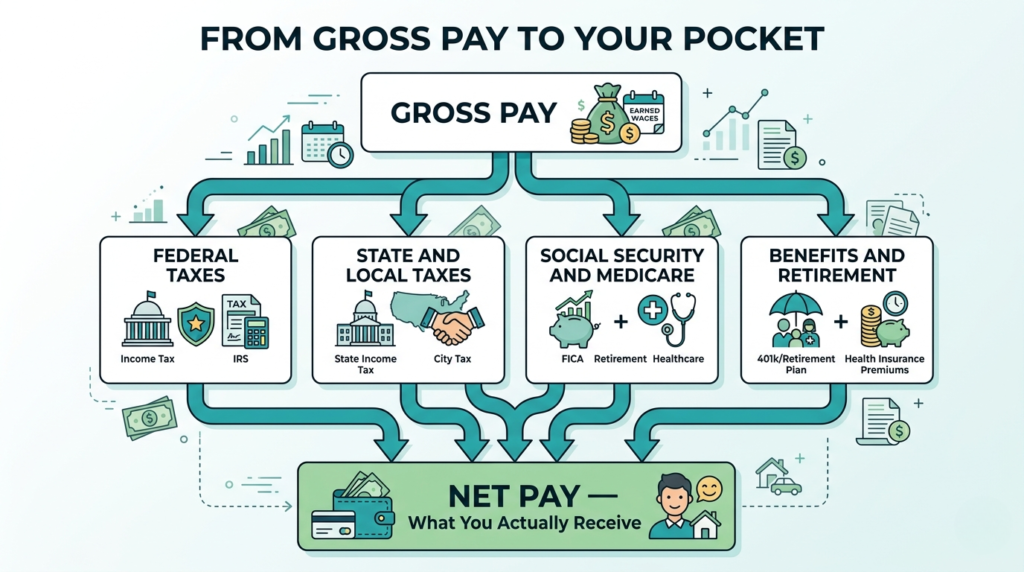
The Short Version: What Every Line Means
| Line on Your Stub | What It Is | Rate or Amount |
|---|---|---|
| Gross Pay | Total earned before deductions | Your rate x hours |
| Federal Income Tax | Tax owed to federal government | Varies by income and W-4 |
| Social Security (OASDI) | Federal retirement program | 6.2% of gross |
| Medicare | Federal health program for seniors | 1.45% of gross |
| State Income Tax | Tax owed to your state | Varies by state (0% to 13%+) |
| Local Tax | Tax owed to your city or county | Varies or may not apply |
| Health Insurance | Your share of employer health plan | Varies by plan |
| 401(k) | Your retirement contribution | Amount you elected |
| FSA or HSA | Pre-tax healthcare savings | Amount you elected |
| Net Pay | What you actually receive | Gross minus all deductions |
One Last Thing Worth Knowing
All of those taxes being withheld from your paycheck, the Social Security, the Medicare, the federal income tax, they are not just disappearing. They are building something.
Social Security credits toward a future benefit. Medicare eligibility. A tax record that supports your immigration history, your loan applications, your naturalization process. Every pay stub is a document of your presence and contribution in this country.
Keep them. Scan them if you can. And now that you know what every line means, you can read them without that quiet dread that comes from not understanding where your money went.
Disclaimer: This article is for educational and informational purposes only. Tax rates, contribution limits, and withholding rules change annually. Always verify current figures with the IRS, your state tax agency, or a qualified tax professional.