How to Save Money as a New Immigrant in America
Saving money in America is hard for everyone. For a new immigrant, it is a different kind of hard. You are not just managing a budget. You are managing a budget in a new currency, in a city you do not know yet, with costs that nobody warned you about, while possibly sending money home, while building a financial history from nothing, and while paying for the setup costs of an entire life: furniture, a phone plan, a security deposit, work clothes, transportation, and a hundred small things that quietly cost more than you expected.
The advice that exists for saving money in the US was mostly written for people who grew up here. It assumes you have a credit history. It assumes you know what a W-4 is. It assumes you know the difference between a checking account and a savings account and that your bank has no monthly fee. None of those things are safe assumptions for someone in their first year.
This article is written with your actual situation in mind. Every strategy here accounts for the real constraints newcomers face. And every piece of advice here has helped someone in exactly your position keep more of what they earned.
Start With the Number That Actually Matters
Before any saving strategy works, you need one number: your actual monthly take home pay.
Not your annual salary divided by 12. Not the number on your offer letter. The number that lands in your bank account after federal taxes, state taxes, Social Security, Medicare, and any benefits deductions are removed. For most people in the United States, that number is 25 to 35% lower than the gross salary they were hired at.
If you earn $18 an hour and work 40 hours per week, your gross monthly income is approximately $3,120. Your actual take home in most states, after all deductions, is more likely $2,400 to $2,600. Every spending decision and every savings target you set has to be based on the lower number, not the higher one.
Getting clear on this number is the first act of financial control available to you. If you have not done it yet, pull up your last pay stub and find the net pay line. That is your real income. That is what you are working with.
Our article on your first US pay stub explained breaks down every deduction line in plain language if anything on your stub is still unclear.
Strategy 1: Attack Your Three Biggest Costs First
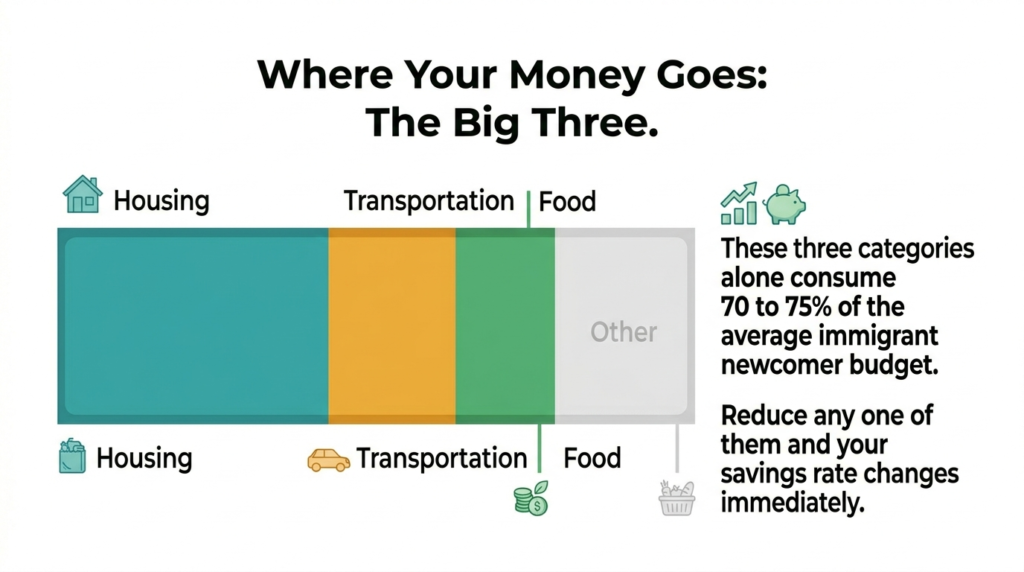
Personal finance advice often focuses on cutting small costs: make your coffee at home, cancel subscriptions, stop eating avocado toast. That advice is not wrong but it misses the point. Small cuts produce small savings. If you want to save meaningfully, you need to focus on the three categories that consume the overwhelming majority of most newcomers’ income: housing, transportation, and food.
Housing
Housing is typically the single largest cost in any immigrant household, often consuming 35 to 45% of take home pay in major cities. The most effective housing strategies for new arrivals are not complicated.
Share housing aggressively in your first year. A two bedroom apartment shared with a roommate costs roughly half what a studio costs. A three bedroom shared between three people costs even less per person. The financial difference between living alone and sharing with one other person can be $600 to $900 per month in most US cities. Over a full year, that is $7,200 to $10,800 that either goes into your savings or goes to your landlord. The choice is yours to make.
Live closer to work, even if the neighborhood is less desirable. Transportation costs, both in dollars and in time, are often underestimated. A slightly larger apartment further from work that requires a car or long commute can easily cost more than a smaller, less glamorous apartment within walking or biking distance.
Negotiate your lease renewal. Landlords almost universally prefer to keep a reliable tenant over going through the cost and uncertainty of finding a new one. When your lease comes up for renewal, ask if the rent can stay flat. You will be surprised how often the answer is yes, particularly if you have been a quiet, reliable tenant who pays on time.
Transportation
Transportation is the second largest variable cost for most newcomers. Owning a car in America is expensive in ways that are easy to underestimate: the monthly payment, insurance (which runs $150 to $300 per month in most states for someone with no US driving history), gas, parking, and occasional maintenance. The total cost of car ownership for a new immigrant can easily run $500 to $800 per month before you drive a single mile.
If public transit is available in your city, use it aggressively in your first year. Monthly transit passes in most cities cost $80 to $130 and eliminate the need for a car entirely if your routes are covered.
If a car is genuinely necessary for your work situation, buy used and pay cash if at all possible. A reliable used vehicle in the $5,000 to $8,000 range that you own outright has zero monthly payment. An auto loan at the interest rates typically offered to someone with no US credit history can carry an APR of 15 to 20%, turning a $15,000 car into a $20,000 car by the time the loan is paid off.
Food
Eating at restaurants in the US is one of the fastest ways to drain a tight budget. A single restaurant meal with a tip costs $15 to $30 for one person. Cooking at home, the same caloric content costs $3 to $6.
Ethnic grocery stores, which your community is likely already using, typically carry staples at dramatically lower prices than chain supermarkets. Rice, beans, lentils, plantains, fresh vegetables, and the specific ingredients your cuisine calls for are almost always cheaper at a neighborhood market than at a national grocery chain.
Meal planning and batch cooking once or twice a week eliminates the temptation to order food when you are tired and hungry and the decision feels hard. Cook a large pot of something on Sunday. Eat from it Monday through Wednesday. Repeat.
Strategy 2: Automate Your Savings Before You Can Spend Them
The most reliable saving strategy that exists is not willpower. It is removing the decision from your hands entirely.
Set up an automatic transfer from your checking account to a separate savings account on the same day your paycheck arrives. The amount does not matter as much as the habit. Even $50 per paycheck adds up to $1,200 per year. Even $25 per paycheck gets you somewhere. The point is that the money moves before you see it, before you account for it in your mental budget for the week, and before something tempting appears.
A high yield savings account pays meaningfully more interest than a standard checking account. While a typical checking account pays approximately 0.08% per year on your balance, a high yield savings account currently pays around 4% annually. On $2,000 in savings, that difference is roughly $78 per year. It is not transformational, but it is free money for choosing the right account.
Keep your savings account at a different bank than your checking account. The small friction of having to log in to a second app to transfer money back creates a pause that often prevents impulsive spending from savings.
Strategy 3: Stop Paying Fees That Should Be Zero
One of the fastest ways to save money as a new immigrant is to identify every fee you are currently paying that you should not be paying at all.
Monthly bank account fees. Many traditional bank accounts charge $10 to $15 per month if you do not meet a minimum balance requirement. Over a year that is $120 to $180 leaving your account for nothing. Online banks and credit unions offer free checking accounts with no minimum balance and no monthly fee. Switching takes 30 minutes and saves real money every month.
Check cashing fees. If you are cashing your paycheck at a check cashing store rather than depositing it at a bank, you are paying 2 to 5% of your paycheck in fees every time. On a $1,500 paycheck, that is $30 to $75 per pay period. Opening a free bank account and setting up direct deposit eliminates this cost entirely.
ATM fees. Using an ATM outside your bank’s network typically costs $2.50 to $5 per withdrawal, both from your bank and from the ATM owner. Over a year of weekly ATM use, this adds up to $260 to $520 in fees to access your own money. Use your bank’s app to find in-network ATMs, or switch to an online bank that reimburses ATM fees anywhere.
Subscription creep. Streaming services, apps, and subscriptions accumulate quietly. Go through your bank statement and identify every recurring charge. Cancel anything you have not used in the past month. In most US households, there are two to four subscriptions being paid for that the account holder has forgotten about.
Our guide on best bank accounts for migrants covers the specific fee-free options available to immigrants at different stages of the process.
Strategy 4: Build and Use a Simple Budget Every Month
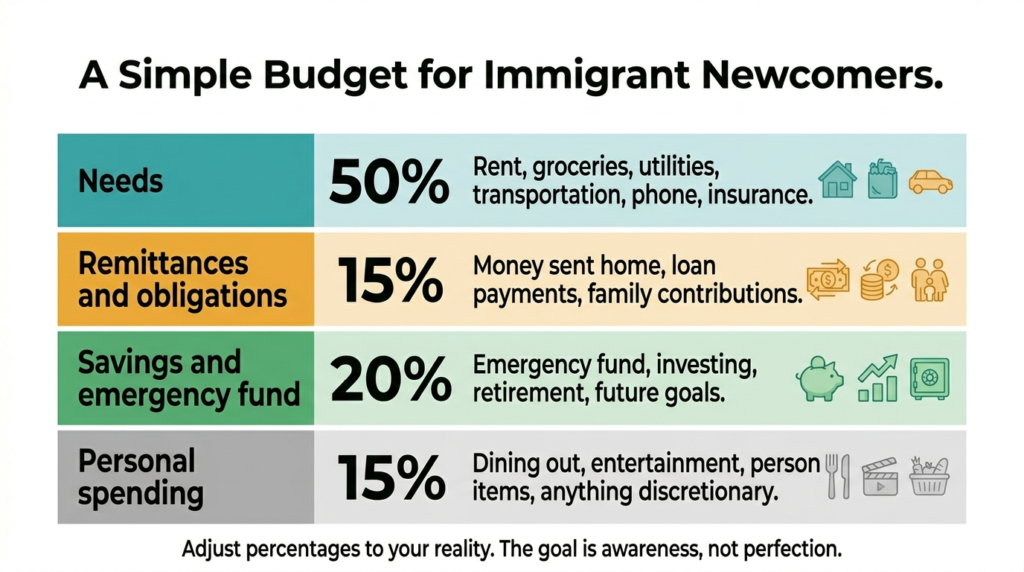
A budget is not a punishment. It is a map. It shows you where you are, where your money is going, and whether those two things are pointing in the direction you actually want to go.
The simplest budget for a new immigrant has four categories. What you must spend on to survive (rent, utilities, groceries, transportation, phone, insurance). What you send home or owe others (remittances, any loan repayments, family obligations). What you save and invest (emergency fund, retirement account, any investment contributions). What you spend on everything else (restaurants, entertainment, personal items, anything discretionary).
Write those four numbers down once a month. At the end of the month, check what you actually spent against what you planned. You do not have to be perfect. You just have to know the score. Immigrants who track their spending, even imprecisely, consistently save more than those who do not.
Free apps like Mint or YNAB (You Need a Budget) connect to your bank account and categorize your spending automatically. If you prefer a notebook and a pen, that works just as well. The tool does not matter. The consistency does.
Strategy 5: Manage Remittances Strategically
Most immigrants send money home. It is one of the most consistent financial behaviors across every immigrant community, and it is one that mainstream financial advice almost entirely ignores.
Sending money home is not a luxury. For most people reading this, it is a moral obligation and a practical necessity. But how you send it and how much you send can be managed thoughtfully without feeling like you are failing the people you care about.
Treat remittances as a fixed monthly expense, not a variable one. Decide at the beginning of each month how much you are sending home this month. Transfer that amount and stick to it. When remittances are reactive rather than planned, they tend to expand to whatever is available, leaving nothing for your own financial stability.
Use a digital transfer service, not a bank wire. Bank wire transfers for international sends cost $25 to $50 in flat fees plus an exchange rate markup of 3 to 5%. Digital transfer services like Wise and Remitly typically charge a fraction of that and use rates close to the real mid market rate. On a $400 monthly remittance, switching from a bank wire to a digital service can save $20 to $40 per transfer, or $240 to $480 per year.
Fund your transfers from a bank account, not cash. Since the beginning of this year, cash-funded international money transfers are subject to a new 1% federal excise tax. Transfers funded from a US bank account, debit card, or credit card are explicitly exempt. For a detailed guide on which services are tax exempt and how to compare your options, our article on how to send money abroad without fees covers everything in one place.
Strategy 6: Use Free and Low-Cost Resources You Are Already Entitled To
The United States has a substantial network of free and subsidized resources that most new immigrants either do not know about or assume are not available to them. Using what you are entitled to is not shameful. It is smart financial management.
Free tax filing. If your household income is below a certain threshold, you qualify for completely free tax preparation through VITA (Volunteer Income Tax Assistance), MyFreeTaxes, or IRS Free File. Many immigrants pay $80 to $200 to have a simple tax return prepared when free options would have done exactly the same job. Our guide on free tax filing resources every newcomer should know about covers every option including which ones accept ITIN filers.
Community health centers. Federally Qualified Health Centers provide medical care on a sliding scale based on income, meaning you pay what you can afford. For immigrants without insurance or with high deductible plans, these centers provide primary care, dental care, and mental health services at dramatically lower cost than private clinics.
Library cards. A public library card is free and provides access to digital books, audiobooks, streaming services, language learning apps, job search resources, and in person programming. In many cities, the library also provides free access to tools, kitchen equipment, and other items that immigrants typically buy during their first year.
SNAP, WIC, and other food programs. Eligibility for federal nutrition programs depends on your immigration status, but many lawfully present immigrants qualify. Green card holders after five years are generally eligible for SNAP. WIC (Women, Infants, and Children) covers pregnant women and young children and has broader immigrant eligibility. Check benefits.gov or your state’s social services agency for current eligibility rules.
Energy assistance programs. The federal Low Income Home Energy Assistance Program (LIHEAP) helps eligible households pay heating and cooling costs. Availability and eligibility vary by state. Your local 2-1-1 service can connect you with this and other utility assistance programs.
Strategy 7: Avoid the Traps Designed for People in Your Situation
Some financial products in the US are specifically designed to profit from people who are new to the system, under financial pressure, and unaware that better alternatives exist. Knowing what they are is your protection.
Payday loans. Short-term loans with annual percentage rates of 300 to 800%. They are marketed as quick cash for emergencies. They are traps that most borrowers cannot escape without paying far more than they originally borrowed. If you need emergency cash, your alternatives in order of preference: your emergency savings, a credit union personal loan, a credit card cash advance, an advance from your employer, or community assistance through 2-1-1.
Rent to own furniture and electronics. These arrangements let you take home furniture or appliances with a small weekly payment. By the time you complete the payment plan, you have typically paid two to three times the retail price of the item. Buy secondhand from Facebook Marketplace, OfferUp, or a thrift store instead.
Refund anticipation loans. Offered by some tax preparers as a way to receive your refund instantly, these are high-fee loans against your expected refund. If you file electronically and choose direct deposit, the IRS processes most refunds within 21 days anyway. Wait the three weeks. Keep the fee.
“No credit check” auto loans from buy here, pay here dealerships. These dealerships offer financing to people with no credit history at interest rates that are often predatory and with vehicles that have significant undisclosed mechanical problems. If you need a car, buy an older model with cash from a private seller. Have a mechanic inspect it before you buy. Avoid dealer financing until your credit score has improved enough to qualify for reasonable rates.
Strategy 8: Connect Saving to a Specific Goal
Saving money in the abstract is difficult. Saving money toward something specific is dramatically easier.
Decide what you are saving for. It does not have to be grand. One month of emergency savings. Enough to cover the first and last month’s rent on a better apartment. A plane ticket home to see your family. A specific amount to invest. An amount you want to have saved by a specific date.
Write the goal down. Put the number and the date somewhere you will see it. When the month feels long and the decision about whether to transfer $50 to savings feels optional, the goal makes it less optional.
The immigrants who build lasting financial stability here are almost never those who earned the most in their first years. They are those who saved consistently toward something that mattered to them, even when the amounts were small and the progress felt slow.
The Real Point
Saving money in your first year as an immigrant in the United States is genuinely difficult. The costs are high, the income is often modest, the obligations to family back home are real, and the system was not designed to make this easy for you.
But it is possible. Thousands of immigrants before you have done it. They did not do it by being exceptional. They did it by knowing where their money was going, cutting costs where the cuts mattered most, avoiding the products designed to exploit their situation, and saving something every month even when something felt impossible.
Start where you are. Save what you can. Let the habit grow as your income grows.
The financial life you are building here is real, even when it does not feel like it yet.
Disclaimer: This article is for educational and informational purposes only and does not constitute financial, tax, or legal advice. Program eligibility, interest rates, and financial product terms change frequently. Always verify current information directly with relevant institutions and programs.