
How Much Is Your Overtime Really Worth? Calculating Your Overtime Tax Deduction
You worked the extra hours. You skipped the weekend plans. You showed up when everyone else went home. And at the end of the pay period, your overtime check arrived and the government took its share just like it always had.
That changed.
A federal law signed in the summer of 2025 created a new income tax deduction specifically for overtime pay. It is called the overtime premium deduction, and while it has been marketed loudly as a win for American workers, most of the immigrant workers who stand to benefit from it have never heard of it.
If you earn overtime wages as a W-2 employee in the United States, this deduction may reduce what you owe in federal income tax. In some cases it eliminates the federal income tax on your overtime earnings entirely. But it only helps you if you know it exists, understand how it works, and claim it when you file your tax return.
This article explains all of it.
What Is the Overtime Tax Deduction?
The overtime premium deduction was created by the One Big Beautiful Bill Act, signed into law on July 4, 2025. It is a new above the line deduction, meaning it reduces your taxable income whether you take the standard deduction or itemize. You do not have to choose between this deduction and your standard deduction. You can claim both.
The deduction applies to the premium portion of overtime pay. To understand what that means, you need to understand how overtime pay works under the Fair Labor Standards Act (FLSA).
Under the FLSA, if you are an eligible employee and you work more than 40 hours in a single workweek, your employer must pay you at least 1.5 times your regular hourly rate for every hour beyond 40. That is where the phrase “time and a half” comes from.
Here is a concrete example. If your regular wage is $20 per hour and you work 48 hours in a week:
Your regular pay for 40 hours: $800 Your overtime pay for 8 hours at $30 per hour: $240
But the deduction does not apply to the full $240 in overtime pay. It applies only to the premium portion, which is the extra half above your regular rate. At $20 per hour, your regular rate covers the first $20 of each overtime hour. The premium is the extra $10 per hour.
So for those 8 overtime hours: The premium portion is $10 times 8 hours, or $80.
That $80 is what you deduct from your taxable income. Not the full $240. Just the half that represents the premium above your regular rate.
The IRS describes it this way: you may deduct the pay that exceeds your regular rate of pay, meaning the “half” portion of the “time and a half” compensation required by the FLSA.
How Much Can You Actually Deduct?
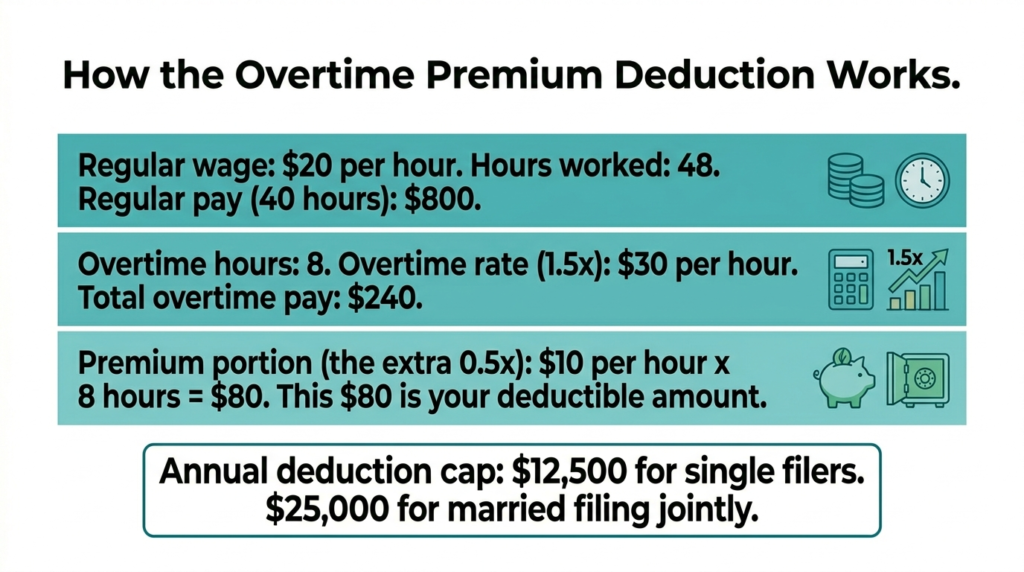
The deduction is capped at $12,500 per year for single filers and $25,000 per year for married couples filing jointly.
For most hourly workers, reaching that cap requires working a substantial amount of overtime. Here is roughly how much overtime you would need to work each year to reach the maximum deduction, depending on your hourly rate:
At $15 per hour, the premium is $7.50 per overtime hour. To reach a $12,500 deduction, you would need approximately 1,667 overtime hours in the year, or about 32 overtime hours every week. That is a very high amount that most workers would not sustain.
At $20 per hour, the premium is $10 per overtime hour. To reach a $12,500 deduction, you would need approximately 1,250 overtime hours per year, or about 24 overtime hours per week.
At $25 per hour, the premium is $12.50 per overtime hour. To reach the maximum deduction, you would need approximately 1,000 overtime hours per year, or about 19 overtime hours per week.
The practical reality is that most hourly workers will deduct a portion of the maximum rather than the full amount. If you work an average of 5 overtime hours per week at $20 per hour, your annual premium deduction would be approximately $5,200. If you are in the 22% federal income tax bracket, that deduction saves you approximately $1,144 in federal income tax.
For a nurse, a warehouse worker, a truck driver, or a construction worker who regularly works overtime, this adds up to a real amount of money each year that you would have simply not known to claim without this article.
Who Qualifies for the Deduction?
Not every worker is eligible. Here is what the law requires.
You must be a W-2 employee. The deduction applies to employees who receive a Form W-2. Independent contractors and gig workers who receive 1099 forms are not covered by the Fair Labor Standards Act overtime rules in the same way and are generally not eligible for this deduction. If you drive for a rideshare company or do freelance work, this deduction does not apply to your extra hours.
Your overtime must be FLSA-covered overtime. The deduction applies specifically to overtime required by the Fair Labor Standards Act, meaning pay for hours worked beyond 40 in a workweek at the required rate of at least 1.5 times your regular rate. Voluntary extra pay that your employer calls overtime but that exceeds the FLSA standard may not qualify.
Your employer must report your overtime separately. For you to claim this deduction, your employer must report your total qualified overtime compensation separately on your W-2 or another required statement. If your employer does not break out your overtime pay separately, you may not be able to claim the deduction even if you worked qualifying overtime hours. Talk to your payroll department or HR as early in the tax year as possible to confirm this is being tracked correctly.
Your income must fall below the phase out threshold. The full deduction is available if your Modified Adjusted Gross Income (MAGI) is below $150,000 for single filers or $300,000 for married couples filing jointly. Above those thresholds, the deduction begins to phase out and eventually disappears. For most immigrant hourly workers earning overtime, income levels are well below these thresholds, which means the full deduction is available.
You cannot be filing as Married Filing Separately. That filing status does not qualify for the overtime deduction. If you are married, you need to file jointly with your spouse to access this benefit.
You must have a valid Social Security Number. The overtime deduction requires a valid SSN for the filer. ITIN filers are not eligible for this specific deduction under the current law.
Does It Apply to State Taxes Too?
This is an important limitation that many explanations of this deduction leave out.
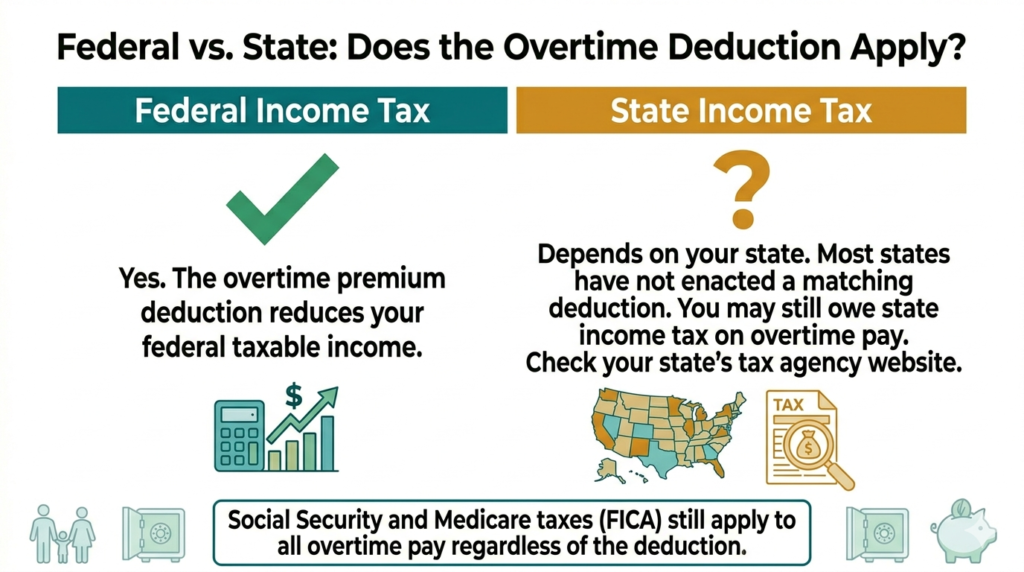
The overtime premium deduction reduces your federal taxable income. It does not automatically reduce your state income tax, because most states have not passed a matching state level deduction. As of mid-2026, only a handful of states have enacted or proposed state level overtime deductions to match the federal provision.
What this means practically: if you live in a state with an income tax, you will likely still owe state income tax on your full overtime earnings, including the premium portion that you are deducting for federal purposes.
Additionally, and this is critical: the overtime deduction does not reduce your FICA taxes. Social Security (6.2%) and Medicare (1.45%) are still calculated on all of your wages, including overtime pay. The deduction only reduces federal income tax. It does not touch payroll taxes.
To find out whether your specific state has enacted a matching overtime deduction, search your state’s department of revenue website directly or ask your tax preparer.
How to Calculate What This Deduction Is Worth to You
Here is a simple calculation you can do right now to estimate your potential tax savings from the overtime deduction.
Step 1: Find your regular hourly rate. If you are salaried, divide your weekly salary by 40 to find your equivalent hourly rate.
Step 2: Calculate your premium rate. Divide your regular hourly rate by 2. This is the premium per overtime hour. For example, at $18 per hour, your premium is $9 per overtime hour.
Step 3: Estimate your annual overtime hours. Look back at your recent pay stubs or ask payroll how many overtime hours you worked over the past several months. Project that forward to estimate annual overtime hours.
Step 4: Calculate your annual premium amount. Multiply your premium rate by your annual overtime hours. For example: $9 premium times 200 overtime hours equals $1,800 in deductible premium pay.
Step 5: Compare to the annual cap. If your calculated premium amount is below $12,500 (single filer) or $25,000 (married filing jointly), that is your estimated deduction. If it exceeds the cap, your deduction is capped at the maximum.
Step 6: Estimate your tax savings. Multiply your deduction amount by your federal income tax bracket rate. If you are in the 22% bracket, a $1,800 deduction saves you approximately $396 in federal taxes. If you are in the 12% bracket, the same deduction saves approximately $216.
The savings may not sound enormous on a single example, but for workers who consistently earn significant overtime, the deduction can reduce federal tax liability by $1,000 to $2,500 or more per year.
What This Deduction Means for Immigrants Specifically
Many of the workers who earn the most overtime in the United States are immigrants. Healthcare workers pulling double shifts. Warehouse and fulfillment center workers hitting peak season. Construction workers on deadline. Long haul drivers. Hotel and hospitality staff covering night shifts. Agricultural and food processing workers.
These workers are disproportionately immigrant, disproportionately paid hourly, and disproportionately likely to work overtime as a primary income strategy. They are also disproportionately likely to never have heard of the overtime deduction or to have claimed it.
The deduction is available to any W-2 employee with a valid SSN, regardless of citizenship status or immigration background. Green card holders, H-1B visa holders, TN workers, and workers with other valid work authorization who earn overtime wages and hold a valid SSN can claim this deduction on their federal tax return.
For ITIN holders: as noted above, the current law requires a valid Social Security Number. If you currently file with an ITIN and earn overtime, this is an additional reason to pursue SSN eligibility if your immigration status allows it, or to explore whether your work authorization status may qualify you for an SSN.
The deduction is temporary as currently written. It applies to overtime pay earned during a defined period through the end of 2028. Congress would need to pass additional legislation to extend it beyond that date. Plan accordingly. Use it every year it is available, and monitor IRS guidance and legislative updates through the IRS newsroom at IRS.gov.
How to Claim the Deduction When You File
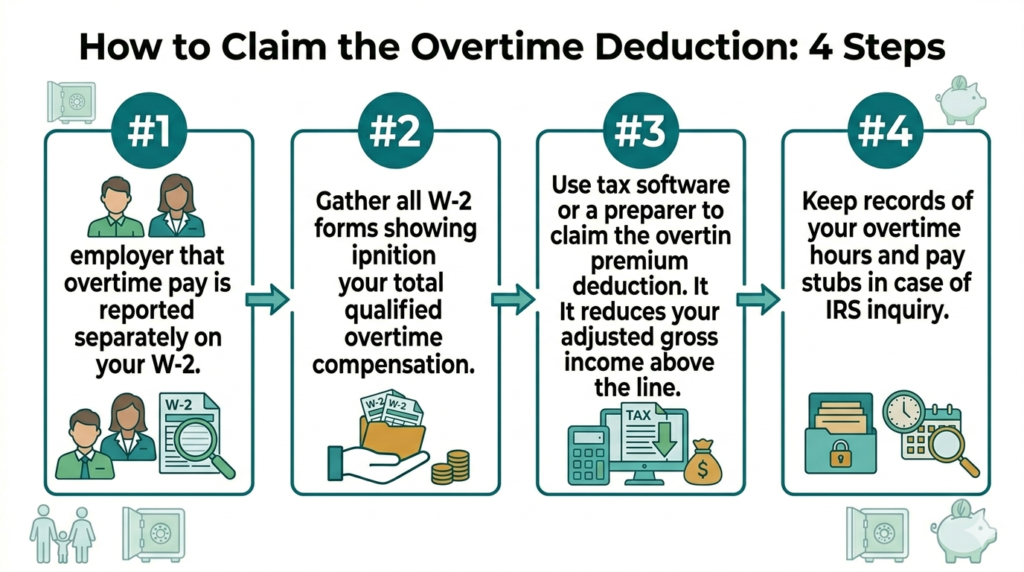
The overtime premium deduction is an above the line deduction, which means it reduces your adjusted gross income and is available to you whether you take the standard deduction or itemize. You claim it on your federal income tax return.
When your employer provides your W-2 at the end of the tax year, look for the separately reported overtime compensation figure. The IRS requires employers to report qualified overtime compensation separately from regular wages. If you do not see it separated on your W-2, contact your employer’s payroll department before filing.
Your tax software should walk you through claiming the deduction if you answer the questions about your income sources accurately. If you are using a tax preparer, tell them specifically that you earned FLSA-covered overtime pay and ask about the overtime premium deduction.
If you use one of the free filing services, confirm that the service supports this deduction before you begin. It is a newer provision and not all free filing platforms have fully integrated it into their guided interviews. Our article on free tax filing resources every newcomer should know about covers which services are available and what complex situations they can handle.
For a broader understanding of what deductions you may be leaving on the table as an immigrant filer, our guide on tax deductions every migrant is missing covers the most commonly overlooked benefits across the full immigrant tax landscape.
A Realistic Summary: What You Can Actually Expect
The overtime premium deduction is a real tax benefit that produces real savings for hourly workers who regularly work overtime. For most workers, those savings range from a few hundred to a couple thousand dollars per year in reduced federal income tax.
It is not, as some headlines suggested, a complete elimination of taxes on overtime. You still owe income tax on your regular rate portion of overtime hours. You still owe FICA taxes on all of it. And most states still tax your full overtime earnings.
What it is: a meaningful above the line deduction that reduces your federal taxable income by the premium amount you earned working beyond 40 hours per week. For immigrants who work overtime regularly, this is money that now stays in your pocket instead of going to the federal government, as long as you know to claim it.
Know to claim it.
Disclaimer: This article is for educational and informational purposes only and does not constitute tax, legal, or financial advice. Tax laws change and IRS guidance on specific provisions evolves. Always verify current rules at IRS.gov and consult a qualified tax professional for advice specific to your situation before filing.