
The First 90 Days: A Financial Checklist for Newly Arrived Immigrants
Nobody hands you a manual when you land. You clear customs, you find the exit, someone picks you up or you figure out the bus, and then life in your new country begins. Immediately and without ceremony. And somewhere between your first grocery run and your first paycheck, you realize that you have approximately zero idea how the financial system here actually works.
I remember standing in a bank branch in my second week, trying to open a checking account, and being asked for documents I did not know I was supposed to bring. I left without an account. I came back three days later with the right things. I lost a week I could not afford to lose.
This checklist exists so that does not happen to you.
The first 90 days are not about getting rich or building an investment portfolio. They are about getting the foundations right: the identification numbers, the accounts, the basic protections, and the habits that everything else gets built on. Miss these steps early and you spend months fixing problems that did not have to happen. Get them right in the first three months and the rest of your financial life here gets dramatically easier.
Here is the order that makes sense.
Before Anything Else: Understand Your Immigration Status and What It Allows
The financial steps available to you depend directly on your immigration status. Not because the financial system judges you, but because certain products, accounts, and programs require specific documentation that different visa categories and residency statuses provide.
Green card holders have the broadest access to financial products and government programs. Most work visa holders (H-1B, L-1, O-1, TN, and others) can access nearly all private financial products. DACA and TPS holders have access to most private products but face limitations on certain government programs. ITIN holders without work authorization can open some bank accounts and file taxes but face more restrictions.
Knowing where you stand lets you move quickly and confidently through the steps below rather than running into walls you did not see coming.
Week 1 to 2: Get Your Identity Numbers in Order
This is the single most urgent financial task of your first days in the United States. Everything else on this list flows from it.
Get Your Social Security Number (SSN) If You Are Eligible
If you arrived on a work visa (H-1B, L-1, O-1, TN, and most other employment authorization categories) or with a green card, apply for your Social Security Number as soon as possible. Do not wait.
Go to your nearest Social Security Administration office with your passport, your visa documentation, your I-94 arrival record (available online at i94.cbp.dhs.gov), and your offer letter or employment documentation if required for your visa category. The SSN typically arrives by mail within two to four weeks of your application.
Your SSN is a nine digit number that functions as your primary financial identity in the United States. You need it for employment, bank accounts, credit applications, tax filing, and most government services. It is the starting point for everything.
Apply for an ITIN If You Are Not Eligible for an SSN
If you are not eligible for an SSN based on your current immigration status, your alternative is the Individual Taxpayer Identification Number. An ITIN is issued by the IRS to people who have a federal tax filing obligation but do not qualify for an SSN.
To apply, complete IRS Form W-7 and submit it with your original passport or certified copies and supporting documentation. Working with a Certified Acceptance Agent (a person authorized by the IRS to verify your documents) means you do not have to mail your original passport anywhere. Many VITA tax assistance sites have Certified Acceptance Agents on staff.
An ITIN is not a work authorization document and does not affect your immigration status. It is simply a tax ID number. A growing number of banks and credit unions accept ITINs to open accounts, and it allows you to file a US tax return and build a tax history.
For a complete explanation of how to open a US bank account with an ITIN rather than an SSN, our article on how to open a US bank account without an SSN walks through the specific options available to ITIN holders.
Week 1 to 2: Open a US Bank Account
Open your US bank account as early as your first week if possible. Do not wait until you have your SSN. Many banks and credit unions will open an account with a passport and ITIN, and some will open one for you while your SSN application is still pending if you can show evidence of your application.
The account you want is a free checking account with no monthly maintenance fee, no minimum balance requirement, and a large ATM network. Online banks and credit unions typically offer better terms than traditional big bank branches. For a detailed comparison of your options, our guide on best bank accounts for migrants covers the specific accounts worth considering.
What to bring to the bank:
Your passport. Your visa or immigration documentation. Proof of US address (a signed lease, a utility statement, or a letter from your employer showing your address). Your SSN or ITIN (if you have it). If you do not yet have an SSN or ITIN, ask specifically whether the bank accepts a passport alone.
Once your account is open, set up direct deposit with your employer immediately. This eliminates any need to cash paper checks, which costs money and time you do not need to spend.
Week 2 to 3: Establish Your US Address and Phone Number
Your US address and phone number are foundational to your financial life in ways that are easy to underestimate. You need a US address to open a bank account, to apply for credit, to receive tax documents, and to register with any financial institution. You need a US phone number to receive verification codes and two factor authentication from banks, brokerage accounts, the IRS, and virtually every other digital financial service.
If you are staying with family or friends temporarily, use that address while you look for your own place. A PO Box is generally not accepted for financial account registration. The address on file needs to be a physical address.
For your phone, a prepaid SIM card from T-Mobile or AT&T gets you a US number within hours at low cost. Once you have income and a credit history started, you can switch to a standard postpaid plan.
Week 3 to 4: Open a Savings Account and Start a Small Emergency Buffer
Alongside your checking account, open a high yield savings account. This is a separate account, ideally at an online bank, that pays a meaningfully higher interest rate than a traditional savings account.
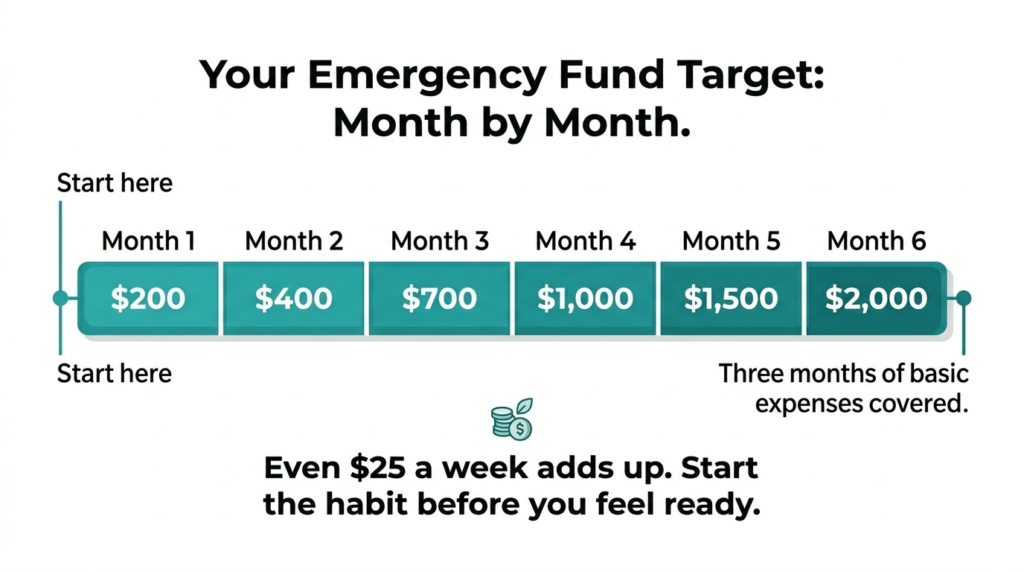
The purpose of this account in your first 90 days is simple: begin building an emergency fund. Your target eventually is three to six months of essential living expenses. In your first 90 days, the target is more modest: get to one month of essential expenses saved before anything else.
An emergency fund is not optional. It is the financial foundation that keeps one unexpected expense from turning into a debt spiral. A car repair, a medical bill, a gap between jobs. Without a buffer, any of these events becomes a crisis. With even one month of savings behind you, most of them become manageable problems.
Transfer whatever you can afford immediately after each paycheck into this savings account, before you have a chance to spend it. Even $25 a week creates a habit and a balance that grows faster than you expect.
For a clear picture of where a savings account fits within your broader financial plan, our guide on the US financial system explained for immigrants is a useful overview of how all the pieces connect.
Week 3 to 5: Understand Your Pay Stub Before You Spend Anything
If you have started working by now, take 20 minutes to read your first pay stub carefully before you build any budget around your salary.
Your pay stub shows the difference between your gross pay (what your employer agreed to pay you) and your net pay (what actually lands in your bank account after federal taxes, Social Security, Medicare, state taxes, and any benefits deductions). For most immigrants, this gap is surprising. A $50,000 annual salary does not produce $4,167 per month in your account. After deductions, it is more likely to be $3,100 to $3,400 depending on your state.
Every financial decision you make in your first 90 days, including your apartment budget, your savings target, and what you can send home, needs to be based on your net pay. Not your gross salary.
Our plain-language guide on your first US pay stub explained breaks down every line including federal income tax, FICA, Social Security, Medicare, and voluntary deductions.
Week 4 to 6: Apply for a Secured Credit Card
One of the most important financial moves you can make in your first 60 days is opening a secured credit card and starting to build your US credit history.
In the United States, your credit score is a number between 300 and 850 that determines whether you can rent an apartment, what interest rate you pay on loans, and in some cases whether you get a job. When you arrive, you have no US credit score at all. The goal of your first 90 days is to begin changing that.
A secured credit card requires a cash deposit, typically $200 to $500, which becomes your credit limit. You use the card for small routine purchases such as groceries or gas, pay the full balance before the due date every month, and that on time payment history is reported to the three major credit bureaus. After six months of consistent payments, you will have your first US credit score. After 12 to 18 months, most secured card issuers will upgrade you to a regular unsecured card and return your deposit.
The rules that build your score fastest:
Keep your spending below 30% of your credit limit. Always pay the full balance, not just the minimum. Never miss a payment. Set a calendar reminder or automatic payment so this never happens accidentally.
For a full comparison of secured card options and what to look for, our guide on secured credit cards for beginners with no credit covers the specific products available to immigrants.
Week 6 to 8: Learn How Taxes Work Here (Even If Tax Season Is Months Away)
Tax season in the United States runs from January through April each year. But understanding how taxes work should happen in your first two months, not the week before the filing deadline.
The US tax system is different from most countries. Taxes are withheld from your paychecks throughout the year based on estimates. At the end of each tax year, you file a return that reconciles what was withheld against what you actually owe. If too much was withheld, you receive a refund. If too little was withheld, you owe the difference.
Your immigration status determines which forms you file and what income you must report. As a resident alien (which most work visa holders become after a year or two based on the Substantial Presence Test), you report your worldwide income on Form 1040 and can claim the same deductions and credits available to US citizens.
Three things to do now, even if tax season is far away:
First, check your Form W-4 with your employer. This form tells your employer how much to withhold from each paycheck. If you filled it out incorrectly during onboarding, you may be having too much or too little withheld all year. Correcting it now saves you a surprise in April.
Second, keep all your income documents. Every W-2, 1099, and bank statement you receive throughout the year belongs in a folder (physical or digital) that you open once a year in January.
Third, know that filing is worth it even in a low income year. Tax credits like the Earned Income Tax Credit can return significant money to working immigrants who file, but only if they file.
For a full step by step explanation of the filing process, our guide on how to file US taxes as a newcomer walks through every part of the process from residency status to submission.
Week 6 to 10: Enroll in Your Employer’s 401(k) If One Is Offered
If your employer offers a retirement savings plan and you have not yet enrolled, do it now.
A 401(k) is a retirement account your employer sponsors that allows you to contribute a portion of each paycheck before federal income tax is calculated. This immediately reduces your taxable income. The money grows inside the account over time, and you pay taxes on it when you withdraw it in retirement.
The most important feature to understand is the employer match. Many employers will match your contributions up to a certain percentage of your salary. If your employer matches 50% of contributions up to 6% of your salary, and you contribute 6%, your employer adds another 3% for free. Not contributing enough to capture the full match is leaving free money on the table every single paycheck.
Enrollment does not require a deep understanding of investing. Start by contributing whatever percentage captures your full employer match. If your plan offers a target date retirement fund (labeled with an approximate retirement year like 2050 or 2055), selecting one of those gives you an automatically diversified, automatically rebalanced investment without needing to choose individual funds.
Week 8 to 12: Build a Real Monthly Budget
By the end of your first 90 days, you have enough information to build a real budget. You know your net monthly income. You know your fixed costs from your first month of expenses. You have an emergency fund started and a credit card building your score.
Now you set the numbers.
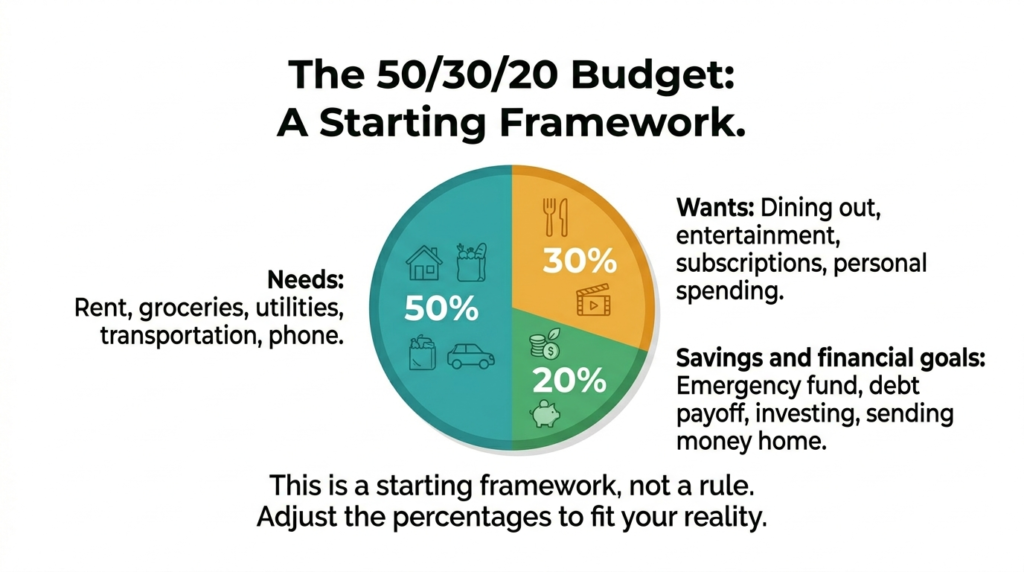
The 50/30/20 framework is the simplest starting point. Allocate 50% of your net income to needs (rent, utilities, groceries, transportation, phone), 30% to wants (restaurants, entertainment, anything discretionary), and 20% to financial goals (emergency fund, investments, debt repayment, and money sent home).
In the real world of early immigrant life, 20% for financial goals may not be immediately achievable. That is fine. The framework is a direction, not a requirement. Even putting 5% toward savings while covering your needs is progress. The percentage grows as your income grows.
What matters most is that you have a number for each category and you look at your spending against those numbers at least once a month. The immigrants who build lasting financial stability here are almost universally people who know where their money is going, not people who earn the most.
The 90 Day Checklist at a Glance
Use this as a reference to track where you are.
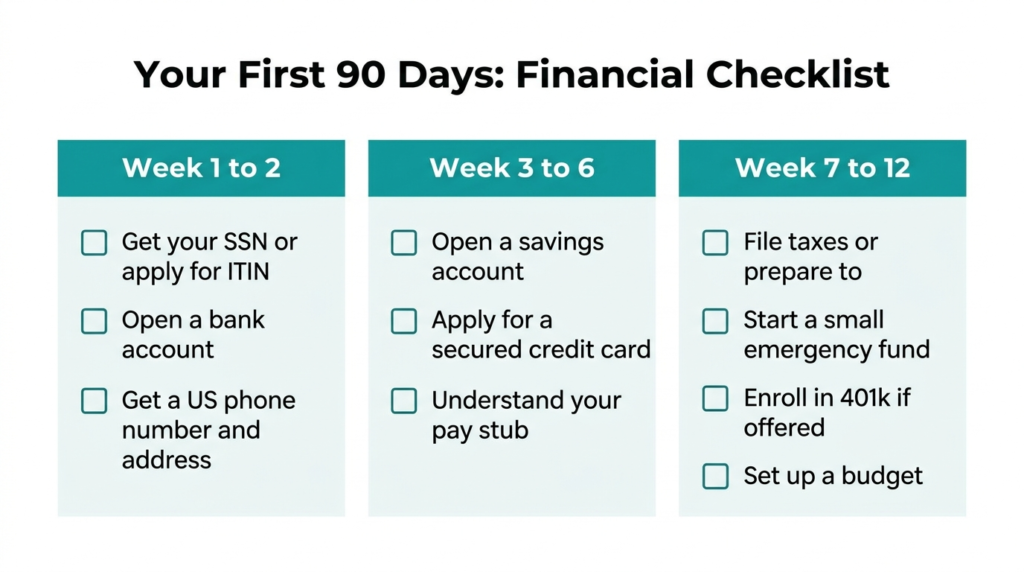
Week 1 to 2: Apply for SSN at the Social Security Administration (if eligible). Apply for ITIN using Form W-7 (if not eligible for SSN). Open a free checking account with direct deposit set up. Get a US phone number and confirm your US address.
Week 3 to 6: Open a high yield savings account. Begin automatic transfers to savings after each paycheck. Read your first pay stub and understand your real net income. Apply for a secured credit card. Enroll in your employer’s 401(k) (capture the full match).
Week 7 to 12: Check your Form W-4 and adjust if needed. Begin organizing tax documents in a dedicated folder. Build your first monthly budget based on actual net income. Set a reminder to review your budget and savings at the end of each month.
One More Thing Worth Saying
The first 90 days feel overwhelming because they are. You are navigating a new city, a new job, possibly a new language, and a financial system that was not designed to explain itself to people arriving from outside it.
Every step on this list is manageable on its own. None of them requires a financial advisor or a large amount of money. They require information, a few hours of your time, and the willingness to do the next right thing.
You do not have to finish all of this in exactly 90 days. The list is a direction, not a deadline. But the earlier you complete these steps, the more of your financial energy you can spend building toward something rather than catching up from behind.
Start with the SSN or ITIN. Then the bank account. Then the savings. Everything else follows from those three.
You already did the hardest part. You got here.
Disclaimer: This article is for educational and informational purposes only and does not constitute financial, tax, legal, or immigration advice. Eligibility for financial products and government programs varies by immigration status and changes over time. Always verify current requirements directly with banks, the IRS, and relevant agencies before making decisions.