
The 50/30/20 Rule Explained for Immigrants
I discovered the 50/30/20 rule about eight months after arriving in the United States.
I was reading a personal finance article online, trying to make sense of why my money kept running out before the end of the month despite my best intentions. The article laid out the framework simply: spend 50% of your after tax income on needs, 30% on wants, and 20% on savings and financial goals. It made the whole thing sound clean and manageable, like a simple algorithm you plug your numbers into and it solves everything.
I plugged in my numbers. It did not solve everything.
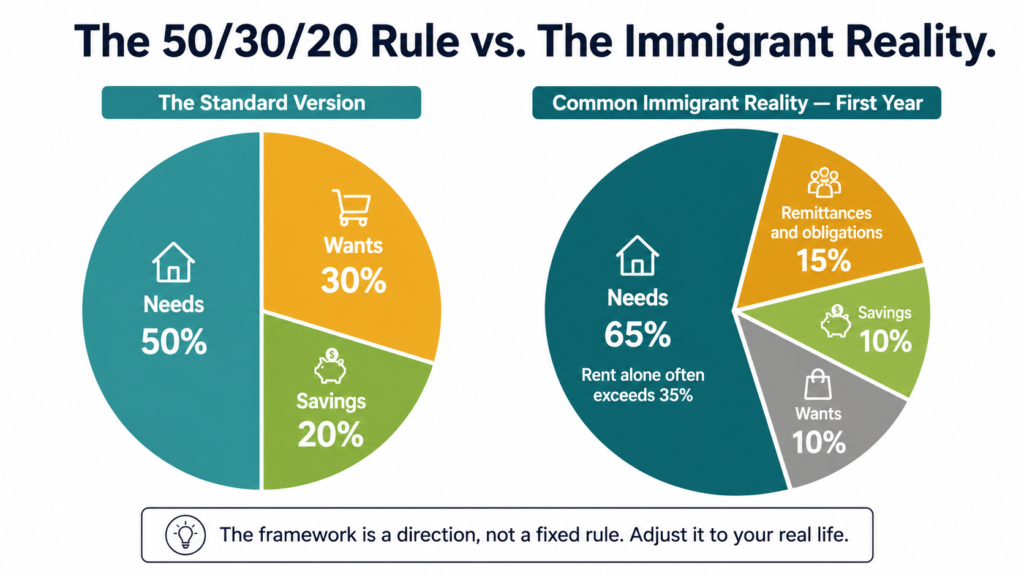
My rent alone was consuming nearly 42% of my take home pay. Groceries, utilities, phone, transportation, and the remittances I sent home every month pushed my essential costs well past 60%. The 30% for wants was theoretical. The 20% for savings felt like a cruel joke about a future that did not yet exist for me.
What the article did not say was that the 50/30/20 rule was designed for a specific financial situation, and that most immigrants in their first years in the US are not in that situation. Understanding what the rule was designed for, where it actually helps, and how to adapt it honestly to your real circumstances is more useful than either adopting it uncritically or dismissing it entirely.
This article does all three.
Where the Rule Came From
The 50/30/20 rule was popularized by Elizabeth Warren, then a Harvard Law professor and now a US Senator, and her daughter Amelia Warren Tyagi in their 2005 book “All Your Worth: The Ultimate Lifetime Money Plan.” The framework was designed for American households with a stable income, moderate cost of living, and no extraordinary obligations beyond their own household.
The specific percentages reflected what Warren and Tyagi found when analyzing household financial data for typical middle-income American families at the time: approximately half of a household’s income went to essential fixed costs, roughly a third went to discretionary spending, and a viable savings rate was around 20%.
These proportions made sense for that dataset. A household earning $65,000 to $85,000 annually in a mid cost US city in 2005, with no remittances to send, no credential rebuilding costs, no immigration legal fees, and a housing market that had not yet experienced the cost increases of the past decade, can reasonably allocate roughly half to needs.
That is not most immigrants in 2026.
The Honest Problem: Why 50% Often Does Not Cover Needs
Housing costs in the United States have increased dramatically relative to incomes over the past two decades. In 2005, when the 50/30/20 rule was published, the national median rent for a one bedroom apartment was approximately $650 per month. Today it averages more than $1,500 nationally and significantly more in the cities where most immigrants settle: New York, Los Angeles, Houston, Chicago, Miami, Dallas.
An immigrant earning $20 per hour, working full time, takes home approximately $2,600 to $2,900 per month after taxes depending on their state. A modest one bedroom apartment in those cities costs $1,300 to $2,000. Before adding groceries, utilities, phone, transportation, or anything sent home, needs are often already at 55% to 70% of take home pay.
On top of the standard household expenses, many immigrants carry financial obligations that the original framework does not account for at all.
Remittances. Sending money home is not a luxury for most immigrant families. It is a moral obligation that the 50/30/20 rule has no category for. Is it a need? A want? A financial goal? It is none of these cleanly, and forcing it into any one bucket distorts the whole picture.
Credential rebuilding costs. Licensing exams, English language programs, professional certification courses, and credential evaluation fees can run thousands of dollars in the years following arrival. These are investments in future earning power, but they compete with savings and cannot reasonably be classified as wants.
Immigration legal fees. Green card applications, visa renewals, adjustment of status proceedings, and family petition costs are significant and recurring. For many immigrant households, these run $2,000 to $10,000 per year in legal fees alone.
Thin emergency reserves. A newcomer who has been in the country for six months has not yet built the financial cushion that the 50/30/20 rule assumes in its savings category. The 20% savings target feels aspirational when you are still building your first emergency fund from near zero.
Why the Rule Still Matters, Even When the Numbers Do Not Fit
Despite its limitations for immigrant households, the 50/30/20 rule contains a genuinely useful idea that survives the criticism of its specific percentages.
The idea is that every dollar of income should be consciously directed to one of three purposes: maintaining your life, enjoying your life, or building your future. Not every dollar to survival, not every dollar to the future, and not every dollar to immediate gratification. A proportional allocation across all three, with your future getting a meaningful slice regardless of how tight things are.
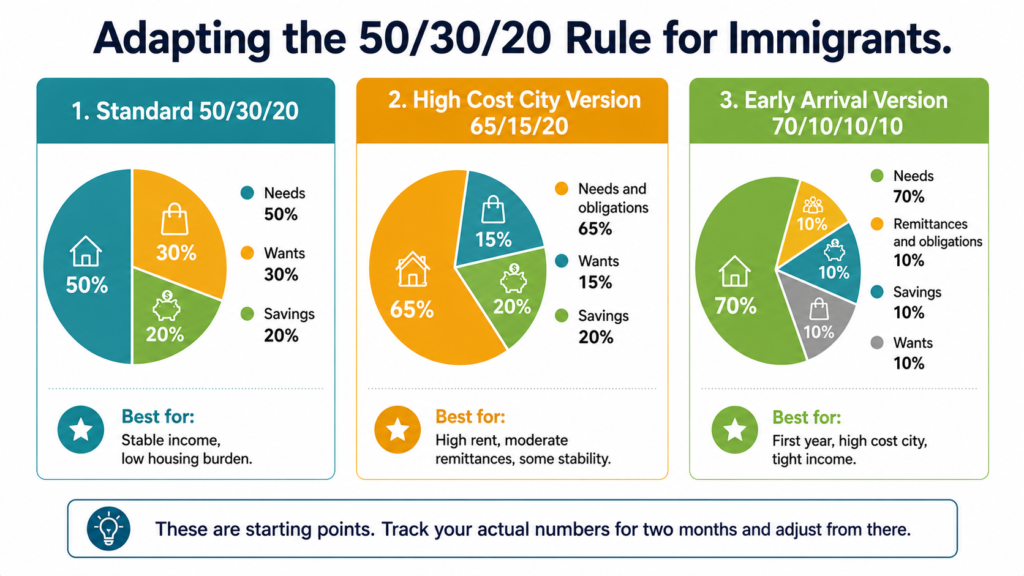
That idea is sound even when the percentages need adjustment. The immigrant who adopts a 65/10/15/10 split, spending 65% on needs, 15% on obligations and remittances, 10% on savings, and 10% on personal spending, is not failing at the 50/30/20 rule. They are applying its underlying logic to their actual situation.
The framework matters because without it, the most common outcome is that spending flows into whatever is most urgent and most immediate, which is almost always needs, and savings simply never happens because it is never first. A percentage split, even an imperfect one, forces savings into the budget as a fixed commitment rather than a residual afterthought.
How to Adapt the Rule to Your Reality
Here is a practical approach to using the framework despite its limitations.
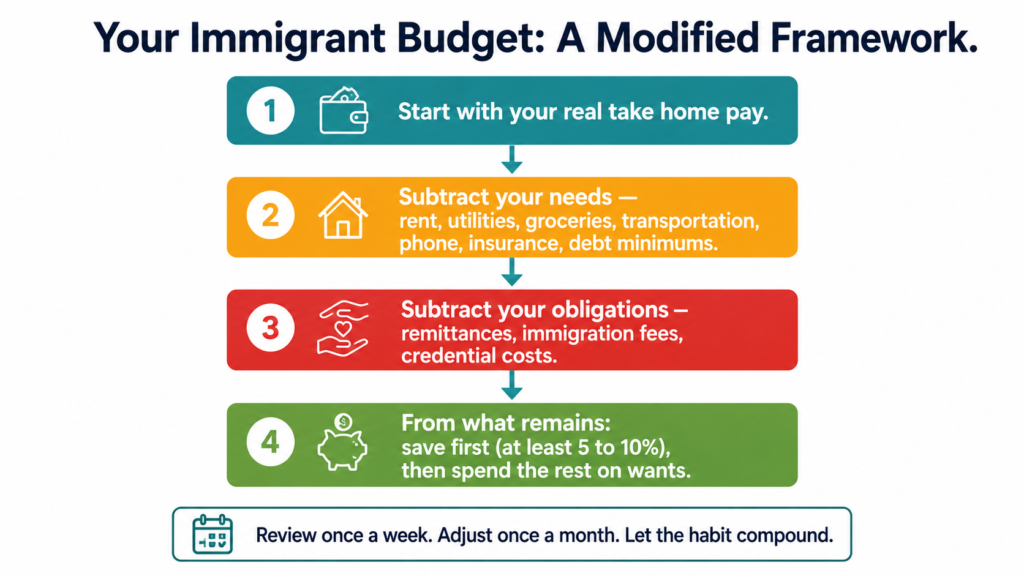
Step 1: Find your real monthly income. Your after tax take home pay is the number that matters. Not your salary. Not your hourly rate multiplied by hours. The number that lands in your bank account every month. If your income varies, use your lowest reliable month from the past three months as your baseline. Our guide on your first US pay stub explained covers every deduction line so you can identify your real number clearly.
Step 2: List your actual needs. Rent. Utilities including electricity, gas, water, and internet. Groceries. Transportation including transit pass, car payment, or fuel. Phone. Health insurance if not covered by your employer. Minimum debt payments. These are non-negotiable fixed costs. Add them up. Whatever percentage of your take home they represent is your real needs percentage.
Step 3: Add your obligations. Remittances, immigration fees, and other recurring commitments that are not standard household expenses get their own category. This is the category the original framework does not include. Treating it as a fixed planned amount, rather than a reactive variable one, is the key discipline. Decide at the start of each month what you are sending home and commit to that number rather than sending whatever is left over, which tends to grow to consume everything available.
Step 4: Set your savings percentage first, then figure out wants. This is the most important structural change from how most people approach budgeting. Savings should be a fixed percentage you commit to before calculating what is left for personal spending, not the remainder after everything else has been spent. Even 5% is better than 0%. Even $100 per month builds a habit and a balance. Our article on how to create your first budget in a new country walks through this sequencing in full detail with practical tools for tracking.
Step 5: What remains is your wants budget. If needs, obligations, and savings consume 85% of your income, your wants budget is 15%. If they consume 90%, it is 10%. The wants category is the adjustment knob. When the other three are set correctly, wants simply becomes whatever is left.
What Each Category Actually Includes
Needs
Rent or mortgage payment. Electricity and gas. Water. Internet (essential for job searching, banking, and remote work). Groceries (not restaurants, just food from the store). Transportation to and from work: car payment, insurance, fuel, or transit pass. Phone. Health insurance not covered by employer. Minimum monthly payment on any debt (credit card minimum, student loan minimum). Childcare if required for you to work.
Notice what is not on this list: restaurants, subscriptions, clothing beyond basics, personal care beyond basics, entertainment. Those are wants.
Wants
Dining out and food delivery. Streaming services. Clothing beyond what is strictly necessary. Personal care beyond basics. Entertainment: movies, events, hobbies. Gym memberships. Non essential subscriptions. Travel. Gifts. Anything that makes life better but would not prevent you from working, eating, or maintaining shelter if eliminated.
Savings and Financial Goals
Emergency fund contributions. 401(k) contributions beyond the minimum to capture the employer match. Roth IRA contributions. Additional debt payments above the minimum. Savings toward a specific goal: a car, a down payment, children’s education, a business.
If your employer offers a 401(k) match and you are contributing enough to capture the full match, that matched amount is effectively part of your savings percentage at a 100% return. It is the highest-value financial action available to most working immigrants, and it should come before any other savings goal. Our article on what is a 401(k) and should I actually use mine explains exactly how the match works and how to enroll.
Obligations (the immigrant specific category)
Remittances to family. Immigration legal fees. Credential evaluation and licensing exam costs. Additional training or certification programs. These are neither needs nor wants in the traditional sense. They are fixed obligations that real immigrant households carry, and naming them explicitly as their own category prevents them from invisibly consuming savings.
The One Thing That Makes Any Budget Framework Work
The percentage split matters less than the consistency of tracking.
A household running 70/10/10/10 who reviews their numbers every week and adjusts when something is off will build more wealth over three years than a household with a perfect 50/30/20 budget that checks their spending once a month, if at all.
The act of looking at where your money went, regularly and honestly, is what creates the feedback loop that gradually improves your financial decisions. The first month you track everything carefully, you will see things that surprise you. Two to three months in, your actual spending starts to reflect your actual priorities rather than just your impulses.
If you are ready to start tracking and want a clear tool recommendation, our article on how to save money as a new immigrant in America covers specific practical strategies including free apps and simple tracking methods that work regardless of your income level.
A Quick Reference: Your Modified Framework
| Category | Standard Rule | Realistic First-Year Range |
|---|---|---|
| Needs | 50% | 55% to 70% |
| Obligations (remittances, fees) | Not included | 10% to 20% |
| Savings and financial goals | 20% | 5% to 15% |
| Wants | 30% | 5% to 20% |
The ranges reflect real immigrant household data, not an ideal scenario. Start where you are. The goal is not hitting a specific percentage in month one. The goal is knowing your numbers, saving something, and increasing that something consistently over time.
The Bigger Picture
The 50/30/20 rule is a useful framework that was not designed for your situation. That does not make it useless. It makes it a starting template that requires honest adaptation.
The immigrants who build lasting financial stability here are almost never those who found a perfect budget and followed it perfectly. They are those who built the habit of looking at their money clearly, adjusting when reality diverged from the plan, saving something consistently even when the amount felt insufficient, and increasing that amount incrementally as their income grew.
Your version of the 50/30/20 rule might be the 65/15/10/10 rule in year one, the 60/15/15/10 rule in year two, and something closer to the original framework in year three or four as your income grows and your costs stabilize. That progression is not a failure to follow the rule. It is exactly how the rule is supposed to work in a real life.
Disclaimer: This article is for educational and informational purposes only and does not constitute financial advice. Individual financial circumstances vary significantly. Consider consulting a qualified financial professional for guidance specific to your situation.