
The Best Careers for New Immigrants
There is a difference between a job and a career. A job is what you do to survive the next three months. A career is what you build to change your next three decades.
Most of the job advice available to immigrants focuses on the first category: what you can get quickly, what does not require credentials that do not transfer, what is available right now. That advice is useful and necessary. But it is not the whole picture.
This article covers both. The careers that are genuinely accessible to immigrants in their early years, with realistic timelines and realistic starting points. And the careers worth building toward over time, because the financial and personal upside justifies the investment.
None of the paths on this list require a four year US degree. None require you to have been born here. All of them have meaningful demand, genuine income potential, and a documented record of being built by immigrants who arrived knowing very little about the American labor market and figured it out anyway.
What Makes a Career “Best” for an Immigrant?
Before the list, the criteria matter.
A career worth building as an immigrant in North America should satisfy at least three of these four conditions.
Accessible entry. You can get your foot in the door without years of US-specific credential rebuilding. Either through a short certification program, a paid apprenticeship, demonstrated skill, or recognized international qualifications.
Real income growth. Starting pay is reasonable and increases significantly with experience, specialization, or licensure. Not a flat, capped wage that stays the same for years regardless of performance.
Labor market demand. The field is growing or at least stable. Not declining due to automation, offshoring, or oversaturation.
Transferable across status changes. The career does not disappear if your immigration status changes. It is not locked to a specific employer who could drop your sponsorship at any point.
The careers below meet most or all of these criteria for most immigrants. The right specific path depends on your background, your current documentation, your financial runway, and where you live, but every option here is realistic for someone who arrived recently with limited US-specific experience.
1. Skilled Trades: Electrician, Plumber, HVAC Technician, Welder
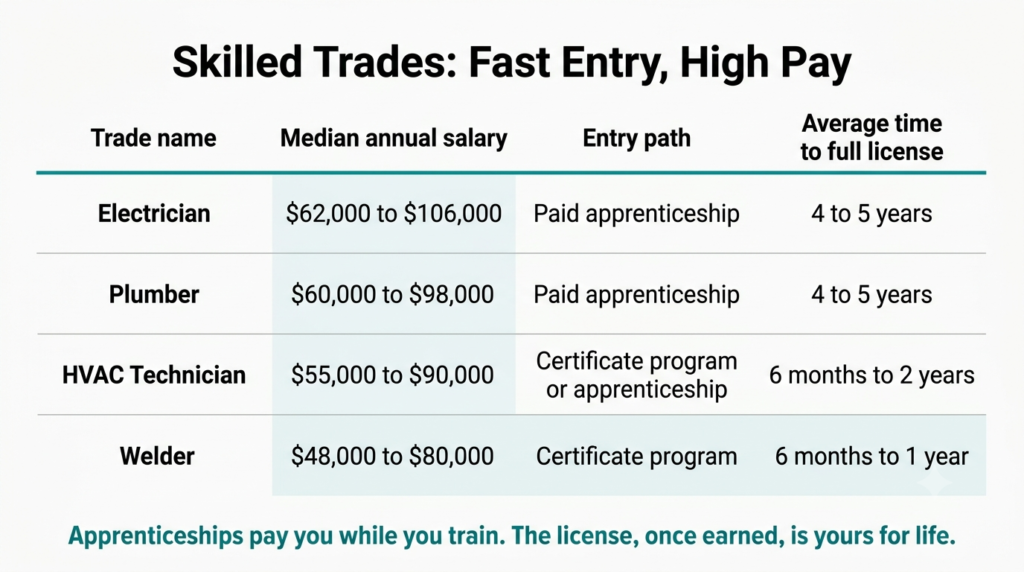
The skilled trades are the single most consistent pathway to high income for immigrants who are willing to do physical work, enter through an apprenticeship, and commit to a licensing process that takes several years but pays well throughout.
The entry model for most trades is the apprenticeship: a structured program of two to five years, sponsored by a union, an employer, or a trade association, during which you work alongside experienced tradespeople and attend classroom instruction. You earn roughly 40% to 50% of journeyman wages in your first year, increasing each year until you qualify for full licensure. By the time you complete the apprenticeship, you have years of paid experience, a license, and earnings that match or exceed most college educated office workers.
For immigrants specifically, the trades have an additional advantage: the license, once earned, belongs to you independently of any employer. You can work for a contractor, start your own business, or take your skills to any state or city that needs them. No employer can revoke your qualifications because they are not tied to any employer.
The demand for skilled tradespeople in the US is structural and growing. The existing workforce is aging out faster than new entrants are replacing it. The Associated Builders and Contractors estimated a shortage of more than 500,000 skilled craft workers in the US. That shortage will not reverse quickly.
To explore the income potential in detail across both the US and Canada, our article on the highest paying jobs without a degree in North America covers specific salary figures and entry requirements state by state.
2. Healthcare Support Roles: CNA, LPN, Medical Assistant, Interpreter
Healthcare is the largest employment sector in the United States and one of the most consistent sources of stable, well-paying work for immigrants. The specific roles accessible without a four year degree and without a long licensing process include Certified Nursing Assistants (CNAs), Licensed Practical Nurses (LPNs), Medical Assistants, Phlebotomists, and Medical Interpreters.
CNAs require a state-approved training program, typically four to twelve weeks, followed by a certification exam. Average pay ranges from $35,000 to $48,000 annually, with significantly higher figures in high-cost states like California and New York. The role is physically demanding and the work involves direct patient care, but it is the fastest entry point into a healthcare career that exists.
LPNs require a diploma program, typically 12 to 18 months at a community college, followed by the NCLEX-PN exam. Average annual pay ranges from $52,000 to $65,000, with experienced LPNs in specialty settings earning more. Many LPN programs are specifically designed to accommodate working adults with evening and weekend schedules.
Medical Interpreters are in persistent and growing demand as immigrant patient populations grow in American healthcare. If you are fluently bilingual in English and a language with significant patient population representation, such as Spanish, Mandarin, Vietnamese, Arabic, Tagalog, or Haitian Creole, medical interpretation is a genuine career pathway. The National Board of Certification for Medical Interpreters and the Certification Commission for Healthcare Interpreters both offer certifications that significantly increase earning potential. Certified medical interpreters earn $45,000 to $75,000 annually, and remote interpretation has expanded the job market considerably.
For immigrants with healthcare backgrounds from their home countries, credential recognition pathways exist but vary significantly by profession and by state. The path for a foreign trained nurse or physician is long and expensive, but bridging roles like the ones above can sustain income while that longer process unfolds.
3. Information Technology: Software Development, Cybersecurity, IT Support
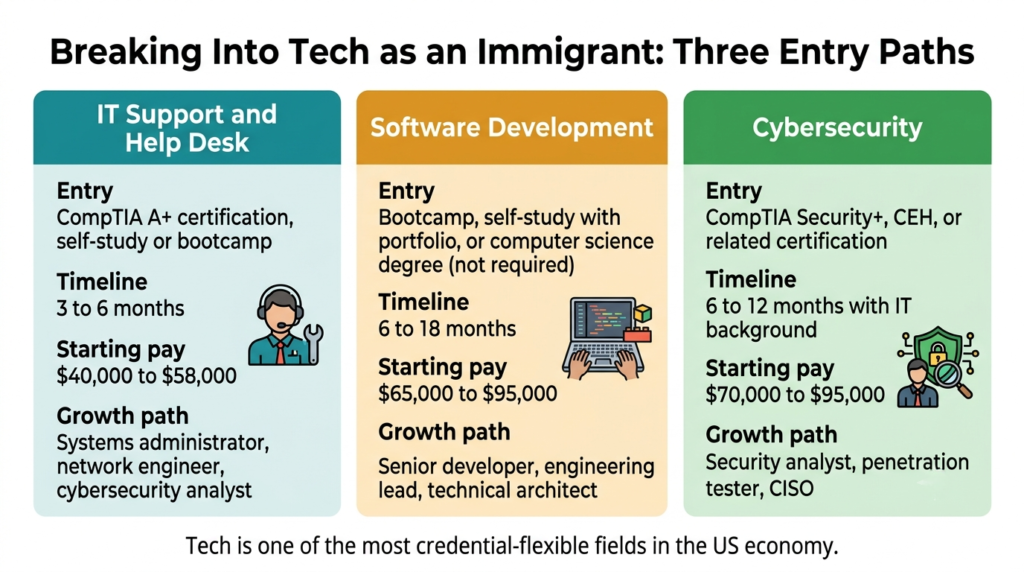
Technology is the most meritocratic sector of the US economy in the sense that employers in tech fields care more about what you can demonstrably do than where you studied or where you grew up. A portfolio of working software, a certification in cybersecurity, or verifiable IT support experience from anywhere in the world is evaluated on its own merits.
This makes technology particularly accessible to immigrants who have genuine skills but whose credentials from home countries are either unrecognized or require years to validate through formal US processes.
IT Support is the fastest entry point into tech. CompTIA A+ certification, which can be self studied and passed in three to six months, qualifies candidates for help desk and IT support roles paying $40,000 to $58,000 annually. From there, the career ladder into systems administration, network engineering, and cybersecurity is steep and well compensated.
Software development has the widest range of entry paths, from formal computer science degrees to coding bootcamps to completely self taught portfolios. Employers hiring junior developers often evaluate GitHub portfolios and completed projects as much as formal credentials. A bootcamp of four to six months costs $10,000 to $20,000 but can place graduates in entry roles paying $65,000 to $85,000 in markets with decent tech demand. Many bootcamps offer income share agreements that defer payment until you are employed.
Cybersecurity has among the most severe talent shortages in the tech sector. Certifications like CompTIA Security+, the Certified Ethical Hacker (CEH), or the Systems Security Certified Practitioner (SSCP) open doors to roles paying $70,000 to $95,000 at the junior level. Experienced cybersecurity professionals command significantly higher salaries, and the remote nature of much of the work expands the geographic range of opportunities.
4. Commercial Driving: CDL Holder, Truck Driver, Bus Driver
The United States has a genuine, structural, ongoing shortage of commercial drivers. The American Trucking Associations has repeatedly reported shortfalls of 60,000 to 80,000 drivers, a number expected to grow as the existing workforce ages. This is not a temporary or cyclical shortage. It is a demographic and training pipeline problem that creates consistent opportunity for anyone willing to obtain a Commercial Driver’s License (CDL).
CDL training programs typically run three to seven weeks and cost between $3,000 and $10,000, though many trucking companies offer paid CDL training in exchange for a one to two year employment commitment after licensing. Starting pay for CDL drivers ranges from $50,000 to $70,000 annually, with experienced drivers and owner-operators earning significantly more.
The CDL is a federal credential, meaning it is recognized in all 50 states. It opens doors not only to long-haul trucking but to local delivery driving, school bus operation, transit authority positions, construction vehicle operation, and other commercial driving categories.
For immigrants with no US credit history who need an income that does not depend on an employer’s sponsorship relationship, commercial driving is one of the most reliable options available. The license belongs to you, the demand is consistent, and the earnings are real from the first week you are on the road.
5. Real Estate Agent
Real estate agent licensing in the United States and Canada requires no degree, no prior real estate experience, and no specific immigration status beyond legal residency and work authorization. The process in most US states involves a pre licensing course of 40 to 180 hours depending on the state, followed by passing a state licensing exam.
The income ceiling for successful real estate agents is genuinely high. Top agents in active markets routinely earn $100,000 to $300,000 or more annually. The income is commission based, which means it can also be very low in the first year while you build your client base, and inconsistent month to month even for experienced agents. This is a career that rewards persistence, community relationships, and local market knowledge, all of which immigrants who are embedded in active ethnic communities can develop faster than outsiders who lack those networks.
For immigrants specifically, one of the most effective niches in real estate is serving as the agent of choice for your own community. Buyers and sellers who are immigrants or newcomers often strongly prefer to work with an agent who speaks their language, understands their specific financial situation, including ITIN mortgages and non-citizen buyer concerns, and can explain the US real estate process in a culturally fluent way. That niche, while competitive, is also underserved in most markets.
6. Entrepreneurship and Self-Employment
The United States has one of the most accessible business formation systems in the world. An LLC can be registered in most states for under $200 in filing fees, takes less than a day to set up, and is open to immigrants regardless of documentation status. An ITIN is sufficient to open a business bank account, apply for an EIN, and operate a legal business.
The most successful immigrant built businesses in the early years tend to start from a genuine skill or service that is either in demand in the immigrant community, underserved in the local market, or both. Home cleaning services, food preparation and catering, childcare, landscaping, trucking, translating and interpreting, alterations and tailoring, hair care and beauty services, and construction subcontracting are all industries where immigrant entrepreneurs have built real, sustainable businesses without formal business education, significant startup capital, or employer sponsorship.
The financial discipline required to survive the early years of self employment is real and demanding, but the upside is that the business you build is yours, entirely independent of any employer’s willingness to continue your visa or keep you on payroll.
Our guide on how to start an LLC as an immigrant covers the formation process, the tax implications, the banking options available with an ITIN, and the specific legal and operational considerations for immigrant-owned businesses.
7. Financial Services and Insurance
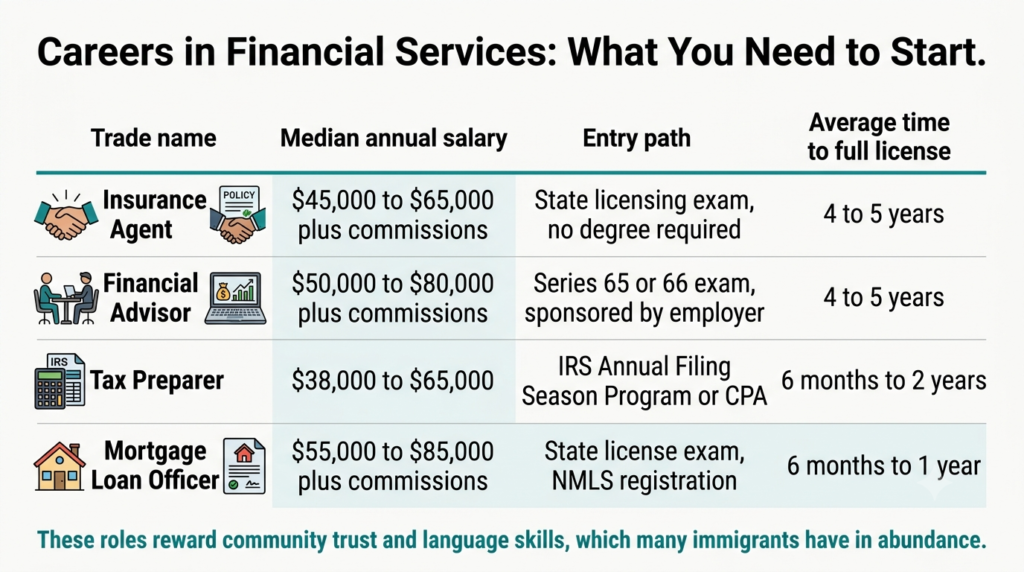
Financial services is a career sector where immigrant status can be an outright advantage rather than a barrier, because immigrant communities often distrust financial institutions staffed entirely by people who have no shared background, language, or cultural frame with them.
A licensed insurance agent who speaks Spanish, Tagalog, or Amharic and understands the specific concerns of immigrant families, like remittances, dual country asset planning, and coverage for extended family members, can build a client base faster than an agent without those community connections.
A tax preparer who understands ITIN filing, foreign income reporting, and the specific tax situations immigrants face is genuinely scarce and in genuine demand.
A mortgage loan officer who knows which lenders offer ITIN mortgages and can guide a non-citizen buyer through the process is serving an underserved market that most agents ignore.
Insurance agent: State licensing exams are required. Most states require a pre licensing course of 20 to 40 hours followed by a state exam. No degree is required. Many agencies provide training and support new agents through the first months. The income is commission based and builds over time as a client book grows.
Tax preparer: The IRS Annual Filing Season Program allows individuals to prepare and file returns without CPA credentials, after completing specific continuing education hours. Many immigrant tax preparers start part time during filing season and grow into full time practices.
Mortgage loan officer: The Nationwide Multistate Licensing System (NMLS) administers licensing for mortgage loan originators. The process requires pre licensing education, a background check, and a state specific exam. No degree is required.
8. Trucking Business Owner
The transition from employed CDL holder to owner-operator represents one of the clearest paths from employment to entrepreneurship in the US economy, and it is a path with established infrastructure and financing options that many immigrants have successfully navigated.
An owner-operator owns or leases one or more commercial trucks and contracts with freight brokers, shippers, or carriers to haul loads independently. Income varies based on routes, contract quality, and operating costs, but experienced owner-operators typically earn $100,000 to $200,000 per year gross, with net income after truck expenses and insurance of $60,000 to $120,000.
The pathway is: obtain your CDL, drive for an employer for one to two years to build experience and a safety record, then either purchase a truck and register as an independent operator or lease-to-own through a carrier. Business credit, rather than personal credit, is the primary financial tool for acquiring the truck, which means this path is more accessible than mortgage financing for immigrants who are still building their personal credit profile.
How to Choose Based on Your Starting Point
If you are in your first six to twelve months and need income quickly, healthcare support roles and CDL driving offer the fastest realistic timelines from zero to stable income.
If you have transferable technology skills from your home country, IT and software development roles offer the fastest path to competitive wages without credential rebuilding.
If you have community relationships and language skills, financial services and real estate reward those assets more directly than almost any other career category.
If you are physically capable and willing to commit to a multi year training program, the skilled trades offer the best combination of income, independence, and long term job security available to anyone without a US college degree.
If you want to build something of your own from the beginning, entrepreneurship combined with any of the service based skills above provides the highest ceiling, with the highest short term difficulty.
The right career is the one that matches what you already have, what you are willing to build, and what your financial runway actually supports. Our guide on how to choose a career in North America walks through that decision framework in more depth, including how to determine whether your specific profession is regulated and what that means for your timeline.
The Financial Foundation Underneath Any Career
A career that pays well is only as powerful as what you do with what it pays.
Every path on this list can produce the income to fund an emergency fund, contribute to a 401(k) match, open a Roth IRA, and eventually invest consistently toward long term financial independence. But none of those outcomes happen automatically. They happen because you build the financial habits alongside the career.
Our guide on the first 90 days financial checklist for newly arrived immigrants covers the specific financial steps to take in parallel with your career search, so that when the income begins to grow, the infrastructure to capture its value is already in place.
Disclaimer: This article is for educational and informational purposes only. Salary ranges are approximate and vary by location, experience, and employer. Licensing requirements for regulated professions vary by state and province and change over time. Always verify current requirements directly with the relevant licensing or regulatory body before making career or educational investment decisions.