
How to Furnish an Apartment on a Budget
When I rented my first apartment in the United States, I was so focused on making the first and last month’s deposit work that I had not given much thought to what would actually go inside the empty space I was paying for.
I slept on an air mattress for three weeks. I ate at a folding camping table I borrowed from a coworker. My kitchen had one pot, two plates, and a butter knife.
That situation resolved itself faster than I expected, and almost entirely for free, once I understood something about how Americans relate to furniture and household goods: they discard enormous quantities of perfectly functional items constantly. Moving, divorcing, upgrading, downsizing, redecorating. The result is a permanent, enormous, informal marketplace of free and nearly free household goods flowing through every American city at any given moment.
You just need to know where to look.
This article covers every strategy for furnishing an apartment without spending significant money, organized from completely free to low cost, with the specific platforms, programs, and approaches that work best for newly arrived immigrants.
Why Furnishing Is a Hidden Financial Trap for Newcomers
Before the strategies, it is worth naming the trap directly.
Many immigrants, especially those arriving from countries where furniture is purchased new as a matter of cultural expectation or where secondhand markets are limited, default to buying everything at retail. A basic bed frame, mattress, couch, dining table, and dresser purchased new at a mid range store like IKEA or Target can cost $2,000 to $4,000. Purchased at a furniture store with financing, the same items can become a debt that compounds over months or years at high interest rates.
Rent-to-own furniture stores, which are common in immigrant neighborhoods and are sometimes the only visible option for someone without a credit card, are among the most expensive ways to acquire household goods available. A $400 sofa rented to own over 18 months typically costs $900 to $1,200 in total payments. These stores exist specifically to profit from people who do not yet know that better options are available.
The better options are available. They are abundant. They are often completely free. And using them is not a sign of financial difficulty. It is a sign of financial intelligence.
Strategy 1: Facebook Marketplace Free Listings
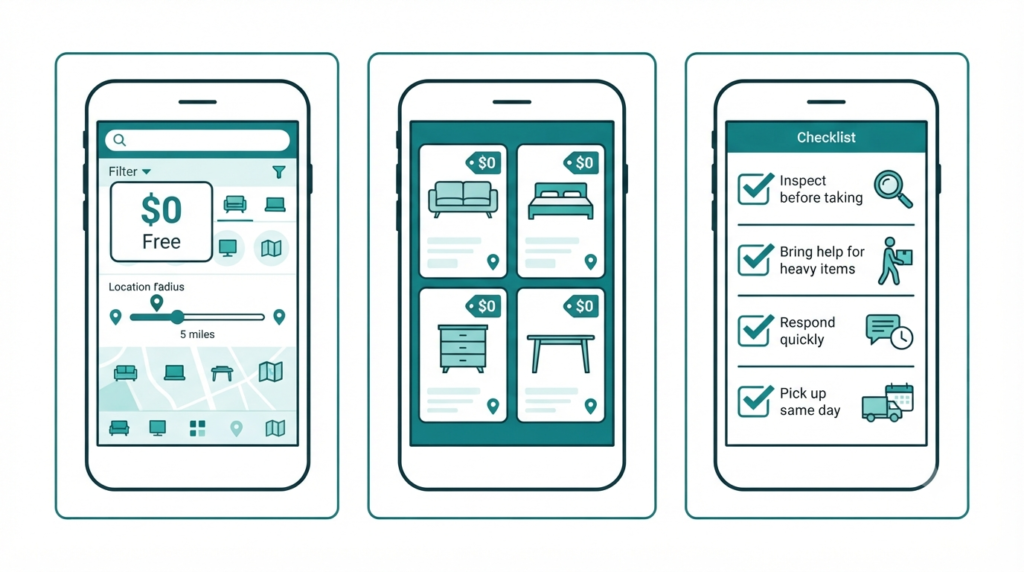
What this image shows: Three steps for finding free furniture on Facebook Marketplace — set the filter to Free in your location, browse available items including sofas, bed frames, dressers, and tables, then follow pickup best practices: inspect first, bring help, respond fast, and pick up the same day you arrange it.
Facebook Marketplace is the single most effective source of free furniture for immigrants in the United States, and it is completely free to use with any Facebook account.
The key that most newcomers miss: there is a specific filter inside Facebook Marketplace called “Free.” Setting this filter shows only items being given away at no charge. In any American city with a population above 100,000, checking this filter daily will reveal couches, bed frames, mattresses, dining sets, dressers, kitchen items, lamps, and appliances being given away, usually because the owner is moving or upgrading and cannot or does not want to haul the item away.
How to use it effectively:
Search Facebook Marketplace in your city. Click “Filters” and set Price to Free. Sort by “Date Listed: Newest First” so you see the most recent listings before other people claim them. Set a distance radius of 10 to 15 miles so results are actually reachable.
When you find something you want, message the seller immediately with a short note: “I am interested. I can pick up today or tomorrow. What time works?” Speed matters enormously. Free items attract dozens of messages within the first hour.
Bring your own transportation. Most giveaway listings require you to pick up the item. If you do not have a vehicle large enough, arrange a vehicle rental, ask a friend with a truck or van, or use a service like Lugg or TaskRabbit that provides movers with vehicles for a flat fee.
Bring someone to help. Furniture is heavy. Having a second person makes pickup safe and fast, which the person giving the item away will appreciate and remember if you want to come back for more.
Strategy 2: Buy Nothing Groups
Buy Nothing groups are neighborhood level gift economies where members give items to each other at no cost, no exchange required. They operate primarily through Facebook groups, though a dedicated app also exists.
Unlike Facebook Marketplace free listings, which are open to anyone in a geographic area, Buy Nothing groups are specifically for a defined neighborhood or zip code. The community is usually smaller and more connected, which means you see the same people repeatedly and trust builds over time.
To join: search “Buy Nothing [your neighborhood or city name]” on Facebook and request to join the group for your area. Once approved, you can post requests for items you need, respond to items being offered, and over time build relationships with neighbors who give away high quality household goods regularly.
Items commonly given away in Buy Nothing groups include kitchen equipment, small appliances, children’s clothing and toys, books, garden tools, decorative items, and household goods of every description. Furniture appears regularly, particularly in neighborhoods with higher turnover of residents.
Strategy 3: Mutual Aid Networks and Community Groups
Every major city in the United States has immigrant community mutual aid networks, ethnic social media groups, and neighborhood organizations through which household goods flow informally between community members.
These networks are often the fastest source of household goods for immigrants because they operate through existing trust relationships. Someone in your WhatsApp group for people from your home country knows someone who is leaving and wants to give their furniture to a community member rather than a stranger. Someone at your church or mosque is upgrading their kitchen and wants the old appliances to go to someone who needs them.
Actively asking within your community networks for what you need is one of the most underused strategies available to newcomers. The combination of community trust and the volume of household goods being given away at any given moment means that a few direct questions in the right groups often produces results faster than any app.
Strategy 4: Thrift Stores for What You Cannot Get Free
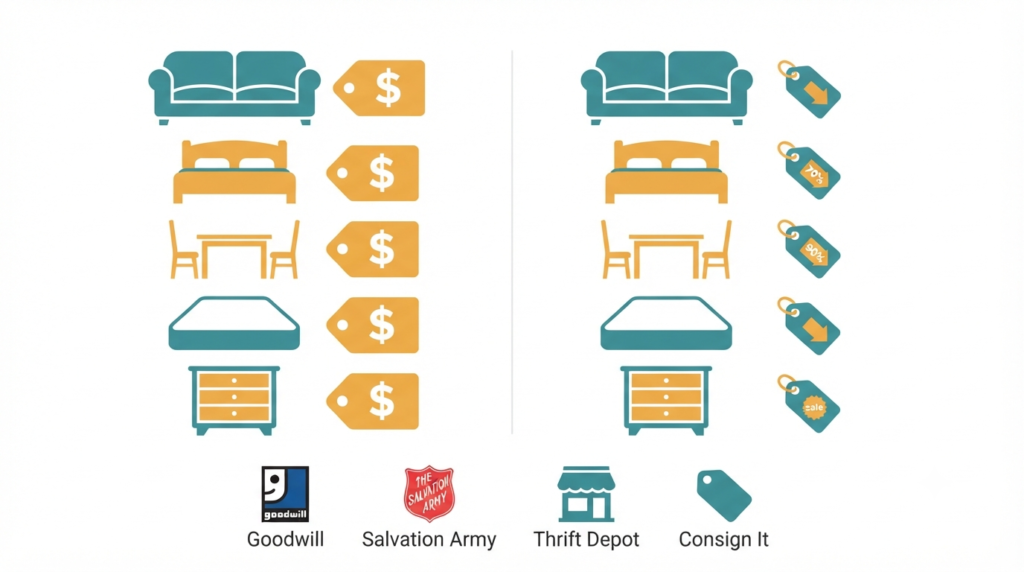
What this image shows: The same household items that cost hundreds of dollars at retail — sofas, bed frames, dining sets, mattresses, dressers — typically cost 70% to 90% less at thrift stores. Major thrift chains operate in most US cities and accept donated furniture and household goods that they resell at significantly reduced prices.
For items you cannot find through free channels, thrift stores are the next most cost effective option. The major national thrift chains — Goodwill, Salvation Army, Habitat for Humanity ReStores, and Savers — accept donated furniture and household goods and resell them at prices ranging from a few dollars for kitchen items to $20 to $150 for furniture pieces, depending on size and condition.
Goodwill is the most widely available thrift chain in the US, with stores in nearly every city. Their furniture section varies by location — some stores have very limited furniture, others have large selections. Prices are set by the store and can vary. Goodwill also runs an online auction platform at shopgoodwill.com where items from across the country are listed.
Habitat for Humanity ReStores specialize specifically in home goods: furniture, appliances, building materials, lighting, and hardware, all donated by individuals and contractors. ReStores tend to carry higher quality items than general thrift stores, particularly in kitchens and bathrooms. Prices are still dramatically below retail.
Salvation Army operates thrift stores in most major cities with furniture sections, appliances, and household goods. Prices are generally comparable to Goodwill.
Tips for thrift shopping:
Go on weekdays in the morning when new stock has been put out and before weekend shoppers arrive. Ask the staff what days new donations are processed — most stores have specific days when trucks are unloaded and fresh items appear on the floor.
Inspect furniture carefully before buying. Look for structural stability, check drawers and doors open and close properly, smell the item for mildew or pet odor, and look for stains or damage that would require more than a wipe down to address.
Buy the basics first. A bed frame, a mattress, a table, one chair per person. Resist filling every corner at once. A minimal, functional space costs a fraction of a fully furnished one and can be added to over time as free items appear.
Strategy 5: Craigslist Free Section
Craigslist remains one of the largest platforms for free and low cost household goods in the US, despite being less visually polished than Facebook Marketplace. The Free section of Craigslist in most cities is updated constantly with furniture, appliances, and household items.
Go to craigslist.org and select your city. Click “For Sale” and then “Free.” Browse by category or use the search bar with specific items you need. Craigslist posts are text based and often do not include photos, which means responding quickly and asking for pictures is often necessary to evaluate what is being offered.
Unlike Facebook Marketplace, Craigslist does not require an account to browse, which makes it useful for newcomers who do not yet have a US-based Facebook account or who prefer to keep their furniture search separate from their social media.
Strategy 6: OfferUp and Nextdoor
OfferUp is a mobile first marketplace for buying and selling used goods locally. Its interface is more modern than Craigslist and more transaction-focused than Facebook Marketplace. OfferUp is particularly strong in cities where Facebook Marketplace is less active, including some mid-size cities and specific neighborhoods.
Search OfferUp for your city, filter by price from low to high, and set a distance filter to show only nearby listings. Prices on OfferUp for furniture are typically 50% to 80% below retail.
Nextdoor is a neighborhood based social network where residents share local information including items for sale or giveaway. Nextdoor requires registration with a verified address, but the community is often more curated and trustworthy than broader platforms because all members are verified neighbors.
Strategy 7: IKEA and Budget Retailers for What You Must Buy New
After exhausting free and thrift options, some items are more practical to buy new, particularly mattresses, linens, and pillows where hygiene is a genuine concern.
For new purchases on a tight budget, IKEA is the most cost effective option for most furniture categories. Their flat pack model keeps shipping and storage costs low, which translates to lower prices. A basic bed frame runs $80 to $150. A simple wardrobe starts at $100. A small dining table and two chairs can be had for under $150.
The tradeoff with IKEA is assembly time. Every piece requires assembly, which takes one to three hours for most items with basic tools. If you do not have tools, a basic toolkit including a screwdriver, hammer, and Allen keys can be purchased at a dollar store or Walmart for under $10.
Walmart, Target, and Amazon all carry budget furniture lines that compete with IKEA on price. Walmart’s Mainstays brand and Amazon basics furniture are the most commonly cited affordable options. For very basic needs — a folding table, a plastic chair, a small bookshelf — these options are often the fastest and cheapest path.
What to Furnish First: A Priority Order
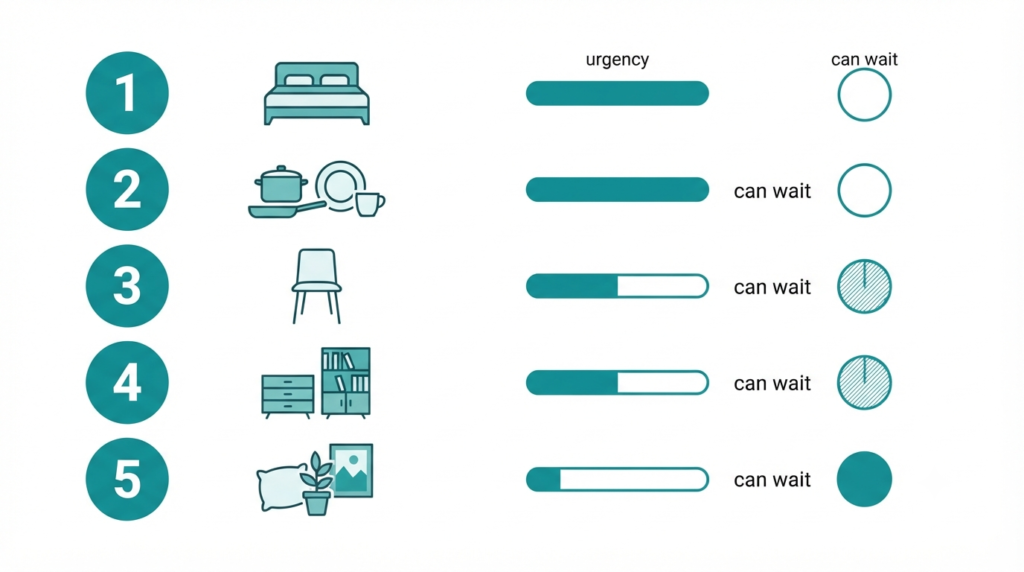
What this image shows: A five-step furnishing priority order — start with sleeping (bed or mattress), then kitchen essentials, then at least one seat per person, then storage, and finally comfort and decorative items. The urgency level decreases from top to bottom. The first two categories are immediate needs; the last two can be gathered over time as free items become available.
Not all furniture is equally urgent. Furnishing in priority order prevents the trap of spending money on decorative items while sleeping on the floor.
Priority 1: Sleeping setup. A mattress, or at minimum a mattress pad or camping mat, and bedding. This is non-negotiable for health and basic functioning. A free mattress from Facebook Marketplace is fine if it is in clean condition. If purchasing new, a basic twin or full mattress from Walmart or IKEA starts at $150 to $200.
Priority 2: Kitchen basics. One pot. One pan. Plates, bowls, and cups for however many people live with you. Cutlery. These items are extremely easy to find free on Facebook Marketplace, at thrift stores for $1 to $3 each, or at dollar stores for very low cost. A functional kitchen can be assembled for under $20 at a dollar store or thrift store.
Priority 3: Seating. At minimum, one place to sit per person in the household. This does not have to be a sofa. A dining chair, a camp chair, or a floor cushion all work in the short term. Free sofas and chairs are among the most commonly given-away items on Facebook Marketplace.
Priority 4: Storage. A dresser, a wardrobe, or shelving for clothing. Without storage, clothes end up in suitcases or on the floor, which creates disorder and makes daily life harder. Dressers are common free finds. IKEA’s basic Kallax shelving starts at $50 and functions as both storage and room divider.
Priority 5: Everything else. Decorative items, extra seating, a television, a desk, rugs, lamps. All of these can be gathered gradually over months as free items appear or as budget allows. None of them are needed to function on day one.
The Total Cost: What a Complete Apartment Can Actually Cost
Here is a realistic budget for furnishing a one bedroom apartment using the strategies above.
Free (via Facebook Marketplace, Buy Nothing, community networks): Sofa, dining table, chairs, dresser, bookshelf, kitchen items, lamps: $0
Thrift store purchases: Additional kitchen equipment, small items, decorative basics: $20 to $60
New purchases (mattress, bedding, pillow, basic kitchen items): Twin or full mattress: $150 to $200 Bedding set: $30 to $50 Pillow: $10 to $20 Kitchen items not found free: $15 to $30
Total realistic furnishing cost: $225 to $360
Compare that to the $2,000 to $4,000 that a newcomer who walks into IKEA or a furniture store and buys everything new will spend. The difference, redirected to an emergency fund, a Roth IRA, or a 401(k) contribution, is a meaningful financial head start.
For context on how this kind of spending decision fits into your overall monthly budget framework, our article on how to create your first budget in a new country walks through how to categorize and plan for one time setup costs as a newcomer.
And if your current income is making even a $225 furnishing budget feel difficult, our guide on how to make enough money to survive here covers practical income strategies that can help you close that gap.
One More Resource Worth Knowing: TEFAP and Resettlement Organizations
If you arrived in the United States as a refugee, an asylee, or through a resettlement program, your resettlement agency may have access to donated household goods, furniture, and welcome kits that are distributed to newcomers at no cost. Contact your resettlement agency or local refugee services organization directly and ask specifically about household goods assistance.
Similarly, many local churches, mosques, temples, and community organizations maintain household goods programs or informal networks for distributing donated items to newcomers. These programs are often not publicly advertised but become visible once you ask within your community.
Disclaimer: This article is for educational and informational purposes only. Platform availability, free item listings, and thrift store inventory vary by location and change constantly. Always inspect secondhand items carefully before accepting or purchasing them.