
Warehouse Jobs vs Retail Jobs: What Pays More?
When you are newly arrived and looking for work that does not require a US degree, a long credential recognition process, or years of local experience, two industries show up again and again: warehousing and retail. Both hire large numbers of workers with limited English. Both have physical locations in nearly every city. Both are often willing to hire immigrants who are still building their US work history.
But they are not the same. The pay, the schedule, the benefits, the physical demands, and the long term career ceiling are meaningfully different — and for an immigrant making decisions about where to invest their first years of US work experience, those differences matter.
This article gives you the full, honest comparison based on current data, so you can make the choice that actually fits your situation.
The Starting Point: What Each Job Actually Pays
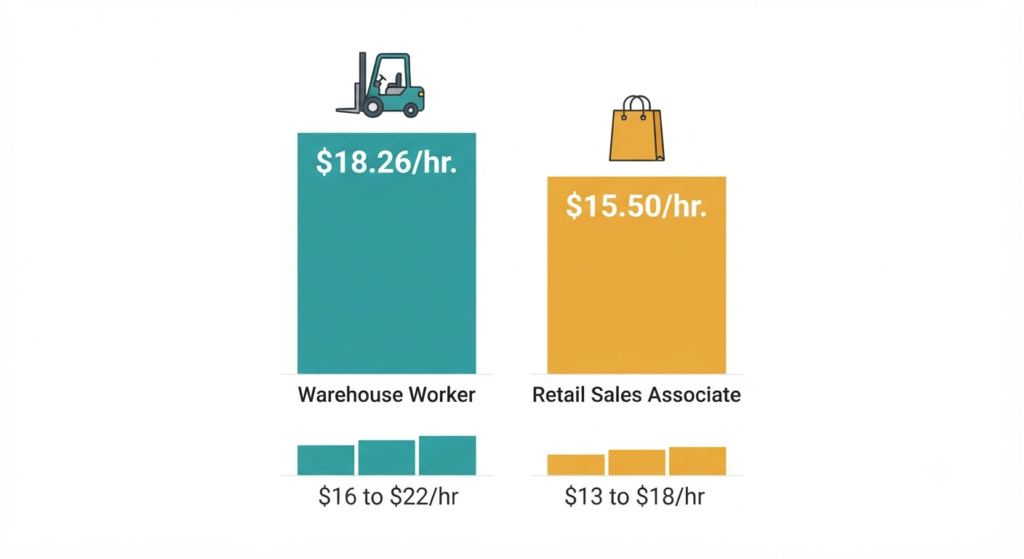
What this image shows: The average warehouse worker earns approximately $18.26 per hour in the US as of 2026, compared to approximately $15.50 per hour for an entry level retail sales associate. Warehouse pay ranges from around $16 to $22 per hour depending on location, employer, and role. Retail ranges from roughly $13 to $18 per hour for floor level positions. Across both ranges, warehouse work consistently pays more at the entry level.
Based on current data from Indeed, ZipRecruiter, and PayScale, here is the entry level pay picture for both industries:
Warehouse work: Average hourly pay: $18.26 per hour nationally (Indeed, May 2026) Amazon fulfillment centers: $18 to $22 per hour nationally, up to $25 per hour in California and New York Entry-level annual salary range: $32,000 to $43,500 (ZipRecruiter, July 2026) With overtime, which is common in warehouse settings, total annual compensation frequently reaches $40,000 to $50,000
Retail work: Average hourly pay for a sales associate: approximately $15 to $16 per hour Walmart and Target: $15 to $17 per hour entry level Home Depot: $15 to $21 per hour, with skilled roles like Pro Desk paying toward the higher end Department store positions: $14 to $16 per hour in most markets
The wage gap between the two is consistent: warehouse work pays approximately $2 to $3 more per hour at the entry level. Over a full time work year, that difference amounts to roughly $4,000 to $6,000 in additional annual income before overtime is considered.
The Overtime Factor: Where Warehouse Work Pulls Further Ahead
One of the most significant financial differences between the two industries is how overtime works in practice.
Warehouse operations, particularly those tied to e-commerce fulfillment like Amazon, UPS, FedEx, and third party logistics companies, run on peak demand cycles. During holiday seasons, back-to-school periods, and promotional events, warehouse workers routinely work 50 to 60 hours per week. Overtime pay at 1.5 times the regular rate applies to all hours beyond 40 in the United States.
A warehouse worker earning $18 per hour who works 10 hours of overtime per week earns an additional $27 per hour for those extra hours. Over a ten-week peak season, that adds approximately $2,700 to their earnings beyond regular pay.
Retail overtime exists but is generally less predictable and less generous. Many retail employers manage hours carefully to avoid paying overtime, keeping most workers at or just below 40 hours per week, or staffing with a combination of part time workers specifically to avoid overtime obligations. The exception is management, where salaried retail managers often work far beyond 40 hours without additional compensation.
For immigrants who are actively trying to maximize income in their early years in the US, the consistent overtime availability in warehouse work is a genuine financial advantage.
If you are already working overtime and wondering how to calculate what it is actually worth to you after tax, our guide on how much is your overtime really worth walks through the math including the new overtime tax deduction that may reduce what you owe on those extra hours.
Benefits Comparison: Health Insurance, 401(k), and More
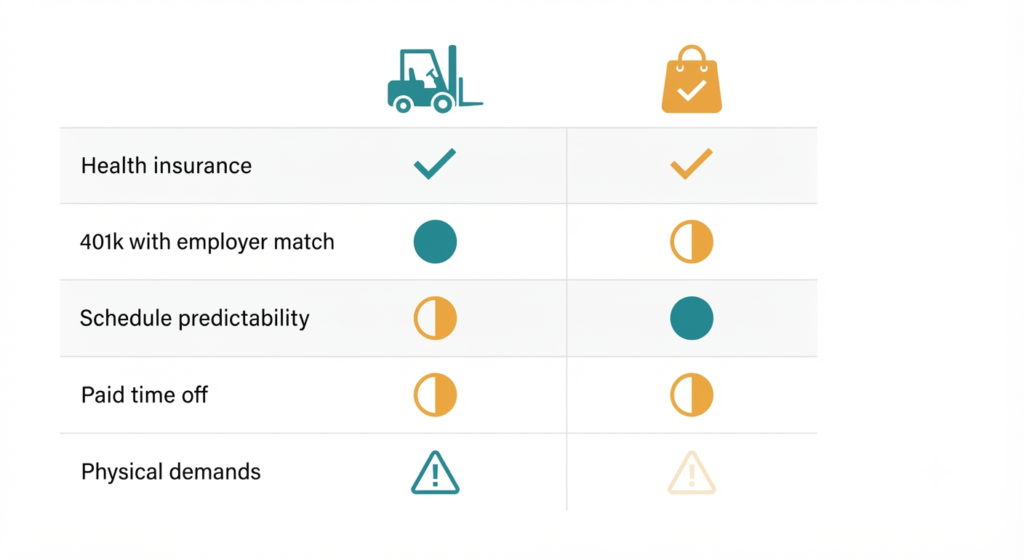
What this image shows: Warehouse jobs generally offer stronger health insurance and 401(k) matching benefits than entry level retail positions, particularly at major employers like Amazon where benefits are comprehensive for full time workers. Retail schedules tend to be more predictable and less physically intense. Both industries offer paid time off, though policies vary by employer. Warehouse work carries higher physical demands and injury risk.
Health Insurance
Large warehouse employers, particularly Amazon, UPS, FedEx, and major third party logistics companies, offer comprehensive health insurance to full time workers, often with employer-paid premiums. Amazon specifically offers medical, dental, and vision coverage beginning on the first day of employment for full time associates, which is significantly more generous than the industry standard.
Retail health insurance varies widely. Large chains like Walmart, Target, and Home Depot offer benefits to full time employees, but many retail positions are structured as part time specifically to avoid the benefits threshold. Workers who are kept at 29 to 35 hours per week do not qualify for employer health benefits at many retailers.
401(k) Matching
Amazon matches 50% of employee contributions up to 4% of eligible salary for full time workers, which is a meaningful benefit that begins compounding immediately. Many major logistics companies offer similar plans.
Retail 401(k) matching is inconsistent. Walmart matches contributions up to 6% of wages at a 100% match rate for workers with more than one year of service, which is actually among the best in retail. Many smaller and regional retailers offer no match at all.
Schedule Predictability
This is an area where retail has a genuine advantage. Retail schedules, while often variable, are typically posted one to two weeks in advance and can be discussed with a manager. Workers who prefer day shifts or need specific days off can often arrange this through scheduling requests.
Warehouse schedules are often fixed by shift: day shift, evening shift, or overnight. The shift itself is predictable, but the hours within it may expand significantly during peak periods. Workers assigned to overnight or evening shifts in warehouses have less flexibility to adjust, and the physical and social costs of those schedules are real.
Career Progression: Which Industry Goes Further?
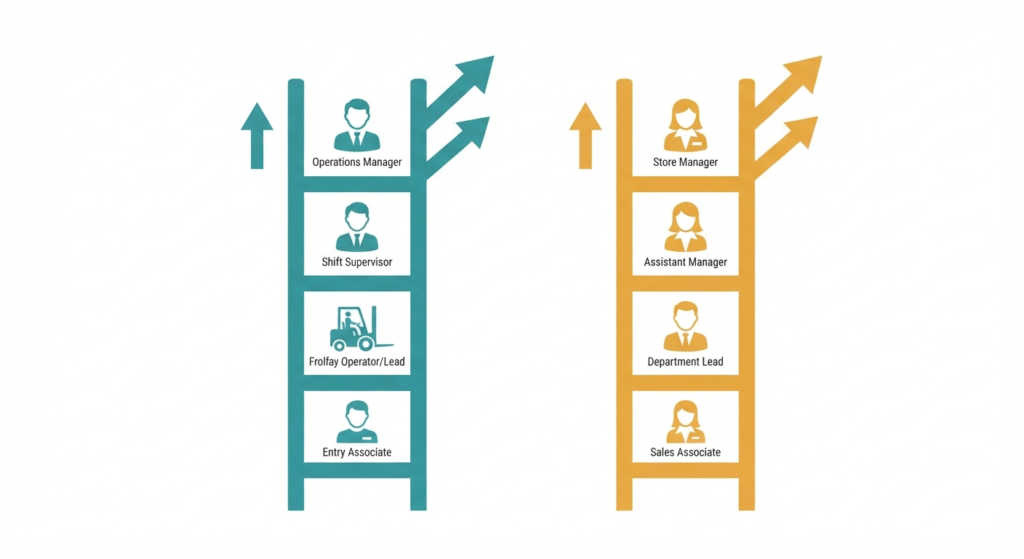
What this image shows: Both warehouse and retail offer internal career ladders from entry level worker to management. In warehouses, the path runs from associate to lead to shift supervisor to operations manager. In retail, from sales associate to department lead to assistant manager to store manager. Both tracks can reach management salaries of $50,000 to $80,000 or more, but the specific steps, speed, and culture of advancement differ significantly between the two industries.
Warehouse Career Path
The entry level in warehouse work is picking, packing, sorting, or receiving. Workers who demonstrate reliability, productivity, and willingness to take on additional responsibility can advance to team lead or process guide roles within one to two years. From there, shift supervisors and operations supervisors manage teams of workers and earn $45,000 to $65,000 annually in most markets.
At Amazon specifically, the Area Manager track is the first salaried management role, paying $55,000 to $75,000 per year at entry level. This is reachable from hourly associate status, though it typically requires additional education or demonstrated management readiness.
Specialized skills significantly accelerate advancement and pay in warehouses. A forklift operator certification adds $2 to $4 per hour to base pay in most facilities. Reach truck, order picker, and cherry picker certifications similarly increase earning potential. Quality assurance and inventory management roles pay above standard associate rates and offer a path toward supply chain coordinator positions that pay $50,000 to $70,000 annually.
Retail Career Path
Retail management is one of the more accessible management tracks in the US economy: many current retail store managers and district managers began as hourly sales associates. The assistant manager role is typically the first step into salaried management, often paying $38,000 to $52,000 annually. Store managers at major retailers earn $60,000 to $110,000 depending on store volume and chain.
The retail path, however, has grown increasingly complicated by the structural decline in brick and mortar retail. <cite index=”11-1″>The BLS projects that four sectors will experience job losses through 2034, with the bulk concentrated in retail trade</cite> as e-commerce continues to shift consumer spending. This does not mean retail will disappear, but it does mean that management positions in retail are increasingly competing with fewer stores, smaller teams, and more automation at the store level.
Physical Demands and Health Considerations
This is an honest section that many job comparison articles skip.
Warehouse work is physically demanding in ways that accumulate over time. Workers in fulfillment centers walk 10 to 15 miles per shift at busy facilities. They lift, carry, bend, and stand on concrete floors for eight to ten hours at a stretch. Repetitive motion injuries, back injuries, and knee problems are documented occupational hazards, particularly in high production environments with productivity quotas.
Amazon in particular has been the subject of significant reporting on injury rates. Their fulfillment center workers experience musculoskeletal injuries at rates higher than the industry average, according to studies cited by the Strategic Organizing Center. This is not a reason to avoid warehouse work, but it is a real consideration for anyone planning a multi year career in the industry.
Retail work is also physically demanding — long hours on your feet, occasional heavy lifting, and the mental fatigue of customer facing work across a full shift — but the physical intensity is generally lower and more variable than warehouse production environments. Workers in retail have more physical variety in their movement, more opportunity to sit during slow periods, and less exposure to the constant productivity targets that characterize large warehouse operations.
For immigrants who are supporting family, managing health conditions, or working a second job alongside this one, the physical sustainability of each option deserves honest consideration alongside the wage comparison.
Which One Is Right for Your Situation?
Rather than declaring a single winner, here is a direct framework for choosing based on where you actually are.
Choose warehouse work if: You want to maximize hourly income immediately. You are able and willing to do physically demanding work for at least two to three years. You want strong benefits from day one, particularly health insurance. You are interested in logistics, supply chain, or operations as a longer-term career direction. You are comfortable with fixed shifts and irregular overtime demands.
Choose retail if: You prioritize schedule flexibility and predictability. You prefer customer facing work and find interpersonal interaction energizing rather than draining. You have existing retail or service experience from your home country that transfers credibly. You want a role with lower physical intensity. You are interested in eventually moving into retail management or buying/merchandising careers.
Consider both simultaneously if: You are in your first weeks in the US and need income quickly. Apply to both. The first offer you receive is the right choice for right now. You can always reassess in six to twelve months once you have US work history, a clearer sense of the local job market, and a better understanding of which environment suits you.
The Bigger Financial Picture
Whether you choose warehouse or retail, the financial habits you build around that income matter more than the $2 to $3 per hour wage difference between them.
An immigrant earning $18 per hour in a warehouse who captures their full employer 401(k) match, builds an emergency fund, and invests consistently will build more wealth than one earning $20 per hour who does none of those things. The income is the raw material. What you do with it is the actual decision.
Our guide on how to make enough money to survive here covers what to do when your current income is not meeting your needs, including how to build toward higher-paying roles over time. And once your income stabilizes, our article on what is investing and why does it matter covers how to put that income to work beyond the paycheck.
Quick Reference: Warehouse vs Retail at a Glance
| Factor | Warehouse | Retail |
|---|---|---|
| Starting hourly pay | $16 to $22/hr | $13 to $18/hr |
| Overtime availability | High, predictable in peak seasons | Lower, often managed to avoid |
| Health insurance | Strong at major employers, day one eligibility | Variable, often part time positions excluded |
| 401(k) match | Common at major employers | Varies widely |
| Schedule flexibility | Lower, fixed shifts | Higher, but irregular |
| Physical demands | High | Moderate |
| Career ceiling | Operations/logistics management | Store/district management |
| Job growth outlook | Growing with e-commerce | Declining in brick and mortar |
| Best for | Maximizing income fast | Flexibility and customer facing work |
Disclaimer: Salary figures reflect data from Indeed, ZipRecruiter, PayScale, and Glassdoor as of 2026 and are national averages. Actual pay varies significantly by location, employer, shift, and experience. Always verify current compensation directly with any employer before accepting a position.