Why Keeping All Your Money in a Savings Account Is Keeping You Poor
For the first two years I was in the United States, I was proud of my savings account. I had money in it. It was growing, slowly but steadily. I could see the balance every time I opened my banking app, and it felt like evidence that I was doing something right. The number was higher than it had ever been in my life. The account was safe. The money was mine.
What I did not see was the invisible cost of that safety.
Inflation was quietly consuming a portion of everything I had saved. The stock market was returning 14% that year. My savings account was returning 0.06%. Every month I kept my money sitting still, I was falling further behind the people who had learned how to make their money work.
This article names what that cost actually is, explains why so many immigrants make this mistake, and shows you exactly what to do instead.
Why Immigrants Keep Everything in Savings
Before explaining the problem, it is worth understanding why this happens so consistently in immigrant communities. It is not ignorance. It is history.
In many countries, banks failed. Governments seized deposits. Currencies collapsed overnight. Inflation wiped out decades of savings in months. The people who kept their money in their mattress sometimes came out better than those who trusted institutions.
If you or your parents survived any of those experiences, or if those stories were passed down to you as the lesson your family learned the hard way, then keeping your money somewhere you can see it and touch it is not a character flaw. It is a rational response to a history where financial institutions betrayed ordinary people.
The United States has a different history. Not perfect. But different in ways that matter for how you should make financial decisions here.
The Federal Deposit Insurance Corporation (FDIC) insures deposits up to $250,000 per person per institution. That means if your bank fails, the US government guarantees you get every dollar back up to that limit. Bank failures in the US are rare and, when they happen, depositors with FDIC-insured accounts do not lose money. The risk that made keeping cash rational in other countries is largely absent here.
The US stock market, for all its volatility, has never had a 20-year period where it ended lower than it started. The historical average annual return of a diversified US stock index fund is approximately 7% after accounting for inflation.
Understanding this context is not about abandoning the caution your history taught you. It is about applying that caution correctly in a system that works differently from the one your family learned to distrust.
The Real Cost of Keeping Everything in Savings
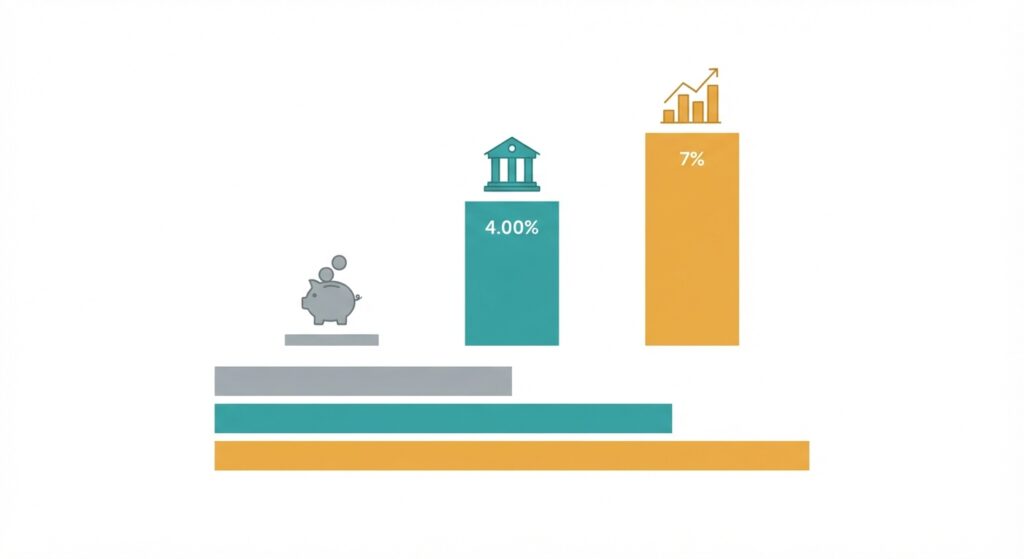
What this image shows: Three returns on the same $10,000 over 20 years. A traditional savings account at 0.06% produces approximately $10,120. A high yield savings account at 4% produces approximately $21,900. A diversified stock market index fund at the historical average of 7% produces approximately $38,700. The gap between the worst and best option is $28,580 on the same original amount, with no additional contributions. The visual shows clearly that where you put money matters enormously over time.
Let us make the numbers completely concrete.
You have $10,000 saved. You leave it alone for 20 years. Here is what happens at three different return rates.
Traditional savings account at 0.06%: After 20 years, you have approximately $10,120. You gained $120. Inflation over that same period, assuming a modest 2.5% per year, reduced the purchasing power of your original $10,000 to approximately $6,100 in real terms. You did not just fail to grow. You quietly lost ground.
High yield savings account at 4%: After 20 years, you have approximately $21,900. Real growth, meaningfully ahead of inflation, but limited by the nature of savings rates, which change with interest rate environments and have historically averaged far less than 4% over long periods.
Diversified stock market index fund at 7%: After 20 years, you have approximately $38,700. More than three times your original amount. This is the historical long term average, not a guaranteed outcome, but a reasonable expectation over a 20-year horizon based on more than a century of US market data.
The difference between keeping $10,000 in a traditional savings account and investing it in a low cost index fund over 20 years is approximately $28,580 on a single $10,000 deposit, with no additional contributions. That is not a small rounding error. That is the cost of playing it safe.
The Inflation Problem Nobody Talks About Clearly
Here is the part that most people feel but cannot name precisely.
When your savings account pays 0.06% and inflation runs at 2.5% per year, you are not just failing to grow your money. You are losing approximately 2.44% of your purchasing power every single year.
A dollar in your account today buys 100 cents’ worth of goods. In ten years, at 2.5% annual inflation, that same dollar buys approximately 78 cents’ worth of goods. Your balance is the same number, but the number means less.
This is why financial educators say that a savings account is not a risk free option. The risk of inflation is real, continuous, and does not require any dramatic event to occur. It happens quietly, every month, regardless of what the market is doing.
A high yield savings account at 4% APY roughly matches or slightly outpaces moderate inflation in the current environment, which is why it is the right place for your emergency fund: it protects against the inflation risk while keeping the money safe and accessible.
But for money you will not need for three years or more, accepting a savings account’s modest return, even a high yield one, when stock market index funds have historically returned significantly more, is a real financial cost measured in tens of thousands of dollars over a lifetime.
The Right Money for Each Account
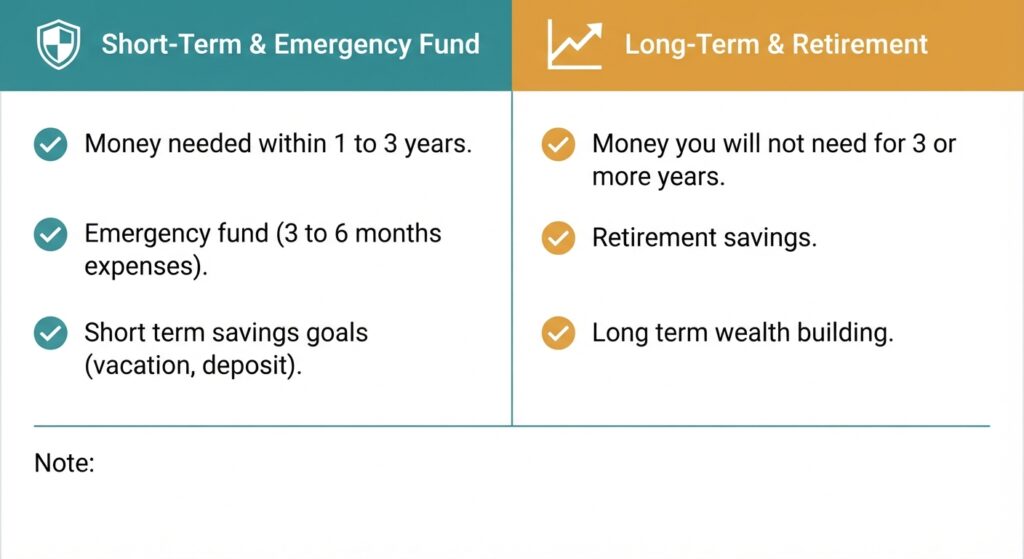
What this image shows: Two categories of money require two different homes. Money needed within one to three years, including your emergency fund and near term savings goals, belongs in a high yield savings account where it is safe and accessible. Money you will not need for three or more years, including retirement savings and long term wealth building, belongs in investment accounts where it can grow at a significantly higher rate over time. Mixing these categories, keeping long term money in a savings account or short term money in volatile investments, is the structural mistake this article addresses.
This is the core principle that most budgeting articles never quite state clearly enough.
Your money has a timeline. Different timelines require different tools.
Money you need within one to three years belongs in a high yield savings account. Your emergency fund. Money you are saving for a car or a move. Your tax reserves if you are self-employed. This money needs to be safe, accessible, and protected from the short term volatility of the stock market. If the market drops 30% the month before you need to use your emergency fund, that is a problem you need to avoid.
Money you will not need for three or more years belongs in investments. Your retirement savings. Money you are building toward financial independence. The portion of your savings that has a genuinely long horizon. This money can afford to experience the short term ups and downs of the market because it will not be needed during those down periods. Time is the asset that makes the market’s volatility manageable.
The mistake is not having a savings account. The mistake is keeping long term money in a short term vehicle.
What to Do Instead: A Simple Framework
You do not need to sell your savings account or change your entire financial life in a week. The shift from savings only to a diversified approach happens in clear, manageable steps.
Step 1: Keep your emergency fund in a high yield savings account. Three to six months of essential living expenses should remain in a savings account, ideally a high yield one earning around 4% APY. This money is not for investing. It is your financial cushion and it needs to be liquid and protected. Leave it exactly where it is.
Step 2: Keep your near term savings goals in savings. Money you plan to spend within the next one to three years, whether that is a car, a move, immigration fees, or a trip home, belongs in savings. Do not invest money that has a near term deadline, because the market may be down exactly when you need to withdraw.
Step 3: Identify money that has no timeline. Look at your savings account balance. After subtracting your emergency fund and your near term goal savings, is there a remaining amount that has been sitting there with no specific purpose or timeline? That is the money that should be working harder.
Step 4: Open an investment account and start small. A brokerage account at Fidelity, Charles Schwab, or Vanguard can be opened online in 15 minutes with no minimum balance. Transfer the portion of your savings that has a long horizon. Invest it in a total market index fund or an S&P 500 index fund. Set up automatic monthly contributions from your paycheck going forward.
Step 5: If your employer offers a 401(k) match, start there. Before opening a separate brokerage account, check whether your employer offers a retirement plan with a matching contribution. That match is an immediate 50% to 100% return on your money before a single dollar of market growth occurs. Our article on what is a 401k and should I actually use mine explains exactly how to capture that match.
Step 6: Open a Roth IRA for long term tax free growth. After the employer match, a Roth IRA is the next highest-priority account for most immigrants building wealth in the US. Your money grows completely free of federal income tax. Qualified withdrawals in retirement are also tax-free. For a complete explanation of why this account is particularly valuable for immigrants, our article on why every immigrant needs a Roth IRA walks through who qualifies and how to open one.
The Common Objections, Answered
“But the stock market is too risky.” The stock market is volatile in the short term. Over long periods, it has been one of the most reliable wealth building tools in financial history. The risk of losing money over a 20-year period in a diversified index fund is historically very low. The risk of inflation quietly consuming your savings account balance over 20 years is certain. Both are risks. One is widely feared and discussed. The other is rarely named.
“What if the market crashes right when I need the money?” This is exactly why the timeline framework matters. If you only invest money you will not need for three or more years, and you keep your emergency fund in savings, a market crash does not force you to sell. You simply wait for recovery, which has historically always happened. Forced selling during a downturn, by people who invested money they needed in the short term, is how the market damages ordinary investors. Patience protects against it.
“I do not understand investing well enough to start.” A total market index fund or S&P 500 index fund requires no ongoing management decisions. You buy it, you set up automatic contributions, and you leave it alone. The fund’s managers handle everything internally. You do not need to pick stocks, follow news, or make any ongoing decisions. Our guide on the beginners guide to the stock market covers exactly how these funds work in plain language.
“What if the bank fails?” FDIC insurance covers up to $250,000 per person per institution. SIPC insurance covers brokerage accounts up to $500,000. Both are backed by the US government. The risk of losing money to a bank or brokerage failure in the US, within those limits, is extremely low.
The Bigger Picture
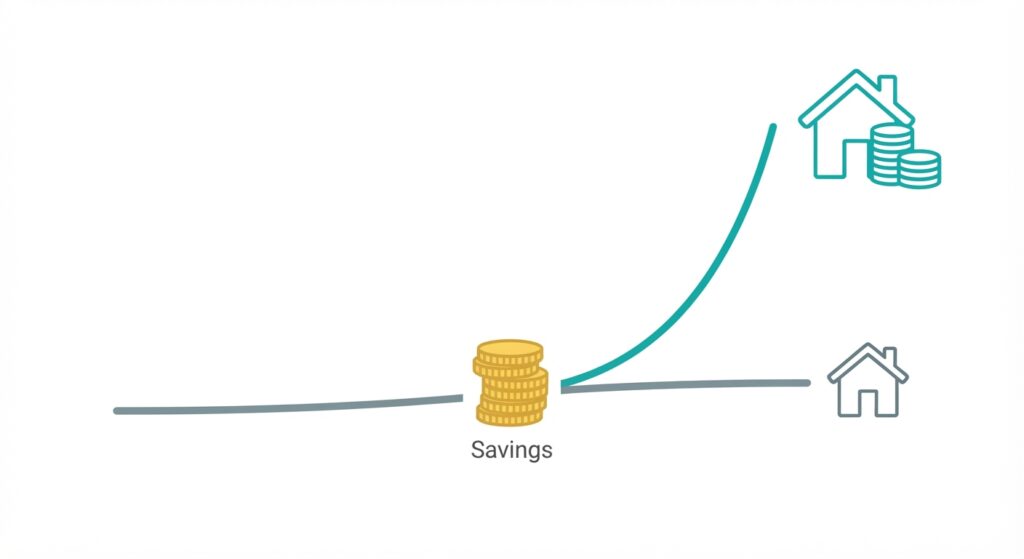
What this image shows: Two financial paths beginning with the same starting savings. One path keeps everything in savings accounts and grows slowly, ending with modest wealth after 30 years. The other path uses the right account for the right money: savings for short term needs and investments for long term goals. The investment path diverges dramatically from the savings only path over 20 to 30 years, producing a significantly larger final outcome from the same starting point and the same monthly contribution.
The choice between keeping everything in savings and using the right account for the right timeline is not a choice between safety and risk. It is a choice between two different kinds of risk: the visible, dramatic risk of market volatility, and the invisible, gradual risk of inflation and lost compounding.
Most immigrants have been taught to fear the first kind. Fewer have been taught to recognize the second.
Both are real. Both have consequences. The job of a good financial plan is not to eliminate risk but to match each type of risk to the correct tool and the correct timeline.
Your savings account is a good tool for the right job. It is a poor tool for a job it was never designed to do.
Keep your safety net in savings. Put your future in something designed to build it.
Disclaimer: This article is for educational and informational purposes only and does not constitute financial advice. All investing involves risk including the possible loss of principal. Past performance does not guarantee future results. Consult a qualified financial professional before making investment decisions.