
Should Immigrants Rent or Buy a Home? A Realistic Financial Breakdown
When I had been in the United States for about two years, people started asking me whether I was going to buy a house.
Not strangers. People who knew me. Coworkers, acquaintances, the financial advisor I had started seeing. The question carried a particular weight in those conversations, as if buying a home was the arrival at adulthood that renting could only approximate. As if the mortgage was the proof that I had committed, fully and finally, to this place and this life.
I was not ready to commit. Not because I did not want to be here, but because I did not yet have the credit history, the savings, or the certainty about my city and my job to make homeownership financially sensible. Buying a home when those things are not in place is not a symbol of commitment. It is an expensive financial mistake.
This article gives you the real framework for making this decision: what the financial comparison between renting and buying actually looks like, what immigrants specifically need to know about qualifying for a mortgage, and the honest questions that should determine your answer.
The Myth: Renting Is Throwing Money Away
Before the numbers, let us address the most common piece of advice people give about this decision, because it is the one most likely to push you toward buying before you are ready.
“Renting is throwing money away.” You have heard this. It comes from well-meaning people who own homes and want to encourage you toward what they believe is a milestone worth reaching. It is also financially imprecise in a way that matters.
Renting is paying for a service: a place to live, without the financial risk and responsibility of ownership. You pay for housing. You receive housing. That is not throwing money away any more than buying groceries is throwing money away.
What people mean when they say this is that rent payments do not build equity, while mortgage payments do, at least in part. That is true but incomplete. Mortgage payments in the early years of a loan consist largely of interest, not principal. A $1,500 monthly mortgage payment on a $300,000 loan in year one might include only $250 to $350 of actual principal reduction. The rest is interest paid to the bank, property taxes, insurance, and maintenance, none of which builds equity either.
Meanwhile, the money you are not spending on a down payment, a home inspection, closing costs, and ongoing maintenance while renting can be invested in index funds and growing at the market’s historical 7% average annual return.
Renting is not throwing money away. It is a rational financial choice under the right circumstances. The question is what those circumstances actually are.
The Real Cost Comparison
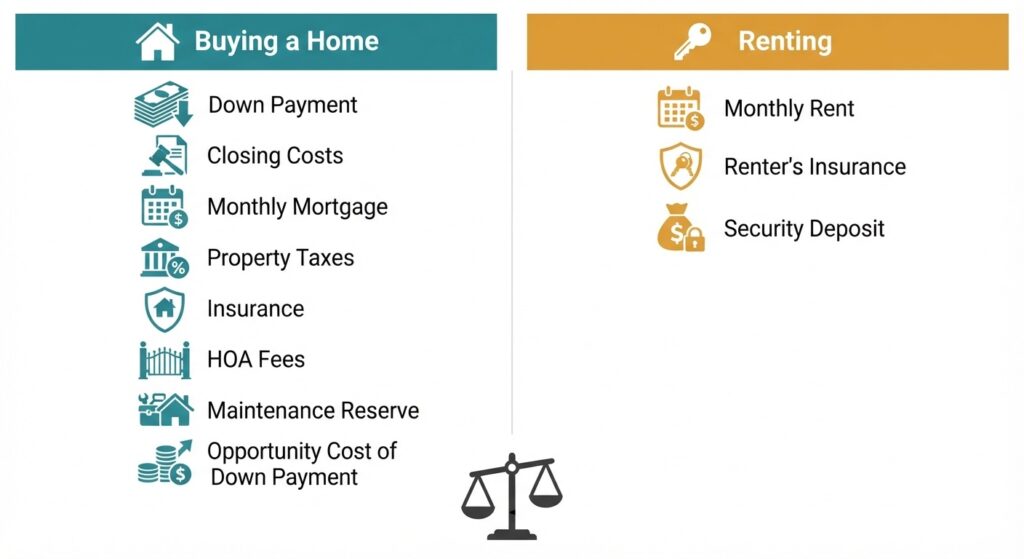
What this image shows: Buying a home involves significantly more cost categories than renting. Beyond the monthly mortgage payment, buyers face a down payment, closing costs, property taxes, homeowner’s insurance, potential HOA fees, ongoing maintenance, and the opportunity cost of the capital tied up in the down payment. Renting primarily involves monthly rent and renter’s insurance. Understanding all the costs on both sides is the starting point for an honest comparison.
The Full Cost of Buying
Down payment. A conventional mortgage typically requires 5% to 20% down. An FHA loan, which is accessible to many immigrants with credit scores as low as 580, requires 3.5% down. On a $300,000 home, that is $10,500 to $60,000 out of pocket before you even close.
Closing costs. Typically 2% to 5% of the purchase price. On a $300,000 home, that is $6,000 to $15,000 in additional costs at closing for lender fees, appraisal, title insurance, attorney fees, and other items.
Monthly mortgage payment. On a $300,000 home with a 10% down payment and a 30-year mortgage at 7% interest, your monthly principal and interest payment is approximately $1,794.
Property taxes. Vary significantly by location, but the national average is approximately 1.1% of home value annually. On a $300,000 home, that is $3,300 per year, or $275 per month.
Homeowner’s insurance. Approximately $1,200 to $2,000 per year, or $100 to $167 per month.
Maintenance and repairs. The commonly cited rule is 1% of home value per year in maintenance costs. On a $300,000 home, that is $3,000 per year, or $250 per month. This figure varies enormously based on the age and condition of the home, but budgeting zero for maintenance is a mistake that costs buyers dearly.
HOA fees. If the home is in a community with a homeowners association, monthly fees ranging from $50 to $500 or more apply on top of everything above.
Total monthly cost of owning a $300,000 home: Approximately $2,419 to $2,486 per month in the scenario above, not including HOA fees.
The Full Cost of Renting the Equivalent Property
In the same market, renting a comparable property might cost $1,500 to $2,200 per month, depending on location. Add renter’s insurance at $15 to $25 per month, and your total monthly cost is approximately $1,515 to $2,225.
The Missing Variable: Appreciation and Investment Return
The calculation above makes renting look obviously cheaper, and in the short term it often is. But buying builds equity over time as the loan is paid down and as the property appreciates in value.
The question is how long it takes for the equity building and appreciation to outweigh the higher monthly costs and the upfront capital deployed.
This is called the break-even horizon, and it is typically five to seven years in most US markets under normal conditions. Before that horizon, selling the home would likely produce a net loss compared to having rented and invested the same capital. After that horizon, homeownership typically produces better financial outcomes than renting in the same market.
If you are confident you will stay in the same city for at least five to seven years, buying becomes increasingly sensible as that timeline extends. If you are uncertain about your city, your job, or your immigration situation, buying before that horizon carries real financial risk.
What Immigrants Specifically Need to Know About Qualifying
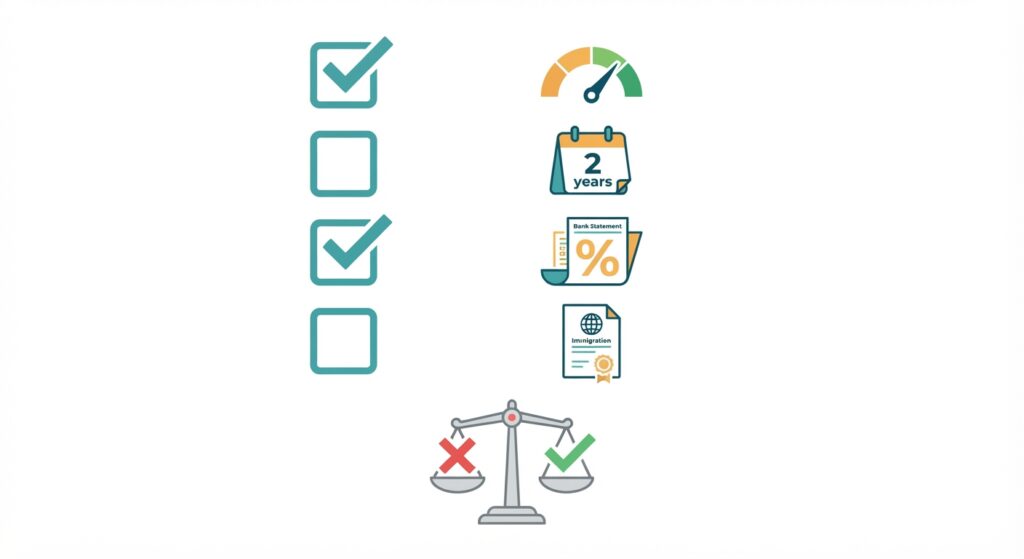
What this image shows: Four key qualification factors for a mortgage as an immigrant. A strong credit score is required, typically 580 minimum for FHA and 620 to 660 for conventional. A two-year employment history in the United States is the standard requirement, though exceptions exist for recent graduates and job changers with consistent fields. A down payment and cash reserves must be documented and sourced. Immigration status affects which loan programs are available and what documentation lenders require.
Credit Score Requirements
For an FHA loan, the minimum credit score is 580 with a 3.5% down payment, or 500 with a 10% down payment. For a conventional loan, most lenders require a minimum of 620 to 660, with better rates available above 740.
Most newly arrived immigrants begin with no US credit history at all. Building a credit score from zero to mortgage-qualifying levels typically takes 12 to 24 months of consistent credit building: a secured credit card paid in full monthly, possibly a credit builder loan, and time.
Our article on how I built my US credit score from zero walks through exactly how to build a score from nothing to the range needed for a mortgage application.
Employment History
Most mortgage lenders want to see a two-year employment history in the United States. This does not necessarily mean two years with the same employer, but two years of consistent employment documented through W-2s or tax returns.
For immigrants who have been working in the US for less than two years, getting mortgage approval is more difficult but not impossible. Some lenders accept recent graduates who have just started in their field, recent immigrants with strong employment in the same profession abroad, or H-1B holders who have strong employer letters and consistent high income. The key is finding lenders who specialize in working with immigrants and non-traditional employment histories.
Down Payment and Cash Reserves
The down payment must be documented and must come from an acceptable source. Most lenders require that the funds have been in your account for at least 60 to 90 days before closing. A gift from a family member is acceptable with the right documentation. Cash that cannot be traced to a documented source is generally not acceptable.
Beyond the down payment, most lenders want to see two to six months of mortgage payments in reserve savings. This is money you do not spend at closing but that remains in your account as evidence that you can sustain payments if your income is temporarily disrupted.
Immigration Status and Loan Types
Green card holders (lawful permanent residents): Eligible for all conventional and FHA loans using their green card as identification. No citizenship required.
H-1B and other work visa holders: Eligible for conventional loans at most lenders and FHA loans at many. Some lenders specifically focus on serving H-1B borrowers. The key requirement is that your visa must be valid beyond the loan’s closing date, typically by at least one year, and that you can document employer sponsorship or visa renewal.
EAD holders: Eligible for conventional loans if the EAD is valid and employment is documented. May face more lender scrutiny than green card holders. Some lenders require the EAD to be valid for a minimum period beyond closing.
DACA recipients: Some lenders accept DACA EADs for conventional loans. The availability varies by lender and has fluctuated with policy changes. Freddie Mac currently allows loans for DACA borrowers. Check current lender policies directly, as this area continues to evolve.
ITIN mortgages: For immigrants who are not eligible for an SSN, a growing number of community banks, credit unions, and specialized lenders offer ITIN mortgages. These typically require a larger down payment (15% to 30%), a stronger credit profile built through alternative means, and significant documentation of income and assets. Interest rates are generally higher than standard mortgages, but ITIN mortgages have made homeownership possible for immigrants who would otherwise have no path to it.
The Five Questions That Determine Your Answer
Rather than a blanket recommendation, here is the framework for making this decision for your specific situation.
Question 1: How long are you staying in this city? If you cannot honestly say you are staying for at least five years, buying is financially risky in most markets. The transaction costs of buying and selling eat the first several years of equity building. If your visa situation, your family circumstances, or your career could plausibly take you elsewhere within three years, renting preserves your flexibility at relatively low financial cost.
Question 2: Is your credit score mortgage-ready? A score below 620 means you are not yet qualifying for a conventional mortgage at competitive rates. A score below 580 means you are not qualifying for an FHA loan at all. If you are not there yet, the right move is to continue building credit while renting, not to rush toward a purchase at rates that would cost you significantly more over the life of the loan.
Question 3: Do you have the full upfront costs plus reserves? Down payment, closing costs, moving costs, initial repairs and setup costs, and cash reserves. Can you fund all of these without depleting your emergency fund? If funding the purchase means arriving at your closing with no financial cushion, you are buying at the wrong time regardless of other factors.
Question 4: Does the monthly cost of owning fit your budget without strain? Run the real numbers for the specific property and market you are considering. If the monthly ownership cost, including mortgage, taxes, insurance, and a maintenance reserve, exceeds 28% to 30% of your gross monthly income, most financial guidelines say the property is too expensive for your current income.
Question 5: Are you buying because it makes financial sense or because of social pressure? This question matters more than any of the others. The pressure to buy, from family, from coworkers, from the general cultural message that homeownership is the mark of success and commitment, is real and powerful. It also has nothing to do with whether buying is the right financial decision for your specific situation right now.
If the honest answer to questions 1 through 4 is yes, buy with confidence. If any of them is no, renting while you close those gaps is the financially intelligent choice, not a sign of failure.
When Renting Is Clearly the Right Answer
Renting is clearly the right choice in the following situations.
You arrived within the last 12 to 18 months and are still building your US credit profile from zero.
Your immigration status is not yet resolved or carries significant uncertainty about your ability to remain in the US.
Your income or job situation has been in the US for less than two years.
You are not yet certain about your city or neighborhood and want the flexibility to move when you find the right fit.
Your savings are not yet sufficient to cover the full upfront costs of buying without depleting your emergency fund.
The monthly ownership cost in your target market would require more than 30% of your gross income.
When Buying Is Clearly the Right Answer
Buying becomes the right choice when the following are true.
You have been in the US for at least two years with consistent employment and a documented income history.
Your credit score is 680 or above, with access to competitive mortgage rates.
You have a down payment plus closing costs plus reserves saved, with your emergency fund still intact after closing.
You are confident you are staying in this specific city for at least five years, ideally longer.
The monthly ownership cost is within your budget without stretching.
The market you are buying in has reasonable appreciation potential based on job growth, population trends, and housing supply.
The Middle Path: House Hacking
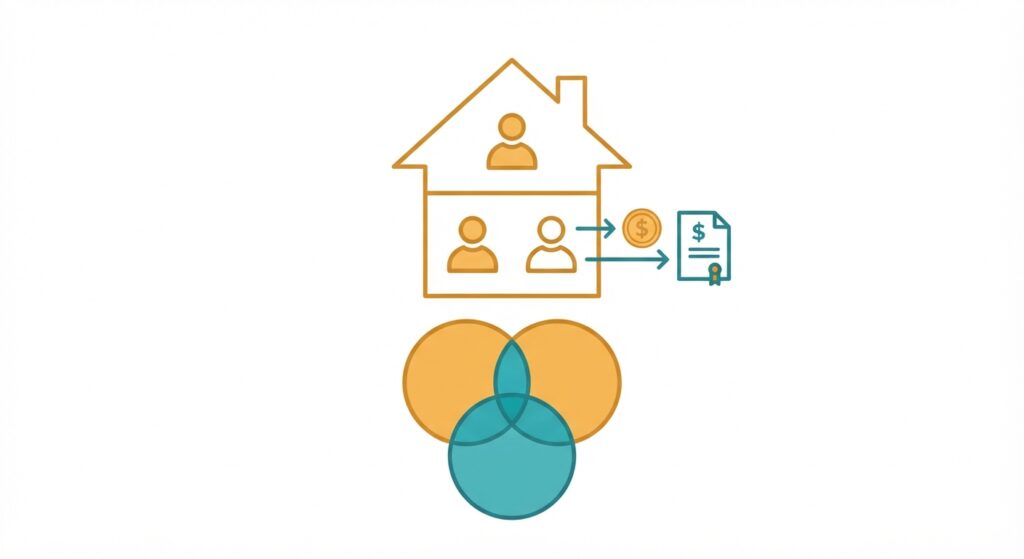
What this image shows: House hacking is a strategy where a homebuyer purchases a property with multiple units or extra bedrooms, lives in one part, and rents out the remaining units or rooms. The rental income from tenants covers a portion of the monthly mortgage, reducing the owner’s effective housing cost. In successful house hack scenarios, the rental income can cover the majority of or even the entire mortgage payment, allowing the owner to build equity while living nearly rent-free.
For immigrants who want to begin building equity sooner but face the financial constraints of a high monthly cost of ownership, house hacking is worth serious consideration.
House hacking means buying a property with multiple units or extra bedrooms and renting out the portion you do not occupy. A duplex where you live in one unit and rent the other. A three-bedroom house where you rent two bedrooms and occupy one. The rental income from tenants offsets your mortgage, reducing your effective housing cost.
Jean-Pierre, whose real estate journey we told in our article on from dishwasher to landlord in eight years, used exactly this strategy in his first property. He rented the second bedroom immediately upon purchase. His effective housing cost after that rent dropped below what he had been paying as a renter. He was building equity and receiving income from the very first month.
House hacking does not require a large portfolio or significant experience. It requires only the willingness to share your living space temporarily while you build the equity that funds the next purchase.
A Simple Summary
| Factor | Rent | Buy |
|---|---|---|
| Credit score | Not required | 580 minimum, 680 preferred |
| US employment history | Not required | 2 years preferred |
| Upfront cash needed | Security deposit only | Down payment plus closing costs plus reserves |
| Flexibility | High, leave when lease ends | Low, 5 plus years to recoup transaction costs |
| Equity building | None | Yes, after mortgage interest in early years |
| Maintenance responsibility | Landlord’s | Owner’s |
| Monthly cost | Generally lower | Generally higher (all in) |
| Best for | First 1 to 3 years, uncertain timeline | Confirmed long-term stay, strong financials |
For context on how the down payment and housing costs fit into your broader financial picture, our article on how to save money as a new immigrant in America covers the specific saving strategies that build toward a down payment faster.
And for anyone already renting who wants every possible strategy to reduce that monthly cost in the meantime, our guide on 15 ways to lower your monthly housing costs covers the full list of options available to renters.
Disclaimer: This article is for educational and informational purposes only and does not constitute financial, legal, or mortgage advice. Mortgage eligibility, interest rates, and program availability change frequently and vary by lender, location, and individual circumstance. Always consult a qualified mortgage professional and financial advisor before making homeownership decisions.