
Free and Low-Cost Healthcare Options for Immigrants
I avoided going to the doctor for almost eight months after arriving in the United States.
Not because I was healthy. Because I was afraid of what it would cost. I had heard the stories: a single emergency room visit that cost $8,000. A broken arm that became a $5,000 bill. An ambulance ride billed separately from the emergency care. Every story made waiting seem safer than going.
What nobody told me was that multiple systems existed specifically to serve people in my situation: immigrants with no insurance, limited income, and no clear path through the maze of American healthcare. Some of them were completely free. Some charged based on what you could actually afford. All of them were available to me. I simply did not know they were there.
This article is what I needed in those eight months. A complete, honest guide to every free and low-cost healthcare option available to immigrants in the United States, organized by what you need and where to find it.
The First Thing to Understand: You Have a Right to Care
Before listing specific resources, one legal reality needs to be stated clearly.
No hospital in the United States that receives federal funding, which includes virtually every hospital in the country, can legally turn you away in an emergency because of your inability to pay, your insurance status, or your immigration status. This right is guaranteed by the Emergency Medical Treatment and Labor Act (EMTALA), passed in 1986 and still in full force.
If you have a medical emergency, go to the emergency room. You will be treated. The bill can be addressed afterward, and there are multiple programs designed to reduce or eliminate that bill for people with low incomes. A bill you can negotiate is better than a health crisis you delayed treating.
This right to emergency care is the floor. The resources in this article are the ceiling: the full range of free and low-cost options available before emergencies happen, so that you can stay healthy without depending on the emergency room as your only access point.
Option 1: Federally Qualified Health Centers
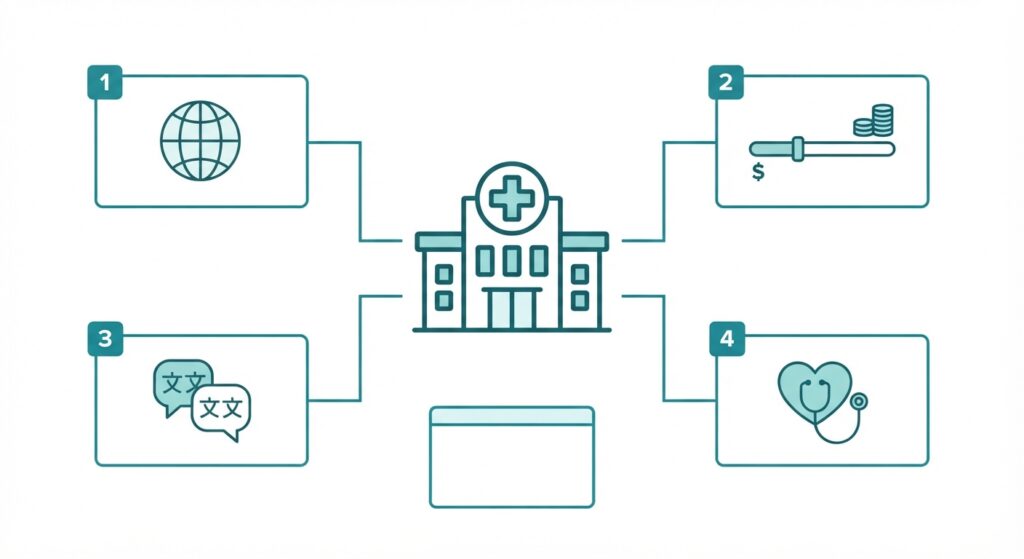
What this image shows: Federally Qualified Health Centers are community-based clinics that serve everyone regardless of immigration status, ability to pay, or insurance coverage. They offer primary care on a sliding scale fee, multilingual services, and comprehensive health services including dental and mental health. They are the most important healthcare resource for immigrants in the United States and are available in every state.
Federally Qualified Health Centers (FQHCs), also called community health centers, are the single most important free and low-cost healthcare resource available to immigrants in the United States. They exist in every state, in both urban and rural communities, and they are required by federal law to serve anyone who comes through their door regardless of immigration status, insurance coverage, or ability to pay.
FQHCs receive federal funding specifically to subsidize care for uninsured and underinsured patients. In exchange, they must charge on a sliding scale based on income: the less you earn, the less you pay. For patients below a certain income threshold, many services cost nothing at all. For patients with modest incomes, a primary care visit might cost $20 to $40. For patients with higher incomes, the fee increases but remains below market rate.
Services available at most FQHCs include primary and preventive care, dental care, mental health and substance use services, prenatal and maternal care, pediatric care, laboratory testing and imaging, prescription medications at reduced cost, vision care at some locations, and health education and case management.
You do not need to prove your immigration status to receive care at an FQHC. You do not need to show a Social Security Number. You do not need insurance. You do not need to be a US citizen or legal resident. You need only to show up.
To find the federally qualified health center nearest to you, go to findahealthcenter.hrsa.gov and enter your zip code. The site lists every FQHC by location with contact information and services offered.
Option 2: Free Clinics
Free clinics are nonprofit medical facilities that provide healthcare at no cost to patients who are uninsured and meet income guidelines. Unlike FQHCs, free clinics do not receive federal funding and rely instead on volunteer healthcare providers and charitable donations.
The National Association of Free and Charitable Clinics estimates that more than 1,400 free clinics operate across the United States, collectively serving millions of patients annually. Most are staffed by volunteer physicians, nurses, pharmacists, and other healthcare professionals who donate their time.
Services vary by clinic but commonly include primary care visits, prescription medications, basic laboratory tests, dental care at clinics with dental programs, mental health services, and referrals to specialist care.
Free clinics typically do have income requirements and some serve specific geographic areas, so calling ahead to confirm eligibility before your first visit is worthwhile. Many serve patients regardless of immigration status, though this varies by organization.
To find a free clinic near you, the National Association of Free and Charitable Clinics maintains a searchable directory at nafcclinics.org.
Option 3: Medicaid for Those Who Qualify
Medicaid is the federal-state program that provides free or very low-cost health coverage to people with low incomes. While immigration status does affect Medicaid eligibility, the program is more accessible to immigrants than many people realize.
Who can qualify:
Green card holders who have been lawful permanent residents for at least five years are generally eligible for federal Medicaid in states that have expanded coverage. Several categories of immigrants are exempt from the five-year waiting period and can qualify immediately, including refugees, asylees, Cuban and Haitian entrants, and citizens of Compact of Free Association nations such as the Marshall Islands and Micronesia.
For pregnant people, regardless of immigration status, Medicaid covers pregnancy-related care in most states. As of 2025, more than 30 states have extended pregnancy Medicaid to cover immigrants regardless of documentation status, using state funds when federal funds are unavailable.
For children under 19, more than 37 states plus DC have eliminated the five-year waiting period, meaning children can access Medicaid or CHIP regardless of how long their parents have been in the country. If you have children, check your state’s Medicaid program for child eligibility, because the rules for children are often significantly more generous than the rules for adults.
Public charge note: Applying for or receiving Medicaid does not make you a public charge for most immigration purposes. USCIS has confirmed that Medicaid used for emergency care, pregnancy-related care, and most standard Medicaid programs is not counted against you in immigration filings. The exception is long-term institutional care. For most immigrants, accessing the healthcare benefits you qualify for has no immigration consequences.
To check your eligibility and apply, visit healthcare.gov or your state’s Medicaid agency website.
Option 4: CHIP for Children
The Children’s Health Insurance Program (CHIP) provides low-cost health coverage to children in families that earn too much for Medicaid but cannot afford private insurance. CHIP covers doctor visits, immunizations, hospital care, dental and vision care, and prescriptions.
CHIP eligibility for immigrant children is broad in most states. As noted above, 37 states plus DC have eliminated immigration-related waiting periods for CHIP, meaning children can enroll regardless of their parents’ documentation status. In states that have not eliminated the waiting period, recently arrived immigrant children may still qualify through state-funded programs.
CHIP applications are accepted year-round through your state’s Medicaid agency. Income limits vary by state but are generally set at 200% to 300% of the federal poverty level, covering a wide range of working families.
Option 5: Emergency Medicaid
For immigrants who do not qualify for regular Medicaid due to their immigration status, Emergency Medicaid provides coverage specifically for emergency medical conditions.
Emergency Medicaid is available to people who meet the income requirements for Medicaid but do not have an eligible immigration status. It pays for emergency medical care, meaning care necessary to treat a condition that, without treatment, would place the patient in serious jeopardy. This includes emergency room visits, emergency surgery, emergency childbirth services, and other acute conditions.
Emergency Medicaid does not cover follow-up care, prescriptions, or ongoing treatment for chronic conditions. But in a genuine medical emergency, it is a meaningful protection against catastrophic bills.
Option 6: State-Funded Programs Beyond Federal Medicaid
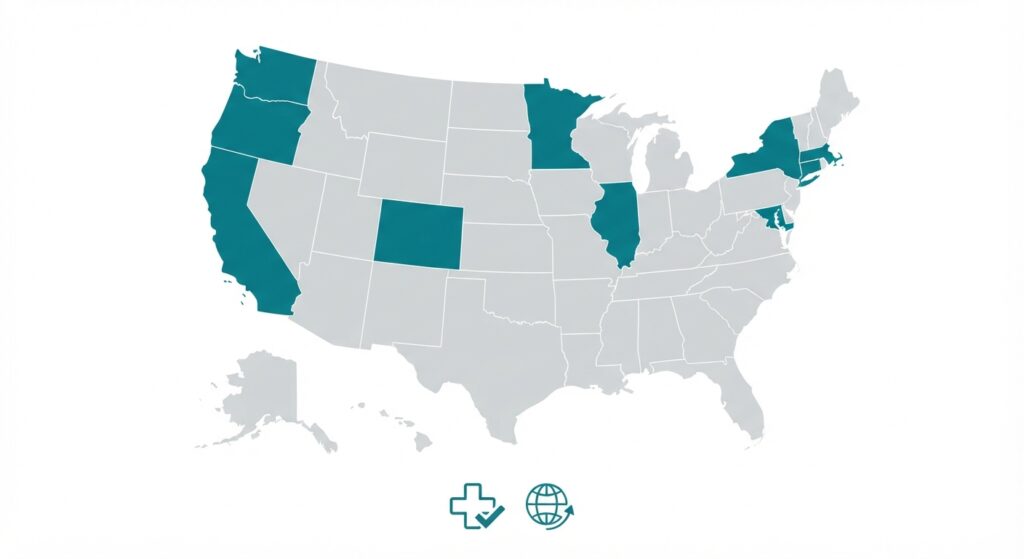
What this image shows: Several US states have gone beyond federal Medicaid requirements to fund their own healthcare coverage programs for immigrants regardless of documentation status. The teal-highlighted states on the map represent states that have established state-funded health coverage programs for low-income immigrants who do not qualify for federally funded Medicaid. If you live in one of these states, significantly more coverage may be available to you than the federal baseline.
Several states have used their own funding to extend health coverage to immigrants who do not qualify for federal Medicaid programs. These are among the most important but least publicized options available.
California offers Medi-Cal to all income-eligible adults regardless of immigration status. California uses state funds to cover people excluded from federal programs. This is the most expansive state program in the country and has covered hundreds of thousands of immigrants who would otherwise be uninsured.
New York has the Essential Plan, which provides low or no-cost coverage to many lawfully present immigrants, and NYC Care, which provides low-cost services to New Yorkers who cannot access insurance regardless of immigration status.
Washington and Colorado have both established state-funded programs allowing immigrants without lawful status to purchase Marketplace-equivalent coverage.
Illinois has expanded coverage for certain immigrant groups through state-funded programs separate from federal Medicaid.
Massachusetts, Minnesota, Oregon, and the District of Columbia all have state-funded programs or expanded Medicaid eligibility for immigrants that goes beyond the federal baseline.
To find out what your specific state offers, search “[your state] immigrant health coverage” or visit your state’s Medicaid and health department website directly. These programs change more frequently than federal programs, so verifying current eligibility directly is important.
Option 7: Hospital Charity Care
Every nonprofit hospital in the United States is required by law to have a charity care program that reduces or eliminates bills for patients who cannot afford them. This requirement is part of what justifies the nonprofit tax status these hospitals hold.
Many for-profit hospitals also have charity care programs, though these are voluntary rather than required.
If you receive a hospital bill you cannot pay, do not ignore it and do not simply pay the minimum without asking about options. Call the hospital’s billing department and ask specifically: “Do you have a charity care or financial assistance program, and can I apply?”
You will typically need to complete an application and provide proof of income. The process takes several weeks. But hospitals with charity care programs can reduce bills by 50%, 80%, or even 100% for patients who meet their income thresholds. Many immigrants who did not know to ask have paid bills in full that they would have qualified to have eliminated.
Option 8: Community Health Workers and Patient Navigators
Many hospitals, health centers, and community organizations employ patient navigators and community health workers who specifically help immigrants access care and coverage programs. These are bilingual staff members who understand both the health system and the immigrant experience.
Patient navigators can help you understand your coverage options, complete enrollment applications, find providers who speak your language, and understand your rights as a patient. Their services are typically free.
To find a patient navigator in your area, contact your nearest FQHC, your county health department, or call 211 and ask about healthcare navigation assistance.
Option 9: Prescription Drug Assistance
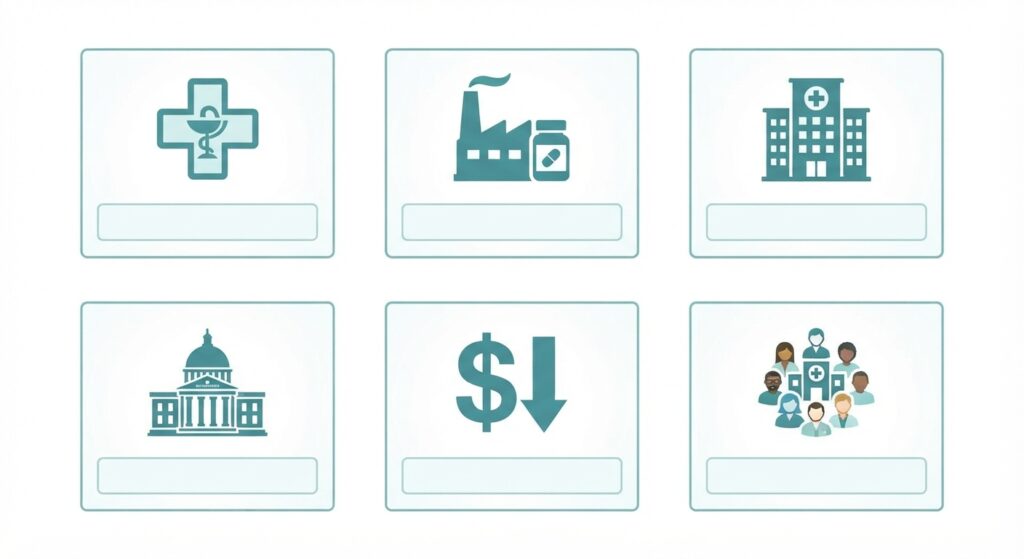
What this image shows: Six resources for reducing prescription drug costs for immigrants without insurance. These include GoodRx for real-time price comparison at pharmacies, pharmaceutical manufacturer patient assistance programs for free or reduced-price brand medications, the NeedyMeds database connecting patients to assistance programs, the 340B drug pricing program available at FQHCs and qualifying clinics, the practice of asking for generic equivalents, and FQHC in-house pharmacies that dispense medications at reduced cost to patients.
High medication costs stop many immigrants from filling prescriptions they genuinely need. Several programs exist specifically to address this.
GoodRx is a free app and website that shows the lowest available price for any prescription at pharmacies near you. In many cases, the GoodRx cash price is lower than the price even insured patients pay. Check GoodRx before filling any prescription.
Pharmaceutical manufacturer patient assistance programs provide name-brand medications free or at very low cost to patients who cannot afford them and do not have insurance. Most major drug companies operate these programs. NeedyMeds.org maintains a free searchable database of every patient assistance program available, organized by medication. Search your specific medication at needymeds.org to find out if you qualify for free access.
The 340B drug pricing program requires drug manufacturers to sell medications at reduced prices to certain healthcare organizations, including FQHCs and qualifying hospitals. When you receive care at an FQHC, you may have access to their in-house pharmacy where medications are dispensed at 340B prices, which are significantly below retail.
Always ask for the generic. Generic medications contain the same active ingredient as brand-name drugs at a fraction of the cost. Ask your provider explicitly: “Is there a generic version of this medication?” whenever you receive a prescription.
Option 10: Mental Health Resources at Low or No Cost
Mental health care is often the most neglected area of healthcare for immigrants, both because the cost is high and because the cultural stigma around seeking mental health support is strong in many communities.
Several no-cost options exist specifically for this.
The 988 Suicide and Crisis Lifeline is available 24 hours a day by calling or texting 988. It is free, confidential, and available in Spanish and other languages. It connects callers to trained counselors and can also connect you to ongoing mental health resources.
SAMHSA’s National Helpline at 1-800-662-4357 is a free, confidential, 24-hour service for mental health and substance use disorder information and referrals. Available in English and Spanish.
Open Path Collective at openpathcollective.org connects people who cannot afford standard therapy rates with licensed therapists who offer sessions for $30 to $80. Therapists on the platform serve clients regardless of insurance status.
Community mental health centers, funded by state and local governments, provide mental health services on a sliding scale. Your county health department can direct you to the nearest community mental health center.
FQHCs, as noted above, include behavioral health and mental health services at most locations, available at the same sliding scale pricing as their primary care services.
How to Find Everything in Your Area: The Two Tools That Cover Almost All of It
Rather than searching separately for every resource type, two tools cover the majority of what is available in any zip code.
findahealthcenter.hrsa.gov — Enter your zip code to find every federally qualified health center near you. This single search surfaces primary care, dental, mental health, and prescription services all in one place.
211.org — Dial 2-1-1 from any phone or visit 211.org and enter your zip code. This service connects you to local social services including healthcare resources, insurance enrollment help, and patient navigation assistance. Available 24 hours a day and in multiple languages.
Both tools work anywhere in the United States and require no account or registration to use.
For the broader picture of all health insurance options available to immigrants, including the ACA Marketplace, employer coverage, and Medicaid pathways, our article on how healthcare works in the US covers the complete landscape. And if you recently lost your job and your employer-sponsored insurance along with it, our guide on what to do as an immigrant after losing your job covers your healthcare options in that specific situation.
The Most Important Thing
Every year, millions of immigrants in the United States avoid medical care they need because they believe they cannot afford it or that the system will not serve them. Many of them are wrong on both counts.
The system is imperfect and has genuine gaps. But it also has genuine resources: community health centers in every state, free clinics staffed by volunteers, charity care programs at hospitals, prescription assistance programs from drug manufacturers, and state-funded programs that go further than federal law requires in many places.
You paid into this system with your labor and your taxes from the moment you started working here. Using the resources available to you is not charity. It is not shameful. It is simply knowing where the doors are.
Go through them.
Disclaimer: This article is for educational and informational purposes only and does not constitute medical, legal, or immigration advice. Healthcare program eligibility, state-funded programs, and policies change frequently. Always verify current eligibility directly with relevant agencies or programs before making healthcare decisions.