
Budgeting for Children in North America
Nobody told me that American kindergarten would cost money.
Where I grew up, school started at age six and the government provided it. You showed up. You brought a pencil and sometimes your own lunch. That was the agreement.
In the United States, my son turned four and a woman at the church we had started attending asked me which preschool he was enrolled in. I told her he was not enrolled in any preschool. She looked at me the way people look at someone who has said something mildly alarming.
That conversation was my introduction to the American philosophy of early childhood, which is that the preparation for kindergarten begins years before kindergarten, that most of that preparation happens in programs that cost money, and that the window for getting your child into the right program closes earlier than you would ever expect if you were approaching this system for the first time as an adult.
There is a version of immigrant parenting that stretches every dollar to give children everything. And there is a version that goes broke trying, never quite understanding where all the money went.
This article is about neither. It is about building a real budget for children in a new country, with honest numbers, practical priorities, and the specific knowledge about free and subsidized programs that most immigrant parents either do not know about or do not believe they qualify for.
The Real Cost of a Child in the United States
The USDA estimates that raising a child from birth to age 17 in the United States costs approximately $300,000 in total for a middle-income family. That number includes housing, food, clothing, transportation, healthcare, childcare and education, and other expenditures. It does not include college.
Broken into monthly terms, the average cost of a child is approximately $1,470 per month, though this varies dramatically depending on your city, your childcare situation, and your family’s specific circumstances.
For immigrant families, several of these costs arrive with specific complications that the average estimate does not capture. Healthcare costs for children without access to employer-sponsored family coverage. Childcare costs that may not be offset by subsidies that require documentation the family does not yet have. Education materials and activity costs in a system the parents do not yet fully understand. And often, simultaneously, the continuation of remittances home that do not pause because a child has arrived.
The budget framework in this article is designed for that specific reality.
Step 1: Know the Actual Monthly Cost of Your Child
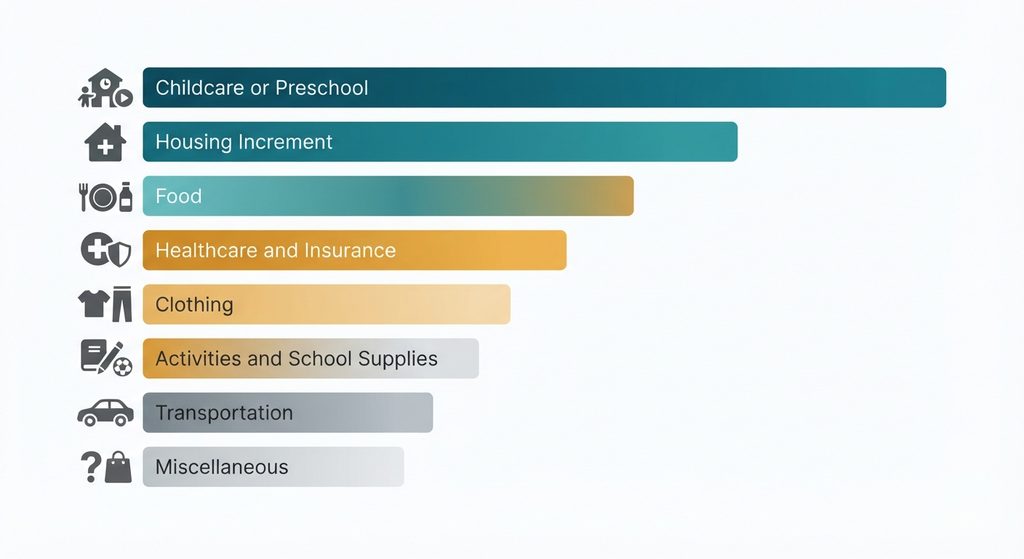
What this image shows: Eight categories that make up the monthly cost of raising a child in the United States, shown in relative proportion. Childcare is by far the largest single child-related expense in most families with young children, often exceeding the cost of rent. Housing, food, and healthcare follow. Activities, clothing, school supplies, and transportation are smaller but consistent. Understanding the relative size of each category helps parents allocate budget accurately rather than being surprised by categories they had not anticipated.
Before you can budget for a child, you need honest numbers for your specific situation. General estimates are a starting point. Your actual numbers determine your actual budget.
Childcare: This is the line item that shocks most immigrant parents. The national average cost of full-time childcare for an infant is approximately $1,300 to $1,500 per month. In cities like New York, San Francisco, Boston, and Washington DC, full-time infant care at a licensed center can cost $2,000 to $4,000 per month. Even family daycare homes, which are generally less expensive than centers, average $800 to $1,200 per month in most markets. For families with children under school age who need both parents to work, childcare may be the single largest expense in the household budget.
Healthcare: If your employer’s family coverage is available and affordable, this is typically the lowest-cost way to cover your children. If not, children may qualify for CHIP (Children’s Health Insurance Program) at low or no cost depending on your household income and immigration status. Our article on free and low-cost healthcare options for immigrants covers CHIP eligibility in detail, including the fact that in more than 37 states children can qualify regardless of their parents’ immigration status.
Food: Children increase your grocery bill, typically by $200 to $350 per month per child depending on age. Older children and teenagers cost more. Infants who are breastfed cost less. This is one of the more manageable costs in the child budget because it responds directly to shopping habits and meal planning.
Clothing: Children grow quickly and their clothing needs are constant. Budget $50 to $150 per month per child depending on age, climate, and how aggressively you use secondhand sources. Thrift stores, Facebook Marketplace, and community Buy Nothing groups are particularly cost-effective for children’s clothing because items are outgrown rather than worn out.
School supplies and activities: Once school age begins, school supply lists, activity fees, field trip costs, and extracurricular activities accumulate throughout the year. Budget $50 to $100 per month as a running average across the year, with higher months in August and September when supply lists arrive.
Transportation: If your child’s school, daycare, or activities require driving, add the incremental transportation cost to your child budget. If you use public transit or your child walks, this may be minimal.
Step 2: Find Every Free and Subsidized Program First
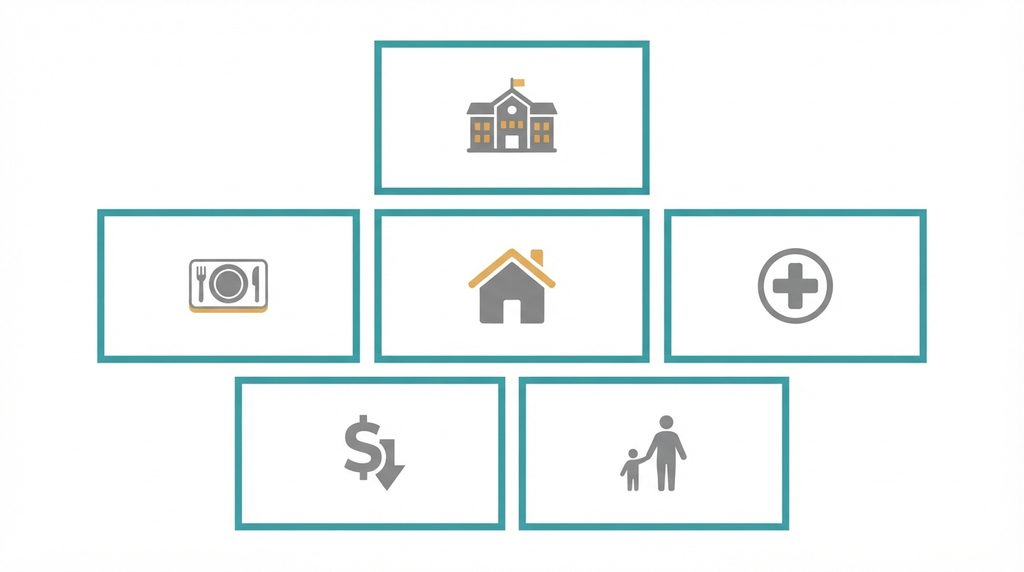
What this image shows: Five categories of free or subsidized programs available to immigrant families with children. Education programs (Head Start, public PreK, free public school). Nutrition programs (WIC, school meals, food banks). Healthcare (CHIP, community health centers, free clinics). Financial assistance (childcare subsidies, tax credits). Parent support programs (early intervention services, family resource centers). Knowing what is available in each category before building your budget allows you to account for subsidies rather than paying full price for services you could receive at low or no cost.
Before you build a budget that assumes you are paying full cost for everything, spend time learning what programs your family may qualify for. Many immigrant families significantly overspend on child-related costs because they do not know about programs that could offset those costs.
Head Start and Early Head Start: Federally funded programs that provide free preschool, health services, and family support to income-eligible families. Head Start serves children ages 3 to 5. Early Head Start serves infants, toddlers, and pregnant women. Eligibility is based on income, not immigration status, for most programs. Children in families receiving public assistance, children in foster care, and children experiencing homelessness are automatically eligible. Find a program near you at headstartlocator.ohs.acf.hhs.gov.
State-funded universal pre-K: Several states, including New York, California, Oklahoma, Florida, Georgia, and Vermont, offer publicly funded preschool programs to children at age 4 and in some states at age 3. These programs are free and do not require proof of income or immigration status. Check your state’s department of education for eligibility and enrollment information.
WIC (Women, Infants, and Children): WIC provides free nutritious food, breastfeeding support, and healthcare referrals for pregnant women, new mothers, infants, and children up to age 5 who meet income guidelines. WIC eligibility for immigrants is broad and does not require legal permanent residency in most states. Accepting WIC benefits does not affect immigration status. Apply through your local WIC office.
SNAP for children: Households with children who qualify for SNAP receive food benefits that can significantly reduce grocery costs. Green card holders after five years are generally eligible. Several states have eliminated the five-year waiting period for children using state funds.
School meal programs: Once your children are in public school, reduced-price or free school breakfast and lunch are available based on income through the National School Lunch Program. Apply at the beginning of each school year through your child’s school. This is one of the most consistently underutilized benefits in immigrant families.
CHIP: As mentioned above, children in most states can access low or no-cost health insurance through CHIP regardless of their parents’ immigration status. Apply through your state Medicaid agency.
Childcare subsidy programs: The Child Care and Development Fund (CCDF) provides subsidies to help low-income families pay for childcare so parents can work or attend school. Eligibility and availability vary significantly by state and funding is often limited, leading to waitlists. Apply early, even before you need it, because waitlists in many areas run six to twelve months.
Child Tax Credit: Families with qualifying children under 17 can receive up to $2,000 per child per year in tax credits (with up to $1,600 being refundable). To claim the credit, children must have valid Social Security Numbers. The credit phases out at higher incomes. Filing your taxes is how you access this benefit.
Child and Dependent Care Tax Credit: If you pay for childcare so you can work, you can claim a percentage of those costs as a tax credit. This is separate from the Child Tax Credit. To claim it, you need the provider’s name, address, and tax identification number.
Step 3: Build the Child Budget Category by Category
With the free and subsidized programs identified, you can build your actual monthly child budget with realistic numbers.
Non-negotiables that cannot be reduced:
Whatever healthcare costs remain after CHIP or employer coverage. Your share of childcare costs after any subsidy. Food costs after WIC benefits are applied.
Variable costs you can manage:
Clothing (maximize thrift and secondhand sources). Activities (prioritize free programs, community leagues, and library programs before paid classes). School supplies (shop sale seasons and buy only what is on the list).
Future planning contributions:
A monthly contribution to a custodial investment account for your child, even $25 or $50 per month, compounds significantly over 18 years. Our article on how to open a custodial investment account for your children covers exactly how these accounts work and how to start with as little as $1.
A 529 college savings plan is the other major savings vehicle for education costs. Contributions grow tax-free when used for qualified education expenses. Most states allow non-citizens to open 529 accounts. Minimum contributions at many plan providers start at $25 per month.
The Hidden Costs Most Immigrant Parents Do Not Budget For
These are the costs that arrive unannounced and consistently disrupt otherwise solid budgets.
School fundraisers. American schools run fundraisers constantly: for equipment, for field trips, for end-of-year activities. The unspoken social pressure to participate is real, especially for children who are already navigating the social challenges of being new to a school. Budget $20 to $50 per school year per child for fundraiser participation.
Birthday parties. American birthday party culture can be expensive. Your child will be invited to parties, and gifts of $20 to $30 are typical. Over a school year with multiple parties per classroom, this can amount to $200 to $400. Setting a per-party gift budget and sticking to it is entirely reasonable. Buying gifts during sales and keeping a small birthday gift reserve prevents scrambling each time an invitation arrives.
Class photos and yearbooks. School photo packages typically run $20 to $60 per child. Yearbooks are $20 to $40. These feel mandatory but are optional. Budget for them only if you want them.
After-school programs and summer. When school ends at 3pm and your workday ends at 5pm, the gap costs money. After-school programs at YMCAs and community centers typically run $200 to $500 per month. Summer camps for the months when school is out can run $500 to $2,000 per summer per child depending on the program. Research subsidized and low-cost programs in your area well before summer. Many YMCA programs offer sliding-scale pricing based on income.
Sports equipment and uniforms. If your child joins a sports league, the equipment and uniform costs arrive quickly. Soccer cleats, shin guards, and league fees. Basketball shoes and registration. Investigate whether your community league or school has equipment lending or exchange programs before purchasing new.
Technology. By middle school, most American schools require or strongly expect children to have access to a computer or tablet for homework. Budget for this one to two years before your child reaches that age so it does not arrive as a surprise.
Talking to Your Children About Money
One of the most valuable things you can give your children in their American life is financial literacy that begins early and is rooted in honesty.
Children who grow up understanding that money is finite, that choices have costs, and that saving is a habit rather than a luxury are better prepared for financial independence than those who grow up shielded from financial reality or surrounded by spending without explanation.
This does not mean burdening children with adult financial stress. It means age-appropriate conversations: letting a six-year-old choose between two items at the store because you have budgeted for one. Explaining to a ten-year-old that the family is saving for something specific and that is why the answer to this request is no right now. Showing a teenager a simplified version of the household budget so they understand where money comes from and where it goes.
Immigrant children often grow up in two financial worlds: the one their parents are building in the United States and the one that still exists, often with different economics, in the home country. Giving them the vocabulary to understand both, and the habits to navigate whichever world they inhabit, is one of the most durable gifts available to them.
Building the Budget: A Month-by-Month Reality
The child budget is not a set-and-forget calculation. It has a season.
September through May (the school year): School supply costs in September. Fundraiser asks in October and November. Holiday gift costs in December. Spring activity fees in March and April. Track these as they arrive and adjust your discretionary spending in those months to absorb them without going into debt.
June through August (summer): Childcare costs spike if you do not have school coverage. Summer camp fees arrive. Apply for subsidized summer programs in January or February, because waitlists fill months in advance.
Year-round: Healthcare copays for well-child visits, sick visits, dental cleanings, and eye exams. These are predictable even if they vary month to month. Setting aside $50 per month per child as a healthcare reserve prevents each copay from disrupting your budget.
The Longer View: Raising Financially Healthy Children in Two Cultures
The financial challenge of raising children as an immigrant is not just budgeting in the practical sense. It is navigating the intersection of the values about money you bring with you and the values your children are absorbing from the American environment around them.
Children who see their parents living below their means to build a future are learning something important. Children who see their parents stressed and secretive about money are learning something different. Children who participate, age-appropriately, in conversations about how the family manages its resources are learning the most useful thing of all.
You are not just raising children. You are raising the first generation of your family that will know, from childhood, how this financial system works. The literacy they develop now, watching you navigate it, will compound for their entire adult lives.
That is worth budgeting for. It is also worth making visible.
For the foundational budget framework that surrounds your child budget, our article on how to create your first budget covers the full structure that a child budget category fits inside. And for saving strategies that free up the money to fund a child category without sacrificing everything else, our guide on how to save money as a new immigrant in America covers the specific tactics that work on a tight income.
Disclaimer: This article is for educational and informational purposes only and does not constitute financial, legal, or immigration advice. Program eligibility, tax credits, and subsidy availability vary by state, income, and immigration status and change over time. Always verify current program eligibility directly with the relevant agency.