
The US banking system does not explain itself. Here is what it should have told you from day one.
The first bank account I opened in the United States felt like a victory. I walked out with a debit card, a starter checks booklet I have never used, and the quiet pride of having navigated a foreign system in a second language without asking anyone to repeat themselves more than twice. I thought I was done with the hard part.
What I did not know was that the account I had just opened came with an overdraft fee of $35 per transaction, a monthly maintenance fee that would kick in after the first 90 days, and a wire transfer policy that would charge me $45 every time I sent money internationally. I found all of this out the hard way, one painful statement at a time, over the following months.
Nobody told me to read the fine print. Nobody explained what a ChexSystems report was. Nobody warned me that some accounts marketed to newcomers are designed to extract fees from people who do not yet know what questions to ask.
This article is the guide I needed when I walked out of that bank with my new debit card and my very expensive feeling of victory.
Why Banking Mistakes Hit Immigrants Harder
Before we go through the mistakes, it is worth naming something honestly: the US banking system is not neutral. Its fee structures, its product designs, and its marketing decisions consistently extract more money from people with lower balances, more irregular income, and less familiarity with how the system works.
According to the Consumer Financial Protection Bureau, nearly twice as many consumers with incomes between $35,000 and $65,000 were charged overdraft fees compared to consumers earning over $100,000. In a typical year before recent reforms, US banks and credit unions collected an estimated $15 billion in overdraft and non-sufficient funds fees alone.
Immigrants, especially in their first years, are disproportionately in that lower income, lower balance category. They are also less likely to recognize when a product is working against them, less likely to know they have the right to complain, and less likely to realize that better alternatives exist. The banking system does not inform you of any of this. That is by design.
Knowing the most common mistakes is your best defense.
Mistake 1: Opening the Wrong Account
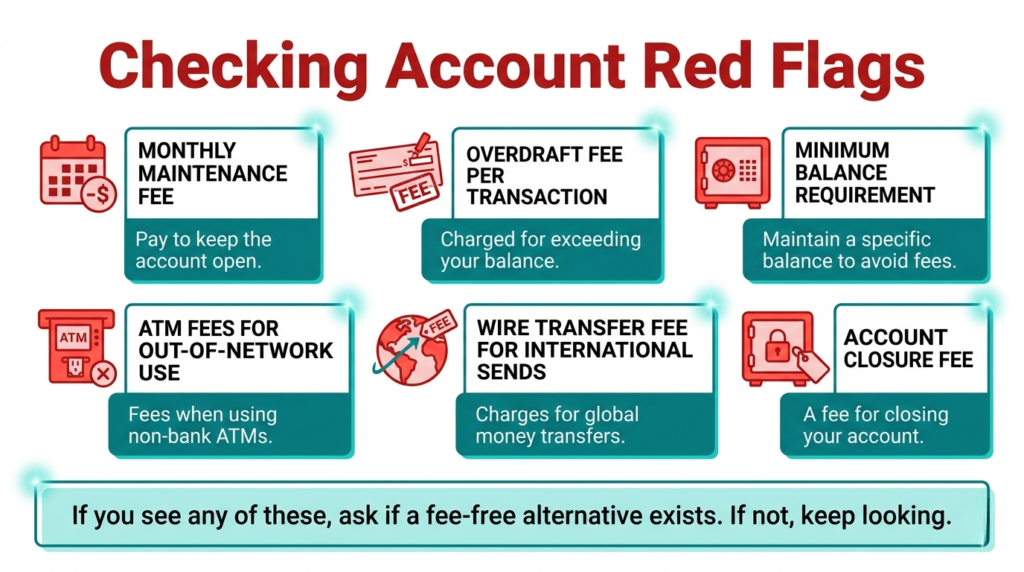
The biggest banking mistake most immigrants make happens before they have even deposited their first dollar: they open whichever account the branch representative recommends without comparing alternatives or reading the fee schedule.
Bank branch representatives are not financial advisors. They are employees with incentive structures that may favor recommending products that generate revenue for the bank. The account that gets recommended first is not necessarily the account that is best for you.
What to look for before opening any checking account:
Monthly maintenance fees. Many standard checking accounts charge $10 to $15 per month unless you meet minimum balance requirements or set up direct deposit. Over a year, that is $120 to $180 quietly leaving your account. Ask specifically: “Is there a monthly fee, and what are the conditions to waive it?”
Overdraft fees. Traditional overdraft fees at major banks run $25 to $35 per transaction. If you spend $3 more than your balance, you owe $35. Multiple transactions on the same day can each trigger a separate fee, stacking quickly into hundreds of dollars. Ask: “What is your overdraft policy, and is there an option to decline overdraft coverage entirely?” Many banks now allow you to opt out of overdraft coverage, which means a transaction is simply declined rather than processed at a cost.
ATM fees. If your bank’s ATM network does not include machines near where you live or work, you will pay $2.50 to $5 per withdrawal in fees, both from your bank and from the ATM owner. Over a year of weekly ATM use, that is hundreds of dollars in fees for accessing your own money.
Wire transfer and international transfer fees. If you send money internationally, knowing your bank’s wire transfer fees matters before you open the account, not after. Traditional bank international wire fees typically range from $25 to $50 per transfer, and exchange rate markups add another 3% to 5% on top. For a newcomer who sends money home regularly, these fees compound into a significant annual cost.
Better Alternatives to Traditional Bank Accounts
Online banks and neobanks: digital-only banking institutions without physical branches, almost universally offer free checking accounts with no monthly fees, no minimum balance requirements, and large ATM networks. SoFi, Chime, and Ally are among the most commonly recommended options for immigrants building their US banking foundation.
Credit unions are nonprofit financial cooperatives that return profits to members rather than shareholders. They typically offer lower fees, better interest rates on savings, and more flexible requirements for account opening than traditional banks. For the Hispanic immigrant community specifically, Juntos Avanzamos is a network of credit unions across the United States with a specific commitment to serving immigrants regardless of documentation status. Many accept ITIN holders and consular identification cards in addition to standard documentation.
ITIN-friendly banks: including many community banks and credit unions, can open accounts with an ITIN rather than a Social Security Number. Bank of America, Wells Fargo, and several regional banks have publicly stated that they accept ITINs for account opening, though branch-level implementation varies. If you need to open an account with an ITIN, go to the branch in person rather than applying online, and bring your ITIN letter along with your passport and proof of address.
Mistake 2: Triggering Overdraft Fees Without Knowing It
In 2019, US bank and credit union customers paid an estimated $15 billion in overdraft and non-sufficient funds fees. That number represents an enormous transfer of money from people with tight finances to institutions that profit from the timing of transactions.
Here is how overdrafts happen without obvious carelessness: you deposit a check on Monday. Your bank places a hold on the funds for one to three business days before they become available. On Tuesday, an automatic payment processes against your account. Your available balance is lower than the payment amount because the check has not cleared yet. You are charged an overdraft fee even though the money was coming.
Or: you make several small purchases on the same day without checking your balance. The transactions process in an order that your bank controls, often largest to smallest, a practice that maximizes the number of individual overdraft fees triggered, and you pay $35 for each one.
How to protect yourself:
Opt out of overdraft coverage on your debit card. Under federal regulations, banks must get your explicit consent to charge you overdraft fees on everyday debit card transactions and ATM withdrawals. If you have not opted in, those transactions will simply be declined rather than processed at a fee. Being declined at a register is briefly awkward. Paying $35 for a $3 coffee is actually expensive. Call your bank or go to the app and confirm you are not enrolled in overdraft coverage.
Set up low balance alerts. Most banking apps allow you to set a notification for when your balance drops below a threshold you choose. Setting an alert at $100 gives you time to respond before reaching zero.
Link a savings account as overdraft protection. Many banks offer the option to link a savings account to your checking account so that if a transaction would overdraft, funds are automatically transferred from savings instead. The transfer fee for this, typically $0 to $12, is dramatically less than a standard overdraft fee.
Keep a small buffer in your checking account. Treat your real zero as $50 or $100 rather than $0. This simple mental shift absorbs timing differences between when transactions post and when deposits clear.
Mistake 3: Not Building a US Credit History Through Your Bank Account
Your bank account is not just a place to store money. Used correctly, it is the foundation of your US credit profile.
Many immigrants spend their first one to three years building a banking history without connecting it to the credit building tools that make that history useful. They have an account in good standing, regular deposits, consistent payment patterns, and none of it shows up on their credit report because they never took the next step.
The three most effective ways to use your bank account as a credit building tool:
Open a secured credit card through your bank. A secured card requires a deposit, typically $200 to $500, which becomes your credit limit. Every purchase you make and pay off in full before the due date builds a positive payment history on your credit report. After 12 to 18 months of responsible use, most banks will upgrade you to a standard unsecured card and return your deposit. This is the most direct path from a bank account to a growing credit score.
Apply for a credit builder loan. Many credit unions and community banks offer small loans specifically designed to help people with no credit history build one. You make monthly payments on the loan, and those payments are reported to the credit bureaus. At the end of the loan term, you receive the principal you paid in. It is savings and credit building in one product.
Make sure your rent payments are reported. Several services, including Experian RentBureau and Rental Kharma, allow you to report your monthly rent payments to the credit bureaus, adding a positive payment history for a bill you are already paying. Some landlords and property management companies report automatically. Check whether yours does, and if not, ask about setting it up.
Our detailed guide on how to build credit from zero as an immigrant walks through each of these steps in depth.
Mistake 4: Using Your Bank to Send Money Home
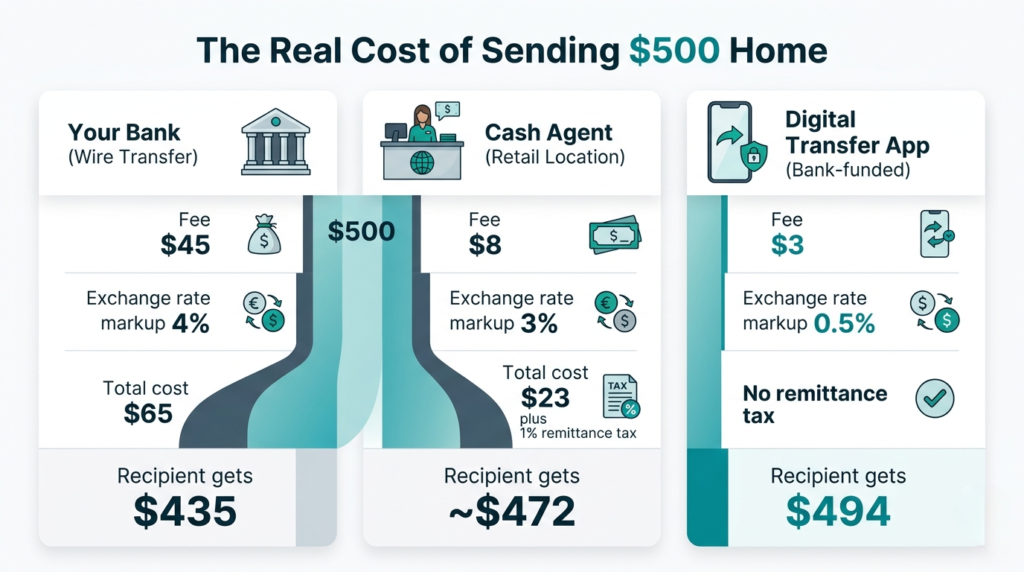
Traditional bank wire transfers are one of the most expensive ways to send money internationally, and for immigrants who send money home regularly, the cost difference between using your bank and using a dedicated transfer service compounds into a significant sum over time.
A typical international wire transfer at a major US bank costs $25 to $50 in flat fees, plus an exchange rate markup of 3% to 5% above the real mid market rate. On a $500 transfer, that combination can mean $35 to $70 in total costs, money that never reaches your family.
Dedicated digital transfer services like Wise, Remitly, and WorldRemit typically charge a fraction of that. Wise, for example, charges fees starting around 0.41% and uses the real mid market exchange rate with no hidden markup. On the same $500 transfer, total costs might be $3 to $6.
There is also the remittance tax to consider. Since January of the current year, cash funded international transfers are subject to a 1% federal excise tax. Transfers funded from a US bank account, debit card, or credit card are explicitly exempt. This is another reason to use a digital transfer service funded from your bank account rather than cash at a retail location.
Our full guide on the best tax exempt ways to send money home covers every option in detail with a direct comparison of costs.
Mistake 5: Ignoring the ChexSystems Report
Most immigrants have never heard of ChexSystems. Most have never heard of it even after they have been in the US for several years. And then one day they try to open a new bank account and get denied, and nobody explains why.
ChexSystems is a consumer reporting agency that tracks negative banking history. Banks and credit unions report when a customer has unpaid overdraft fees, bounced checks, or fraudulent account activity. When you apply to open a new account, most financial institutions check your ChexSystems report. A negative mark on that report can result in denial, even if your credit score is fine and you have done nothing fraudulent.
A negative ChexSystems record typically stays on your report for five years.
For immigrants, ChexSystems problems most commonly arise from: closing an account with an unpaid overdraft balance, writing a check that bounces, or being a victim of fraud on an account that was then reported. Sometimes the record belongs to someone with a similar name or Social Security Number, which means errors are possible and worth checking.
How to protect yourself and recover:
You are entitled to a free ChexSystems report once every 12 months at consumerdebit.com. Check it if you have been denied a bank account, if you have had banking problems in the past, or simply as a routine part of monitoring your financial health.
If you find an error, you can dispute it directly with ChexSystems and with the bank that submitted the report.
If you have a legitimate negative record from an unpaid overdraft, paying the outstanding balance often results in the bank requesting removal of the record before the five year period ends. Contact the bank directly and ask.
If you have a ChexSystems record and need a bank account now, look for second-chance checking accounts. These are accounts specifically designed for people with banking history problems, they typically have more restrictions and fees, but they allow you to rebuild your banking record while the negative mark works its way off your ChexSystems report.
Mistake 6: Keeping All Your Savings in a Checking Account
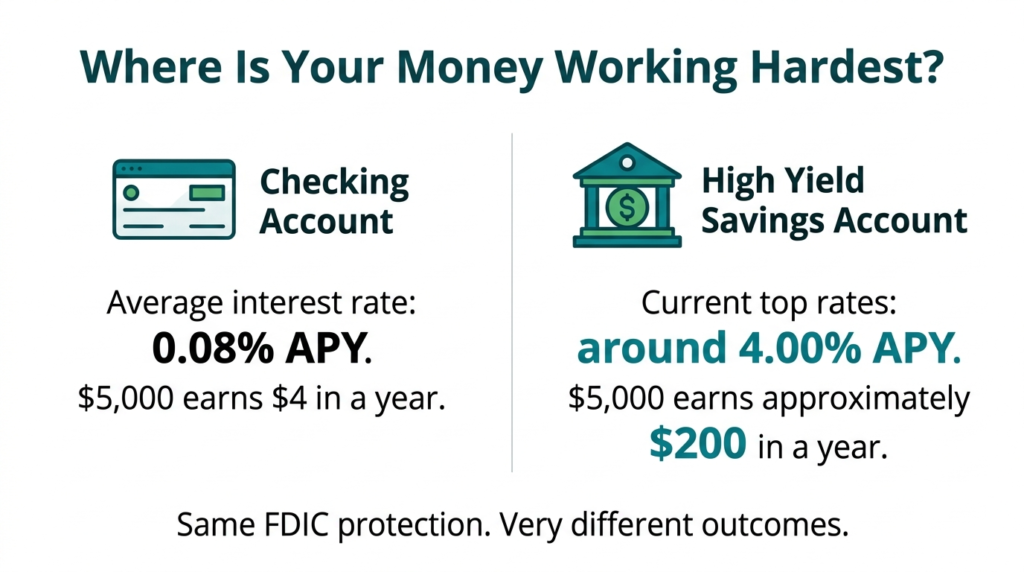
The average interest rate on a traditional checking account is approximately 0.08% APY, meaning $5,000 sitting in a checking account earns about $4 in a year. The average interest rate on a high yield savings account at a leading online bank is currently around 4.00% APY, meaning that same $5,000 earns approximately $200 in a year.
Both accounts are FDIC insured up to $250,000. Both are safe. The difference is purely in how the institution uses your deposits and how much of the return they pass back to you.
Many immigrants keep all of their money, emergency fund, regular spending money, and any savings, in a single checking account because it is simpler and because nobody explained that a better option existed. Over years, this is a meaningful amount of lost growth.
The straightforward fix is to open a high yield savings account at an online bank alongside your regular checking account, and use it specifically for money you are not planning to spend in the next month or two. Keep one to two months of living expenses in checking for daily use, and everything else in high yield savings where it earns a real return.
Transfers between the two accounts are typically free and take one business day. The separation also naturally makes you less likely to spend savings impulsively, a behavioral benefit that adds to the financial one.
Mistake 7: Not Knowing Your Rights as a Bank Customer
Many immigrants do not know they have rights as a bank customer. Some assume that because they are not citizens, or because their English is limited, or because they are relatively new to the system, the bank’s decisions are final and unappealing. None of that is true.
You have the right to:
A free bank account option. Many large banks are required to offer Bank On certified accounts, basic checking accounts with no overdraft fees and low or no monthly fees, as part of their community reinvestment commitments. Ask specifically for a Bank On account if you are having trouble finding a fee-free option.
Dispute unauthorized transactions. Under the Electronic Fund Transfer Act, if your debit card is used without your authorization, you have the right to dispute that transaction and receive a provisional credit while the bank investigates. Report unauthorized transactions within 60 days of the statement in which they appear.
File a complaint. If your bank has charged you fees you believe are improper, denied you a product unfairly, or treated you differently based on your national origin or language, you can file a complaint with the Consumer Financial Protection Bureau at consumerfinance.gov or by calling 855-411-2372. The CFPB investigates complaints and has returned hundreds of millions of dollars in improper fees to consumers through enforcement actions.
Receive account disclosures in plain language. Banks are required by law to provide clear disclosure of fees, terms, and conditions before you open an account. If those disclosures were not provided or were only available in English when you requested them in another language, that is a potential fair lending concern worth raising with the CFPB.
A Quick Reference: Common Fees and How to Avoid Each One
| Fee Type | Typical Cost | How to Avoid It |
|---|---|---|
| Monthly maintenance fee | $10 to $15 per month | Use a no-fee online bank or meet waiver requirements |
| Overdraft fee | $25 to $35 per transaction | Opt out of overdraft coverage, link a savings buffer |
| Out of network ATM fee | $2.50 to $5 per use | Use your bank’s ATM network or an online bank that reimburses ATM fees |
| International wire fee | $25 to $50 flat | Use Wise, Remitly, or WorldRemit instead |
| Paper statement fee | $1 to $5 per month | Switch to paperless statements in your account settings |
| Account closure fee | $25 or more | Wait until the bank’s required holding period passes before closing |
The Mindset That Protects You
The most important shift you can make as an immigrant navigating the US banking system is this: assume the system is not designed to help you and take nothing for granted.
Read the fee schedule before you open any account. Ask every question that occurs to you, even if it feels basic. Compare at least two options before committing. Check your bank statements every month, not just when something feels wrong. Know that you have the right to dispute, to complain, and to leave.
The US banking system, used carefully, is an extraordinarily powerful tool for building financial stability. Used carelessly, or used with an institution that profits from your unfamiliarity, it can quietly drain the very resources you came here to build.
You are not obligated to bank at the institution that was nearest to you when you arrived, or the one a coworker mentioned, or the one with the most recognizable name. You are allowed to choose the bank that serves you best.
Make that choice deliberately.
Disclaimer: This article is for educational and informational purposes only and does not constitute financial or legal advice. Banking products, fees, and regulations change. Always verify current terms directly with any financial institution before opening an account.