
The Global Wealth Strategy: US Investments You Can Take With You Anywhere
Most personal finance content is written as if you are definitely staying. As if the plan is always: arrive, work, build, retire here. As if the possibility of returning home someday, or moving to a third country, or splitting your life across two continents is a complication rather than a reality.
For many immigrants, it is a reality. The future is genuinely uncertain. Maybe you came here for a job and the job could end. Maybe your parents are aging and the question of going back is not abstract, it is a conversation you have regularly. Maybe you have a partner in another country, or children who will grow up between two cultures, or a plan to retire somewhere warmer and cheaper than where you currently live.
And yet most financial advice tells you to plant your roots as deep as possible, optimize for one country, and not think too hard about what happens if you leave.
This article takes a different approach.
It is written for the immigrant who is building wealth in the United States while holding space for the possibility that their life might not end here. It covers which US investments are genuinely portable, meaning you can keep and grow them even if you leave, which ones become complicated when you cross borders, and how to think about building a financial foundation that serves you wherever you end up.
This is not a guide to avoiding taxes or hiding money. It is a guide to building real, lasting wealth in a way that does not trap you in one geography.
The Foundational Truth: US Investments Have Real Global Advantages
Before we get into what travels well and what does not, it is worth understanding why building your wealth through US investments, rather than shifting it to your home country or a third country, is usually the smarter long term strategy, regardless of where you eventually live.
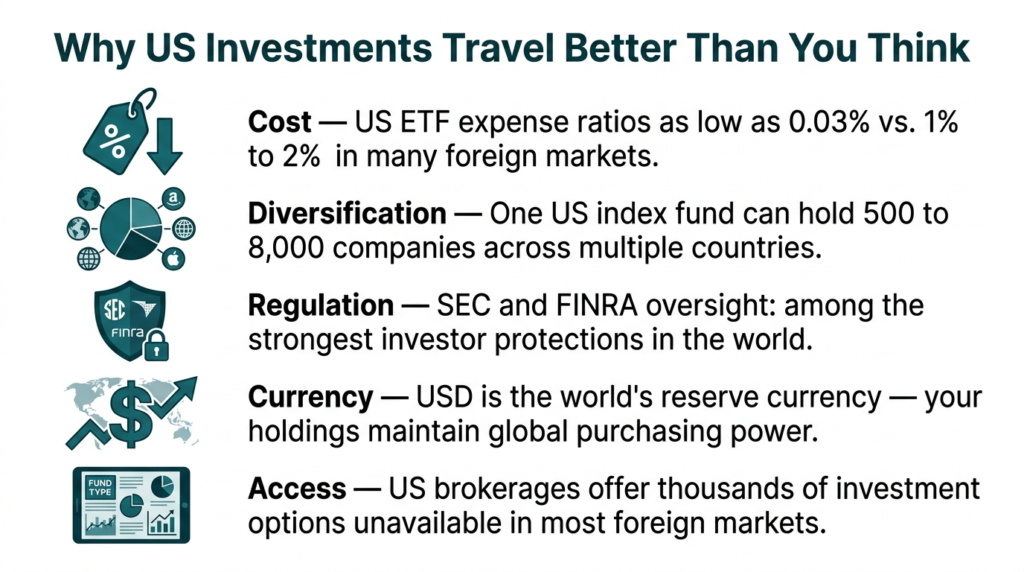
US ETFs and index funds have some of the lowest expense ratios in the world, as low as 0.03%, while foreign funds, especially in Europe and Latin America, often charge 1% to 2% or more annually. Over decades, that difference in fees compounds into an enormous gap in outcomes. A $50,000 portfolio growing at 7% annually for 30 years looks very different if 1.5% of that is being extracted in fees every year.
US accounts are overseen by regulatory bodies like the Securities and Exchange Commission (SEC) and FINRA, which ensure that brokers operate under high standards of transparency and ethics, consumer protections that may not be available in your host country.
And there is one more advantage that is easy to underestimate: the US dollar. Whatever country you eventually settle in, your US investments are denominated in the world’s reserve currency. That is a form of stability and global purchasing power that assets in most other currencies simply cannot match.
The Core Principle: Own the Right Assets in the Right Accounts
The global wealth strategy is not complicated in concept. It comes down to this:
Build your wealth through US investments that have inherently global reach, index funds, ETFs, and stocks that hold companies from around the world, so that your portfolio grows wherever you live, and your returns are not limited by the performance of any single country’s economy.
Then hold those investments in accounts that are structured to survive a move, brokerage accounts and certain retirement accounts that can remain open and functional even when you are no longer a US resident.
The complication comes in the details. Not all accounts travel equally well. Not all investment types are welcomed equally by different countries. And the tax picture gets genuinely complex when two jurisdictions both have a claim on your money.
Here is a clear breakdown of each major investment category.
Category 1: US Domiciled Index Funds and ETFs — The Most Portable Investment You Own
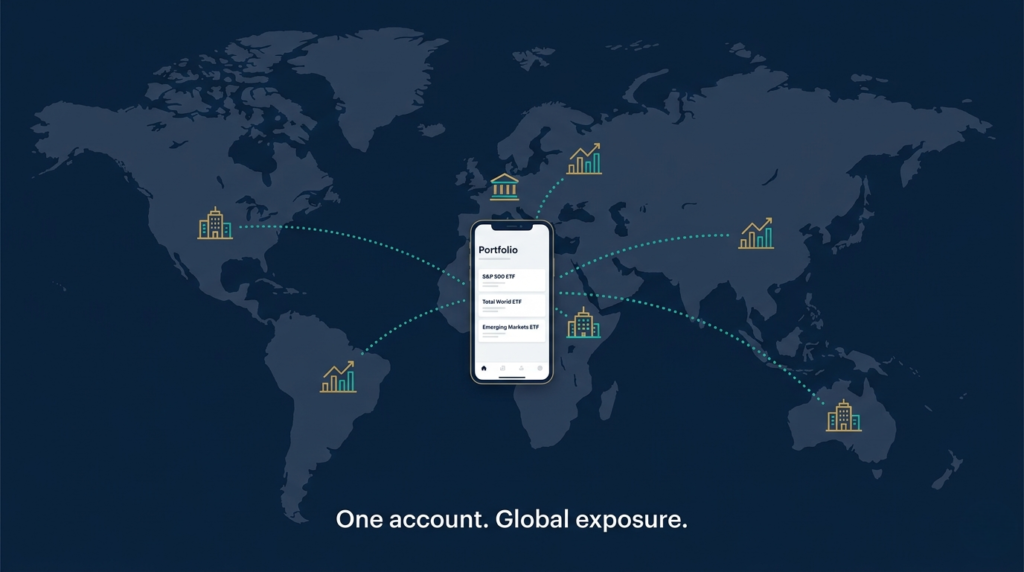
US domiciled index funds and exchange traded funds (ETFs) are the closest thing to a truly global, portable investment that most individual investors can access.
When you own a fund tracking the S&P 500, you own shares in 500 of the largest companies in America, companies that themselves operate in nearly every country on earth. Apple earns revenue in China. Microsoft earns revenue in Europe. Johnson and Johnson earns revenue across Asia. A single index fund gives you exposure to the global economy without requiring you to hold investments in multiple countries or navigate foreign brokerage systems.
When you go further and own a total world market ETF, funds like Vanguard’s VT, which tracks roughly 9,000 companies across both developed and emerging markets in a single fund, your investment is truly borderless in terms of economic exposure. Whether the next decade of global growth comes from the United States, Southeast Asia, or Latin America, a total world fund captures it.
Fortunately, you can avoid the PFIC complication and invest in a tax efficient way by diversifying with only US registered investments like mutual funds or exchange traded funds. ETFs can be a great option for expat investors as they do not face the same compliance restrictions as mutual funds.
The key phrase there is US registered. This matters enormously when you move abroad.
The PFIC Problem: Why You Should Build Your Portfolio in the US, Not Abroad
If you leave the United States and start buying investment funds in your new country, local mutual funds, foreign ETFs, investment products sold by banks in your new home, you may inadvertently create a very expensive tax problem back in the US.
The IRS classifies most foreign investment funds as Passive Foreign Investment Companies, commonly called PFICs. The tax treatment of PFICs under US law is punishing: your gains are taxed at the highest ordinary income rates rather than the lower capital gains rates, interest charges apply retroactively to prior years’ gains, and the reporting requirements, particularly Form 8621, are complex enough that most tax preparers charge significant additional fees to handle them.
Holding investments abroad can introduce you to Passive Foreign Investment Companies, which include foreign mutual funds and ETFs. These face punitive tax rates and complex Form 8621 filing requirements.
The simplest and most effective way to avoid this problem entirely is to build your investment portfolio in the United States, using US domiciled funds, before you move, and to continue holding those same US investments if and when you do move. Your portfolio stays in the US, grows in US dollars, and is reported on your US tax return just as it always was.
Category 2: The Roth IRA — The Most Powerful Account for Long Term Global Mobility
If you have access to a Roth IRA and are not maximizing it, this is the most important section of this article for your long term financial life.
A Roth IRA is a retirement account funded with after tax dollars. The money grows completely tax free inside the account, and qualified withdrawals in retirement are also tax free. You pay taxes once, when you earn the income, and never again on the growth, regardless of how large that growth becomes.
For immigrants thinking about global mobility, the Roth IRA has three specific advantages that make it uniquely powerful:
It travels with you. Unlike a 401(k) that is tied to your employer, a Roth IRA is yours. It does not go anywhere when you change jobs or countries. The account stays open at your chosen brokerage, continues to hold your investments, and continues to grow tax free regardless of where you live.
The tax-free growth compounds over decades. If you contribute $7,000 per year to a Roth IRA starting at age 30 and earn an average of 7% annually, you will have approximately $700,000 by age 65, and every dollar of that is yours, with no tax owed when you withdraw it. If you are in a high-tax country when you retire, that tax-free status is worth a remarkable amount.
Five countries explicitly recognize Roth IRA tax treatment in their tax treaties with the United States: France, Canada, Belgium, Latvia, and Estonia. In those countries, your Roth IRA’s tax-free status is honored at the local level as well, meaning you avoid being taxed twice on the same growth. If you are considering eventual retirement in one of those countries, a well funded Roth IRA is an extraordinarily valuable asset.
One important caution: In most other countries, a Roth IRA is treated as a regular taxable brokerage account for local tax purposes, meaning the host country may tax your Roth’s dividends and capital gains as ordinary income. The tax advantages you built up in the US do not automatically transfer. This does not eliminate the Roth’s value, but it does mean the retirement destination matters when calculating the long-term benefit. Consulting a tax professional who understands both US and your target country’s tax system is worth the investment before you finalize your plans.
Category 3: Traditional IRA and 401(k) — Valuable, But More Complex Across Borders
Traditional IRAs and 401(k)s are funded with pre tax dollars, meaning every contribution reduces your taxable income today and the money grows tax deferred until withdrawal, at which point it is taxed as ordinary income.
These accounts are valuable wealth building tools, but they are more complex in a cross border context than a Roth IRA.
Withdrawals are taxed as ordinary income regardless of where you live when you take them. If you retire in a high-income-tax country, your traditional IRA withdrawals will be taxed by the IRS as ordinary income and may also be taxed by your host country, unless a tax treaty says otherwise.
Required Minimum Distributions (RMDs) begin at age 73, requiring you to take a minimum withdrawal each year regardless of whether you need the money or want to pay the tax. This creates a forced taxable event that you cannot delay by living abroad.
Early withdrawal penalties apply globally. If you access traditional IRA or 401(k) funds before age 59 and a half, a 10% early withdrawal penalty applies on top of the ordinary income tax, regardless of what country you are in when you make the withdrawal.
None of these features make a traditional IRA or 401(k) a bad investment, they are still among the best wealth building tools available, especially when your employer offers a matching contribution on the 401(k) side. But they are less elegantly portable than a Roth IRA, and the tax planning around them requires more care if you intend to retire outside the United States.
If you want to understand what actually happens to your 401(k) if you leave the country, our article on what happens to your 401k if you leave the US walks through every option in detail.
Category 4: Taxable Brokerage Accounts — The Most Flexible Option
A standard taxable brokerage account, an account at Fidelity, Charles Schwab, or a similar platform where you buy and sell investments without any special tax treatment is in many ways the most globally flexible account available.
There are no contribution limits. There are no withdrawal restrictions or penalties. There are no required distributions. You can add money, take money out, buy and sell investments, and manage the account entirely on your own timeline.
The trade off is that investment gains are taxable. Dividends are taxed in the year you receive them. Capital gains are taxed when you sell, though long term capital gains (on investments held more than one year) are taxed at preferential rates of 0%, 15%, or 20% depending on your income.
For an immigrant planning for global mobility, a taxable brokerage account funded with low cost, US domiciled index funds is an excellent complement to your Roth IRA. It provides a pool of accessible, invested capital that you can reach without penalty at any age and in any country, while the index funds inside it continue to grow and compound over time.
The US Address Problem — And How to Navigate It
Here is the practical challenge that immigrants planning to leave the US must confront honestly: to keep a US brokerage or retirement account open and fully functional, you typically must have a US residential address on file.
When you update your brokerage to a foreign address, some platforms will restrict your ability to make new trades, purchase additional shares of mutual funds, or access certain account features. A few major brokerages have gone further and closed accounts of clients who updated to foreign addresses, particularly in the aftermath of FATCA compliance pressure.
Some American expats continue to claim a US mailing address while living overseas. You should understand that this option carries risk, as it likely violates your investment firm’s terms and conditions.
The compliant solutions include maintaining a genuine connection to a US address, a trusted family member’s home, property you still own, or working with an expat friendly brokerage or advisory firm that explicitly serves clients living abroad. Interactive Brokers and TD Ameritrade International are among the platforms that have historically maintained more accommodating policies for international clients, though policies change and verifying current terms directly before you rely on them is essential.
The most important action you can take before leaving the United States is to contact your brokerage directly and ask their specific policy for account holders who move abroad. Getting a clear answer in writing before you change your address is far better than discovering a problem after your account has been restricted.
Category 5: Real Estate Investing — What Stays and What Goes
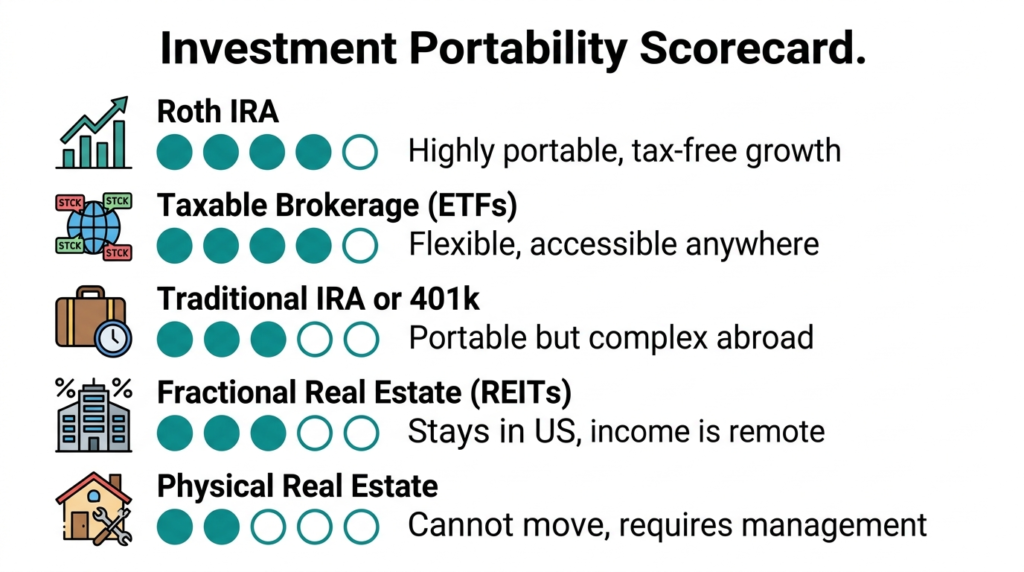
Physical real estate, an investment property you own in the United States, does not travel with you in a literal sense. The property stays where it is. But the income from it can follow you anywhere.
If you own rental property in the United States and move abroad, you can continue to receive rental income as a non resident. That income remains taxable in the US, and you will likely need to file a US non resident tax return (Form 1040-NR) each year to report it. Depending on your new country of residence, the rental income may also be subject to local taxation, with the Foreign Tax Credit helping to offset double taxation in most cases.
Managing a property remotely is the practical challenge. A professional property manager typically charges 8% to 12% of monthly rent, which is a real ongoing cost that reduces your net return. But for many immigrants who own property in the US and are considering leaving, the long term appreciation potential and rental income make keeping the property worthwhile despite the management complexity.
Fractional real estate investments, through platforms like Arrived or Fundrise, which we covered in our article on becoming a landlord with $100, are more naturally portable. You do not manage anything. Income is distributed electronically to wherever you are. And your stake in the investment continues to generate returns regardless of your address.
REIT ETFs in your brokerage account are even simpler: they behave exactly like any other ETF, trade on US exchanges, and require no management from you regardless of where you live.
The Tax Reality of Leaving the US
No article on global wealth strategy is complete without an honest discussion of what leaving the US actually means for your taxes.
If you leave the United States and establish tax residency in another country, you will generally still owe US taxes on your worldwide income as long as you are a US citizen or green card holder. The US is one of only two countries in the world (along with Eritrea) that taxes its citizens based on citizenship rather than residency.
For green card holders, the rules are somewhat different. If you formally abandon your green card and your situation meets certain thresholds, the IRS may apply an exit tax, officially called the Expatriation Tax, that treats certain assets as if they were sold on the day before you left. This can create a taxable gain even if you have not actually sold anything.
For immigrants who are not yet permanent residents, leaving the United States before obtaining a green card generally ends US tax residency once you have been physically absent long enough. But the specific rules depend on your visa status and the facts of your departure.
These are not reasons to avoid building wealth in the US. They are reasons to plan your departure, if and when that time comes, with qualified professional guidance rather than simply updating your address and hoping for the best.
How to Think About Building a Portable Wealth Portfolio
Here is a practical framework for building a financial foundation that genuinely works across borders:
Build your emergency fund first, in a US high-yield savings account. This stays accessible, stays in dollars, and costs you nothing to maintain regardless of where you live. Our article on where to put your first $1,000 as an immigrant covers this in detail.
Maximize your Roth IRA every year you are eligible. This is your single most portable, tax-advantaged investment. If you ever leave the US and settle in a country that recognizes Roth treatment under a tax treaty, this account becomes extraordinarily valuable. Even if you do not, decades of tax-free compounding is difficult to replicate.
Capture your full employer 401(k) match, always. Free money is free money regardless of what country you eventually retire in. The complexity of cross border 401(k) management is worth navigating to capture an immediate 50% to 100% return on your contribution.
Invest your taxable brokerage in US domiciled, globally diversified ETFs. A combination of an S&P 500 fund and a total world ETF gives you genuine global economic exposure while keeping you in the clean, low-cost, PFIC-free structure of US registered investments.
Do not buy foreign investment funds just because you moved there. This is the most common and most expensive mistake immigrants and expats make. Your US investments travel better than local alternatives, and the PFIC consequences of foreign funds are severe.
Contact your brokerage before you leave. Find out their policy on foreign-address account holders and plan accordingly. This is not a conversation to have after you have already updated your address.
The Bottom Line
You do not have to choose between building wealth and keeping your options open.
The right US investments, index fund ETFs, a well funded Roth IRA, a diversified taxable brokerage account, are genuinely global. They hold companies from around the world, grow in the world’s reserve currency, and can be managed from a phone on any continent. They do not care where you live.
What requires planning is the account structure, the tax picture when you cross borders, and the practical question of maintaining access to your US financial accounts from abroad. None of those problems are insurmountable. They simply require knowing about them before you go.
Build the portfolio now, while you are here and the accounts are easy to open. Understand the rules before you move. And if leaving is ever the choice you make, your financial foundation will be ready to go with you.
Your wealth does not have to be rooted in one country. Neither do you.
Disclaimer: This article is for educational and informational purposes only and does not constitute financial, tax, legal, or immigration advice. Cross border tax rules are complex and vary by country, visa status, and individual circumstances. Always consult a qualified financial advisor and tax professional with cross border expertise before making investment or relocation decisions.