
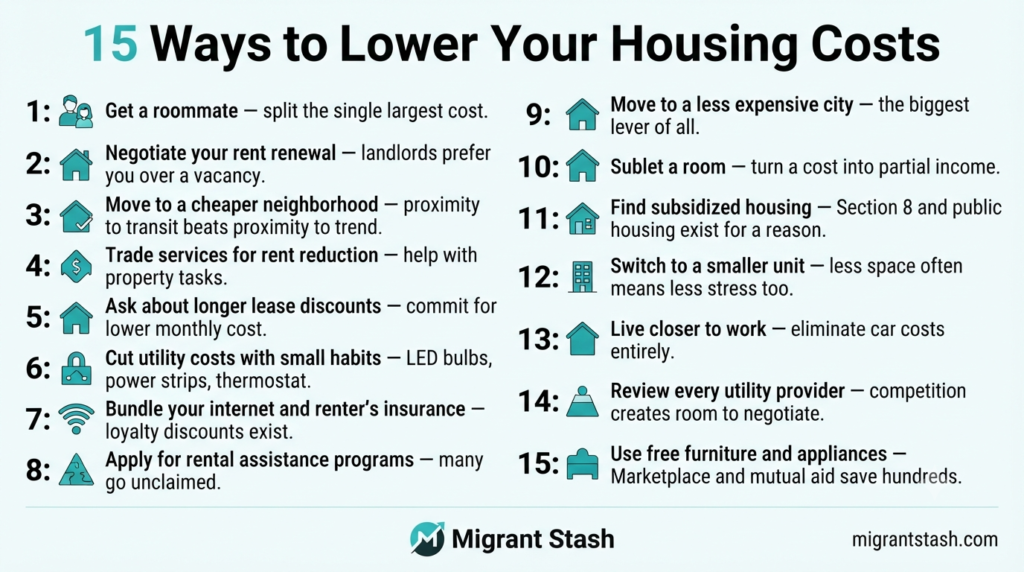
15 Ways to Lower Your Monthly Housing Costs
In most American cities, housing eats between 35% and 50% of a newcomer’s take home pay before anything else is considered. Rent, utilities, renter’s insurance, parking, internet. By the time you have covered shelter, there is often very little left for savings, investments, emergencies, or anything sent home.
The conventional advice is to spend no more than 30% of your gross income on housing. That threshold is now unrealistic in most cities where immigrants actually live. New York, Los Angeles, Chicago, Houston, Miami, Dallas. In those markets, the question is not how to hit 30%. It is how to minimize what you are already spending without sacrificing safety, stability, or the ability to function.
This article gives you 15 specific, actionable strategies, ranging from things you can do this week to things that take a few months to arrange, all aimed at one goal: keeping more of your income for the life you are building here.
1. Get a Roommate
This is the single most powerful lever available to anyone paying rent in an American city, and it works faster than every other strategy on this list.
The math is direct. A one bedroom apartment in Houston averages around $1,400 per month. A two bedroom apartment in the same area averages around $1,700. Splitting that two bedroom between two people costs each person $850 per month, a saving of $550 per month compared to living alone, or $6,600 per year.
In higher cost cities, the math is even more compelling. A one bedroom in New York City averages $3,000 or more. A two bedroom shared between two people can bring each person’s cost down to $1,500 to $1,800, depending on the neighborhood. That gap is enough to fully fund a Roth IRA contribution every year and still have money left over.
Roommates found through Facebook groups for your city, through immigrant community networks, through coworkers, or through apps like Roomies and SpareRoom are the most common routes. The safety screening you apply before moving in with anyone is your own judgment and references, not a platform’s guarantee, so meet people in person before committing.
2. Negotiate Your Rent at Renewal
Most tenants treat rent renewal as a fixed event. The landlord sends a notice. The rent goes up. You either accept or move. This is not how it has to work.
Landlords typically spend one to two months of rent finding a new tenant when a unit turns over: advertising costs, screening fees, cleaning, touch up repairs, and the lost rent during vacancy. A reliable tenant who pays on time and maintains the unit is worth meaningful money to a landlord who wants to avoid that turnover cost.
When your lease renewal arrives, contact your landlord before signing and ask for the renewal rate to remain flat, or for a smaller increase than proposed, specifically because you are a reliable tenant with no late payments, no maintenance issues, and no plans to leave. Offer to sign a longer lease in exchange for a lower monthly rate. This conversation succeeds more often than most tenants expect, particularly for tenants who have been in place for a year or more.
If you have never had this conversation, the only cost of trying is a short email or phone call.
3. Move to a Less Expensive Neighborhood
Rent pricing in American cities is not linear. Within the same city, rent can vary by 40% to 60% depending on the neighborhood, even when commute times to the same downtown core are similar.
In Chicago, for example, a one bedroom in River North averages $2,400 per month. A one bedroom in Bridgeport, four miles south, averages $1,100. Both neighborhoods have CTA access to the Loop. The lifestyle difference exists, but it is not $1,300 per month large for most people’s actual daily lives.
Research the rent range across several neighborhoods in your city before your next lease expires. Use Zillow, Apartments.com, or Craigslist to compare average rents by neighborhood. Focus on areas with good transit access, safe streets at the times you actually commute, and reasonable grocery access. The trendy neighborhood premium almost never pays for itself relative to what you could save a few miles away.
4. Trade Services for a Rent Reduction
Many small and mid size landlords, particularly those managing fewer than ten units, have tasks they are willing to offset against rent in exchange for reliable help.
Common arrangements include helping to show vacant units to prospective tenants, basic landscaping or snow removal depending on your city, picking up packages or ensuring building security protocols are followed, or managing one small maintenance task category, like changing light bulbs or checking smoke detectors, when needed.
This arrangement suits a landlord who needs occasional help but not a full time property manager, and a tenant who has a few hours of flexibility per month and a genuine interest in reducing their rent. Approach the conversation directly, name the specific tasks you are offering, and propose a specific dollar amount to credit against your monthly rent. A $100 to $150 monthly credit is reasonable for two to four hours of light property help.
5. Commit to a Longer Lease for a Lower Monthly Rate
Many landlords will accept a lower monthly rent in exchange for a longer lease commitment, because lease turnover is their primary cost and risk. A tenant who commits to 18 or 24 months instead of 12 gives the landlord predictability and reduced vacancy risk.
When negotiating, offer to sign an 18-month lease in exchange for a flat rate at your current rent, or to sign a two year lease in exchange for a rent reduction of $50 to $100 per month. The landlord gains certainty. You gain savings that compound over the lease term.
This strategy is most effective when you genuinely know you are staying in the same city and situation for the next year or two. Do not commit to a longer lease as a negotiating tactic if relocation is actually possible in that window.
6. Cut Your Utility Bill With Small Consistent Habits
Utilities are a variable cost that most renters treat as fixed. They are not.
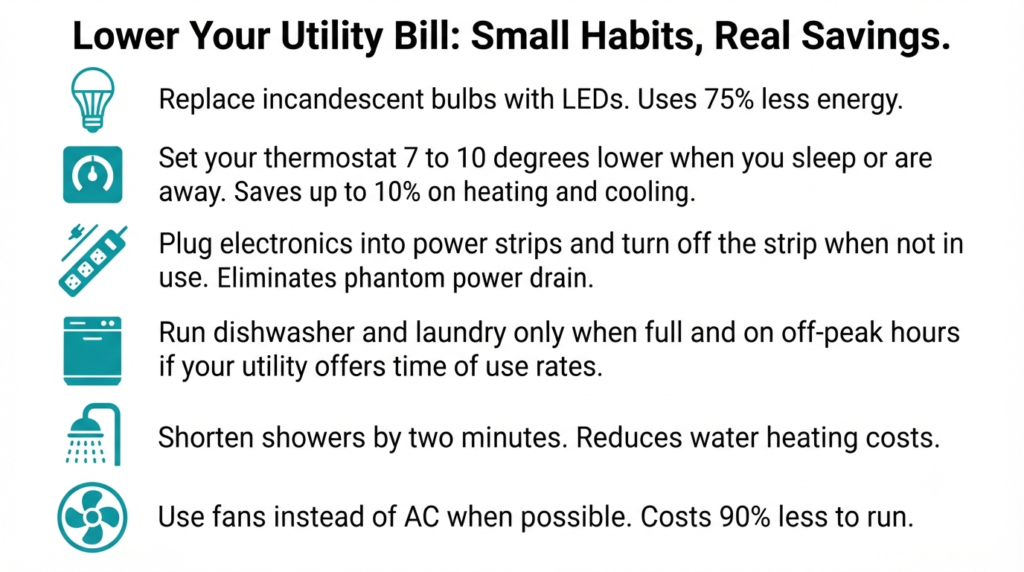
According to the US Energy Information Administration, the average American household spends approximately $135 per month on electricity. Small, consistent habits can reduce that figure by $20 to $40 per month, or $240 to $480 per year, without any significant change in comfort.
Replacing incandescent light bulbs with LEDs costs $2 to $4 per bulb and reduces the energy that bulb uses by at least 75%. A programmable or smart thermostat, available for $25 to $50 at any hardware store, can reduce heating and cooling costs by up to 10% per year by automatically adjusting temperature when you are asleep or away. Plugging electronics and appliances into power strips and switching the strip off when not in use eliminates phantom power, the energy drawn by devices even when switched off, which represents approximately 5% to 10% of the average household electricity bill.
Running your dishwasher and laundry machines only when full, and using cold water settings where the manufacturer allows, further reduces both water and energy use. If your utility company offers time of use pricing, shifting high energy tasks like laundry to evenings and weekends can reduce your bill meaningfully.
7. Compare and Negotiate Internet and Renter’s Insurance
Internet service providers in the US typically offer promotional rates for new customers that are significantly lower than the rates existing customers pay. If you have been with the same provider for more than 12 months, your current rate may be 30% to 50% higher than what a new customer would pay for identical service.
Call your provider, tell them you have received a lower quote from a competitor, and ask whether they can match it. This call takes 10 to 15 minutes and succeeds more often than most people expect. Alternatively, switch to a different provider at the promotional rate. Most providers offer the first 12 months at a significantly reduced price.
Renter’s insurance, which most tenants should carry, typically costs $15 to $25 per month for a standard policy. Comparing quotes through a platform like Policygenius or directly through GEICO, Lemonade, or State Farm takes about 20 minutes and can reduce your premium by 20% to 40% depending on your current provider and coverage level.
8. Apply for Rental Assistance Programs
This is the most underused resource on this list, and it is particularly underused in immigrant communities where awareness of government assistance programs is lower and where fear of public charge consequences sometimes discourages applications even when the risk is minimal or nonexistent.
Section 8 / Housing Choice Vouchers are federally funded rental assistance vouchers administered by local Public Housing Authorities. A voucher pays a portion of your rent directly to your landlord, with you paying the difference between the voucher amount and the actual rent. Eligibility is based on income, and legal residents and citizens with household incomes typically at or below 50% of the Area Median Income qualify to apply.
Important notes for immigrants: accepting a Housing Choice Voucher or other housing assistance does not make you a public charge for immigration purposes. USCIS has confirmed that housing assistance administered through Section 8 is not counted as a public benefit in public charge determinations. However, the waiting lists for Housing Choice Vouchers in most major cities are long, sometimes several years, which is why applying early matters even if you do not expect to need it immediately.
Emergency rental assistance programs exist in most states and many counties and cities, funded through a combination of federal and state money. These programs typically assist households facing eviction or housing instability, with eligibility based on income and documentation of hardship. Find local programs through 2-1-1.org or by searching “[your city or county] rental assistance program.”
For immigrants newly renting in the US who are navigating the credit history challenge alongside the cost challenge, our guide on renting your first apartment in the US with no credit history covers additional strategies for lowering the upfront cost of securing your first US apartment.
9. Consider Moving to a Less Expensive City
This is the biggest lever available and the one most people are least willing to pull, but it deserves an honest mention.
Housing costs in the United States vary by a factor of four or more between the most expensive and most affordable metros. A household that earns $65,000 per year in San Francisco is cost-burdened by any measure. The same household in Columbus, Ohio, or San Antonio, Texas, or Raleigh, North Carolina, can afford a two bedroom apartment without financial stress and still save meaningfully every month.
For immigrants who are early in their US careers, whose employer is either remote friendly or whose industry has job markets in multiple cities, geographic arbitrage, meaning working at a competitive salary while living in a lower cost market, is one of the highest-return financial decisions available.
The cities that consistently combine reasonable housing costs with strong immigrant community infrastructure and job market access include Houston, Dallas, San Antonio, Phoenix, Columbus, Indianapolis, Raleigh, Charlotte, and Omaha. None of these are without their own challenges. But the housing cost delta relative to New York, Los Angeles, Boston, and San Francisco is large enough to materially change what is possible financially within two to three years.
10. Sublet a Room in Your Apartment
If your lease allows subletting, or if your landlord is open to discussing it, renting out a furnished room to another person converts part of your largest expense into partial income.
A furnished room in most US cities rents for $600 to $1,200 per month depending on location, size, and amenities. On a $1,700 two bedroom apartment, a single room sublet at $800 per month reduces your effective housing cost to $900. That is below the national average rent for a studio apartment.
Check your lease before approaching your landlord. Many standard leases prohibit subletting without prior written consent. Some landlords will add a subletting addendum to the lease in exchange for the ability to approve tenants. In cities with strong tenant protections like New York and San Francisco, subletting rights are sometimes guaranteed by law regardless of what the lease says.
Short-term room rentals through platforms like Airbnb require checking local regulations. Many cities have passed restrictions or registration requirements for short term rentals that affect whether this is a viable option in your specific location.
11. Apply for Subsidized or Income-Restricted Housing
Beyond Section 8 vouchers, many cities have income restricted apartment developments built with Low-Income Housing Tax Credits (LIHTC). These are regular apartment buildings, not public housing projects, built by private developers in exchange for tax credits that require them to rent a portion of units at below market rates to households below certain income thresholds.
Income-restricted apartments are often indistinguishable from market-rate apartments in the same building or neighborhood. They are managed by professional property management companies. They require a standard lease application. But their rents are set as a percentage of the Area Median Income rather than at whatever the market will bear.
To find income restricted apartments in your area, use the HUD Resource Locator at resources.hud.gov, contact your local Public Housing Authority, or search “[your city] affordable housing waitlist.” Waiting lists exist for these units as well, which again makes applying early more valuable than waiting until you are in a housing cost crisis.
12. Switch to a Smaller Unit
The relationship between apartment size and cost is not always as large as people expect, but it is real, and for households that have accumulated more space than they actually use, downsizing is a legitimate savings strategy.
If you live in a two bedroom apartment and use the second bedroom primarily for storage or as a guest room that hosts visitors fewer than six times per year, that room is costing you $400 to $700 per month in incremental rent depending on your city. A one bedroom apartment frees that cost entirely and may also reduce utility bills.
Smaller units also tend to accumulate less furniture, less clutter, and less of the ongoing cost that comes with maintaining a larger household. For immigrants in an active saving and building phase, a smaller footprint for a few years is a deliberate and financially sound choice, not a compromise.
13. Live Closer to Work to Eliminate Transportation Costs
Transportation is the second largest household expense for most Americans, and the two costs, housing and transportation, interact directly in ways that standard rent comparisons miss.
A slightly more expensive apartment that is walkable or bikeable to your workplace often costs less in total than a cheaper apartment that requires a car. The true cost of a car for a new immigrant, payment, insurance, gas, registration, and occasional maintenance, typically runs $500 to $800 per month. Transit passes in most cities cost $80 to $130 per month.
When evaluating apartments, always add your estimated transportation cost to the rent figure before comparing options. An apartment that costs $200 more per month but eliminates a $450 car payment is a net gain of $250 per month, not a loss.
For immigrants who do not yet have a US driving history and face the highest insurance rates available as new drivers, this trade is often even more favorable than the math suggests.
14. Review and Negotiate Every Utility Provider
In many US cities and states, electricity and gas supply is deregulated, meaning you can choose your energy supplier rather than being locked into the default utility company. In states including Texas, Illinois, Ohio, Pennsylvania, and New York, competitive energy suppliers often offer rates meaningfully lower than the default utility rate.
Visit your state public utility commission’s website to verify whether your state is deregulated and which comparison tools are available. In Texas, powertochoose.org is the official state comparison site. In other deregulated states, similar comparison portals exist. Switching energy suppliers is free and does not require any physical change to your apartment or utility service.
For water and sewage, where competition does not exist, the lever is consumption reduction through the habits described in strategy 6.
15. Furnish Your Home for Free or Nearly Free
This is not about lowering rent directly, but it is about dramatically reducing the total cost of setting up and maintaining a household, which for many new immigrants is a hidden housing expense that runs into the thousands of dollars.
Facebook Marketplace is the most reliable source of free and low-cost furniture in the United States. People moving, downsizing, or updating their homes list furniture for free pickup constantly. A complete set of bedroom and living room furniture, including bed frames, mattresses, sofas, tables, and kitchen items, can often be assembled for under $200 or even for free by checking free listings daily for a week or two.
Buy Nothing groups are neighborhood-based Facebook groups or apps where members give away household items at no cost. These groups exist in virtually every US city and suburb and are particularly active in areas with high turnover, such as neighborhoods near universities.
Mutual aid networks in immigrant communities frequently exchange furniture, appliances, and household goods among community members at no cost or very low cost. Asking within your community network before purchasing anything large is often the most efficient path.
The money saved by not furnishing a new apartment at retail prices can be redirected into an emergency fund or an investment account, both of which represent a better use of that capital than paying full price for a couch.
Putting It Together
Housing costs are not a single fixed number you accept when you sign a lease. They are a collection of decisions: who you live with, where you live, how you use energy, what you negotiate, what programs you apply to, and how you furnish and maintain your space.
No single strategy on this list solves everything. But four or five strategies applied together, a roommate saving $550, a negotiated renewal saving $75, a utility habit saving $30, and free furniture saving $400 upfront, combine into real, compounding financial relief.
That relief, redirected consistently into savings and investments, is what builds a financial future here. And it all starts with the specific, practical decision to pay less for the largest cost in your life.
For a broader picture of where housing fits within your complete monthly budget and how to allocate what you save, our guide on how to create your first budget in a new country walks through the full picture. And if your current income makes even these strategies feel insufficient, our honest breakdown in how do I make enough money to survive here addresses that directly.
Disclaimer: This article is for educational and informational purposes only. Rental laws, assistance program eligibility, and housing market conditions vary significantly by city, state, and individual circumstance. Always verify program eligibility directly with the relevant agency and review your lease terms before making any decisions about subletting, roommates, or property service arrangements.