
How To Build Wealth in America Starting From Nothing
By someone who started with an empty wallet and a lot of questions.

When I arrived in the United States, I had $200 in a debit card tied to a bank account back home, a suitcase, and absolutely no idea how American money worked.
Nobody in my family had ever used a Roth IRA. Nobody had ever talked about compound interest over dinner. The word “401(k)” sounded like a highway exit. I grew up in a household where money was something you earned, spent on necessities, and hoped there was enough of at the end of the month. Building wealth felt like something that happened to other people. People born into it. People who already had a head start.
What I have learned since then — slowly, sometimes painfully — is that building wealth in America from nothing is genuinely possible. Not easy. Not fast. But absolutely possible, and more accessible than most people realize when they are standing at the starting line with empty pockets and a full set of fears.
This guide is what I wish someone had handed me on day one.
First: Understand What Wealth Actually Means
Before we talk about budgeting apps and index funds, let us get clear on something most personal finance articles skip entirely: wealth is not the same as income.
A wealthy person is someone whose money lasts. A rich person might earn a lot and spend even more. Wealth is your net worth — the total value of everything you own, minus everything you owe. A $60,000 salary with zero debt and a growing investment portfolio can build more long-term wealth than a $120,000 salary spent down to zero every month.
This distinction matters because it changes how you think about every financial decision you make. The goal is not to look wealthy. The goal is to actually become wealthy, quietly and consistently, one decision at a time.
Step 1: Build Your Financial Foundation Before Anything Else
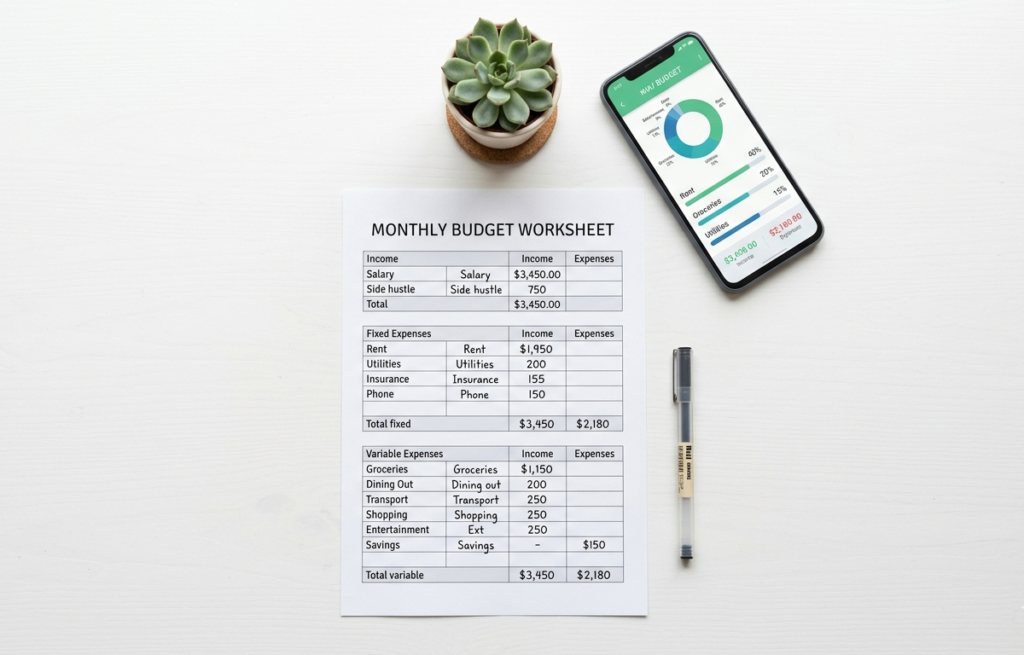
Every wealth-building journey starts the same way, regardless of income level: you need to know where your money is going.
Track Every Dollar With a Budget
The 50/30/20 budgeting rule is one of the simplest frameworks for beginners. It works like this: allocate 50% of your take-home pay to needs (rent, groceries, utilities, transportation), 30% to wants (dining out, entertainment, subscriptions), and 20% to savings and debt repayment. If you are starting from nothing, that 20% is your most important number. Even if it is $40 a month, it is the beginning of everything.
A free tool that makes this nearly effortless is Empower, formerly known as Personal Capital. It connects to your bank and credit accounts, categorizes your spending automatically, and shows your net worth in real time. Seeing the full picture of your finances in one dashboard changes how you think about money — it makes the abstract feel concrete and manageable.
Build an Emergency Fund First
Before you invest a single dollar, you need a financial cushion. Most financial professionals recommend keeping 3 to 6 months of essential living expenses in an easily accessible account. This is not money that earns big returns. This is money that keeps you from having to take on debt or sell investments at the worst possible time when life goes sideways.
SoFi is one of the most beginner-friendly platforms for starting an emergency fund. Their high-yield savings account currently offers competitive APY rates with no account fees, and the platform is designed for people who are building their financial foundation from scratch. They also offer banking, investing, and credit tools all in one place — which matters a lot when you are simplifying a complicated financial life.
Credit Sesame is worth mentioning here too, especially if you are new to the US credit system. It offers free credit score monitoring and personalized tips for improving your credit health. A strong credit score is a foundational wealth-building asset — it affects the interest rates you pay on loans, your ability to rent or buy housing, and even some job applications.
Step 2: Attack Debt Strategically
High-interest debt is the single biggest obstacle between you and wealth. Every dollar you pay in interest on a credit card at 24% APR is a dollar that is actively working against your financial future.
There are two popular strategies for paying down debt:
The avalanche method targets the highest-interest debt first, minimizing the total interest you pay over time. The snowball method targets the smallest balance first, giving you quick wins that build momentum and motivation. Either approach works. What matters is consistency — choosing one and sticking with it until you are free.
Once high-interest debt is eliminated, the money you were throwing at interest payments becomes fuel for your wealth-building engine. That shift in cash flow is transformative.
Step 3: Make Your Money Work While You Sleep

This is the step that changes everything. The wealthy do not rely solely on their paycheck. They build systems that generate income whether they are working or not. For most people starting from nothing, that system begins with investing.
Start With Index Funds and ETFs
You do not need to understand individual stocks to start investing. In fact, most professional fund managers consistently underperform simple index funds over the long term. An index fund is a type of investment that tracks a market index like the S&P 500, which represents the 500 largest companies in the United States. When the American economy grows, your investment grows with it.
Robinhood offers commission-free investing with no account minimum, allowing you to buy fractional shares of index funds and ETFs for as little as $1. This makes it one of the most accessible platforms for building a diversified investment portfolio from scratch, regardless of your starting budget.
Acorns takes a different approach that works beautifully for people who struggle to feel like they have “extra” money to invest. It rounds up your everyday purchases to the nearest dollar and automatically invests the difference into a portfolio of diversified index funds. Spend $3.60 on coffee and Acorns rounds it up to $4.00 and invests the $0.40. It sounds small, but compound interest is the phenomenon where your returns begin earning their own returns — and over years and decades, those small, automatic contributions can grow into something significant.
Maximize Tax-Advantaged Accounts
One of the biggest wealth-building advantages available in the US system that most immigrants and first-generation earners leave on the table is the tax-advantaged retirement account. If your employer offers a 401(k) with a company match, contribute at least enough to get the full match. That is an immediate, guaranteed 50% to 100% return on your contribution — no investment strategy on earth competes with that.
If a 401(k) is not available or you want to invest beyond it, a Roth IRA is one of the most powerful wealth-building tools for people starting from nothing. You contribute after-tax dollars, and the money grows completely tax-free. Withdrawals in retirement are also tax-free. In 2026, you can contribute up to $7,000 per year to a Roth IRA (or $8,000 if you are 50 or older). That tax-free compounding over decades is a genuinely extraordinary advantage.
Step 4: Grow Your Income – There Is No Ceiling
Budgeting and investing will only take you so far if your income stays stagnant. The most reliable way to accelerate long-term wealth building is to increase how much you earn.
This does not mean you need a second job tomorrow. It means developing a habit of investing in yourself alongside your money. Some of the highest-return moves available:
Develop high-income skills. Digital marketing, data analysis, coding, project management, and UX design can all be learned at low or zero cost through platforms like Coursera, LinkedIn Learning, and YouTube. These skills translate directly to higher salaries and freelance income opportunities.
Negotiate your salary. Research consistently shows that most people — especially women and immigrants — are significantly underpaid relative to market rate simply because they do not ask. Knowing your market value and negotiating confidently is one of the highest-leverage wealth-building actions available to you.
Build a side income. Freelance work, digital products, a content-based website, or a small service business can all create multiple income streams that diversify your financial life and accelerate your path to financial independence. Even an extra $200 a month invested consistently over 20 years at historical market returns grows into a substantial sum.
Step 5: Understand the Wealth Mindset
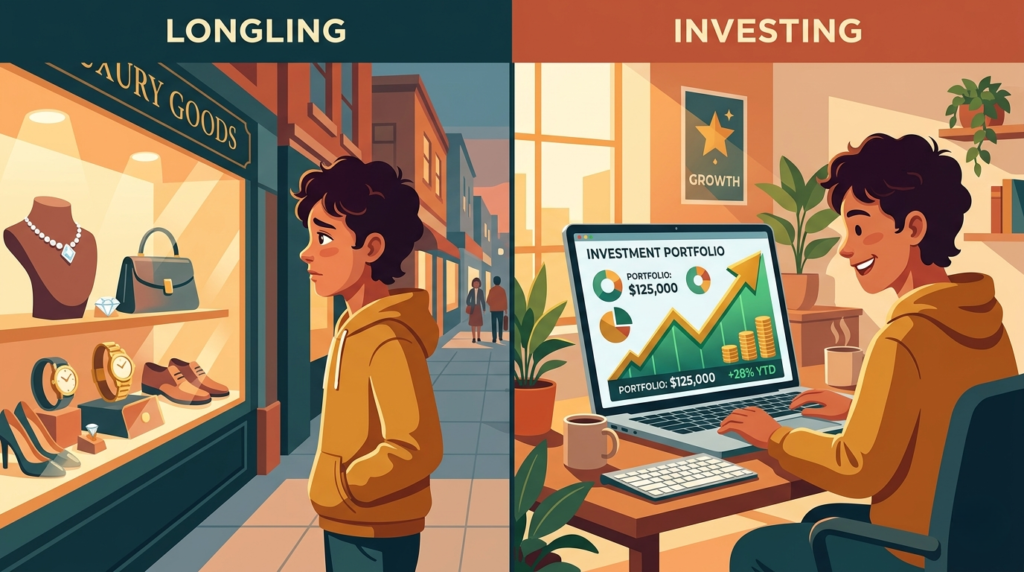
This is the step nobody wants to talk about because it feels less concrete than opening a brokerage account. But every financial expert who studies how people actually build wealth from nothing points to the same truth: your relationship with money shapes every decision you make.
Wealth is built by people who delay gratification without feeling deprived — who find meaning in the process of building, not just the result. It is built by people who do not confuse lifestyle with net worth, who understand that the expensive car and the designer wardrobe can wait, because the freedom those investments will eventually buy is worth so much more.
It is also built by people who are kind to themselves when they make mistakes. You will overspend a budget. You will panic during a market dip. You will make a financial decision that looks wrong in hindsight. None of that is the end of your story. What matters is returning to the plan.
Step 6: Protect What You Build
Building wealth without protecting it is like filling a bucket with a hole in the bottom. As your assets grow, make sure you have the right protection in place.
Health insurance is non-negotiable. One medical emergency without coverage can erase years of savings. If your employer does not offer it, explore options through the Healthcare.gov marketplace.
Renters or homeowners insurance protects your physical assets at a remarkably low monthly cost.
A basic will and beneficiary designations on your retirement accounts ensure that the wealth you build reaches the people you intend it to reach. This is often overlooked by young investors, but beneficiary designations on a 401(k) or IRA override what is written in any will — keeping those updated is genuinely important.
The Wealth Building Roadmap: A Quick Reference
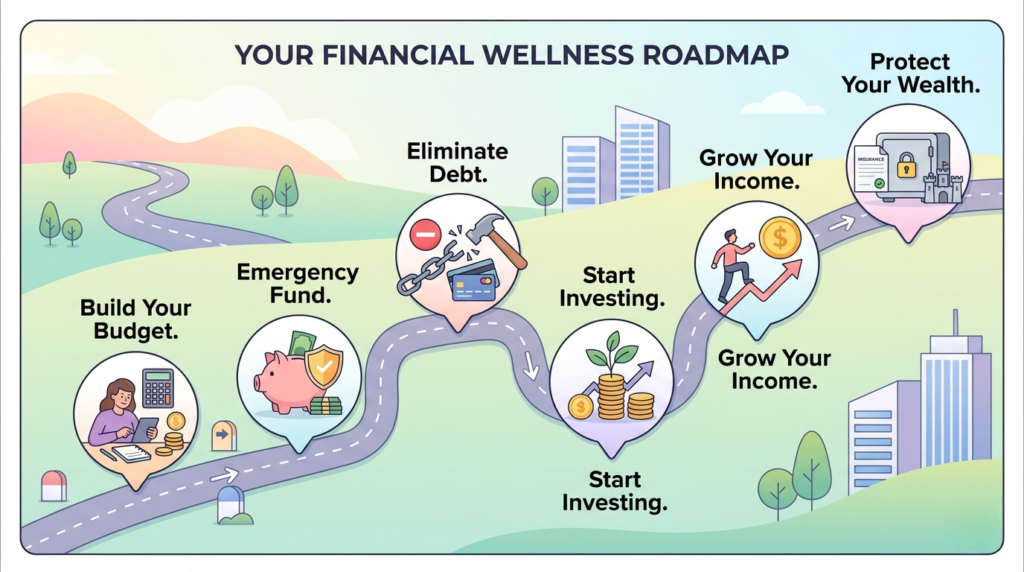
Here is the sequence that works for most people starting from nothing:
Stage 1 — Stability: Build a budget. Open a high-yield savings account. Begin tracking your credit score. Target 1 month of expenses saved.
Stage 2 — Safety: Grow your emergency fund to 3 to 6 months of expenses. Pay off any high-interest debt using the avalanche or snowball method.
Stage 3 — Growth: Open a brokerage account. Start contributing to a Roth IRA or 401(k). Buy index funds consistently, even in small amounts. Automate everything you can.
Stage 4 — Acceleration: Increase your income through skills, negotiation, or a side business. Direct all extra income straight into investments before your lifestyle has a chance to expand.
Stage 5 — Protection: Review insurance coverage. Set up a basic estate plan. Keep beneficiary designations current. Let compound interest do its work over time.
Recommended Tools and Resources
Some of the tools mentioned throughout this guide are linked below. These are platforms I actually recommend to people starting their wealth-building journey.
- SoFi — High-yield savings, banking, and beginner investing in one place
- Robinhood — Commission-free index fund and ETF investing with no account minimum
- Acorns — Automated micro-investing through everyday roundups
- Empower — Free financial dashboard for tracking net worth, budget, and investments
- Credit Sesame — Free credit score monitoring and improvement guidance
FAQ
Q: Can you really build wealth in America starting from nothing?
Yes. The path is slower without a head start, but it exists. The most important factors are not your starting income — they are your consistency, your timeline, and how early you begin. A person earning $40,000 a year who invests 15% consistently over 30 years will build significantly more wealth than a person earning $100,000 who spends everything. Time in the market and disciplined habits matter far more than a high salary.
Q: How much money do I need to start investing?
You can start with as little as $1 using platforms like Robinhood (which offers fractional shares) or Acorns (which invests your spare change automatically). The amount matters less than the habit. Starting with $25 a month and increasing gradually is infinitely better than waiting until you feel “ready.”
Q: What is the best first investment for a beginner?
For most beginners, a broad market index fund tracking the S&P 500 is the most reliable starting point. It provides instant diversification across 500 of the largest US companies, has extremely low fees, and has historically returned an average of around 10% per year over the long term. You do not need to research individual stocks or time the market. You simply invest consistently and let time do the work.
Q: How long does it take to build wealth from nothing?
There is no single answer, but a realistic timeline for building a meaningful investment portfolio from a modest starting point is 10 to 20 years of consistent effort. The key variable is how early you begin. Starting at 25 rather than 35 can mean hundreds of thousands of dollars more at retirement, simply because of how compound interest works over time. The best time to start was yesterday. The second best time is today.
Q: Is it worth building wealth if I am sending money home to family?
Absolutely! and this is one of the most underrepresented questions in mainstream personal finance. Supporting family internationally and building your own financial future are not mutually exclusive. The key is budgeting intentionally for both. Many immigrants who send remittances abroad build wealth by treating their family contribution like a fixed expense, planned, consistent, and non-negotiable, while also automating their own savings and investments with whatever remains.
Disclaimer: This article is for educational and informational purposes only and does not constitute financial or investment advice. Always consult a qualified financial professional before making investment decisions. Past market performance does not guarantee future results.
Affiliate Disclosure: Some links in this post are affiliate links. If you sign up or purchase through them, I may earn a small commission at no extra cost to you. I only recommend tools I genuinely find useful.