
Rent Your First Apartment in the US Without Credit History
I still remember the feeling of pulling up apartment listings for the first time after landing in the US. It felt like possibility, all these places, all these neighborhoods, all this space. Then I started actually applying, and I learned something nobody had warned me about: in America, your credit history is your financial identity. And when you are brand new here, you do not have one.
That does not mean you cannot rent. It means you need a strategy. And that is exactly what this guide is.
Whether you arrived last month or you are still planning your move, everything in here is real, actionable, and built around the specific situation of someone who is new to the US with no American credit file, no US co-signer, and limited time to figure it out.

Why No Credit History Is Not the Same as Bad Credit (But Landlords Treat It That Way)
Here is something that surprised me when I first understood it. In the United States, having zero credit history is treated by most automated rental screening systems almost identically to having a poor credit score. The system does not see a responsible person who has never borrowed irresponsibly. It sees a blank file, and a blank file triggers the same rejection flags as a troubled one.
This is not personal. It is structural. Most large apartment complexes use third party screening software that runs your Social Security number or ITIN against the major credit bureaus – Equifax, Experian, and TransUnion, and generates an instant score. If that score is absent or thin, the system flags your application before a human ever reads it.
Understanding this changes your approach entirely. You stop trying to convince a system that cannot be convinced, and you start looking for situations where a human being is making the decision.
That distinction is the foundation of everything that follows.
Step One: Know What You Are Working With Before You Apply Anywhere
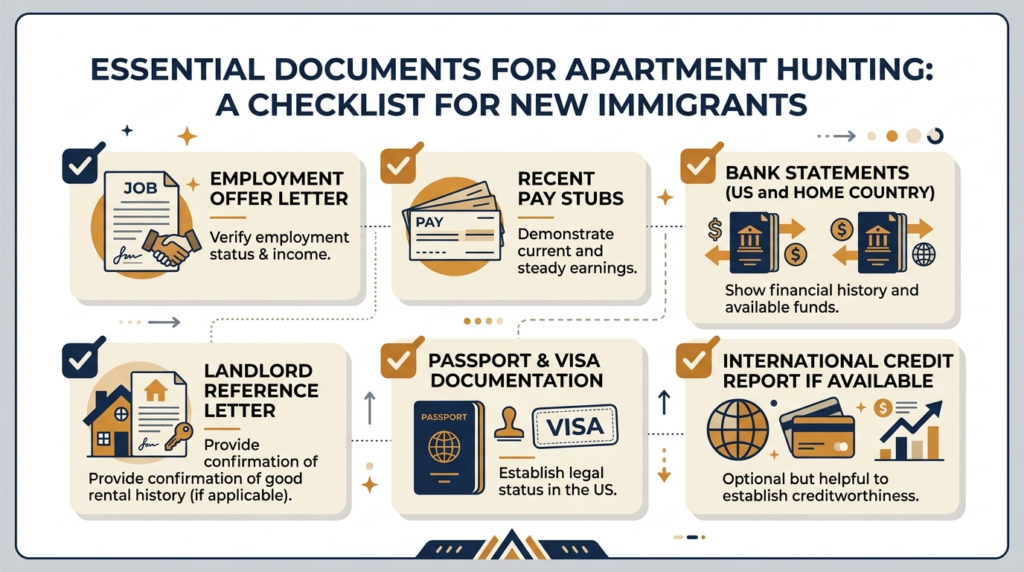
Before you submit a single application, gather everything you have that demonstrates financial reliability. Not American credit history, you do not have that. Everything else.
Your employment offer letter or current pay stubs. Your work visa and any supporting immigration documentation. Bank statements from your home country showing consistent savings or income history and if you have not yet opened a US account, this guide on the best bank accounts for migrants is worth reading before your first application.. A reference letter from your previous landlord, even if that landlord is abroad. If you have savings, a bank statement showing a healthy balance matters more than most people realize.
Some landlords, particularly smaller independent ones, will accept international credit reports. Experian has a product called Experian Global Credit Report that allows immigrants from select countries to import their home country credit data into the US system. Nova Credit operates a similar service and currently supports credit history from countries including Mexico, India, the Philippines, Australia, Canada, the UK, Brazil, South Korea, Kenya, Nigeria, and several others. If your home country is on that list, this single step can transform your application from a blank file into a documented financial history.
Both services are worth checking before you begin your apartment search. Nova Credit in particular is integrated directly with some larger apartment communities and select lenders, meaning your international credit can flow into their system automatically during the application process.
Step Two: Target the Right Type of Landlord
This is the most important strategic decision you will make in your apartment search, and most guides skip over it entirely.
There are two fundamentally different rental markets operating side by side in every American city.
The first is the institutional market: large apartment complexes managed by property management companies, with online applications, automated screening software, and standardized approval criteria. These are the communities with the gym and the rooftop deck and the glossy website. They are also the ones where a missing credit file will almost always result in an automatic decline or a demand for a deposit so large it becomes effectively a rejection.
The second is the individual landlord market: single family homes, duplexes, small apartment buildings, and condominiums owned by private individuals. These landlords review applications themselves. They make decisions based on the full picture of who you are, not a score a machine generated in four seconds. They can weigh your employment letter, your savings, your reference from a previous landlord, your conversation with them — all the things the automated system ignores.
For a new immigrant with no US credit history, the individual landlord market is where your search should begin. Full stop.
Finding these landlords takes more effort than searching a major listing platform. Zillow, Trulia, and Apartments.com all have listings from individual landlords mixed in with institutional ones. Facebook Marketplace has become one of the most reliable places to find individual landlord listings in most US cities, particularly because many landlords there prefer to communicate directly with prospective tenants before any application is submitted. Craigslist still carries a meaningful volume of individual landlord listings in most markets, though it requires more caution about scam listings. Walking neighborhoods you are considering and looking for handwritten or printed FOR RENT signs on buildings remains one of the most underrated strategies, those landlords are often local, long-term owners who have rented to people in all kinds of situations.
When you contact an individual landlord, introduce yourself properly. Explain your situation directly and briefly, you are newly arrived, employed, and your US credit file is thin because you have not had time to build it, not because you have had financial difficulties. Offer to provide your employment letter, pay stubs, and bank statements upfront, before they ask. This proactive transparency signals reliability more effectively than any credit score.
Step Three: Understand the Workarounds That Actually Work
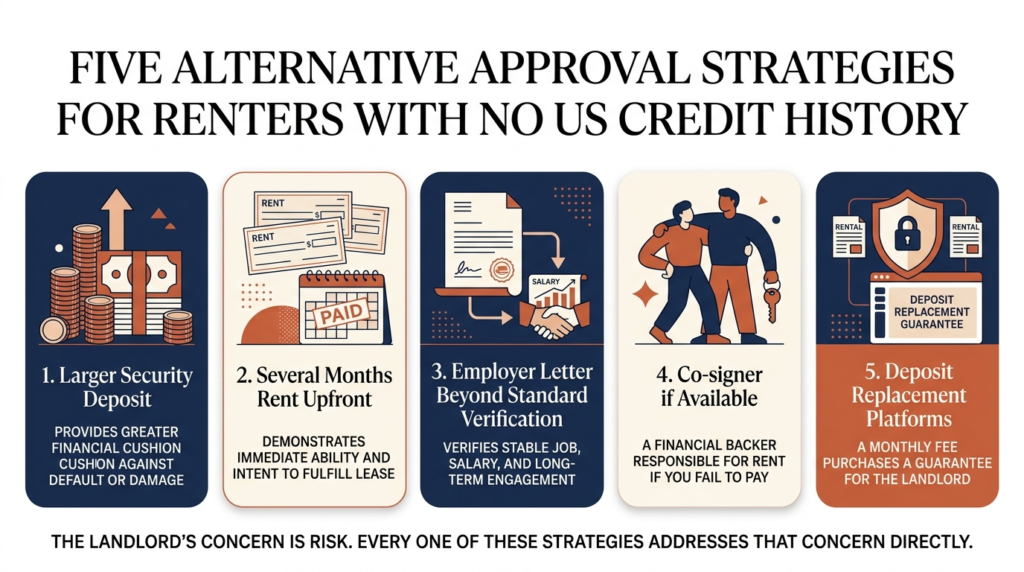
When a landlord is interested but uncertain because of the missing credit history, there are several specific things you can offer that address their real concern, which is not your score, but their risk.
A larger security deposit is the most straightforward option. Standard security deposits in most states are one to two months of rent. Offering two to three months upfront reduces the landlord’s financial exposure significantly. Some landlords who would otherwise decline will approve an application with a larger deposit. Some states cap the amount a landlord can request, so it is worth checking your state’s tenant protection laws, but in general this is a widely accepted workaround.
Several months of rent paid upfront goes further than a deposit for landlords who are genuinely risk-averse. Offering to pay first, last, and an additional month or two at signing is meaningful reassurance. It signals not just that you have the money but that you are invested in making the tenancy work.
A co-signer with US credit is the option most guides recommend first, but for many newly arrived immigrants it is the least accessible. You need to know someone in the US who is willing to be legally responsible for your rent if you do not pay, which is a significant ask of any relationship. If you have a US-based employer contact, a family member who arrived before you, or a colleague willing to help, it is worth exploring. But it is not the only path, and it is not always necessary if you approach the search correctly.
Employer letters that go beyond standard verification can be surprisingly powerful with individual landlords. A standard employment verification letter confirms your title and salary. A stronger version, which you can ask your HR department or direct supervisor to write, speaks to your professional standing, the stability of your position, and the company’s confidence in your long-term employment. Some employers, particularly those that frequently hire international workers, have standard versions of this letter that they provide to employees navigating housing searches.
Rental platforms built for people in your situation have emerged as a genuine option in recent years. Rhino is a service that replaces the traditional large cash security deposit with an affordable insurance policy, reducing the upfront cash burden significantly for renters. Jetty operates similarly. Both work with participating landlords, so availability depends on whether the specific property you are applying to has partnered with them, but they are worth checking during your search.
Step Four: Use Your International Credit History If You Have One
I want to come back to this because it deserves more than a passing mention.
Nova Credit’s Credit Passport product is one of the most genuinely useful tools available to newly arrived immigrants navigating the US financial system, and it remains significantly underused because most people do not know it exists until after they have already fought through their housing search without it.
The service works by retrieving your credit history from your home country’s credit bureau and translating it into a format that US landlords and lenders can read and evaluate. For renters, this means that years of responsible financial behavior abroad, paying rent on time, managing credit accounts, maintaining a clean financial record, can actually count for something in a US application rather than disappearing entirely the moment you crossed the border.
The countries currently supported include Mexico, India, the Philippines, Australia, Canada, the United Kingdom, Brazil, South Korea, Kenya, Nigeria, the Dominican Republic, and Switzerland, with additional countries being added. If your home country is on that list, creating a Nova Credit profile before you begin your apartment search costs you very little time and can change the entire character of your applications.
Experian’s Global Credit Report serves a similar function and is worth checking alongside Nova Credit, particularly if your country of origin is not yet in Nova Credit’s network.
Neither of these services can guarantee approval, the landlord still has to be willing to consider international credit data, and not all of them are. But they give you something concrete to put in front of a landlord who is on the fence, and that something can be the difference between an approval and another rejection email.
Step Five: Build US Credit in Parallel, From Day One
Finding your first apartment is the immediate problem. But while you are solving it, you should simultaneously be starting the process of building a US credit file, because your second apartment search, your first car loan, and eventually your first mortgage will all depend on it.
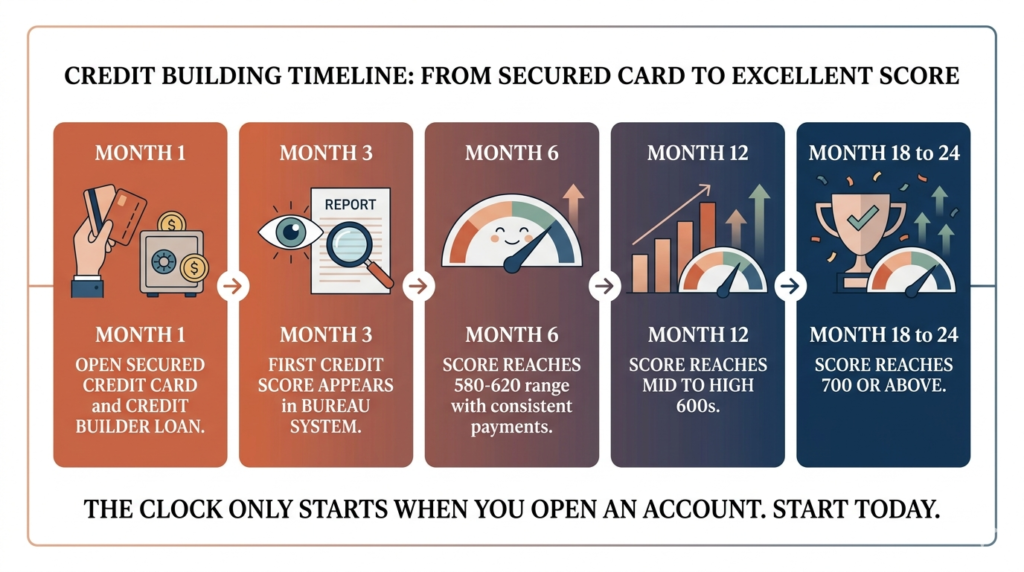
The fastest legitimate path to building US credit from zero starts with a secured credit card. A secured card requires a cash deposit, typically $200 to $500, that becomes your credit limit. You use it for small regular purchases, pay the full balance before the due date every single month without exception, and the card issuer reports your payment history to the credit bureaus. Over twelve to eighteen months of consistent use, this builds a real credit score from nothing.
Discover, Capital One, and Citi all offer secured cards that are accessible to people with thin or no US credit files and that are known to graduate to unsecured cards after a period of responsible use. Some of these cards have no annual fee, making them genuinely low-cost tools for credit building.
A credit builder loan, offered by some credit unions and online lenders, works differently but toward the same end. You make fixed monthly payments into an account, and those payments are reported to the credit bureaus. At the end of the loan term, you receive the accumulated funds. Self Financial offers a credit builder account that works this way and is accessible to people with no existing credit history.
If your employer offers direct deposit, setting it up immediately also helps you establish a banking relationship that some lenders and landlords will ask about.
None of these steps produce a strong credit score overnight. Twelve months of consistent, on-time payments will typically produce a score in the mid to high 600s. Eighteen to twenty-four months can bring you into the 700s. The math works, but only if you start immediately, because the clock only runs if you have an open account reporting.
What to Know About Tenant Rights Before You Sign Anything
This section matters more than most people think, because signing a lease is a legal commitment, and the terms of that lease govern your life for the duration of the tenancy. Reading it carefully is not optional, and understanding what you are reading requires knowing a few things that nobody tells you at the signing.
Every state in the US has landlord-tenant laws that establish baseline protections for renters regardless of what the lease says. These include limits on how much a landlord can charge for a security deposit in many states, requirements around notice before a landlord enters the unit, rules about the condition the unit must be in when you move in, and timelines for returning your deposit when you move out.
The tenant protection laws in your state are publicly available and searchable. HUD, the US Department of Housing and Urban Development, maintains a state-by-state directory of tenant rights resources at hud.gov. Before you sign a lease, spending thirty minutes with your state’s landlord-tenant guide is time that can save you significant money and stress later.
A few specific things to look for in any lease before signing:
The security deposit clause should specify the amount, the conditions under which deductions can be made, and the timeline for return. Vague language here is a red flag.
The early termination clause tells you what happens if you need to leave before the lease ends. For immigrants on employment visas, this matters because your living situation can change if your employment situation changes.
The renewal terms section tells you whether the lease converts to month to month after the initial term and at what notice period. Month-to-month flexibility after the first year is often worth prioritizing, particularly in your first US apartment when you do not yet know which neighborhood or city will be the right long-term fit.
Pet policies, guest policies, and subletting clauses are all worth reading even if they seem irrelevant now. Lease violations in these areas can affect your rental history, and in the US your rental history follows you to your next application.
A Practical Note on Apartment Listing Platforms
Most people begin their apartment search on Zillow, Apartments.com, or a similar aggregator, and this is fine for getting oriented in a new city. But it is worth understanding what these platforms are and are not.
They are advertising platforms. The listings you see are paid placements or data feeds from property management companies. They skew heavily toward institutional landlords, the large complexes with automated screening. For individual landlord listings, which are what you should be prioritizing as a new immigrant, these platforms are less complete.
Facebook Marketplace, as mentioned earlier, has become genuinely valuable for individual landlord listings in most American cities. Craigslist remains useful in many markets. In cities with large immigrant communities, community-specific Facebook groups, WhatsApp groups, and local ethnic media publications often carry rental listings that never appear on the major platforms.
Word of mouth within professional and immigrant communities is consistently underestimated. If you are employed, ask colleagues whether they know of any listings. If you attend a church, mosque, temple, or community organization, ask there. Many individual landlords find their tenants through personal networks rather than online listings, which means the listings that are easiest for you to find are often not the ones that will be easiest for you to get.

The Short Version, If You Need It
If you take nothing else from this guide, take these six things.
Target individual landlords over large complexes. They make decisions that automated systems cannot. Start with Facebook Marketplace, Craigslist, and neighborhood walking before you default to Zillow.
Bring your full financial picture to every application. Employment letter, pay stubs, bank statements, international reference letters. Proactive transparency is more persuasive than any score.
Check Nova Credit and Experian Global Credit Report before you begin your search. If your home country is supported, import your international credit history. It can change the character of your applications entirely.
Offer something concrete to address the landlord’s risk. A larger deposit, additional months upfront, or a stronger employer letter. The concern is not your score. The concern is their risk.
Start building US credit from your first week. A secured credit card and a credit builder account, opened immediately, will produce a real score within twelve months. The longer you wait, the longer your second search looks like your first.
Know your rights before you sign. Read your state’s landlord-tenant guide. Read the full lease. Understand the early termination clause, the deposit terms, and the renewal conditions before your name goes on the document.
The first apartment is the hardest. Not because the process is impossible, but because you are navigating it without the one thing the system expects you to have. Once you understand that the system can be worked around rather than beaten on its own terms, the search becomes a different kind of problem, a practical one, with practical solutions.
You are not starting from zero. You are starting from somewhere else. Those are different things.
Now that housing is sorted, the next question most new arrivals face is what to actually do with their money once they are settled. This guide covers the basics.
This article contains affiliate and referral links. Some of the services mentioned, including Nova Credit and Self Financial, may provide compensation if you sign up through links on this page. This does not affect the cost to you. All services mentioned were included based on their relevance and usefulness to newly arrived immigrants navigating the US rental market.