How to Report Foreign Asset and Avoid $10,000+ FBAR Penalties
Let me tell you about the rule that catches more immigrants off guard than almost any other in the US tax system.
You arrived in the United States. You opened a US bank account. You started paying US taxes. You followed every rule you knew about. And somewhere in another country, a savings account with $12,000 in it sat quietly in the name of your mother, with you listed as a signatory in case of emergencies. Or a brokerage account you opened five years ago still held $15,000 you had been meaning to move. Or your home country pension account had been accumulating contributions your employer back home kept making even after you left.
You did not think of any of those as “foreign assets you needed to report to the US government.” They were just money. Money that was there before you arrived. Money you might not even have touched in years.
But the US government thinks about it differently. And the penalty for not knowing about this rule, even when your non-filing is entirely innocent, can be $16,536 per violation. The penalty for what they call willful non-filing can be 50% of your account balance or $165,353 — whichever is higher.
This is not a niche tax issue for the ultra wealthy. It is a rule that applies to millions of ordinary immigrants with ordinary savings accounts back home. And it is one of the most commonly missed reporting requirements in the entire US tax system.
This article explains exactly what you need to know, what you need to report, when you need to file, and what to do if you have years of unfiled reports sitting behind you.
What Is FBAR?
FBAR stands for Foreign Bank and Financial Accounts Report. It is officially called FinCEN Form 114, and it is filed electronically with the Financial Crimes Enforcement Network, a bureau of the US Treasury Department. The FBAR is not a tax form. It does not calculate any tax you owe. It is purely an informational report that tells the US government where you have money held abroad.
The legal authority for FBAR comes from Title 31 of the Bank Secrecy Act, not the Internal Revenue Code. This distinction matters for a practical reason: filing your tax return does not replace the FBAR requirement. Filing Form 1040, reporting foreign interest income, or filing Form 8938 does not substitute for FinCEN Form 114. If FBAR applies to you, you must file it separately, at a different website, with a different government agency, on a separate filing system.
The FBAR was created in 1970 as part of the Bank Secrecy Act and was designed to help the US government track money laundering, tax evasion, and criminal financial activity conducted through offshore accounts. It was not designed with ordinary immigrants in mind. But ordinary immigrants with accounts back home are caught by it every year.
Who Must File: The Two-Part Test
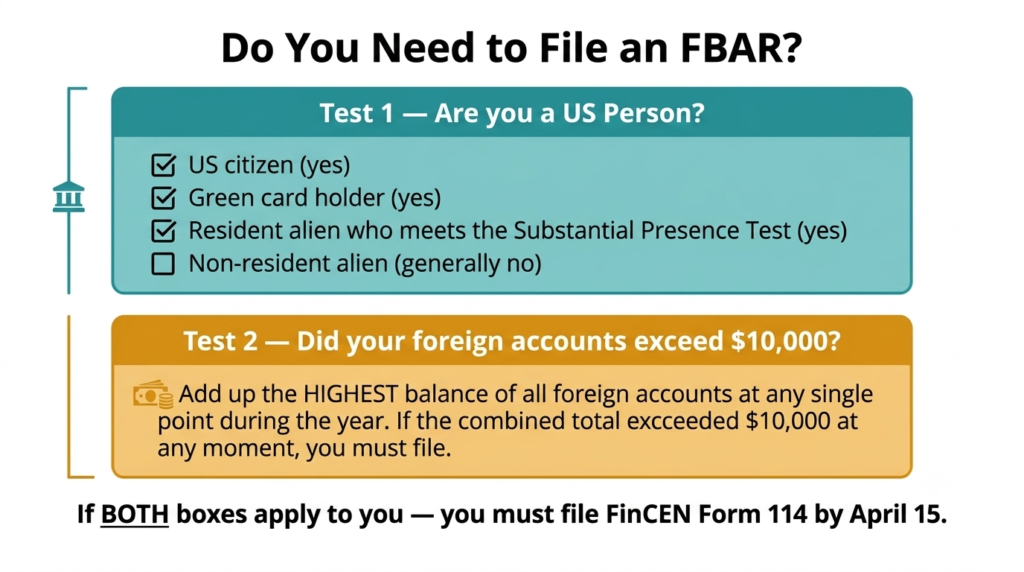
FBAR applies to any “US person” who had a financial interest in, or signature authority over, foreign financial accounts with an aggregate value exceeding $10,000 at any point during the calendar year.
Both parts of that sentence matter.
Part 1: Are You a US Person for FBAR Purposes?
“US person” for FBAR purposes includes US citizens, green card holders (lawful permanent residents), and resident aliens who meet either the Green Card Test or the Substantial Presence Test for the tax year. This is the same definition used for US tax residency.
Nonresident aliens are generally not required to file an FBAR. However, if you changed your status during the year, such as transitioning from an F-1 student visa to an H-1B work visa that made you a resident alien, the FBAR obligation can begin partway through the year. When your residency status changed matters, and it is worth verifying with a tax professional if you had a status change during a year when you also had foreign accounts.
Part 2: Did Your Accounts Exceed $10,000?
The $10,000 threshold is calculated by adding together the highest balance of all your foreign financial accounts at any single point during the calendar year, not just at year end.
This is the detail that surprises most people. A savings account in your home country that peaked at $11,000 in March and was drawn down to $4,000 by December 31 still triggers the FBAR requirement for that year, because the highest balance at any point exceeded $10,000.
The threshold is also aggregate, meaning you add all foreign accounts together. If you have a checking account abroad with a maximum balance of $6,000 and a savings account abroad with a maximum balance of $5,500, their combined peak is $11,500, and you must file, even though neither account individually exceeded $10,000.
What Counts as a Foreign Financial Account
This is where most immigrants underestimate their exposure. The accounts that trigger the FBAR requirement are broader than most people realize.
Foreign bank accounts: Checking accounts, savings accounts, and fixed deposit accounts held at any foreign bank or financial institution. This includes accounts you share with a family member, accounts in your name that someone else primarily uses, and accounts where you are a secondary holder or joint holder.
Foreign brokerage accounts: Investment accounts held at foreign brokers or investment firms, including accounts holding stocks, bonds, and mutual funds.
Foreign pension accounts: In some cases, foreign employer sponsored pension plans and retirement accounts are reportable. The rules here are complex and vary depending on the structure of the plan. Some foreign pensions are exempted, while others are not. If you have a foreign pension from a previous employer, verifying whether it is reportable is worth doing with a qualified professional.
Foreign life insurance with a cash value: Life insurance policies held at foreign insurance companies that have a cash surrender value, meaning you could access the cash if you cancelled the policy, are generally reportable.
Certain cryptocurrency accounts: As of the 2025 tax year, FinCEN has proposed but not finalized rules requiring FBAR reporting for cryptocurrency held on foreign exchanges. The current guidance is that if a foreign exchange account holds both cryptocurrency and fiat currency (like US dollars or another national currency), the entire account may be reportable once it crosses the $10,000 threshold. For accounts holding only cryptocurrency with no fiat currency, the requirement remains under regulatory development. The safest approach for 2025 is to report foreign exchange accounts that hold both crypto and fiat currency and consult a qualified professional about crypto-only accounts.
Signature authority accounts: You are required to report accounts where you have signature authority but no financial interest. This means if your employer or a family member has made you a signatory on their foreign account, you may have an FBAR obligation even if none of the money in that account is yours.
What Does Not Count
Not every foreign asset triggers an FBAR. The following are generally not reportable under FBAR rules, though some may require separate reporting on Form 8938.
Direct ownership of foreign real estate (though a bank account holding the proceeds of a property sale would be reportable). Ownership of foreign stocks held directly in a US brokerage account rather than a foreign account. Foreign business interests where you own a company but the company itself holds the accounts. Precious metals held directly, not in an account. Certain foreign social security payments.
The Deadlines: When You Must File
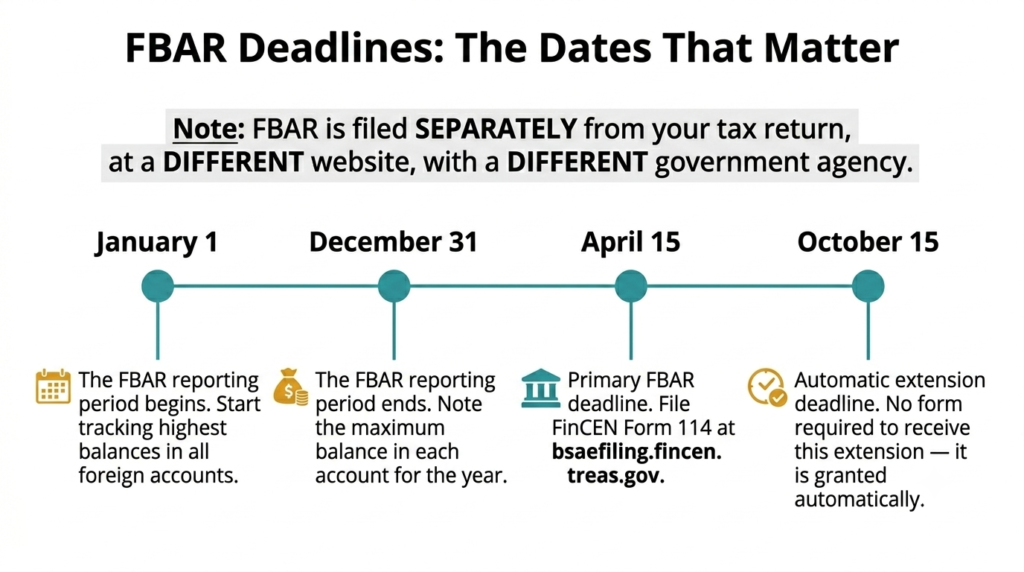
The FBAR for any given calendar year is due April 15 of the following year. This aligns with the federal income tax deadline, though the two forms are filed separately.
Unlike most IRS filing extensions, the FBAR automatic extension requires no application or form. If you miss the April 15 deadline, you automatically receive an extension until October 15. No action is needed to receive this extension.
However, do not mistake the automatic extension as permission to procrastinate. The penalties for late filing can still apply even within the extension period in some circumstances, and the longer a filing remains unfiled, the more difficult the compliance path becomes.
Important: The FBAR Is Filed at a Different Website Than Your Tax Return
This is the logistical detail that catches many first-time filers off guard. The FBAR is filed electronically through the BSA E-Filing System at bsaefiling.fincen.treas.gov. You do not file it through the IRS website, through your tax software’s federal return portal, or alongside your Form 1040. It is an entirely separate submission with an entirely separate agency.
To file: Go to bsaefiling.fincen.treas.gov. Create or log into your account. Select FinCEN Form 114. Enter the required information for each foreign account: the name and address of the foreign financial institution, the account number, the type of account, the maximum value during the year converted to US dollars, and your relationship to the account. Submit electronically and save your confirmation number.
How to Calculate the Maximum Account Value
The maximum value is the highest balance in the account at any point during the calendar year, not the balance on December 31.
For accounts denominated in a foreign currency, you convert to US dollars using the Treasury Department’s official exchange rate. For FBAR purposes, you use the December 31 year end exchange rate published by the Treasury even when converting a balance that peaked at a different time of year. You can find the official Treasury exchange rates at fiscaldata.treasury.gov.
Keep the bank statements or account records that show the maximum balance for each account. FBAR regulations require you to retain records for five years from the filing due date. This means records should be kept not for five years from when you filed, but for five years from the April 15 deadline for that year’s FBAR, even if you filed early.
The Penalties: Why This Matters So Much
The penalties for failing to file an FBAR are among the most severe in the US tax system relative to the amount of money that may be involved.
Non-willful penalty: Up to $16,536 per violation, as adjusted for inflation through January 2025. A violation is generally understood as one unfiled FBAR per year, though some enforcement actions have taken a per-account approach. Non-willful means the failure to file was due to negligence, inadvertence, or honest mistake rather than intentional disregard of the law. The penalty can be reduced or eliminated if you can demonstrate reasonable cause for not filing and ultimately file a proper FBAR.
Willful penalty: The greater of $165,353 or 50% of the account balance at the time of the violation. Willful violations include intentional non-filing and, increasingly under court interpretations, reckless disregard of the requirement. Courts have ruled that claiming ignorance is not automatically a defense against willfulness, particularly if you had professional tax advice, signed tax returns that asked about foreign accounts, or otherwise had reason to know the requirement existed.
Criminal penalties: In cases involving intentional tax evasion or fraud, additional criminal penalties can include fines up to $500,000 and imprisonment up to 10 years.
The practical warning: The window between “I did not know about FBAR” and willful penalty exposure has narrowed significantly in recent years. If you have foreign accounts and have been filing US tax returns without reporting them, the question of whether your non-filing was willful or non-willful is one a qualified tax attorney should evaluate, not something to assume on your own.
FBAR and FATCA: Two Different Requirements, Both May Apply
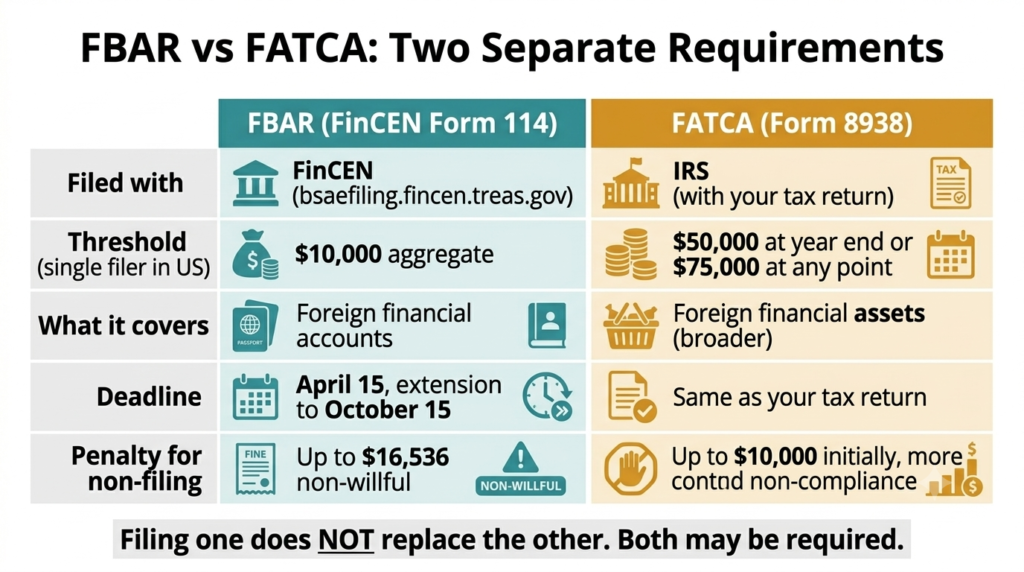
FBAR and FATCA (the Foreign Account Tax Compliance Act, reported on Form 8938 and filed with your tax return) are two separate requirements with two separate thresholds, filed with two separate agencies, on two separate forms. One does not replace the other.
The FBAR threshold is $10,000 aggregate. The FATCA threshold for a single filer living in the US is $50,000 at year end or $75,000 at any point during the year. These thresholds are higher for married filers and for filers living abroad.
FATCA also covers a broader set of foreign financial assets than the FBAR, including direct ownership of foreign stocks and partnerships, foreign financial contracts, and interests in foreign trusts, in addition to the accounts covered by FBAR.
If your foreign assets are significant, you may need to file both. Never assume that filing one satisfies the other. The IRS explicitly states that filing the FBAR does not substitute for FATCA, and vice versa.
Our article on how to file taxes if you have foreign income covers both FBAR and FATCA in the context of the full foreign income reporting picture, including how foreign income is treated on your Form 1040 and which credits and exclusions may reduce your tax liability.
If You Have Missed Prior Year FBARs: The Streamlined Compliance Programs
If you are reading this and realizing that you have foreign accounts you have never reported, you have options. The worst thing you can do is nothing. The IRS and FinCEN have programs specifically designed for people who come forward voluntarily.
The IRS Streamlined Domestic Offshore Procedures
For US residents who are not tax-compliant due to non-willful conduct, the Streamlined Domestic Offshore Procedures allow you to file amended or delinquent returns for the past three years and delinquent FBARs for the past six years. You pay a 5% miscellaneous offshore penalty on the highest aggregate balance of your unreported foreign financial accounts and assets, and you certify that your non-compliance was not willful.
The IRS Streamlined Foreign Offshore Procedures
For people who lived outside the US during the relevant period, the Streamlined Foreign Offshore Procedures apply a 0% offshore penalty on previously unreported foreign accounts, making this an even more favorable path.
Delinquent FBAR Submission Procedures
If you have no unreported foreign income to correct and simply failed to file an FBAR, the Delinquent FBAR Submission Procedures allow you to file the missing FBARs with a statement explaining the reason for late filing. No penalty is imposed if the IRS determines there was reasonable cause for the failure.
The streamlined programs are not permanent guarantees. They are available as long as the IRS is not already examining your returns. Once you are under examination, voluntary disclosure may no longer be an option. This is why coming forward proactively matters.
Consulting a tax attorney or a CPA who specializes in international tax compliance before using any of these programs is strongly recommended. The certifications you sign carry legal weight and the choice of which program to use depends on facts specific to your situation.
Practical Steps: What to Do Right Now
Step 1: Identify all your foreign accounts. Make a list of every account you have a financial interest in or signature authority over outside the United States. Include joint accounts, family accounts where you are listed, pension accounts, brokerage accounts, and any life insurance with cash value. Be thorough.
Step 2: Determine the highest balance for each account in the most recent calendar year. Pull statements or log into each account and find the highest balance at any point during the year. Note the currency and the date of the highest balance.
Step 3: Add the highest balances together. If the total exceeds $10,000 in aggregate, you must file.
Step 4: Convert to US dollars. Use the Treasury Department’s December 31 exchange rate for the relevant year, available at fiscaldata.treasury.gov.
Step 5: File FinCEN Form 114 at bsaefiling.fincen.treas.gov. File by April 15, or by October 15 using the automatic extension. Save your confirmation number and keep it with your records.
Step 6: Keep records for five years from the filing deadline. Bank statements, exchange rate documentation, and the electronic confirmation of your filing should all be retained.
Step 7: Review whether Form 8938 also applies. If your aggregate foreign financial assets exceed $50,000 at year end or $75,000 at any point during the year, Form 8938 must also be filed with your tax return.
One More Thing Worth Saying
If you have been filing taxes in the United States for several years and your tax return has ever included a question asking whether you had foreign financial accounts, which it has, on Schedule B of Form 1040, the IRS may use your answer to that question as evidence in evaluating the willfulness of any FBAR non-compliance. If you checked “no” on that question and had foreign accounts above the threshold, that becomes relevant in any future examination.
This is not meant to alarm you. The vast majority of immigrants who missed FBAR filings did so out of genuine ignorance of a requirement that is simply not widely known or explained. The streamlined compliance programs exist specifically for that situation. But it is a reason to act sooner rather than later, and to act with professional guidance rather than on your own.
For a full overview of how foreign income, foreign tax credits, and foreign account reporting fit together in your US tax return, our guide on how to file taxes if you have foreign income is a useful starting point before you sit down with a tax professional.
Disclaimer: This article is for educational and informational purposes only and does not constitute tax or legal advice. FBAR rules, penalty amounts, and compliance programs change. Penalty figures cited reflect amounts as of January 2025 and are adjusted annually for inflation. Always consult a qualified tax professional or attorney with experience in international tax compliance before making filing decisions, particularly if you have unreported foreign accounts from prior years.