
How To Get Health Insurance as an Immigrant: Every Option Explained
Getting sick in the United States without health insurance is one of the fastest ways to end up in serious financial trouble.
A single night in a hospital can cost $10,000 or more. An emergency room visit for something as routine as a broken arm can generate a bill of $2,000 to $5,000. A serious illness or surgery without coverage can produce debt that takes years to recover from, debt that can follow you across jobs, across cities, and across every financial goal you have been working toward.
Health insurance is not optional in this country. It is a financial protection as essential as any other. And for immigrants, navigating the path to coverage is genuinely complicated because the options available to you depend on your specific immigration status, your income, where you live, and how your employer is set up.
This guide covers every option available to immigrants in the United States, what each one costs, who qualifies for each, and exactly where to go to access it. It also covers what changed in the past year, because the rules shifted significantly in 2025 and many immigrants are navigating a different landscape than they expected.
Start Here: A Note on What Changed in 2025
Before going through each option, it is worth being honest about the current landscape because it is different from what it was even one year ago.
The One Big Beautiful Bill Act, signed into law in July 2025, made significant changes to health coverage eligibility for immigrants. Separately, the Trump administration issued new regulations in June 2025 that changed Marketplace eligibility for certain immigrant categories. Here is a summary of the most important changes.
DACA recipients lost eligibility for ACA Marketplace coverage as of August 25, 2025. Coverage for enrolled DACA recipients terminated on October 1, 2025. This affects hundreds of thousands of people who had been relying on Marketplace plans.
Lawfully present immigrants earning below the federal poverty level lost access to Marketplace premium tax credits as of December 31, 2025. This removed a coverage pathway that had existed for over a decade for immigrants in the five year Medicaid waiting period.
Refugees, asylees, TPS holders, parolees, and survivors of trafficking and domestic violence will lose ACA Marketplace eligibility as of December 31, 2026.
A partial court-ordered restoration: A federal court order on December 11, 2025 restored Marketplace eligibility for certain noncitizen immigration statuses in all states. The situation remains in active litigation. Check healthcare.gov directly for your current eligibility.
Despite these changes, multiple coverage pathways remain open to most immigrants. The rest of this article explains each one clearly.
Option 1: Employer-Sponsored Health Insurance
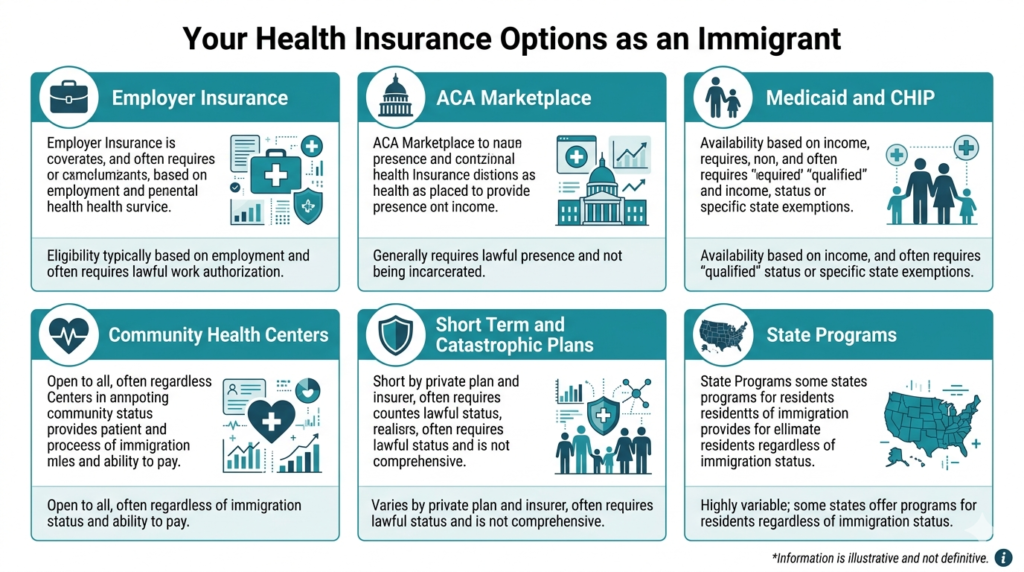
For most working immigrants, employer sponsored health insurance is the best and most accessible option available. Your employer negotiates a group health plan and typically pays a significant portion of the monthly premium, often 70% to 80% for the employee. Your share is deducted from your paycheck, usually before taxes.
Who can access it: Employer sponsored insurance is available to employees regardless of immigration status. Undocumented immigrants can enroll in employer health coverage if their employer offers it and they are on the payroll. Green card holders, work visa holders, and all other lawfully present immigrants can also enroll.
What to do: When you start a new job, ask HR whether the company offers health insurance and what the enrollment window is. Most employers give you 30 days from your hire date to enroll. Missing that window typically means waiting until the next annual open enrollment period, usually in November or December for coverage starting January 1.
What to watch for: Read the plan options carefully before choosing. Compare not just the monthly premium but the deductible, the out of pocket maximum, the copay for primary care and specialist visits, and whether your preferred doctors are in the network. A low premium plan with a high deductible may cost you significantly more than a higher premium plan if you need medical care during the year.
If your employer does not offer health insurance or the coverage offered is unaffordable (defined as costing more than a certain percentage of your household income), you may qualify for Marketplace coverage instead.
Option 2: ACA Marketplace Coverage
The Affordable Care Act Marketplace, also called the Exchange or simply the Marketplace, is an online platform where you can shop for and buy private health insurance if you do not have employer coverage.
Who can access it: Most lawfully present immigrants, including green card holders, H-1B and other work visa holders, COFA nation citizens, and many others. As noted above, DACA recipients lost eligibility as of August 2025, and other groups face changing eligibility through 2026.
A December 2025 court order restored Marketplace eligibility for certain additional noncitizen statuses. Check healthcare.gov or call the Marketplace helpline at 1-800-318-2596 to verify your specific status.
Undocumented immigrants generally cannot purchase Marketplace coverage. Exceptions exist in Colorado and Washington, which have state funded programs that allow undocumented immigrants to access Marketplace equivalent coverage with state subsidies. Maryland planned to join them in late 2025.
Financial help available: Depending on your income, you may qualify for a premium tax credit that reduces your monthly cost, and cost sharing reductions that lower your deductible, copay, and coinsurance. These subsidies are income based and apply when you choose a Silver level plan.
When to enroll: Open enrollment runs from November 1 to January 15 each year in most states. Enroll by December 15 for coverage starting January 1. If you enroll after December 15, coverage starts February 1. Outside of open enrollment, you can only enroll if you experience a qualifying life event such as losing a job, moving to a new state, getting married, or having a child.
Where to go: healthcare.gov for most states, or your state’s own marketplace website if your state runs its own exchange.
Our earlier guide on how healthcare works in the US covers the key insurance vocabulary, premiums, deductibles, copays, and networks, in plain language before you start comparing plans.
Option 3: Medicaid and CHIP
Medicaid is a joint federal and state program that provides free or very low cost health coverage to people with low incomes. CHIP, the Children’s Health Insurance Program, provides low cost coverage to children in families that earn too much for Medicaid but cannot afford private insurance.
Who can access it:
Medicaid and CHIP eligibility for immigrants is complex and varies by state. The general framework is as follows.
Qualified non-citizens — a category that includes lawful permanent residents (green card holders), refugees, asylees, COFA nation citizens, Cuban and Haitian entrants, and several other specific groups, are potentially eligible for Medicaid and CHIP. However, many qualified non-citizens must complete a five year waiting period from the date they obtained their qualified immigration status before they can enroll in federally funded Medicaid.
Exceptions to the five year wait: Refugees, asylees, COFA nation citizens, and several other categories are exempt from the five year waiting period and can enroll in Medicaid immediately.
Children and pregnant people: As of January 2025, 37 states plus DC have eliminated the five year waiting period for children regardless of immigration status, allowing them to enroll in Medicaid or CHIP immediately. 31 states plus DC have done the same for pregnant people. If you have children or are pregnant, your state may have coverage available for your family even if you personally are in the waiting period.
What the One Big Beautiful Bill changed: Starting October 1, 2025, states can only receive federal matching funds for Medicaid and CHIP for a narrow group that includes US citizens, lawful permanent residents after their waiting period, COFA nation citizens, and Cuban and Haitian entrants. Some previously covered groups, including TPS holders and parolees, are losing federally funded Medicaid eligibility.
Undocumented immigrants are not eligible for federally funded Medicaid except for Emergency Medicaid, which covers emergency medical care at hospitals for individuals who meet income requirements but lack eligible immigration status. Hospitals are legally required to provide emergency stabilizing care regardless of your ability to pay or your immigration status.
Public charge: Enrolling in Medicaid or CHIP does not make you a public charge and does not affect your green card application, naturalization, or future immigration filings. This protection applies to most Medicaid and CHIP programs. There is one narrow exception for long-term institutional care paid for by the government.
Where to apply: healthcare.gov or your state’s Medicaid agency website. Medicaid and CHIP applications are accepted year-round, unlike Marketplace enrollment which has specific windows.
Option 4: State-Funded Programs
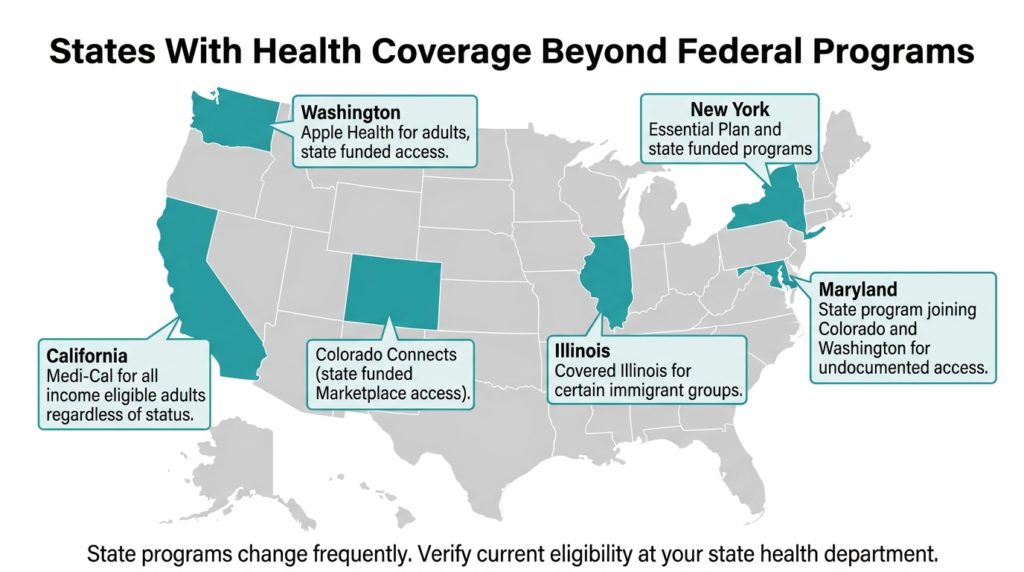
Several states fund their own coverage programs that go beyond what federal law requires, including coverage for people who do not qualify for federally funded programs.
California offers Medi-Cal, the state’s Medicaid program, to all income eligible adults regardless of immigration status. This is one of the most comprehensive state programs in the country and covers millions of undocumented immigrants.
New York has an Essential Plan that covers lawfully present immigrants with incomes up to 200% of the federal poverty level at very low cost, as well as state funded programs for certain additional groups.
Illinois offers Covered Illinois programs for certain immigrant groups who do not qualify for federal coverage.
Washington has expanded its Apple Health program and provides state funded Marketplace access for undocumented immigrants, though enrollment caps apply.
Colorado allows undocumented immigrants to purchase Marketplace equivalent coverage through Colorado Connects with state funded subsidies.
Maryland was scheduled to join Colorado and Washington in offering state funded Marketplace access for undocumented immigrants in late 2025.
Massachusetts, Minnesota, Oregon, and several other states have state funded programs or Medicaid expansions that go beyond federal baseline requirements for immigrants.
To find out what your specific state offers, go to your state’s Medicaid agency website or health department and search specifically for immigrant health coverage programs. These programs change frequently and the information above may have been updated since this article was written.
Option 5: Federally Qualified Health Centers
Regardless of your immigration status, your income, or your ability to pay, Federally Qualified Health Centers (FQHCs) — also called community health centers, are required by federal law to provide care to anyone who comes through their door.
FQHCs are not emergency rooms. They are neighborhood clinics that provide primary care, preventive care, dental care, mental health services, and prescription medication services. They charge on a sliding scale based on your income, meaning you pay what you can afford. For very low income patients, that can be close to zero.
This is one of the most underused and most important resources in immigrant communities. You do not need to prove immigration status. You do not need insurance. You do not need to show any documentation beyond what is needed to register as a patient.
To find a Federally Qualified Health Center near you, go to findahealthcenter.hrsa.gov and enter your zip code.
Option 6: Short-Term and Catastrophic Plans
If you do not qualify for any of the options above and employer coverage is not available to you, two types of limited coverage plans are worth understanding.
Short term health plans are private insurance products that provide temporary coverage, typically for periods of one month to 364 days. They are available to most applicants regardless of immigration status and can be purchased outside of open enrollment windows at any time.
The limitations are significant. Short term plans are not required to cover essential health benefits under the ACA. They typically exclude pre existing conditions. They have annual and lifetime benefit limits. They are not a substitute for comprehensive coverage. But they are meaningfully better than no coverage at all for someone facing a gap between jobs or waiting for their Marketplace enrollment to begin.
Catastrophic plans are available through the ACA Marketplace to people under 30 or people with a hardship exemption. They have very low premiums and very high deductibles, meaning they protect you from the worst case scenario of a major medical event while keeping your monthly cost low. They do count as qualifying ACA coverage.
Option 7: COBRA After Losing a Job
If you had employer sponsored health insurance and lost your job, you have the right to continue that same coverage for up to 18 months under the federal COBRA law.
The catch is cost. Under COBRA, you pay the full premium yourself including the portion your employer was previously covering, plus a 2% administrative fee. For a single person, this typically runs $400 to $700 per month. For a family, it can exceed $1,500 per month.
COBRA makes the most sense if you expect to find new employment quickly, if you have ongoing medical needs that require continuity of care, or if you are mid-treatment and switching plans would be disruptive.
Job loss is also a qualifying life event that opens a 60-day special enrollment window on the ACA Marketplace. In many cases, a Marketplace plan with subsidies will be significantly cheaper than COBRA, particularly if your income drops during a period of unemployment. Compare both options before deciding.
For a full breakdown of what to do financially and medically in the immediate aftermath of a job loss, our article on what to do as an immigrant after losing your job covers the step by step process including health coverage decisions.
Finding the Right Option for Your Situation
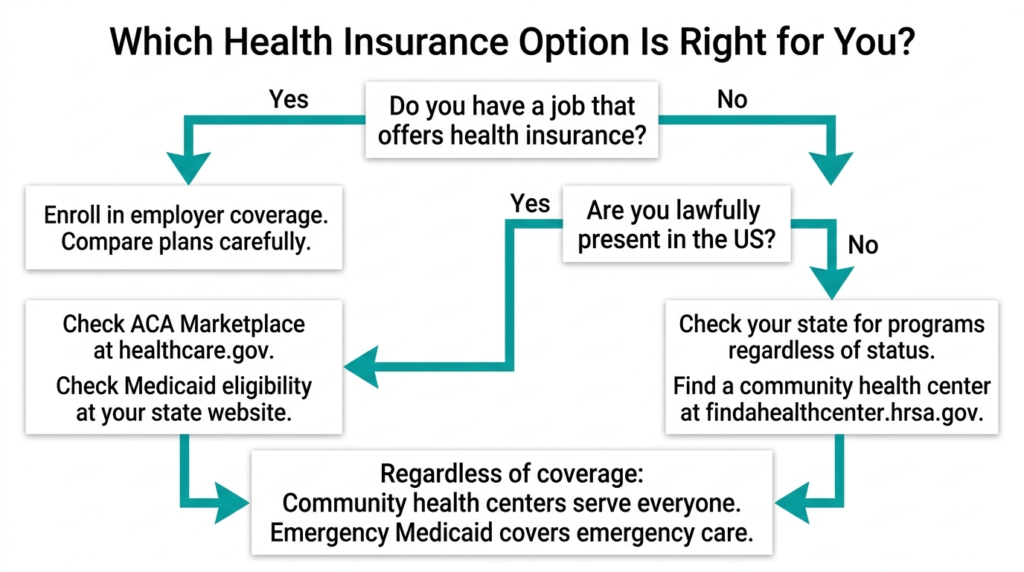
Rather than declaring one option better than another, the right answer depends on your specific situation. Here is a direct framework.
If your employer offers coverage: Enroll unless the cost is genuinely unaffordable. Employer coverage is almost always the most comprehensive option available.
If you have lawful status and no employer coverage: Check the ACA Marketplace at healthcare.gov first. Based on your income, you may qualify for significant subsidies that make a comprehensive plan affordable. Simultaneously check your state’s Medicaid eligibility if your income is low.
If you have children regardless of your own status: Check CHIP and Medicaid eligibility for your children in your state. In 37 states plus DC, children qualify regardless of immigration status or the five year waiting period.
If you are pregnant: Check your state Medicaid program. In 31 states plus DC, pregnancy related Medicaid coverage is available regardless of immigration status.
If you are a DACA recipient: Marketplace coverage ended in August 2025. Check whether your state has a state funded program. Find your nearest community health center at findahealthcenter.hrsa.gov. If you have an employer, check whether employer coverage is available to you.
If you are undocumented: Employer coverage may be available if your employer offers it and you are on payroll. State funded programs exist in California, Colorado, Washington, and several other states. Community health centers serve you regardless of status. Emergency Medicaid covers emergency care at hospitals.
If you just lost coverage: You have a 60-day special enrollment window on the Marketplace from the date you lost coverage. Act within that window. Compare Marketplace costs with COBRA costs before deciding.
What Coverage Actually Costs: A Real Range
Health insurance costs in the United States vary enormously based on the type of plan, your income, your state, and whether you qualify for subsidies. Here is a realistic range to help you plan.
Employer sponsored individual coverage: $50 to $200 per month for your share of the premium, depending on your employer’s contribution and the plan you choose.
ACA Marketplace with subsidies: For lower-income filers who qualify for premium tax credits, plans can cost as little as $0 to $50 per month for Silver level coverage.
ACA Marketplace without subsidies: $300 to $600 per month for an individual, $800 to $1,500 for a family, depending on the plan tier and your state.
Medicaid and CHIP: Free or nominal cost, usually $0 to $20 per month for most enrollees.
Community health centers: Sliding scale based on income. Many patients pay $20 to $40 per visit. Some pay nothing.
COBRA: $400 to $700 per month for an individual, more for a family.
Short term plans: $50 to $200 per month, with significant coverage limitations.
Useful Resources
healthcare.gov — Check Marketplace eligibility, compare plans, apply for coverage.
findahealthcenter.hrsa.gov — Locate a federally qualified health center near you.
benefits.gov — Search for all government benefit programs you may qualify for.
Your state Medicaid website — Search “[your state] Medicaid” to find your state’s specific program and eligibility rules.
1-800-318-2596 — The ACA Marketplace helpline, available in multiple languages.
Disclaimer: Health insurance eligibility rules for immigrants change frequently, particularly following recent legislative and regulatory changes. The information in this article reflects the situation as of the time of writing. Always verify current eligibility directly at healthcare.gov, your state Medicaid agency, or with a qualified navigator or enrollment specialist before making coverage decisions.