
Can You Move Your Credit Score to the U.S.? Exploring Cross-Border Credit Solutions
I remember the moment I first understood what “credit invisible” meant.
I had been in the United States for about four months, working, paying my bills, living in an apartment I had only managed to rent because the landlord accepted a larger deposit instead of a credit check. My bank account was in good shape. My payment history back home was spotless. I had never missed a payment on anything, ever.
And none of it meant anything here.
The American financial system had never heard of me. Every lender, every credit card company, every apartment screener operated as if I had just arrived on earth rather than just arrived in a new country. I was not a bad credit risk. I was no credit risk at all, because I did not exist yet in the only system that counted.
If you are reading this and recognize that feeling, this article is for you.
We are going to answer the question that many immigrants ask and nobody answers clearly: can you actually move your credit score to the United States from another country? And if not, what can you do to make your existing credit history count for something while you build a new one from scratch?
The Direct Answer: No, You Cannot Transfer a Credit Score
Let us start with the honest part before getting to the useful part.
Your credit score from another country does not transfer to the United States. Full stop. The number itself, whether it is a CIBIL score from India, a credit score from the UK, a Buró de Crédito score from Mexico, or any other system, is not recognized by the three major US credit bureaus: Equifax, Experian, and TransUnion.
This is not a policy decision that could be changed with a phone call. It is a structural incompatibility. Credit scoring systems in different countries are built on different data, measured on different scales, administered by different organizations, and evaluated by lenders using different criteria. There is no universal conversion formula that reliably translates a score from one country’s system into an equivalent score in another’s.
When you arrive in the United States with no US credit history, you are what the credit industry calls “credit invisible.” According to the Consumer Financial Protection Bureau, approximately 45 million people in the United States have no credit score at all or have a score based on such a thin file that most scoring models cannot calculate a meaningful number. Immigrants make up a significant portion of that group.
The consequences of being credit invisible are real and immediate. You cannot get most credit cards without a deposit. Landlords require larger security deposits or reject your application entirely. Auto loans, if available at all, come at punishingly high interest rates. Even some employers run credit checks as part of hiring decisions.
What Does Exist: Cross-Border Credit Solutions
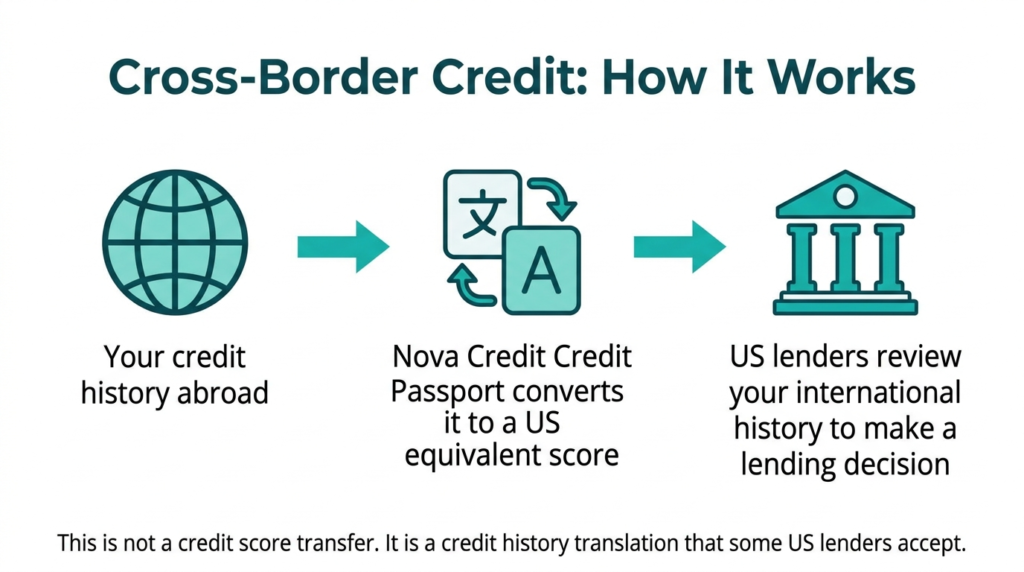
While you cannot transfer a credit score, something meaningfully useful does exist: services that translate your international credit history into a format that certain US lenders can read and evaluate.
The most established of these is Nova Credit, a fintech company that describes itself as the world’s only cross-border credit data solution. Nova Credit connects with credit bureaus in approximately 20 countries and, with your permission, pulls your foreign credit history and converts it into what they call a Credit Passport.
A Credit Passport is not a US credit score. It is a standardized report that presents your international credit history in a format familiar to US lenders: payment history, credit accounts, credit utilization, and a local equivalent score that gives American underwriters a reference point for evaluating your creditworthiness.
The countries Nova Credit currently supports include Australia, Brazil, Canada, Dominican Republic, India, Kenya, Mexico, Nigeria, Philippines, South Korea, Spain, Switzerland, and the United Kingdom, among others. Coverage quality varies by country depending on how detailed and current the home country’s credit bureau records are.
The process works like this: you apply for a credit product with a participating US lender. During the application, you are offered the option to share your international credit history through Nova Credit. You follow the country specific steps to authorize access. Nova Credit retrieves your data from your home country’s bureau and delivers it to the lender in real time, alongside your US information.
The lender then reviews your international history to inform their decision about whether to approve your application, even if you have no US credit history at all.
Which US Lenders Accept International Credit History
This is the most practical question, and the honest answer is: fewer than you might hope, but enough to matter.
Nova Credit’s lender partnerships have evolved over time. As of 2026, the American Express partnership that was previously one of their most prominent arrangements ended in 2025. However, other lenders and financial products continue to work with Nova Credit and accept international credit history as part of their underwriting process.
The categories of US lenders that have accepted or currently accept international credit history through services like Nova Credit include certain credit card issuers, specific apartment rental platforms and property management companies, some student loan lenders for international students, and select auto lenders.
The list of participating lenders changes as partnerships are added or updated. Before assuming your international history will be accepted, verify directly with the specific lender or on Nova Credit’s website what products currently support the Credit Passport. This is important because applying for a product and discovering midway through that your international history is not accepted wastes a hard inquiry on your credit report.
For specific lenders currently accepting Credit Passport, visit novacredit.com directly and use their lender lookup tool.
The Real Limitation: It Does Not Build Your US Credit Score
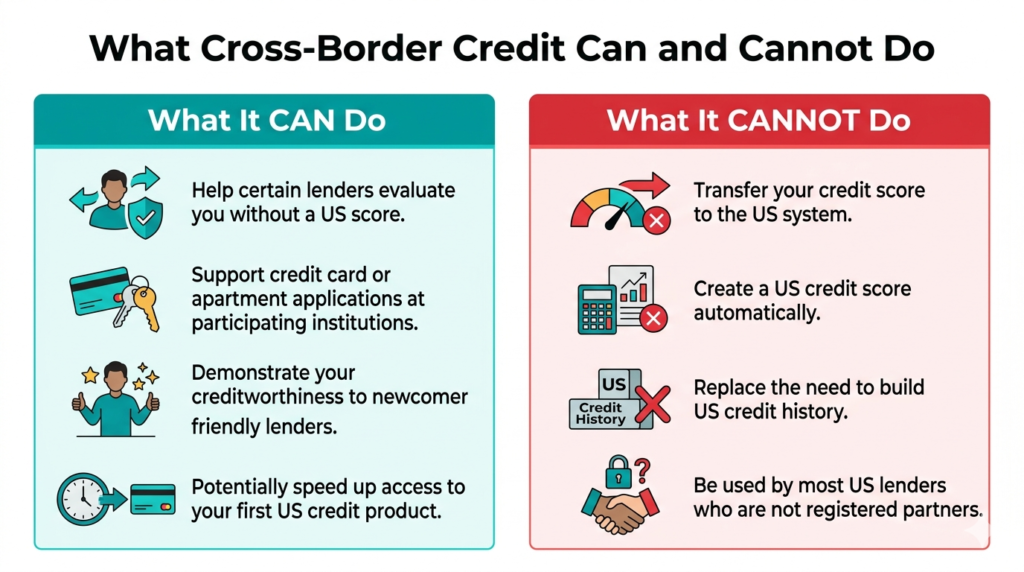
This is the part that many articles about Nova Credit and cross-border credit skip, and it is the most important thing to understand before you rely on these services.
Using your international credit history through Nova Credit to secure a credit card or an apartment does NOT automatically give you a US credit score. The Credit Passport is a tool for getting a foot in the door. Once you have that first credit card or first loan, you still need to use it responsibly and consistently to begin building actual US credit bureau records with Equifax, Experian, and TransUnion.
In other words, cross-border credit services solve the initial access problem, meaning they can help you get your first US credit product despite having no US credit history. But from that point forward, you build your US credit history the same way everyone else does: by using credit, paying on time, keeping balances low, and letting time do its work.
The goal is not to rely on your international credit history indefinitely. The goal is to use it to bridge the gap in your first weeks or months in the US, get your first credit product, and immediately begin building the US credit file that will serve you for the rest of your time here.
Countries With the Strongest Cross-Border Coverage
Coverage quality through Nova Credit and similar services varies significantly depending on your home country. Here is a practical breakdown.
Best coverage: Australia, Canada, India, Mexico, United Kingdom, and South Korea have well-developed credit bureau systems with detailed records that translate reliably to US-equivalent formats. If you come from any of these countries and have a strong credit history there, cross-border services are most likely to work meaningfully for you.
Good coverage: Brazil, Dominican Republic, Kenya, Nigeria, Philippines, Spain, and Switzerland have reasonable coverage, though the depth and currency of records vary more than in the top group.
Limited or no coverage: Many countries in Eastern Europe, the Middle East, Central Asia, and much of Southeast Asia are not currently covered by Nova Credit. If your home country is not on the list, cross-border credit services are not available to you and you will need to build your US credit history from scratch using the strategies in the next section.
To check whether your specific country is supported, visit novacredit.com before planning your approach.
If Your Country Is Not Covered: Building US Credit From Zero
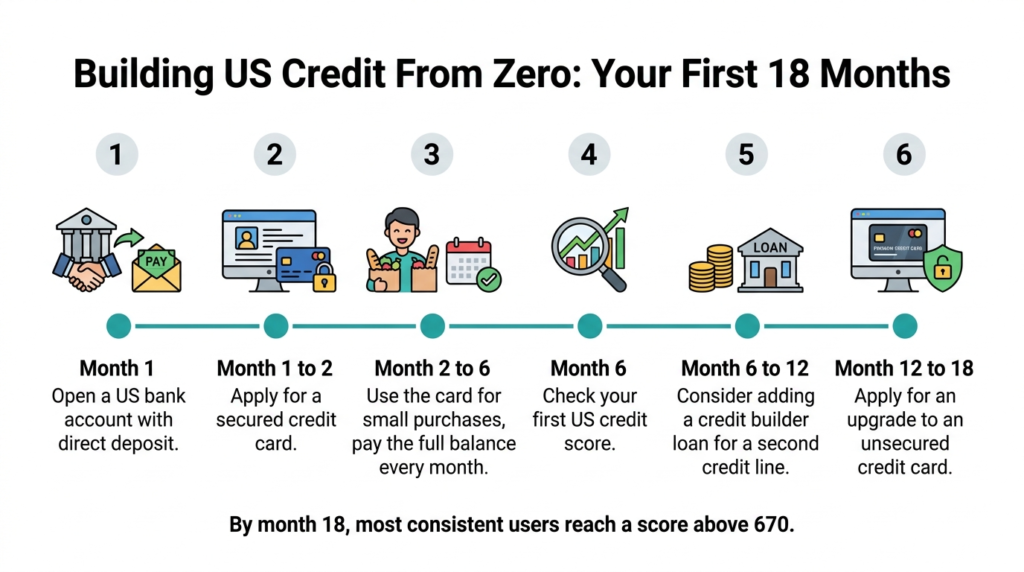
Whether your country is not covered by cross-border services or you simply want to move beyond relying on your international history, building US credit from scratch is straightforward. It just takes time and consistency.
Step 1: Open a US Bank Account
A US bank account is the foundation. It is where your paycheck arrives, where your credit card payments originate, and where your financial history in this country begins. If you have not opened one yet, our article on how to open a US bank account without a Social Security Number covers the specific options available to immigrants at different stages.
Step 2: Get a Secured Credit Card
A secured credit card requires a cash deposit, typically $200 to $500, which becomes your credit limit. You use the card for small, regular purchases, pay the full balance before the due date every month, and that payment history is reported to all three major credit bureaus. After six to twelve months of consistent use, you will have your first US credit score.
For a complete comparison of secured card options for immigrants, our guide on secured credit cards for beginners with no credit covers the specific products worth considering.
Step 3: Add a Credit Builder Loan
A credit builder loan from a credit union or community bank adds a second credit line to your file, which improves your credit mix, one of the factors in your US credit score. You make monthly payments on a small loan, and at the end of the term you receive the money you paid in. Every on time payment builds your credit history further.
Step 4: Report Your Rent
Services like Experian RentBureau and Rental Kharma allow your monthly rent payments to be reported to credit bureaus. This adds a significant positive payment history for money you are already spending, accelerating your score’s growth without taking on any new debt.
Step 5: Keep Utilization Low
Credit utilization, the percentage of your available credit that you are using, is one of the most heavily weighted factors in your US score. Keeping your credit card balance below 30% of your limit at all times, and ideally below 10%, signals responsible use to the bureaus and pushes your score upward faster.
The Timeline
With consistent, responsible use of a single secured credit card, most newcomers see their first credit score appear within three to six months. After twelve months of clean history, scores in the 650 to 700 range are achievable. After eighteen months, scores above 700 are realistic for people who have kept utilization low, never missed a payment, and added at least one additional credit line.
Newcomer Credit Cards: A Faster Entry Point for Some
Several US credit card issuers have developed products specifically designed for immigrants and internationals who have little or no US credit history. These cards look at employment status, income, educational background, and in some cases your international credit history directly, rather than relying solely on a US credit score.
Cards in this category include the Deserve EDU Mastercard for international students, the Firstcard for immigrants and newcomers, and several others that have emerged in recent years. The specific products available and their terms change frequently, so researching current options at the time you apply is important.
These cards are a meaningful development because they acknowledge the reality that being credit invisible in the US does not mean being financially irresponsible. They are built for exactly the situation you are in.
The Bigger Picture: Why US Credit Is Worth Building Fast
The reason this topic matters so much is not just about getting a credit card. Your US credit score touches almost every major financial decision you will make in this country.
Renting an apartment in a desirable neighborhood typically requires a credit score of at least 620, and competitive markets in cities like New York, Los Angeles, and Chicago often require 700 or above. Car financing rates vary by 10 percentage points or more between someone with excellent credit and someone with no credit. Mortgage rates, personal loans, and even some job applications are all affected by your credit score.
According to Nova Credit’s own research, it can take immigrants up to five years to rebuild an equivalent credit history in the US to what they had in their home country. That is five years of higher interest rates, larger deposits, and limited access to financial products simply because your prior history does not translate across borders.
Cross-border credit services like Nova Credit can shorten that gap at the beginning. A fast, disciplined approach to building US credit from the moment you arrive shortens it further. The combination of both, where applicable, is your fastest path to the financial standing you actually deserve based on your real financial track record.
A Summary: Your Options Based on Where You Come From
| Your Situation | Best First Step |
|---|---|
| From Australia, Canada, India, Mexico, UK, South Korea | Try Nova Credit at novacredit.com for immediate lender access |
| From Brazil, Nigeria, Philippines, Dominican Republic | Check Nova Credit coverage, have a backup plan if results are thin |
| From a country not covered by Nova Credit | Secured credit card plus credit builder loan, starting week one |
| Have an SSN and US address | Any secured card. Fidelity, Discover, Capital One all have strong options |
| Have an ITIN, no SSN yet | Self credit builder, certain credit unions, some secured cards accepting ITIN |
| Student in the US | Deserve EDU card, Nova Credit if your country is covered |
Disclaimer: This article is for educational and informational purposes only and does not constitute financial or legal advice. Nova Credit partnership details, supported countries, and participating lenders change frequently. Always verify current information directly at novacredit.com and with individual lenders before applying.