
How to Choose a Career in North America
Somewhere in the first months after arriving, almost every immigrant faces the same quiet, disorienting question: what am I actually going to do here.
Maybe you were an engineer back home and you are now wondering whether that means anything in the United States or Canada. Maybe you were a teacher, a nurse, an accountant, a business owner, and you are staring at a job market that does not seem to recognize any of it on paper. Maybe you never had a defined profession at all, and the question feels even more open ended: what career even makes sense to build from here.
This is one of the most consequential decisions you will make in your new life, and very few people walk you through it clearly. This article is that walk through. It covers how credential recognition actually works in both the US and Canada, what counts as a transferable skill even when your exact job title does not transfer, and a practical framework for choosing a direction when the options feel overwhelming.
First, an Honest Truth About “Brain Waste”
Before the practical steps, it is worth naming something directly, because pretending it does not exist helps no one.
Nearly 2 million college educated immigrants in the United States, more than half of them arriving with academic and professional credentials, are unable to fully use their professional skills and instead work in low skilled jobs or remain unemployed. Researchers call this brain waste, and it is not a rare misfortune. It is a structural, well documented pattern that costs the US economy more than $39 billion in lost wages and $10 billion in unrealized tax revenue every year.
The reasons are not usually about your ability. They are about systems: credential evaluation processes that vary by state and by profession, licensing boards that require US specific training even when your underlying skill is identical, language requirements, and employers who simply do not know how to interpret a foreign degree or work history.
Knowing this upfront matters because it reframes the problem correctly. If your first months of job searching feel harder than they should given your actual qualifications, that is not necessarily a reflection of your worth or competence. It is a reflection of a fragmented system that this article will help you navigate more efficiently than most people manage on their own.
Step 1: Figure Out If Your Profession Is Regulated
This is the single most important fork in the road, and it determines almost everything else about your career path here.
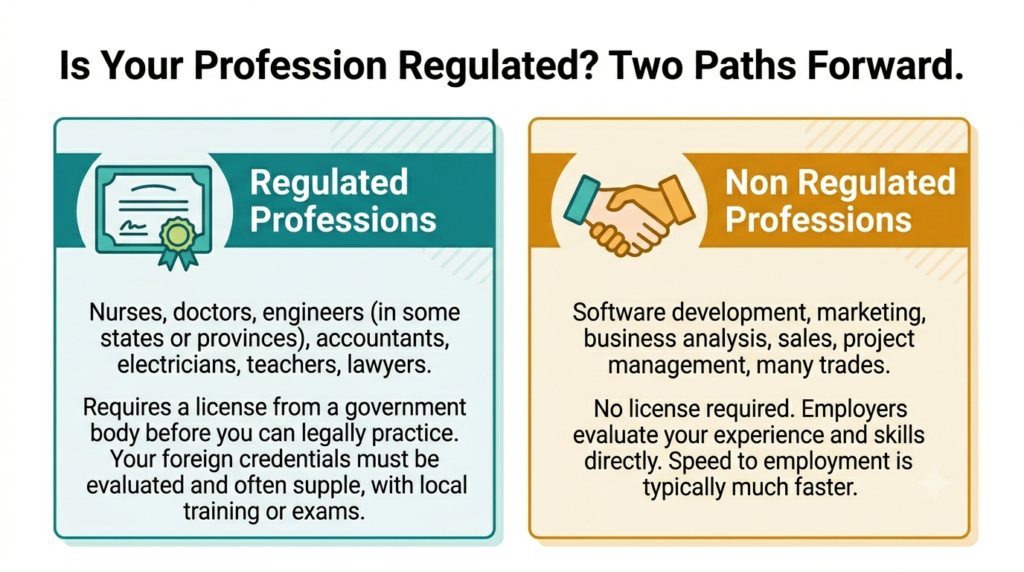
A regulated profession is one that requires a government issued license before you are legally allowed to practice, regardless of your experience or education. In the United States, regulated professions are licensed at the state level, not federally, which means the requirements, the fees, and even whether your foreign credentials are accepted can differ significantly depending on which state you live in. Common regulated professions include nursing, medicine, law, accounting, teaching, and several skilled trades such as electrical work and plumbing.
In Canada, the same general pattern exists at the provincial level. Nurses, doctors, accountants, and compulsory trades like electricians, plumbers, and steamfitters all require a license from a provincial regulatory body before you can work in the field.
A non regulated profession has no licensing requirement. Employers evaluate your background directly, without a government gatekeeper in between. Fields like software development, marketing, business analysis, sales, customer service, and many corporate roles fall into this category.
Why this distinction matters so much: if your profession is regulated, your path to working in that exact field will likely take longer and cost more, often involving a formal credential evaluation, additional coursework, exams, and sometimes a supervised practice period. If your profession is non regulated, your path can be considerably faster because the only gatekeeper is convincing an employer that your skills and experience translate.
How to check: In the United States, the authoritative source for whether your profession is regulated, and by whom, is always the state where you intend to work. There is no single federal answer. Search “[your profession] license requirements [your state]” or check your state’s professional licensing board directly. In Canada, use the Canadian Information Centre for International Credentials (CICIC) website, or look up your occupation’s National Occupational Classification (NOC) code through the Canada Job Bank to find out if it is regulated in your target province.
Step 2: If Regulated, Start the Credential Recognition Process Immediately
If your profession requires licensing, the most important thing to understand is that this process takes time, often many months, and starting early is the single biggest factor in how quickly you can practice your profession again.
In the United States
Begin by contacting the human resources department of any employer you are interested in, since they can often tell you exactly what credential evaluation is required for that specific role. Separately, identify whether your profession is regulated in your state and contact that state’s licensing board directly, since they are the authoritative source on what foreign credentials are accepted.
Most paths require a credential evaluation from a recognized agency, which compares your foreign degree and transcripts to US equivalents. The National Association of Credential Evaluation Services and the Association of International Credentials Evaluators are the two main professional bodies whose member agencies provide these evaluations. Costs vary depending on complexity, and evaluations are not free. Certified translations of your academic transcripts and any professional licenses you held abroad should be obtained early, since you will need them repeatedly throughout this process.
For healthcare professions specifically, some changes since the pandemic have made things somewhat easier. Several states, including Tennessee, created permanent new licensing pathways for foreign trained doctors after the temporary pandemic era flexibilities proved effective. It is worth checking whether your state has adopted similar permanent reforms for your specific healthcare profession.
In Canada
The process is more standardized in name but still varies meaningfully by province. Begin by finding your National Occupational Classification (NOC) code through the Canada Job Bank, which is Canada’s official system for classifying every job in the labor market. The second digit of your NOC code indicates your TEER level, which signals the education and training typically required for that role.
Once you know your NOC code, identify whether your occupation is regulated in your target province and contact the relevant regulatory body. If you need credential recognition specifically for immigration purposes, you will use an Educational Credential Assessment (ECA) through a designated provider. It is critical to understand that an ECA is not the same as a license. An ECA can help your immigration application, but separately, you still need to complete the actual licensing process with the provincial regulator if your occupation requires one.
Canada has also expanded financial support for this process. The Foreign Credential Recognition Program now offers loans ranging from $15,000 to $30,000 Canadian dollars to help cover the costs of licensing exams, additional training, and educational upgrades, alongside career counseling and job readiness support. As of 2026, an expanded set of agreements aims to help approximately 32,000 internationally trained professionals move through this process faster.
If full licensing in your exact field proves too costly or time consuming in the short term, consider a related role that uses your skills while you work toward full recognition. An internationally trained doctor might work in medical research or as a healthcare assistant. An overseas engineer could take a technical support or project coordination role. These positions build local experience and income while your formal credential recognition proceeds in parallel.
Step 3: If Non Regulated, Focus on Transferable Skills and Local Context
If your profession does not require a license, your biggest opportunity and your biggest challenge are the same thing: convincing an employer who has never heard of your previous company, your previous degree program, or your previous country’s professional norms that your underlying skills are exactly what they need.
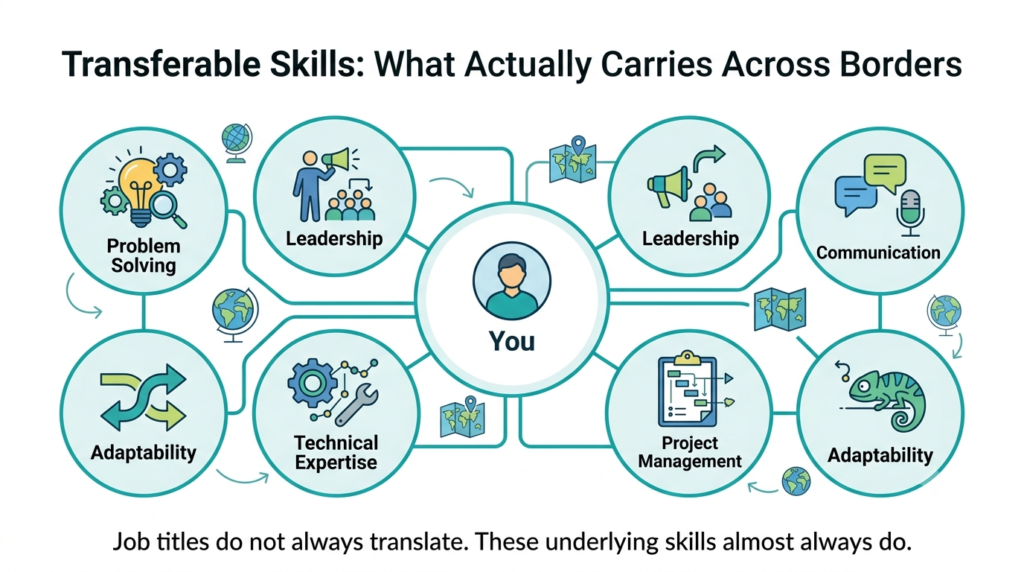
Identify your transferable skills explicitly. Problem solving, leadership, project management, technical expertise, and adaptability are universal regardless of which country you developed them in. When writing your resume or speaking in an interview, translate your past experience into language and frameworks that are immediately legible to a North American employer, rather than assuming the connection is obvious.
Demonstrate local context, not just credentials. In non regulated fields, employers look for what some career counselors call “information gain,” meaning evidence that you understand how your skills apply specifically in the local context, not just that you are technically qualified in the abstract. Researching the specific skills employers in your target role are asking for, using tools like the Canada Job Bank or US job postings on LinkedIn and Indeed, helps you speak directly to what is actually expected.
Consider micro credentials to bridge specific gaps. Short, targeted courses from local colleges or recognized online platforms can validate specific skills relevant to your target job without requiring a full second degree. These are particularly useful when your foreign education is strong overall but missing one or two specific, easily addressed gaps that are holding back employer confidence.
Build local experience deliberately, even unpaid at first if necessary. Internships, volunteer roles, and part time work related to your field, even below your skill level, build the specific kind of “local experience” that employers consistently ask for and that immigrants consistently lack in their first months. This is not a permanent compromise. It is a deliberate bridge.
Step 4: Consider the High Demand Paths That Need No Degree at All
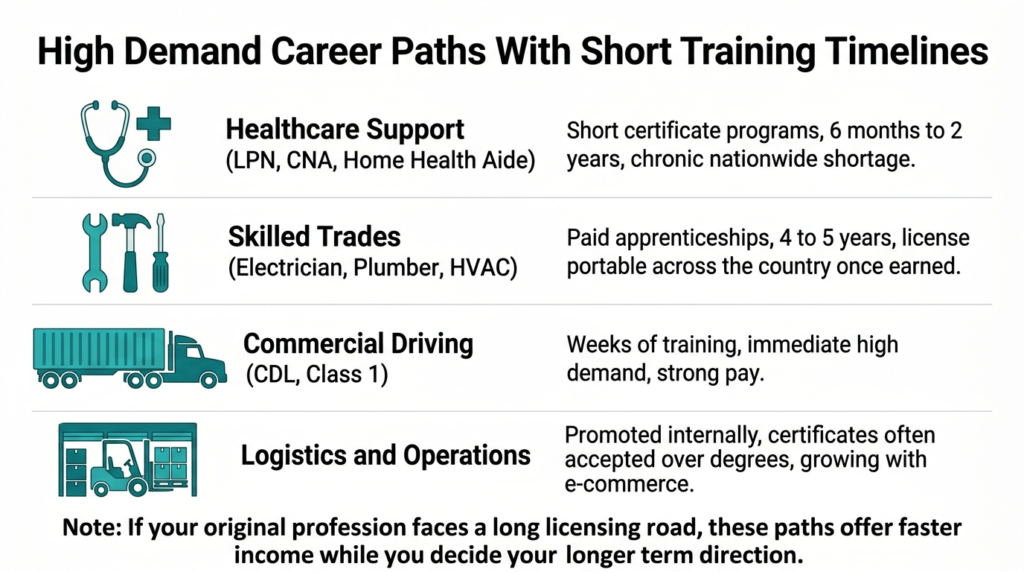
Not every immigrant needs to or should pursue full recognition of their previous profession immediately, especially if that path is long, expensive, and uncertain. Several career categories in both the US and Canada share three traits that make them genuinely strong options regardless of your background: short or flexible training pathways, requirements based on demonstrated skill rather than pedigree, and significant ongoing labor shortages.
Healthcare support roles such as Licensed Practical Nurses in Canada or Certified Nursing Assistants in the US require certificate programs rather than full degrees, often six months to two years, and face chronic nationwide demand, particularly as both countries’ populations age. If you had any healthcare background in your home country, this category deserves serious consideration even if your original credential, such as a foreign nursing degree, is not the credential you ultimately use.
Skilled trades, covered in more depth in our article on the highest paying jobs without a degree in North America, offer paid apprenticeships that train you while you earn, and the resulting license, once obtained, is recognized nationally in ways many professional credentials are not.
Commercial driving, logistics, and operations roles often require weeks rather than years of training and are growing steadily with the expansion of e-commerce and global trade in both countries.
These paths are not a downgrade from your original ambitions. For many immigrants, they are a faster route to financial stability that also opens a longer term path, since experience gained here often makes any later transition into your original field, if you choose to pursue it, considerably easier.
Step 5: Build Your Financial Foundation Alongside Your Career Decision
Choosing a career direction and building your financial life are not separate projects. They move together, and decisions in one area should inform the other.
If a credential recognition process or licensing path will take a year or more and cost several thousand dollars, that is a financial planning decision as much as a career one. Understanding your actual monthly budget, what you can realistically set aside for licensing fees, exam costs, or additional coursework, while still covering your needs, is essential before committing to a specific timeline. Our guide on how to create your first budget in a new country walks through exactly how to build that picture clearly.
Many immigrants pursue a bridge job in a related or unrelated field while working toward their longer term credential, exactly as recommended above. If your current income situation feels genuinely insufficient while you navigate this transition, our honest breakdown in how do I make enough money to survive here covers practical income strategies across different timelines, from immediate options to longer term skill building.
And once you are earning consistently in your chosen direction, whether that is your original profession finally recognized or a new path entirely, understanding what is investing and why it matters is the natural next step toward building lasting financial stability from that income.
A Practical Framework for Deciding
If you are still uncertain which direction to pursue, here is a simple sequence of questions to work through in order.
Is my profession regulated in my target state or province? If yes, research the credential recognition timeline and cost before committing, since this fundamentally shapes your near term plan. If no, move directly to building a North America specific resume and network.
Can I afford the time and cost of full licensing right now? If the honest answer is no, identify a related bridge role that uses some of your skills while you work toward full recognition over a longer timeline, rather than waiting on the sidelines with no income.
Are there high demand, shorter training paths that interest me, even if they differ from my original profession? Many immigrants discover genuine satisfaction and strong income in fields they had never previously considered, simply because the path here was faster and the demand was real.
What does my realistic financial runway look like? Know your numbers before committing to a multi year credential path, and build your budget around your actual situation rather than an optimistic estimate.
Am I building local experience and local language confidence in parallel, regardless of which path I choose? This single habit accelerates every other path simultaneously and should not wait until your “main” career decision is finalized.
The Bigger Picture
The career you build in North America does not have to be an exact replica of the one you left behind, and for many immigrants, it eventually becomes something different and, in time, something they would not trade back even if the original path had been easier.
What matters most in the near term is making an informed, deliberate decision rather than drifting into whatever job happened to be available first. Knowing whether your profession is regulated, understanding the real timeline and cost of credential recognition if it is, and identifying genuinely strong alternative paths if a long licensing road does not fit your current situation, are the tools that turn a confusing first year into a clear, navigable plan.
You did not come this far to stay stuck in the wrong question. The right career is the one that matches both your real skills and your real circumstances right now, with room to keep building from there.
Disclaimer: This article is for educational and informational purposes only and does not constitute legal, immigration, or career advice. Licensing requirements, credential recognition processes, and program details vary by state, province, and profession, and change frequently. Always verify current requirements directly with the relevant licensing board, regulatory body, or a qualified career counselor.