How Compound Interest Builds Wealth
There is a story Albert Einstein is often credited with, though historians debate whether he actually said it. The story goes that someone asked him to name the most powerful force in the universe. His answer, according to the story, was compound interest.
Whether Einstein said it or not, the underlying point is accurate. Compound interest is the mechanism behind virtually every significant wealth building outcome in personal finance, and it works in both directions with equal mathematical force: silently building your savings and investments when it is working for you, and quietly consuming your finances when it is working against you in debt.
Most people who grow up in the US financial system absorb an intuitive understanding of this concept over years of exposure: advertisements for retirement accounts, school lessons about savings, conversations with parents who invested early or warned them about credit card debt. Immigrants arrive without that background. The concept may be familiar in theory but the specific products, the specific numbers, and the specific strategies are all new.
This article explains compound interest completely, from the basic mechanics through the real numbers to the specific actions that put it to work for you as a newcomer building wealth in the United States.
What Compound Interest Actually Is
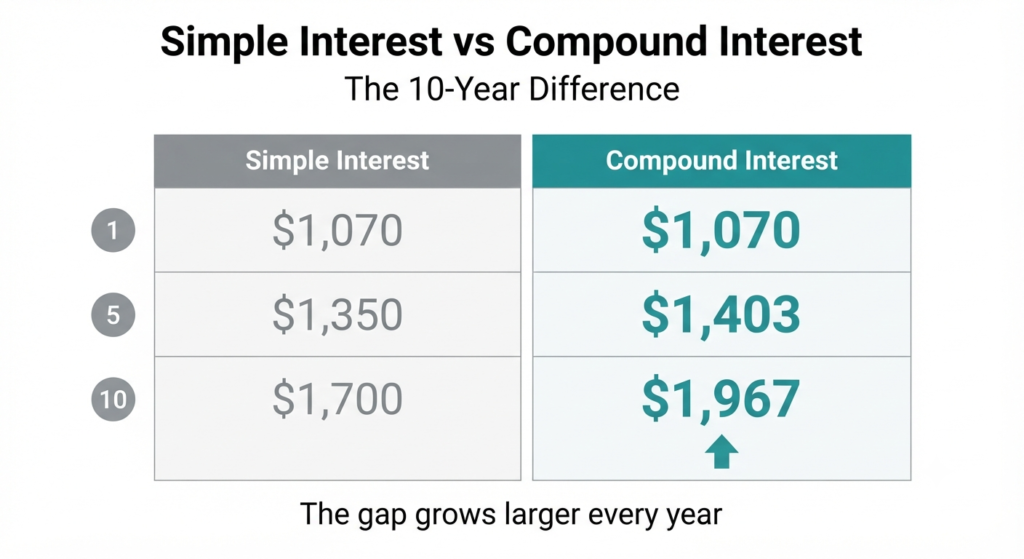
this image shows how starting with the same $1,000 at the same 7% rate, simple interest produces $1,700 after 10 years while compound interest produces $1,967 — a difference of $267. The gap continues to widen every year, reaching more than double by year 30. The reason is that compound interest earns returns on previously earned interest, not just on the original amount.
Let us start with the simplest possible explanation.
Simple interest is calculated only on the original amount you deposited or invested, called the principal. If you put $1,000 in an account paying 7% simple interest per year, you earn $70 in year one. You earn $70 in year two. You earn $70 in year three. After ten years, you have earned $700 in interest, and your total balance is $1,700.
Compound interest is calculated on the principal plus all the interest already earned. If you put the same $1,000 in an account earning 7% compounded annually, you earn $70 in year one. But in year two, you earn 7% on $1,070, which is $74.90. In year three, you earn 7% on $1,144.90, which is $80.14. The interest earns interest. Every year, the base on which interest is calculated grows larger.
After ten years with compound interest, your $1,000 has become $1,967. That is $267 more than the simple interest scenario, from the same $1,000 and the same 7% rate.
After 20 years, compound interest turns that $1,000 into $3,870. Simple interest would give you $2,400.
After 30 years, compound interest turns it into $7,612. Simple interest gives you only $3,100.
The same mechanism. The same original amount. The same rate. But an outcome more than twice as large after 30 years. That difference is entirely produced by the compounding itself, by interest earning interest, year after year, without you doing anything at all.
This is why time is the most powerful variable in wealth building. More powerful than the amount you invest, more powerful than the specific investment you choose, more powerful than almost any other decision you make. Time is the input that makes compounding enormous. Delay is the thing that takes it away from you.
The Rule of 72: A Quick Mental Tool
There is a shortcut for estimating how long it takes to double your money at any given interest rate, called the Rule of 72.
Divide 72 by the annual interest rate or return percentage, and the result is approximately how many years it takes for your money to double.
At 4% annual return (roughly current high yield savings rates): 72 divided by 4 equals 18 years to double.
At 7% annual return (roughly the long term historical average of diversified stock market index funds): 72 divided by 7 equals approximately 10.3 years to double.
At 10% annual return: 72 divided by 10 equals 7.2 years to double.
This mental tool is useful because it makes the time value of money intuitive without needing a calculator. $5,000 invested at 7% doubles to approximately $10,000 in about 10 years, then to $20,000 in about 20 years, then to $40,000 in about 30 years. No additional contributions. No decisions. Just time and compound growth doing their work.
Why Starting Early Matters More Than Starting with More
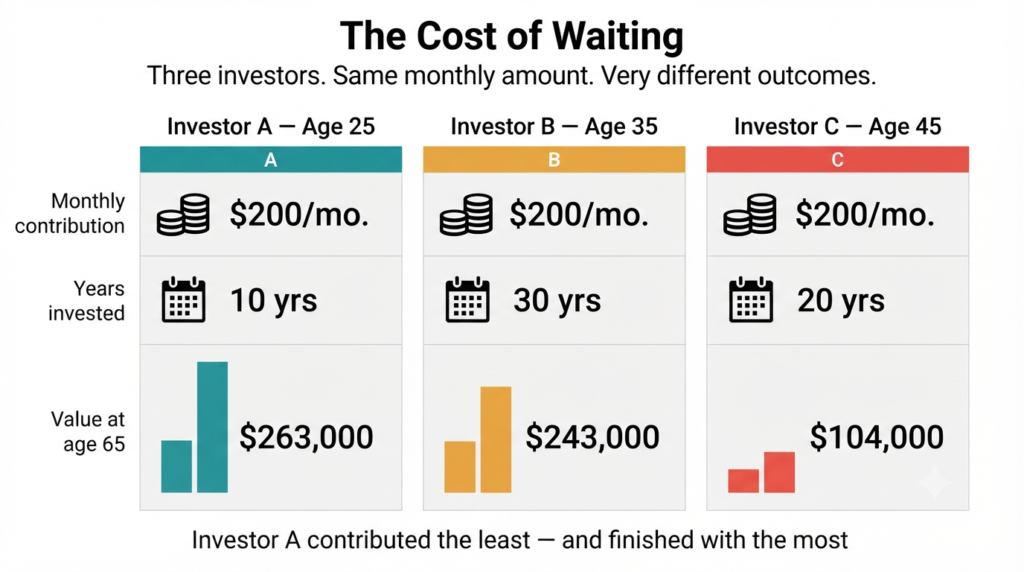
This image shows how starting to invest early makes a big difference over time. It compares three people who each invest $200 per month but begin at different ages — 25, 35, and 45. The person who started at 25 ends up with $263,000, even though they invested for only 10 years, while the one who waited until 35 finishes with $243,000, and the one who started at 45 ends with $104,000. The message is simple: starting early gives your money more time to grow through compound interest.
This comparison is the most counterintuitive and most important illustration of how compounding actually works in practice.
Consider three immigrants who each invest $200 per month at a 7% average annual return.
Investor A starts at age 25 and contributes for only 10 years, then stops and never adds another dollar. Total contributed: $24,000.
Investor B starts at age 35 and contributes consistently until age 65, never missing a month. Total contributed: $72,000.
Investor C starts at age 45 and contributes consistently until age 65. Total contributed: $48,000.
At age 65, who has the most?
Investor A: approximately $263,000. Investor B: approximately $243,000. Investor C: approximately $104,000.
Investor A contributed the least, by a wide margin, and ended with the most. Investor B contributed three times as much as Investor A and still ended up with less. Investor C contributed twice as much as Investor A and ended with less than half.
The difference is entirely time. Investor A’s early contributions had 40 years to compound. Each dollar they invested at age 25 had 40 years of growth before age 65. Investor B’s dollars had only 30 years at most. Investor C’s had only 20.
This is the mathematical case for starting now, with whatever amount is available, rather than waiting until a future date when the amount will be larger. The larger amount contributed later cannot fully compensate for the lost years of compounding on the smaller amount contributed earlier.
For immigrants who arrived in the US in their 30s or 40s and feel behind on retirement savings, this comparison does not mean all is lost. It means that starting now, immediately, with whatever is possible, matters more than the size of the contribution. Catching up is real and achievable. But it requires starting, not continuing to wait.
Compound Interest Working Against You: Debt
Everything described above also operates in reverse, and understanding the negative direction of compounding is just as important as understanding the positive one.
When you carry a balance on a credit card charging 22% annual interest, compound interest is working against you at 22% per year. A $2,000 credit card balance left unpaid and growing at 22% interest becomes $2,440 after one year, $2,977 after two years, $3,631 after three years. If you make only the minimum payment each month, the math gets even worse because minimum payments are often barely enough to cover the interest that accrues each month, leaving the principal nearly unchanged.
This is why paying off high interest debt is almost always the highest return financial action available to someone who carries it. Eliminating a debt charging 22% interest is equivalent to earning a guaranteed 22% return on the money used to pay it off, which no investment vehicle reliably matches.
The practical rule: if you carry high interest consumer debt, paying it off aggressively takes priority over investing in anything with a lower expected return than the interest rate you are paying. A credit card charging 22% costs more than index fund investing typically earns. Pay the card first.
The exception is the employer 401(k) match. A 50% or 100% employer match is an immediate return that exceeds any realistic debt cost, which is why most financial educators recommend capturing the full employer match before allocating any additional funds to either debt payoff or non-retirement investing.
Where Compound Growth Actually Happens
Not all accounts and products offer compound growth in the same way. Here is a clear breakdown of where compounding works in your favor and where it does not.
High Yield Savings Accounts compound the interest you earn on your balance, typically daily or monthly, and pay it into your account regularly. At current rates around 4% APY, a $10,000 emergency fund grows by approximately $400 in the first year. The compounding is modest because the rate is modest, but the safety and liquidity make savings accounts the right home for emergency funds and near term money regardless.
Index Funds and ETFs in a brokerage account or retirement account generate returns through two mechanisms: the appreciation of the underlying assets as companies grow in value, and dividends paid by those companies, which, when reinvested automatically, immediately begin compounding on themselves. Historically, a broadly diversified US stock market index fund has returned an average of approximately 7% per year after adjusting for inflation, though specific years vary dramatically.
401(k) and IRA Accounts offer the same investment options as a standard brokerage account but with the powerful addition of tax advantages. Inside a traditional 401(k) or traditional IRA, your investments grow without being taxed each year, which means your entire balance, including what would otherwise have gone to taxes, continues compounding. Inside a Roth IRA or Roth 401(k), your investments grow completely tax free and qualified withdrawals are also tax free, which removes taxes from the compounding equation entirely.
For a deeper explanation of why Roth accounts in particular are so powerful for immigrants, our article on why every immigrant needs a Roth IRA walks through the tax free compounding advantage in detail.
Credit Cards and Consumer Loans compound in the negative direction, as described above. Understanding this symmetry is what makes the decision to pay down debt before investing in lower return vehicles so clear.
Compounding Frequency: Why It Matters Less Than You Think
One technical detail about compound interest that often creates confusion is the concept of compounding frequency: daily, monthly, quarterly, or annually.
The compounding frequency affects how often interest is calculated and added to your balance. More frequent compounding produces slightly higher returns than less frequent compounding at the same nominal interest rate, because interest is being added to the principal more often, giving it more time to generate its own returns within a given year.
However, the difference between daily and monthly compounding at typical savings or investment rates is very small, often fractions of a percent over a year. It becomes more meaningful at very high interest rates (like credit card debt, where daily compounding on a 22% rate does matter over time) but for investment accounts at 7% returns, the compounding frequency is far less important than the rate itself, the time invested, and whether you are contributing consistently.
Do not choose a savings account based on compounding frequency. Choose it based on the APY (Annual Percentage Yield), which already accounts for the compounding frequency in its calculation and represents the actual effective annual return you will receive.
The Practical Steps: Putting Compound Growth to Work
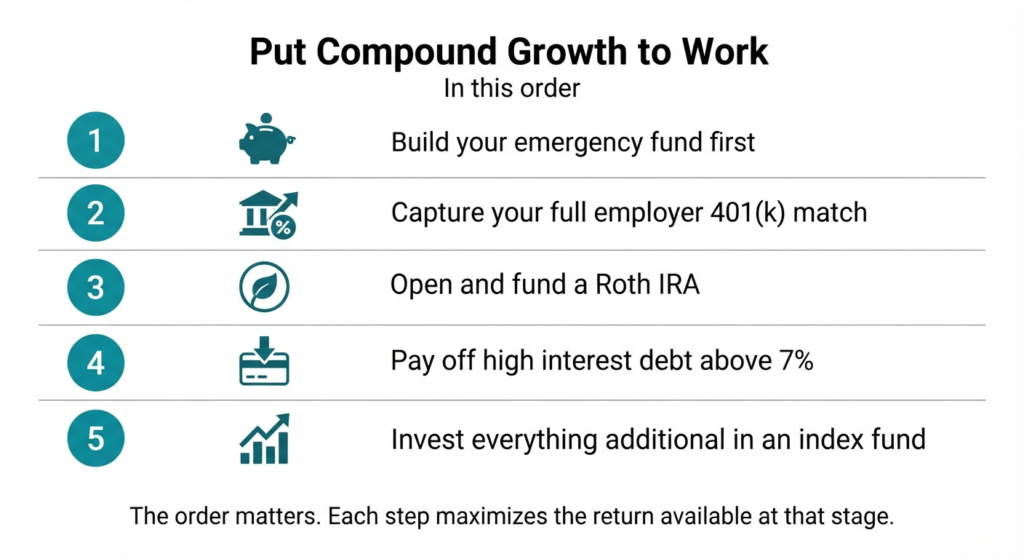
This picture explains five steps to help your money grow safely. First, save some money for emergencies so you are protected if something unexpected happens. Next, if your job gives you extra money when you save in a 401(k), make sure you take it because it is free money. Then, open a Roth IRA to save for your future without paying tax later. After that, pay off any loans or credit cards with very high interest because they cost you a lot over time. Finally, put any extra money into an index fund, which helps your money grow slowly and safely. The picture says to follow these steps in order so your money works better for you.
Understanding compound interest is only useful if it changes what you do. Here are the specific actions, in order of priority, that put compounding to work in your favor.
Build your emergency fund first. Three to six months of essential expenses in a high yield savings account is the foundation that makes everything else possible. Without it, an unexpected expense forces you to sell investments or take on debt, both of which interrupt the compounding process at the worst possible moment.
Capture your employer’s full 401(k) match. The match is the highest guaranteed return available to most working immigrants, because it is immediate and free. Every dollar of match your employer contributes begins compounding immediately. Missing it is the equivalent of declining a guaranteed 50% to 100% return on that money. Our article on what is a 401(k) and should I actually use mine explains exactly how to enroll and how to make sure you are capturing the full match.
Open a Roth IRA. The Roth IRA is the most powerful compounding vehicle available to most immigrants because it removes federal income tax from the equation entirely. Your investments grow without taxes. Your withdrawals in retirement are without taxes. The compound growth works on the full balance, not a balance net of annual taxes. Our guide on why every immigrant needs a Roth IRA covers eligibility, contribution limits, and how to open one.
Pay down high interest debt. If you carry credit card debt or other consumer debt above 7%, paying it down aggressively produces a guaranteed return equal to the interest rate. This is the best risk adjusted investment available at that rate.
Invest everything additional in a low-cost index fund. A total market index fund or S&P 500 index fund at Fidelity, Vanguard, or Schwab gives you diversified exposure to the US stock market’s long term compounding power with minimal fees.
Set up automatic contributions to each account that holds your investments. The automation is what makes the compounding consistent. Consistent contributions at regular intervals, rather than irregular lump sums timed to market conditions, is the strategy that produces the most reliable long term outcomes for most investors.
For a broader picture of how investing fits into the financial life you are building here, our article on what is investing and why does it matter covers the foundations that this article builds on.
A Simple Summary
| Concept | Plain English |
|---|---|
| Compound interest | Interest earning interest on itself, growing larger every year |
| Simple interest | Interest only on the original amount, no growth on growth |
| Rule of 72 | Divide 72 by your interest rate to estimate years to double |
| Why starting early wins | More years of compounding multiplies the effect of every dollar |
| Compounding against you | High interest debt grows the same way your investments do |
| Best accounts for compounding | Roth IRA (tax free), 401(k) (tax deferred), index funds in brokerage |
| The most important input | Time — more than the amount, more than the rate |
The Honest Closing
Compound interest does not care about your immigration status, your citizenship, your country of origin, or your starting balance. It responds only to three inputs: the amount you invest, the rate of return, and time.
Of those three, time is the one you are spending right now, whether you are investing or not.
Every year that passes without investing is not a neutral event. It is a year of compounding on which you have chosen not to collect. The immigrant who starts with $100 per month at age 30 and the one who starts with $500 per month at age 40 will often arrive at similar places by age 65, depending on market conditions, because the ten lost years of compounding are expensive to compensate for even with five times the contribution.
Start with whatever is available now. Let time work on it. Add to it when you can. That is the entire formula. The power of it becomes visible only in retrospect, over years and decades, but it is working from the first dollar on the first day you invest.
Disclaimer: This article is for educational and informational purposes only and does not constitute financial advice. All investing involves risk. Past returns are not a guarantee of future performance. Consult a qualified financial professional for advice specific to your situation.