
Digital Banks vs Traditional Banks for Immigrants: Which One Is Actually Right for You?
When I arrived in the United States, I walked into the first bank branch I could find near my apartment, opened an account, and assumed I had done the right thing. I had not compared anything. I had not asked any questions. I just picked the name I recognized from the sign on the corner.
That account had a $12 monthly fee, a $35 overdraft charge, a $45 international wire transfer fee, and an ATM network that did not include a single machine within a mile of where I lived or worked.
I paid all of those fees, month after month, because I did not know there was a choice.
There is absolutely a choice. And for immigrants specifically, the choice between a digital bank and a traditional bank is one of the most financially consequential decisions of your first year in the United States. The right answer depends on your specific situation, your documentation, how you use money day to day, and what financial goals you are working toward.
This article gives you the full comparison so you can make that decision deliberately rather than by default.
What Is the Difference Between a Digital Bank and a Traditional Bank?
Before comparing the two, it helps to understand exactly what each one is.
Traditional banks are chartered financial institutions with physical branch networks, full banking licenses, and the full range of financial services: checking accounts, savings accounts, mortgages, auto loans, business accounts, foreign currency exchange, safe deposit boxes, and in-person financial advice. Wells Fargo, Chase, Bank of America, Citibank, and regional banks like US Bank and TD Bank are traditional banks. They are regulated by federal and state banking agencies, and deposits are insured by the FDIC up to $250,000.
Digital banks, also called neobanks or online banks, operate entirely or primarily through a mobile app and website with no physical branch network. They typically offer checking and savings accounts with lower fees, higher interest rates on savings, and a better mobile experience than traditional banks. Examples include Chime, SoFi, Ally, and Revolut. Many neobanks partner with an FDIC-insured bank to hold customer deposits, which means your money is still federally protected even though the neobank itself may not hold a full bank charter.
Credit unions are a third category that deserves mention alongside both. They are nonprofit financial cooperatives owned by their members rather than shareholders, which typically results in lower fees, better interest rates, and more flexible account opening requirements. For immigrants, credit unions are often the most welcoming option of all, particularly those in the Juntos Avanzamos network, which is specifically designed to serve immigrant communities.
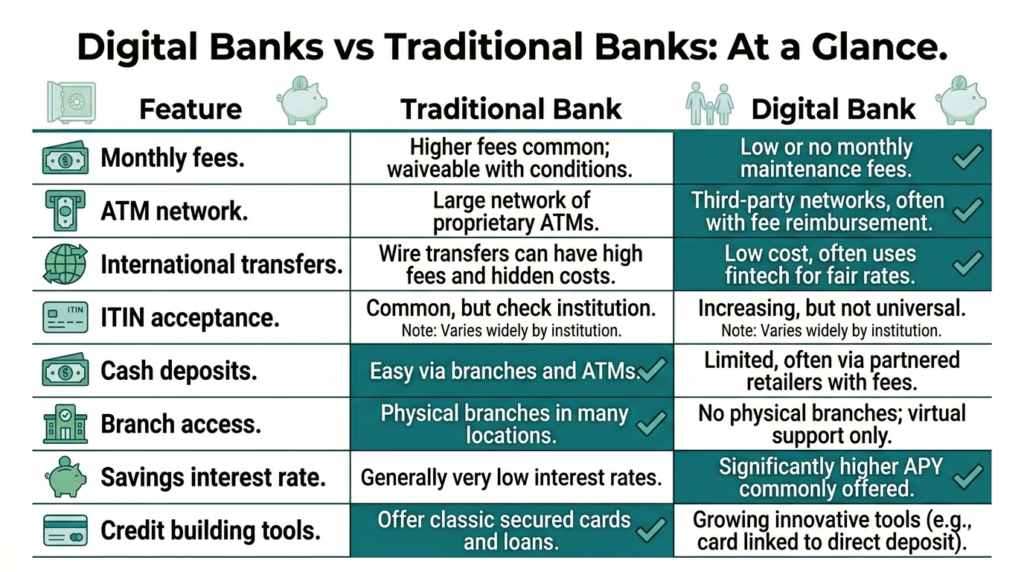
What Immigrants Actually Need From a Bank
Before choosing between digital and traditional, it is worth defining what you actually need a bank to do for you. Most immigrants in their first years in the United States need the following:
An account they can open with their available documentation, whether that is an SSN, an ITIN, a passport, or a combination. A way to receive their paycheck through direct deposit. A debit card for everyday spending. A way to save money and earn something on it. A way to send money home internationally without paying enormous fees. No surprise charges that drain their balance while they are still building it.
Some immigrants also need cash deposit capabilities, particularly if they are paid partially in cash or work in industries where tips arrive in physical form. And some need the in person reassurance and relationship building that comes from a branch they can walk into.
Knowing which of these applies to you narrows the decision considerably.
Where Digital Banks Win for Immigrants
No Monthly Fees and No Minimum Balance
This is the most immediate and impactful advantage of digital banks for immigrants. Neobanks like Chime and SoFi skip monthly fees entirely, while most traditional banks charge $10 to $15 monthly just for keeping your money there. For an immigrant managing a tight budget in their first year, eliminating a $12 monthly fee saves $144 per year with zero effort.
Digital banks also universally drop the minimum balance requirement. You do not need to maintain $1,500 in your account to avoid fees, which is a requirement that punishes the people who can least afford it.
Higher Interest Rates on Savings
Neobanks have challenged the traditional banking model by offering consumers tech savvy, digital only bank accounts, often with low or no fees and higher than average interest rates.
A traditional savings account at a major bank pays approximately 0.01% to 0.08% annually. A high yield savings account at a digital bank currently pays around 4.00% or more annually. On $3,000 in savings, the difference is $120 per year versus less than $3 per year. Same money. Same FDIC protection. Dramatically different return.
Early Direct Deposit
Most digital banks process direct deposits one to two days before the official payment date, because they release funds as soon as the payroll file is received rather than waiting for the official settlement date. For immigrants managing a budget where a day or two of timing can matter, this is a genuinely useful feature.
Better Mobile Experience
Digital-only banks dominate satisfaction rankings, with five neobanks, including Revolut, Cash App, Chime, Ally, and SoFi, all outperforming Chase, the highest-rated traditional bank, demonstrating a systematic satisfaction advantage for digital first business models.
The mobile apps at digital banks are their core product rather than an add on to their branch network. They are typically better designed, faster, and easier to navigate than the apps of traditional banks. For immigrants who manage everything from their phone, this difference in daily usability is real.
Lower International Transfer Costs
Traditional banks charge $25 to $50 per international wire transfer plus an exchange rate markup of 3 to 5%. Many digital banks and neobanks have built international transfer features with dramatically lower fees. Wise, which functions as a digital financial platform rather than a traditional bank, charges fees starting around 0.41% and uses the real mid-market rate. Even SoFi and similar platforms offer international transfer options at meaningfully lower cost than a bank wire.
Where Traditional Banks Win for Immigrants
Branch Access When Things Go Wrong
When something goes wrong with a bank account, having a physical branch you can walk into makes a significant difference. If your debit card is stolen, if your account is frozen due to a suspected fraud flag, if you receive an incorrect statement, or if you simply have a question that the chatbot cannot answer, the ability to sit across from a human being and resolve the problem is valuable.
Digital banks rely entirely on app based chat and phone support. That support is often good. It is not always fast. And for an immigrant who is still building confidence communicating in English, talking to someone in person at a branch can be easier and less stressful than navigating a phone tree or a chat interface.
Cash Deposits
This is the single largest practical disadvantage of most digital banks for immigrants who regularly handle cash. If you are paid partially in cash, work in an industry with cash tips, or simply prefer to deposit physical money, most digital banks have no straightforward way for you to do it.
Some digital banks partner with Green Dot or similar networks to allow cash deposits at participating retail locations, but these partnerships often come with fees of $4 to $5 per deposit and limited location availability. Traditional banks and credit unions accept cash deposits at their branch windows and ATMs with no additional fee.
If you regularly deposit cash, a traditional bank or credit union is almost certainly the more practical choice for your primary account.
Lending and Credit Products
Traditional banks offer the full range of credit products: personal loans, auto loans, mortgages, lines of credit, secured credit cards, and business loans. For an immigrant who is building toward a car purchase, a home purchase, or a small business, having an established relationship with a traditional bank that holds your account history can make the lending process easier.
Most digital banks offer limited lending products. Some, like SoFi, have expanded into personal loans and mortgages, but the breadth of credit products available at a traditional bank or credit union is still meaningfully wider.
ITIN Acceptance Is More Established
Many banks accept an ITIN instead of an SSN or, in some cases, a passport or official foreign ID. Among traditional banks, ITIN acceptance is more clearly documented and more consistently implemented at the branch level. Wells Fargo, Bank of America, and Citibank have all publicly acknowledged ITIN-based account opening, with in-person branch visits required.
Digital bank ITIN acceptance is more variable. Some neobanks require an SSN and have no pathway for ITIN holders. Others have begun accepting ITINs but with less consistent documentation available about the process. If you have an ITIN and are trying to open an account, calling ahead or checking the bank’s specific documentation requirements is essential regardless of which type of institution you choose. Our guide on how to open a US bank account without a Social Security Number covers the specific options available to ITIN holders in detail.
Credit Unions: The Often-Overlooked Third Option
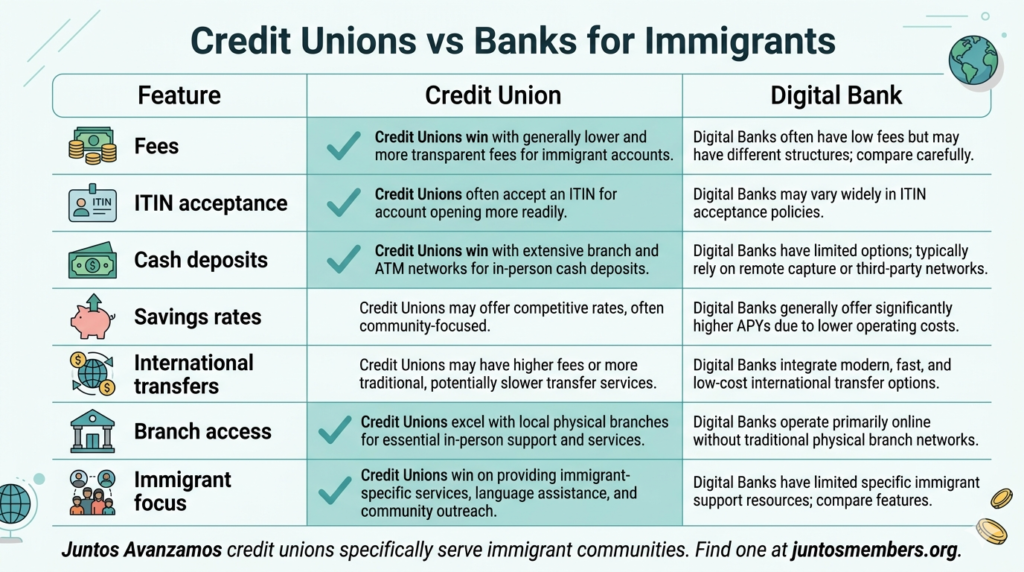
Credit unions deserve their own section because for many immigrants, they represent the best combination of what both banks offer.
A credit union is owned by its members rather than shareholders. Because it is not trying to generate profit, it passes savings back to members through lower fees, better loan rates, and more flexible account requirements. The not for profit structure also creates a genuine incentive to serve underbanked populations, including immigrants, rather than extract fees from them.
The Juntos Avanzamos network is a coalition of credit unions across the United States with a specific commitment to serving immigrant communities. Many banks accept an ITIN instead of an SSN or, in some cases, a passport or official foreign ID. Juntos Avanzamos credit unions go further, accepting consular identification cards, passports from members’ countries of origin, and ITIN numbers, often with staff who speak Spanish and other languages. They exist specifically to serve people the traditional banking system historically excluded.
To find a Juntos Avanzamos credit union near you, visit juntosmembers.org.
Specific Situations and Which Option Fits Best
Rather than declaring one winner, here is a direct framework for different immigrant situations.
You just arrived and have a passport but no SSN or ITIN yet: Your options are limited but exist. Some traditional banks, particularly those in the Juntos Avanzamos network, will open an account with a passport and foreign address. Some neobanks like Majority and Revolut are designed specifically for this situation. Open whatever you can access now and upgrade once your documentation improves.
You have an ITIN but not an SSN: Traditional banks at the branch level, particularly Wells Fargo and Bank of America, have the most established ITIN acceptance policies. Credit unions in the Juntos Avanzamos network are also strong options. Many digital banks still require an SSN, though this is changing. Go to a branch in person with your ITIN documentation rather than applying online.
You have an SSN and are building your financial life: This is where digital banks shine. A free checking account with no fees, a high yield savings account paying around 4.00%, and a good mobile app gives you everything most immigrants need for daily financial management. SoFi stands out here because it combines banking, savings, and investing in one app, which simplifies your financial picture as you start building wealth. Our comparison of best bank accounts for migrants covers the specific products worth considering.
You handle a lot of cash: Use a traditional bank or a credit union as your primary account for cash deposits. You can always open a digital savings account alongside it to earn higher interest on money you do not need immediate access to.
You send money home regularly: Neither traditional bank wire transfers nor most neobanks are the cheapest way to send money internationally. Use a dedicated transfer service like Wise or Remitly funded from your bank account, which avoids both the high bank wire fees and the newer 1% remittance tax on cash-funded transfers. Our article on how to send money abroad without fees covers the full comparison of transfer options.
You are building credit: Both digital banks and traditional banks can support credit building, but the most effective path is a secured credit card, which is offered by both types of institutions. What matters more than which bank you use is whether you are using the account consistently, maintaining a low balance, and paying your card in full every month. Our guide on secured credit cards for beginners with no credit covers the specific card options for immigrants.
The Strategy Most Immigrants End Up Using
After the first year, the most financially effective setup for most immigrants is not one bank. It is two accounts working together.
Account 1: A free checking account, either at a digital bank (if you have an SSN and do not regularly handle cash) or at a credit union (if you handle cash, have an ITIN, or want in person support). This is where your paycheck arrives and where you pay your regular expenses from.
Account 2: A high yield savings account at an online bank or digital bank, where you keep your emergency fund and any savings you are not spending in the next month or two. This account earns meaningfully more interest than a checking account and the slight friction of it being at a different institution makes you less likely to dip into savings impulsively.
This two account structure is simple, costs nothing to maintain, and earns you real money on your savings while keeping your spending money accessible. It is the setup that the wealthiest Americans have used for decades, and it is just as available to a newcomer with $500 in the bank as it is to someone with $50,000.
A Quick Reference: Which Type Fits Which Situation
| Your Situation | Best Starting Point |
|---|---|
| Passport only, no SSN or ITIN | Juntos Avanzamos credit union or immigrant-specific neobank |
| ITIN holder | Traditional bank branch or Juntos Avanzamos credit union |
| SSN holder, minimal cash use | Digital bank (SoFi, Chime, or Ally) |
| Frequent cash deposits | Traditional bank or credit union |
| Sends money home regularly | Digital bank for the account, transfer app for remittances |
| Building credit | Either type, combined with a secured credit card |
| Wants in person help | Traditional bank or credit union |
| Wants highest savings rate | Digital bank high yield savings account |
Disclaimer: This article is for educational and informational purposes only and does not constitute financial or legal advice. Bank features, fees, ITIN acceptance policies, and account requirements change frequently. Always verify current terms directly with any financial institution before opening an account.