
How To Get a US Driver’s License as an Immigrant: State by State Guide
A driver’s license in the United States is not just permission to drive. It is the primary form of identification most Americans use for everything from opening a bank account, to buying alcohol, to boarding a domestic flight, to picking up a package at the post office.
For immigrants, getting that document is often one of the most urgent practical tasks of the first weeks in a new state. And it is also one of the most confusing, because the rules are not set at the federal level. They are set at the state level. Fifty states. Fifty sets of rules. With different documents required, different license types available, and different protections for your data depending on which state you live in.
This guide cuts through that complexity. It explains the different types of licenses available to immigrants, who qualifies for each type, what documents you need, and which states issue licenses to immigrants regardless of documentation status.
Two Types of License: REAL ID vs. Standard
The most important thing to understand before visiting a DMV is the difference between two categories of driver’s license that exist in every state.
REAL ID Compliant License
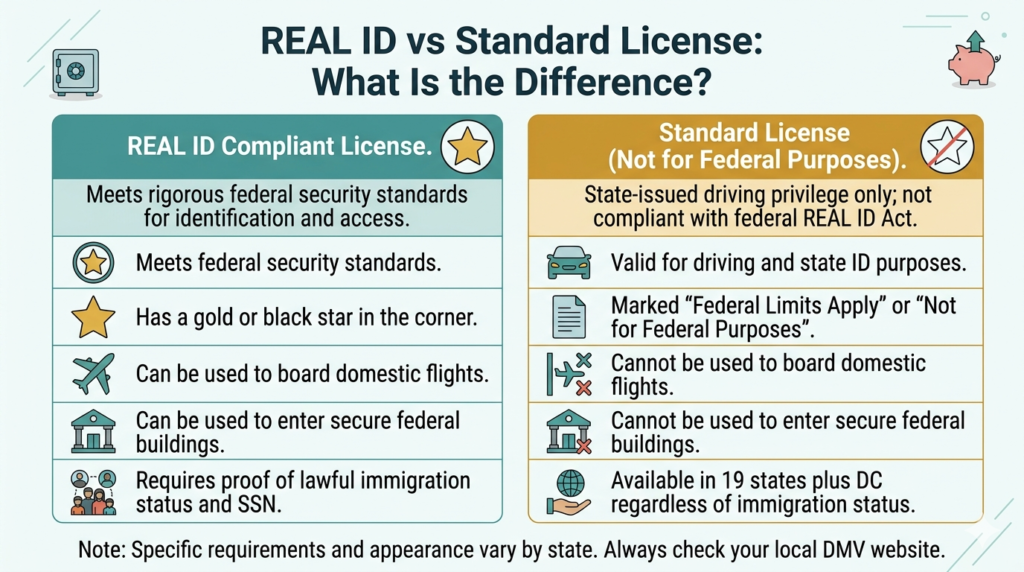
Since May 7, 2025, a REAL ID compliant license or another accepted federal document (like a passport) is required to board a domestic flight or enter certain federal buildings. A REAL ID looks like a regular state driver’s license but has a star printed in the corner, usually gold, black, or white depending on the state.
To get a REAL ID, you must prove lawful presence in the United States. That means providing your Social Security Number along with documents showing your legal immigration status, such as a green card, a work visa, or another USCIS-issued document.
Most lawfully present immigrants, including green card holders, H-1B and other work visa holders, TPS holders, DACA recipients (in most states), refugees, and asylees, are eligible for a REAL ID compliant license. The REAL ID does not reveal your immigration status or look different from licenses issued to citizens. It simply meets the federal security standard.
Standard License (Not for Federal Purposes)
A standard license is a state issued driver’s license that does not meet REAL ID requirements. It is valid for driving, purchasing car insurance, and serving as a state level form of identification. It cannot be used to board a domestic flight or enter federal buildings.
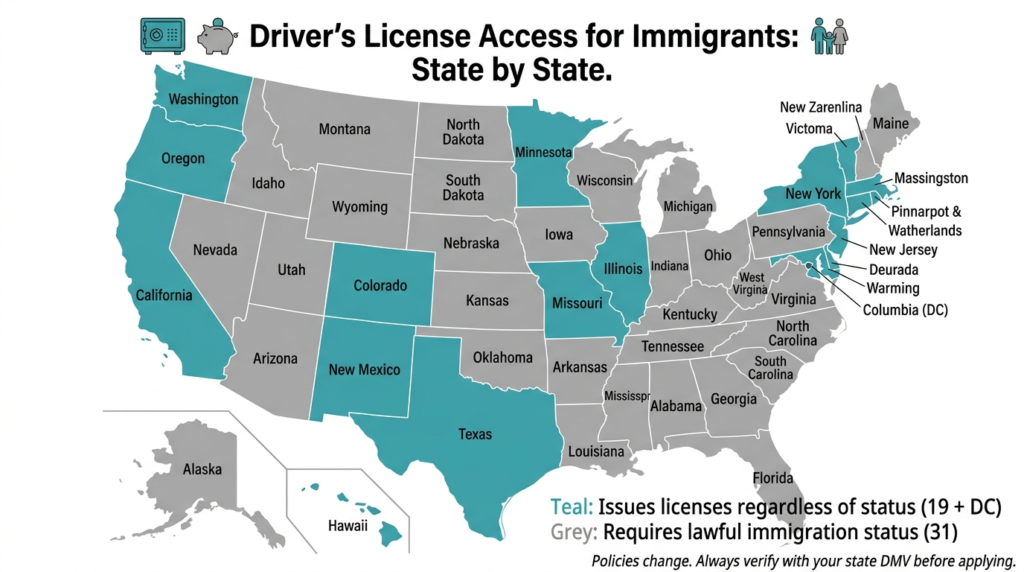
Standard licenses are what most people think of when they ask whether immigrants can get a driver’s license without legal status. About 19 states plus the District of Columbia now issue standard licenses to immigrants regardless of documentation status, using alternative proof of identity such as a foreign passport or consular ID and proof of state residency.
These licenses are typically marked “Federal Limits Apply” or “Not for Federal Purposes” to indicate they are not REAL ID compliant. In most of the states that issue them, the license looks identical to a standard license except for that notation.
If You Have Lawful Immigration Status
If you have a green card, an H-1B visa, an L-1, O-1, TN, F-1 (with work authorization), EAD, TPS, or any other status that authorizes your presence in the United States, you are eligible to apply for a driver’s license in every state. The process is similar to what any resident goes through, with some additional document requirements specific to your immigration status.
What You Typically Need
Proof of identity: Your foreign passport, typically unexpired.
Proof of lawful presence: This varies by license type. For a REAL ID, you need your immigration document, such as your green card, visa, or EAD card. Your I-94 arrival record, available online at i94.cbp.dhs.gov, is accepted in many states as proof of your current authorized stay.
Social Security Number: Required for a REAL ID. If you have an SSN, bring your Social Security card or a document showing your SSN. If you do not have an SSN and are not eligible for one, some states will allow you to apply with an ITIN or a signed declaration stating you are not eligible for an SSN.
Proof of state residency: Two documents showing your name and current address in the state. Accepted documents typically include a utility bill, a bank statement, a lease agreement, a pay stub, or an insurance document. Many states require two separate documents from this category.
Existing license from home country: Many states will accept your foreign driver’s license as proof that you can already drive, though you will still need to pass a written knowledge test and possibly a driving skills test. Some states exempt you from the skills test if your home country has a reciprocal agreement with that state.
The Testing Process
Even if you have been driving for 20 years in your home country, most US states require you to pass at minimum a written knowledge test covering traffic laws, road signs, and safe driving practices specific to that state. The test is available in multiple languages at most state DMVs.
Many states also require a vision screening and a driving skills test behind the wheel with a DMV examiner. The skills test can be waived in some states if you hold a valid license from a country with a reciprocity agreement, or if you hold a license from another US state.
Study the driver’s handbook for your specific state before taking the written test. These handbooks are available for free as PDF downloads on every state DMV’s website and in multiple languages in most states.
If You Do Not Have Legal Immigration Status
This is the most complicated and most politically variable part of the topic, so it deserves a clear, honest explanation.
There is no federal law that grants driver’s licenses to people without lawful immigration status. The federal REAL ID Act specifically excludes anyone who cannot prove lawful presence from receiving a REAL ID compliant document.
However, state governments have the authority to decide who can receive a state issued driver’s license for the purpose of driving. As of mid-2025, 19 states plus the District of Columbia have passed laws allowing immigrants without lawful status to obtain a standard, non REAL ID driver’s license.
The 19 States Plus DC That Issue Licenses Regardless of Status
States permitting undocumented immigrants to drive include California, Colorado, Connecticut, Delaware, Hawaii, Illinois, Maryland, Massachusetts, Minnesota, Nevada, New Jersey, New Mexico, New York, Oregon, Rhode Island, Utah, Vermont, Virginia, Washington, and the District of Columbia.
These licenses are marked “Not for Federal Purposes” and cannot be used to board domestic flights or enter federal buildings. They are valid for driving within the state and for purchasing auto insurance.
What You Need in These States
Requirements vary by state, but the typical documentation for a standard license in a state that issues them without proof of legal status includes:
A foreign passport, consular identification card (like a Matricula Consular), or foreign national ID card. Proof of state residency, such as a utility bill, lease, or bank statement with your current address. A tax identification number or proof that you pay state taxes, required in some states. Proof of a minimum residency period in the state, typically ranging from one month to one year depending on where you live.
Some states also require completion of a driver education course if you are between certain ages and have no prior license.
Privacy Protections: Your DMV Data and Immigration Enforcement
This is something many immigrants want to know before they step into a DMV: what happens to the information they provide?
California’s approach is among the strongest. State law prohibits government agencies, law enforcement, and commercial entities from accessing DMV information for immigration enforcement purposes. New York’s statute prevents disclosure of records related to non commercial license applications, including photos and Social Security numbers, except when required by federal law or a judicial warrant. Virginia prohibits its DMV from sharing any “privileged information” with government agencies for civil immigration enforcement without the applicant’s consent or a judicial order. Colorado, Illinois, Maryland, and New Mexico have enacted similar restrictions.
These protections vary significantly by state. In states that have strong data privacy laws around DMV information, the act of getting a license does not automatically create a pathway for immigration enforcement to access your information. In states without those protections, or in states that do not issue licenses to people without legal status, the picture is different.
If you have concerns about this, consulting with a qualified immigration attorney before applying is worth the time investment.
The 31 States That Do Not Issue Licenses Without Lawful Status
In 31 states across the country, undocumented immigrants are unjustly denied access to driver’s licenses. In these states, you cannot legally drive and cannot obtain a state issued driver’s license without proof of lawful immigration status. This includes states like Texas, Florida, Georgia, Arizona, North Carolina, and most of the South and Midwest.
If you live in one of these states and do not have lawful immigration status, driving without a license creates significant legal risk. A traffic stop can escalate into a much more serious situation. The safest option is to rely on public transit, rideshare services, or transportation provided through your employer or community until your immigration status changes.
One important note on Florida and Tennessee: both states have laws that specifically make it a misdemeanor to drive with a license issued to undocumented immigrants by another state, including the 19 states listed above. If you have a license from California or New York, for example, and you are driving in Florida or Tennessee, be aware of this risk.
The Financial Side of Getting a License
Getting a driver’s license in the United States is not free, and the costs are worth knowing before you plan your DMV visit.
License fees vary by state, typically ranging from $20 to $90 for a standard license, with some states charging more for longer validity periods. Most states issue licenses valid for four to eight years.
Written test fees are usually included in the application fee, but some states charge separately for retakes if you do not pass on the first attempt.
Driving school costs are not mandatory for adults in most states, but if you are unfamiliar with driving on the right side of the road, in heavy US traffic, or on highways, a few hours with a licensed driving instructor is money well spent. Driving instructors typically charge $50 to $90 per hour.
Car insurance is legally required before you legally drive in any state. For an immigrant with no US driving history, insurance premiums start high, typically $150 to $350 per month for a basic policy, and decrease as you accumulate a claims free driving record in the US. Shop multiple insurers before purchasing. GEICO, Progressive, and State Farm all accept new immigrants and non citizens.
A note on finances and the license itself: Getting a driver’s license is also a key step toward financial opportunity. It opens up job markets that require driving, makes it possible to work longer hours without depending on transit schedules, and functions as an accepted form of ID for opening bank accounts, applying for credit, and completing many financial transactions that previously required a passport. The cost of getting licensed is an investment that pays returns quickly for most immigrants.
Step by Step: How to Apply
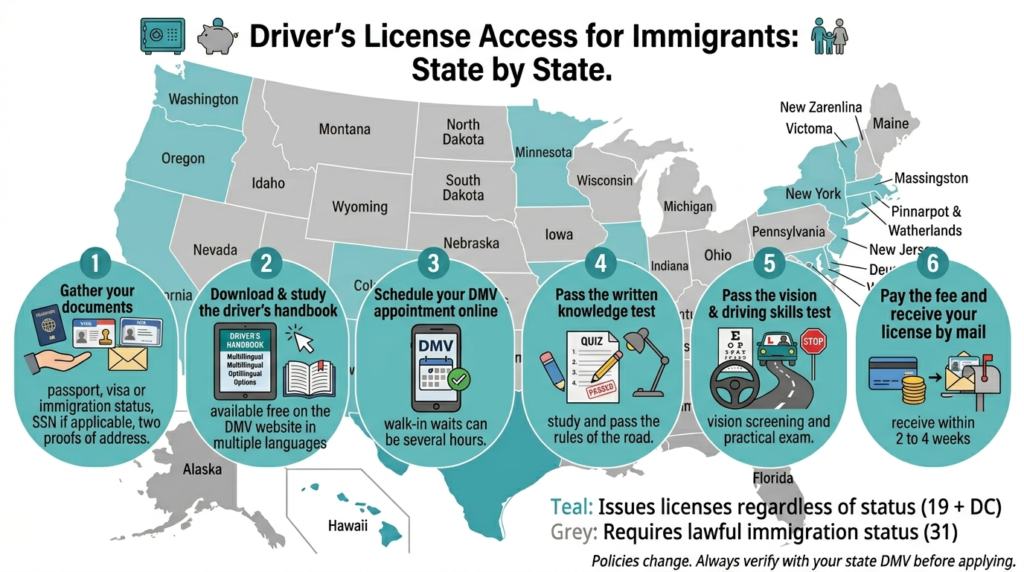
Step 1: Gather your documents before you go. Every DMV visit that ends without a license is usually because of a missing document. Prepare everything in advance. Make copies of every document you bring. Organize them in the order you expect to present them.
Step 2: Download your state’s driver’s handbook and study it. The written knowledge test covers your state’s specific traffic laws, road signs, right of way rules, and driving regulations. The handbook is free and available in multiple languages on your state DMV’s website. Most people who fail the written test did not study the handbook for their specific state.
Step 3: Schedule your appointment online. Walk-in waits at DMV offices can run two to four hours in many urban areas. Most states allow you to schedule an appointment online, which dramatically reduces your wait time. Go to your state DMV’s official website (.gov address) to book.
Step 4: Arrive early and bring everything. Arrive at least 15 minutes before your appointment. Bring originals of every document, not just copies, because DMV staff will inspect original documents. Keep copies for your own records.
Step 5: Take the tests. The written test is typically 25 to 46 questions. You need to answer approximately 80% correctly to pass, though the exact threshold varies by state. The vision screening is quick. The driving skills test evaluates basic vehicle control, observation habits, speed management, and knowledge of traffic signs and right of way.
Step 6: Receive your license. Most states mail your permanent license to your address within two to four weeks. You may receive a temporary paper license at the DMV that is valid in the meantime. Keep your mailing address current with the DMV, particularly if you move.
Converting a Foreign License
If you hold a valid driver’s license from another country, some states allow a simplified conversion process rather than requiring a full new application with all tests.
States with formal reciprocity agreements for certain countries include California, Florida, Texas, New York, and several others. The specific countries involved and the exemptions granted vary by state. Germany, France, Canada, Taiwan, South Korea, and several other countries have reciprocity agreements with at least some US states.
If your home country has a reciprocity agreement with your new state, you may be exempt from the driving skills test, the written knowledge test, or both. Contact your state DMV directly to ask about their specific reciprocity policies and which countries are covered.
Even without a formal reciprocity agreement, many states will accept your foreign license as evidence that you can drive and allow you to skip the skills test while still requiring the written knowledge test.
If your foreign license is not in English, bring a certified translation or an International Driving Permit alongside it. An International Driving Permit is issued by automobile associations in your home country before you travel and serves as an official translation of your license. It is not a license itself and does not replace the need to get a US license, but it is useful supplementary documentation.
Frequently Asked Questions
Q: Can I use an International Driving Permit instead of a US license? An International Driving Permit (IDP) allows you to drive legally in the US for a temporary period, generally up to one year from your date of entry, as a visitor. Once you establish residency in a state, most states require you to obtain a state issued driver’s license within 30 to 90 days of establishing residency. The IDP does not replace a state license for residents.
Q: Can immigrants get a REAL ID? Lawfully present immigrants can get a REAL ID compliant license by providing their immigration documents and Social Security Number. Undocumented immigrants cannot get a REAL ID, but can obtain a standard license in the 19 states plus DC that issue them.
Q: Will getting a driver’s license affect my immigration case? For immigrants with lawful status, getting a driver’s license does not affect an immigration case. For immigrants without lawful status in states that have strong DMV data privacy protections, the risk is significantly reduced, though not zero. Consulting an immigration attorney before applying in this situation is the most conservative and safest approach.
Q: Does a US driver’s license help me build credit? Not directly. A driver’s license does not appear on a credit report. However, it functions as accepted ID for opening a bank account and applying for a secured credit card, both of which are the first steps toward building a US credit history.
Q: How do I study for the written knowledge test? Download the official driver’s handbook from your state DMV’s website. Many states also offer free online practice tests. Apps like DMV Genie and Zuto offer practice tests for all 50 states and are available in Spanish and other languages.
Disclaimer: This article is for educational and informational purposes only and does not constitute legal or immigration advice. Driver’s license laws, eligibility rules, and state policies change. Always verify current requirements directly with your state DMV and consult a qualified immigration attorney if you have concerns about how obtaining a license may affect your specific situation.