
The 7 Biggest Financial Mistakes Immigrants Make in Their First Year
Nobody arrives in the United States with a manual. You get a visa, a plane ticket, maybe a phone number for a distant relative who moved here years ago, and a general understanding that things work differently here. What you do not get is anyone sitting you down and explaining how the financial system actually operates, what it rewards, what it punishes, and where the traps are.
So most of us learn by making mistakes. Expensive ones. Avoidable ones. Mistakes that cost real money during the years when we could least afford it.
I made several of these myself. So did almost every immigrant I know. The ones on this list are not unusual or shameful, they are the predictable result of navigating a financial system you were never taught, often under pressure, often in a second language, often while carrying obligations back home that do not pause for you to figure things out.
This article is the thing I wish someone had put in my hand on arrival day.
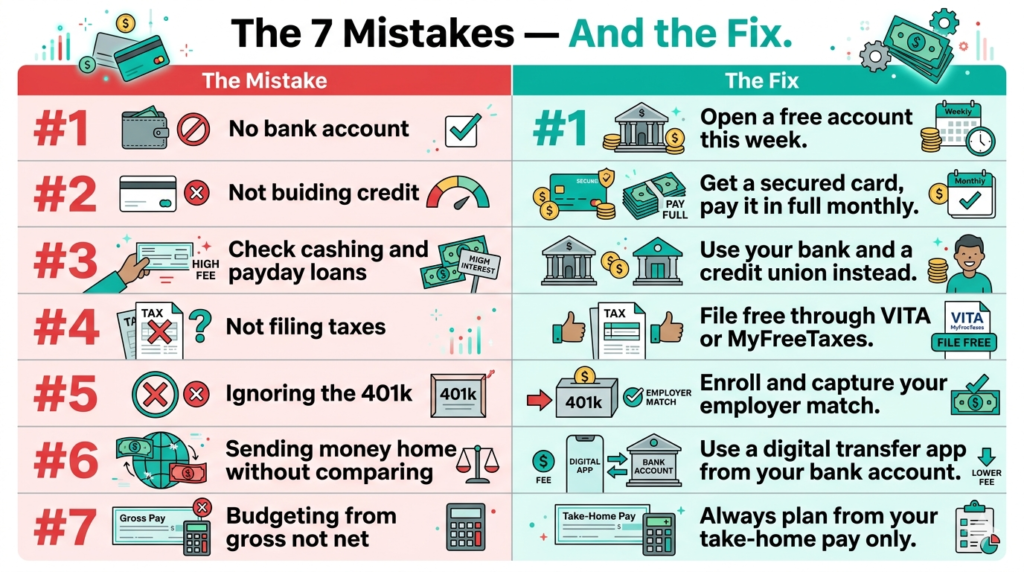
Mistake 1: Not Opening a US Bank Account Immediately
This is the most common and most costly mistake of all, and it compounds every other mistake on this list.
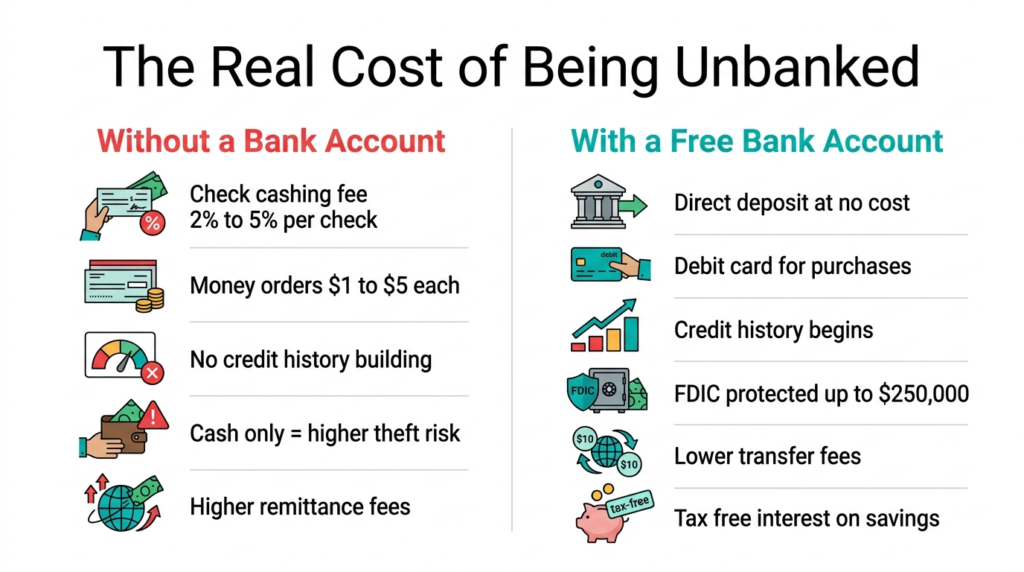
Without a US bank account, you are effectively locked out of the mainstream financial system. You pay fees to cash your paychecks. You pay fees to buy money orders for rent or utilities. You pay higher fees to send money home because you cannot use digital transfer apps that require a linked bank account. You cannot build a credit history. You cannot receive direct deposit. You cannot access the lower cost services that are available only to people inside the banking system.
According to the Consumer Financial Protection Bureau, households where only Spanish is spoken are five times less likely to use a bank or credit union than English speaking households. The reasons are real and understandable, distrust of institutions, language barriers, fear that immigration status will cause problems, uncertainty about what documents are required. But the financial cost of staying outside the system is enormous and accumulates every single month.
Cashing a $1,000 paycheck at a check cashing store can cost $50 or more each time, adding up to over $1,300 a year. That is money that could be in your savings account instead.
The reality is that most banks and many credit unions accept non citizen residents. You typically need a passport, a US address, and either a Social Security Number or an ITIN. Some banks explicitly accept ITIN holders. Credit unions in immigrant communities often have the most flexible requirements of all.
If you are worried about what a bank account does to your immigration record: a basic checking or savings account is not a public benefit and is not considered by USCIS in any public charge analysis. Opening one is purely a financial decision with no immigration consequences.
Our guide on how to open a US bank account without a Social Security Number walks through the specific options available to ITIN holders and immigrants at different stages of the process.
Mistake 2: Not Building Credit From Day One
You can be a highly educated professional with a strong financial history in your home country, and in the United States, you are invisible to the credit system. Your credit score from back home does not transfer. Your financial track record does not transfer. You start from zero, or more precisely, from nothing at all, which credit bureaus call being “credit invisible.”
In 2022, nearly half of recent immigrants reported difficulty obtaining a US credit card, citing lack of credit history and unfamiliarity with the system. And yet, a credit score here determines not just whether you can borrow money but whether you can rent an apartment, what you pay for car insurance, and in some cases whether you get a job.
The mistake is not that you arrive with no credit history, that is unavoidable. The mistake is not starting to build one immediately.
The fastest legitimate paths to building a US credit score from zero include:
A secured credit card. You deposit a small amount, typically $200 to $500, as collateral, and the bank issues you a card with a credit limit equal to your deposit. Use it for small purchases each month, pay the full balance before the due date, and your on time payment history begins appearing on your credit report within 30 to 60 days.
A credit builder loan. Offered by many credit unions and community banks, these are small loans specifically designed to help people build credit. You make monthly payments and at the end of the loan term, you receive the money. Every payment builds your credit history.
Becoming an authorized user. If you have a trusted friend or family member with a good credit history and a US credit card, being added as an authorized user on their account can transfer some of their credit history to you. You do not need to use the card, just being listed helps.
The target to work toward in your first year is a credit score of 670 or above, which is considered “good” by most lenders and opens the door to unsecured credit cards, apartment approvals without large deposits, and better loan terms.
Mistake 3: Using Check Cashing Stores and Payday Lenders
This mistake and Mistake 1 are closely connected: people who do not have bank accounts often end up using the services that fill that gap, and those services are significantly more expensive.
Check cashing stores, payday lenders, rent to own furniture companies, and pawn shops are businesses specifically designed to profit from people who have no better option. They are not predatory because they are run by bad people. They are predatory because their entire business model depends on charging high fees to people who cannot access the free or low cost alternatives.
Payday loans carry annual percentage rates (APRs) ranging from 300% to 800%. According to the Consumer Financial Protection Bureau, over 80% of payday loans are reborrowed within a month, and one in four borrowers reborrow 9 or more times. Borrowers often end up paying more in fees than they initially borrowed.
In a 2021 National Financial Capability Study conducted by FINRA, 37% of Hispanic adults said they had used high cost services like payday loans, pawn shops, or auto title loans. This is not a personal failing, it is the predictable outcome when people are excluded from the mainstream banking system.
The fix, again, starts with a bank account. Once you have a free checking account with a debit card, check cashing stores become unnecessary. Once you have a small emergency fund and a credit card, payday lenders become unnecessary. The emergency fund and the credit union are the replacements, and they cost a fraction of what the high cost alternatives charge.
If you need cash urgently and do not yet have a credit card, most credit unions offer small personal loans at dramatically lower rates than payday lenders. Many community development financial institutions (CDFIs) also offer emergency loan products specifically designed for people with limited credit history.
Mistake 4: Not Filing Taxes — Or Not Knowing You Could Get Money Back
Many immigrants do not file a tax return in their first year, or for several years, because they believe they cannot, they should not, or it is not worth the trouble. Some have been told directly that filing is not their concern. Some assume that because they were paid in cash or received no tax forms, taxes do not apply to them.
All of these assumptions cost real money.
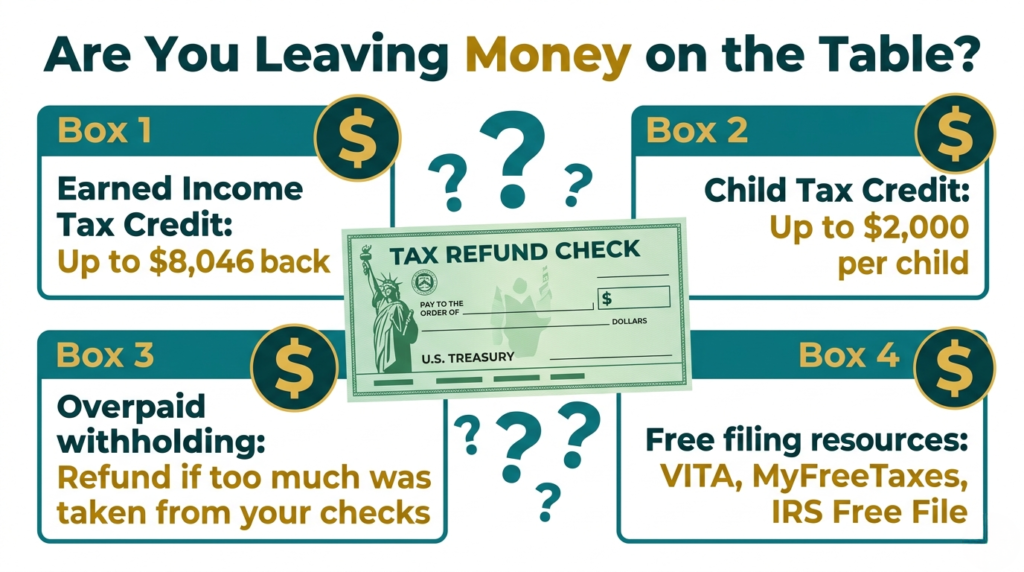
The US tax system works differently from most countries. Taxes are withheld from your paychecks throughout the year based on estimates. At the end of the year, you file a return that reconciles what was withheld against what you actually owe. If too much was withheld, which is extremely common for people who work part of the year, have multiple jobs, or fill out their W4 incorrectly, you receive a refund of the difference.
Beyond refunds from overwithholding, there are credits available to working immigrants that can put thousands of dollars back in your pocket. The Earned Income Tax Credit alone can be worth up to $8,046 for a family with three or more children. The Child Tax Credit can add up to $2,000 per qualifying child on top of that. But these credits only reach you if you file a return and claim them. The IRS does not send you money you are owed without being asked.
Not filing also has immigration consequences. Tax records are requested during green card applications, naturalization proceedings, visa renewals, and affidavits of support. A gap in your tax filing history creates questions that are difficult to answer later.
The good news: most newcomers qualify for completely free tax filing. VITA sites offer free in person tax preparation for households earning $67,000 or less. MyFreeTaxes accepts ITIN filers at no cost. IRS Free File is available online for anyone earning under $89,000.
Our guide to free tax filing resources every newcomer should know about covers every free option in detail, including which ones serve ITIN holders and Spanish-speaking filers.
Mistake 5: Not Using the 401(k) — Especially When There Is an Employer Match
Immigrants coming from countries with different financial systems often struggle to understand the savings and investment options available, such as 401(k) plans, individual retirement accounts, and high yield savings accounts. As a result, newcomers can miss out on opportunities to grow their wealth or save for retirement due to unfamiliarity with these savings vehicles.
The 401(k) is one of the most powerful wealth building tools available to working people in the United States, and it is routinely left unused by immigrants who do not understand what it is, do not trust money they cannot immediately access, or simply never got around to enrolling during their first weeks of a new job.
Here is what a 401(k) actually does: every dollar you contribute comes out of your paycheck before federal income tax is calculated, which immediately reduces your tax bill. The money then grows inside a tax sheltered account, investing in a mix of funds you choose, and compounds over the years without being taxed until you withdraw it in retirement.
The most important part of the 401(k) for newcomers is the employer match. Many employers will match a percentage of what you contribute, often 50% or 100% of contributions up to a certain percentage of your salary. If your employer matches 50% of contributions up to 6% of your salary and you are not contributing at least 6%, you are leaving free money on the table every single paycheck. That match is part of your compensation. Not capturing it is the equivalent of turning down a portion of your salary.
You do not need to contribute the maximum to benefit. Even contributing 3% of your salary to capture the full employer match is meaningful. The question to ask HR in your first week is simple: does this employer offer a 401(k) match, and what do I need to contribute to receive the full match?
Mistake 6: Sending Money Home Without Comparing Costs
Most immigrants send money home. It is one of the most consistent financial behaviors across every immigrant community, regardless of income level or country of origin. And in most cases, it is being done without comparing the real cost of different options.
The sticker price of an international transfer is almost never the full cost. Transfer fees are visible and easy to compare. Exchange rate markups are not. A service that advertises “zero fees” may be taking 3% to 5% of your transfer in the form of a worse exchange rate, money that quietly never reaches your family.
The way to compare the true cost of any transfer is to look at one number: how many units of the recipient’s currency does $1,000 in your pocket turn into? That final amount, after all fees and exchange rate effects, is the only number that matters.
Then there is the new 1% federal excise tax on cash funded international remittances that took effect January 1, 2026. If you bring cash to a retail agent to fund your transfer, which millions of immigrants do, that cash payment now triggers an additional 1% tax on the full transfer amount. Bank account transfers, debit card payments, and credit card funded transfers are explicitly exempt.
The fix on both fronts is the same: use a digital transfer service funded from your US bank account. Services that operate digitally and fund from your bank account or debit card avoid the 1% tax and typically offer significantly better exchange rates than retail cash services.
Our article on the best tax exempt ways to send money home in 2026 compares the top options in detail and explains exactly which payment methods are exempt from the new tax.
Mistake 7: Treating Your Gross Salary as Your Real Income
This is one of the most quietly damaging mistakes a newcomer can make, and it causes problems that ripple through housing decisions, budget planning, and financial stress for months.
When you accept a job offer of $50,000 a year, that is your gross salary, what you earn before deductions. After federal income tax, Social Security, Medicare, state income tax (if your state has one), and any benefits you enrolled in, your take home pay is often 25% to 35% lower than your gross. A $50,000 salary translates to roughly $3,200 to $3,500 per month in your pocket in most states, not the $4,167 a month that dividing by 12 would suggest.
The problem happens when you make financial commitments based on gross income. You sign a lease for an apartment that requires income of three times the monthly rent, which is calculated from gross income, and then discover that your actual monthly take home cannot sustain that rent plus your other expenses. You agree to a car payment assuming you will have more money each month than you actually receive. You send a fixed amount home each month that felt affordable against your salary but leaves nothing for emergencies once your actual take home arrives.
The rule is simple: budget from your net pay only. Your gross salary is the number on your offer letter. Your net pay is the number that actually appears in your bank account after every deduction. Those are two very different numbers and all financial planning should be based on the second one.
If you have never sat down and understood what all those deductions on your check actually are, our guide on your first US pay stub explained walks through every line in plain language so nothing surprises you again.
The Thing All Seven Mistakes Have in Common
Every mistake on this list has the same root cause: the US financial system was not designed to explain itself to people who did not grow up in it.
The system rewards people who know which accounts to open, which employers match 401(k) contributions, which transfer services charge the lowest real cost, and which free resources exist for filing taxes. It does not volunteer that information. You have to find it.
That is exactly why this blog exists. And why the mistakes above are not a reflection of how smart or hard working you are, they are a reflection of how much information was being withheld from you.
Now you have it. Start with the first mistake and work your way through the list. None of these require a lot of money to fix. Some require just a decision and 20 minutes of your time. All of them will change your financial trajectory here.
Disclaimer: This article is for educational and informational purposes only and does not constitute financial, tax, legal, or immigration advice. Individual circumstances vary significantly. Always consult qualified professionals for guidance specific to your situation.