
Common Investing Mistakes New Immigrants Make
There is a particular kind of financial mistake that is easy to understand in hindsight and almost invisible in the moment.
Not the dramatic ones. Not the scams or the obvious gambles. The quiet ones. The ones that look like caution or patience or common sense, but quietly cost thousands of dollars over years and decades.
These are the investing mistakes most immigrants make in their early years in the United States, and they are almost never driven by greed or recklessness. They are driven by unfamiliarity with a system that nobody explained, a distrust that is entirely reasonable given most immigrants’ experience with financial institutions back home, and a fear of making the wrong move that results in making no move at all.
This article names them directly, explains why each one happens, and tells you what to do instead.
Mistake 1: Waiting Until You Feel Ready
This is the most expensive mistake on the list, and also the most understandable.
Investing feels large and unfamiliar when you first encounter it. The terminology is new. The accounts are new. The platforms are new. Everything seems like it requires more understanding before you can safely proceed. So you wait. You tell yourself you will start once you understand it better, once your income is a little more stable, once you have read a few more articles.
Meanwhile, the market keeps growing without you.
The mathematics of compound growth are unforgiving in this direction. Every year of delay is not just one year of missed returns. It is one year less of that return compounding on itself into the future. A $5,000 investment at age 30 growing at 7% annually becomes approximately $38,000 by age 65. The same $5,000 invested at age 40 becomes approximately $19,000. The delay of ten years, with zero additional contributions, cuts the final outcome nearly in half.
You will not feel fully ready. Nobody does. The solution is not more preparation. It is starting with a small, specific, simple action: opening an account, linking your bank, investing $50 in a total market index fund, and letting that first position be the beginning of your education rather than the conclusion of it.
If you want a concrete starting point with a specific dollar amount, our guide on how to start investing in the US with $100 walks through exactly what to do from the beginning.
Mistake 2: Keeping Everything in a Savings Account
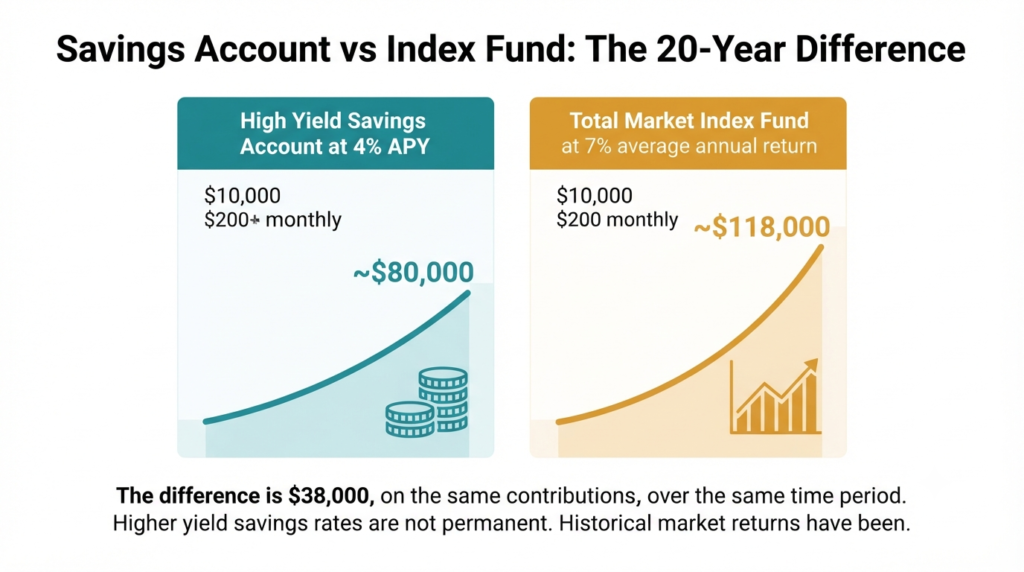
A high yield savings account paying 4% annually is genuinely good for its purpose: keeping your emergency fund safe, liquid, and earning more than a standard checking account. The mistake is treating it as your primary wealth building tool rather than one component of a larger financial strategy.
The current 4% rate on high yield savings accounts is higher than the historical average and will not remain at this level permanently. When interest rates fall, savings account rates fall with them. The stock market’s long term average annual return of approximately 7% to 10% is not risk free, but it is powered by the underlying growth of the actual companies in the global economy, which is a more durable engine than any interest rate environment.
Money you will not need for at least three to five years does not belong in a savings account. It belongs in investments that can grow meaningfully over that time period. The practical line is straightforward: emergency fund and near term expenses in a high yield savings account, everything else with a longer horizon in a diversified investment account.
For a clear comparison of where different kinds of money belong, our article on index funds vs high yield savings: where should an immigrant put their first $1,000 walks through the decision in plain language.
Mistake 3: Not Capturing the Employer 401(k) Match
Every dollar of employer matching contribution that you do not collect is a dollar your employer will not carry forward. It is not waiting for you next year. It does not accumulate and become available later. If you do not contribute enough to trigger the match in a given pay period, that money is simply gone.
Many immigrants either never enrolled in their employer’s retirement plan, enrolled but at a contribution rate below the match threshold, or enrolled without understanding what matching means and therefore never optimized for it. The result is the same in each case: years of free compensation left uncollected.
The employer match is the single highest return financial opportunity available to most working immigrants. A 50% employer match is an immediate 50% return on your contribution before a single dollar of investment growth occurs. No index fund, no savings account, and no other investment vehicle can match that return reliably.
The question to ask HR today, if you have not already, is simple: what is the company’s matching policy, and what percentage do I need to contribute to receive the full match? Whatever percentage that answer describes is your minimum 401(k) contribution. Anything less is leaving money that was already committed to you sitting uncollected.
Our full guide on what is a 401(k) and should I actually use mine explains how the match works, how to enroll, and what to do with the account once you have.
Mistake 4: Panic Selling During a Market Downturn
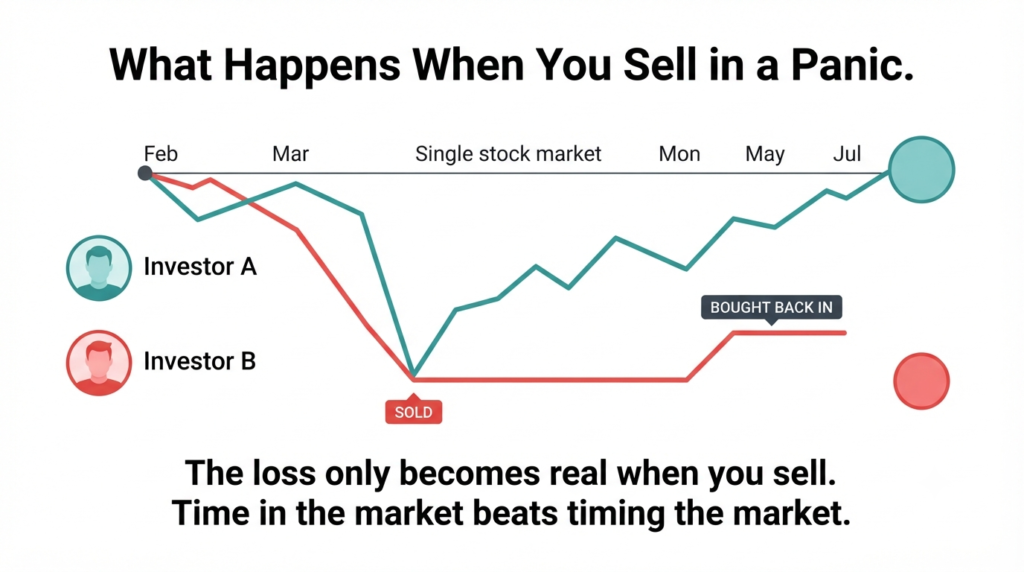
Stock market values fluctuate. Sometimes they fluctuate dramatically. A 20% or 30% decline in the value of your portfolio will feel deeply uncomfortable, particularly for a newcomer who is already managing financial uncertainty and may not have a large financial cushion elsewhere.
The natural impulse in that moment is to sell: to stop the loss, to protect what remains, to wait until things look more stable before investing again.
This impulse, while psychologically understandable, is financially destructive almost every time it is acted on.
Market recoveries are often rapid and unpredictable. The best days in the stock market frequently occur during or immediately after the worst days, and the investors who sell during a downturn often miss those recovery days entirely. A study covering decades of S&P 500 returns found that missing just the 10 best single trading days in a 20-year period cut the investor’s total return by more than half.
The correct response to a market downturn is not selling. It is continuing to invest consistently, since you are now buying the same index funds at lower prices than before, which improves your long term return if you hold through the recovery.
Investing is not a performance you watch and react to. It is a background process you set up, contribute to regularly, and deliberately leave alone during the periods when leaving it alone feels hardest.
Mistake 5: Investing in Things You Do Not Understand
The immigrant community is unfortunately a frequent target of investment scams and predatory products, precisely because the combination of ambition, unfamiliarity with US financial regulations, and community trust networks makes certain fraudulent schemes easier to spread.
Cryptocurrency offerings with guaranteed returns. Multi level marketing investment programs. Unregistered securities sold by a community member or trusted figure. Real estate deals with urgent timelines and promises of outsized returns. Foreign investment products marketed specifically to immigrant communities.
A simple rule protects against virtually all of these: do not invest in anything you cannot explain clearly in two plain sentences. If the investment requires a long explanation of why it is an exception to the normal rules, that explanation is not a reason to invest. It is a warning sign.
The plain alternatives, a total stock market index fund, an S&P 500 index fund, a target date retirement fund, are not exciting. They do not promise fast returns. They do not require a trusted person to explain why this specific opportunity is different. They are, however, backed by decades of documented performance, regulated by the SEC and FINRA, and require no special knowledge to use effectively.
For an overview of what legitimate, accessible investment options are available to immigrants in the US, our article on what is investing and why does it matter covers the foundations clearly and without jargon.
Mistake 6: Investing in Foreign Mutual Funds After Arriving in the US
This is one of the most technically damaging mistakes an immigrant investor can make, and it is almost never committed intentionally.
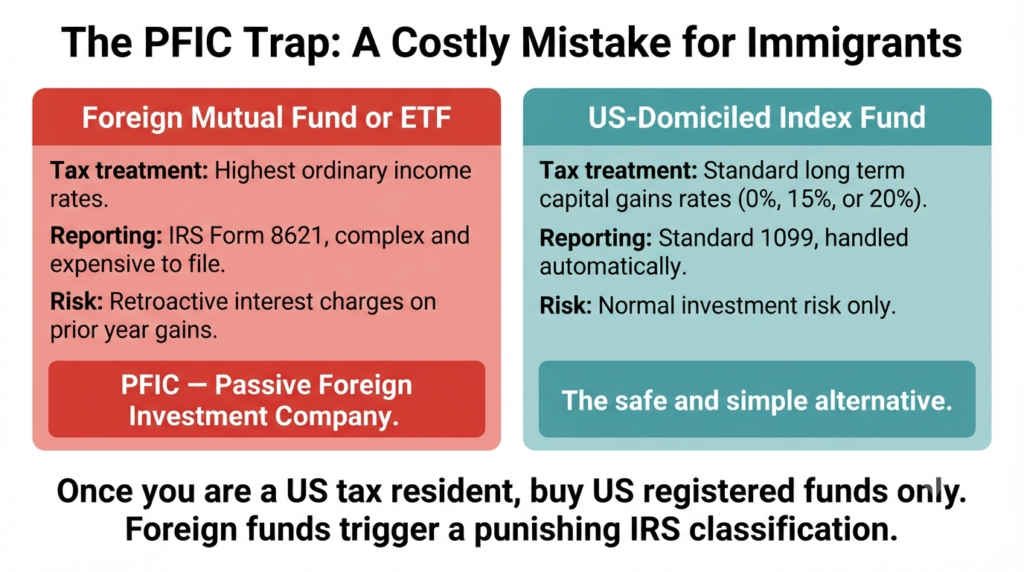
When immigrants arrive in the United States and become US tax residents, they often continue investing in the mutual funds or investment products they were familiar with in their home country. Or they open accounts with foreign financial institutions targeting expat and immigrant investors. In either case, the IRS may classify these foreign investment funds as Passive Foreign Investment Companies, commonly called PFICs.
The tax treatment of PFICs under US law is punishing. Gains are taxed at the highest ordinary income rates rather than the preferential long term capital gains rates. Interest charges apply retroactively to gains from prior years. The reporting requirement, IRS Form 8621, is complex enough that most tax preparers charge significant additional fees to handle it, and some refuse to handle it at all.
The fix is straightforward: once you are a US tax resident, invest through US registered accounts in US domiciled funds. A total market ETF, an S&P 500 index fund, or a target date retirement fund at Fidelity, Vanguard, or Schwab is regulated by the SEC, taxed at standard rates, and requires no special IRS reporting beyond what your brokerage handles automatically.
If you currently hold foreign investment funds and are a US tax resident, consulting a tax professional with international experience before your next filing is worthwhile to understand your current exposure and the most efficient path forward.
Mistake 7: Ignoring the Roth IRA Because It Sounds Complicated
A Roth IRA is one of the most powerful wealth-building accounts available in the United States, and it is open to most lawfully working immigrants regardless of citizenship status. It grows completely free of federal income tax. Qualified withdrawals in retirement are also completely tax free. Your contributions, not the earnings, can be accessed at any time without penalty, which addresses one of the primary concerns immigrants have about locking money away.
Many immigrants bypass it entirely because the name is unfamiliar, because the annual contribution limit and income phase out rules sound complex, or because they assume it is restricted to US citizens.
None of those concerns are barriers in practice. Opening a Roth IRA takes 15 minutes at Fidelity or Schwab. The contribution limit is $7,000 per year for most people under 50. It is available to green card holders, H-1B holders, and other lawfully working immigrants with US earned income and an SSN.
Our complete guide on why every immigrant needs a Roth IRA explains exactly how it works, who qualifies, and why the tax free growth it provides is particularly valuable for immigrants who may be in a lower tax bracket now than they will be later.
Mistake 8: Treating Investing as Something to Do “Later”
There is always a reason to delay. The immigration paperwork is still in process. The emergency fund is not quite where you want it. The income feels too uncertain this year. Something is always happening that makes investing feel like the next thing rather than the current thing.
Each of those reasons may be valid individually. Collectively, they become a habit of permanent deferral.
The honest framing is this: for most immigrants, investing a modest amount consistently from the beginning is financially superior to investing a larger amount perfectly later. A $100 monthly investment started today will outperform a $500 monthly investment started five years from now, depending on market returns and personal circumstances, not because $100 is more than $500, but because the five years of compound growth on those early contributions are irreplaceable.
Starting does not require certainty. It requires a small, specific action: open an account, fund it with something, invest it in a simple index fund. Everything else, increasing the contribution, refining the strategy, exploring additional accounts, can happen incrementally as your knowledge and income grow.
The Connecting Thread
Every mistake on this list shares the same underlying cause: the investing information that most people absorb casually over years of living in the US financial system is information that immigrants have to seek out deliberately. Nobody teaches it to you in onboarding. Your HR department gives you an enrollment form, not an explanation. The financial industry markets its most profitable products to you, not its most appropriate ones.
The immigrants who avoid these mistakes are not smarter or more financially sophisticated than those who make them. They simply encountered better information sooner. This article is that information.
What you do with it next is the actual decision.
Disclaimer: This article is for educational and informational purposes only and does not constitute financial, tax, or legal advice. All investing involves risk. PFIC rules and other tax regulations are complex and change. Consult a qualified financial and tax professional for advice specific to your situation.