
Avoid the 1% Cash Tax: How to Send Money Home for Free in 2026
who sends money home every single month and has no intention of paying a cent more than necessary?

Every other month, without fail, I open an app and send money home.
It is not something I think of as a financial transaction, even though technically it is. It is more like the cord that keeps me connected to the people I left behind, the ones who stayed so I could go. My mother’s electricity bill. My younger sister’s school fees. The occasional emergency that pops up without warning at a time when the exchange rate is particularly brutal.
So when news broke in early 2026 about a new 1% federal remittance tax on international money transfers, I felt it personally. Not as an abstract policy discussion, but as a real number on a real spreadsheet: a tax on the money I send home, collected at the moment I send it, added to the fees and exchange rate markups that already chip away at every transfer.
Here is what I have since learned, and what I want to make sure you know before your next transfer: the 1% remittance tax is entirely avoidable for most people who send money home. You do not need to send less. You do not need to find workarounds. You just need to understand exactly what triggers the tax and use a payment method that is explicitly exempt under the law. This article walks you through everything.
What Is the 1% Remittance Tax and Why Does It Exist?
The 1% excise tax on international remittances was enacted as part of the One Big Beautiful Bill Act, signed into law on July 4, 2025, and effective as of January 1, 2026. It is codified under IRC Section 4475 and applies to certain outbound money transfers sent from the United States to recipients in foreign countries.
The tax equals 1% of the total amount the sender provides. If you send $1,000 using a cash-funded payment method, an extra $10 is charged as remittance tax, on top of the provider’s regular transfer fee. At higher transfer amounts – $500 per month to support a family, multiplied across 12 months, that adds up to real money every year that could instead reach the people you are trying to help.
The Joint Committee on Taxation estimates the tax will raise approximately $10 billion in federal revenue over 10 years. The revenue math points to who the law is primarily aimed at: transfers made mostly by unbanked immigrants who rely on cash-funded services at retail locations because they do not yet have a US bank account.
You do not need to file any additional paperwork as a sender. The remittance provider , the bank, money transfer company, or financial institution, collects the 1% tax from you at the time of transfer and is then responsible for remitting it to the IRS. Your receipt will reflect it, and that is the end of your involvement as a sender.
The good news, and this is the entire point of this article, is that the law includes explicit, broad exemptions that cover the payment methods most digital transfer services already use.
What Triggers the Tax (And What Does Not)
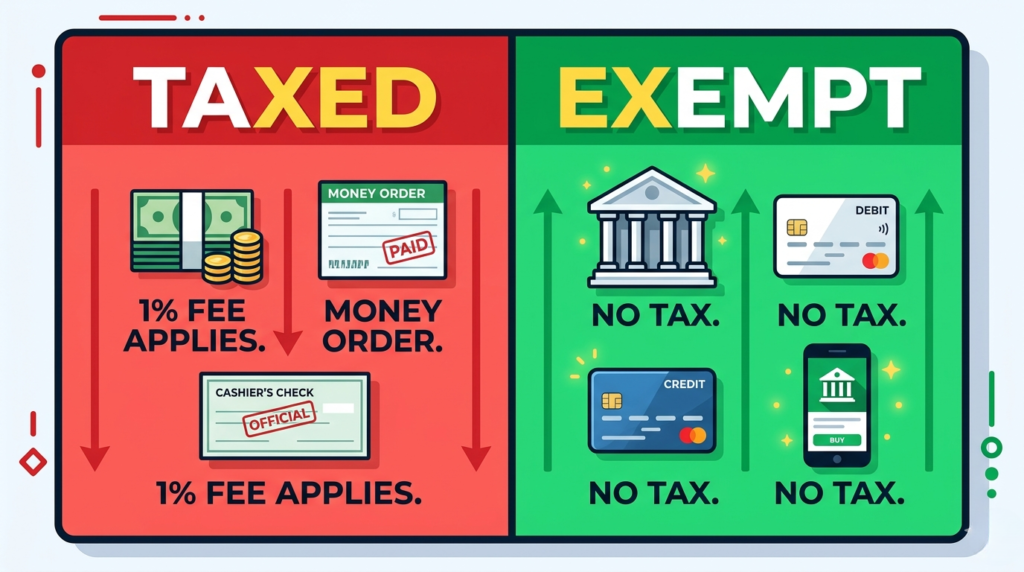
This is the most important thing to understand about the remittance tax, and it is simpler than most people expect.
What triggers the 1% tax:
The tax applies only when you fund an international transfer using a physical instrument — meaning cash, a money order, a cashier’s check, or any similar physical payment method. If you bring $1,000 in cash to a Western Union location to send to family in Mexico, you owe the 1% tax in addition to the normal transfer fee.
What is explicitly exempt under IRC Section 4475:
Transfers from bank accounts at BSA-regulated institutions, US debit cards, and US credit cards are explicitly exempt under IRC 4475(d)(1).
Remittances funded through US-issued debit cards or credit cards are explicitly exempt from the 1% excise tax. Digital wallets like PayPal and Venmo are similarly exempted from the remittance tax, because digital wallets do not utilize cash or checks as sources for transfers.
Most wire transfers and electronic bank transfers by Americans sending money internationally are not subject to tax.
In plain terms: if you pay for your international transfer using your US bank account, a US debit card, a US credit card, or a digital wallet connected to a bank account — you do not pay the 1% tax. The physical form of your payment is what triggers the tax, not the act of sending money internationally.
If you currently stand in line at a grocery store, pharmacy, or money transfer agent to hand over cash to fund a remittance transfer, those transactions will be 1% more expensive. The straightforward solution for most people is simply switching to a digital transfer method — which in many cases is also faster, cheaper, and more secure than cash anyway.
One Important Caution on Anti-Avoidance Rules
The proposed IRS regulations include anti-avoidance language that lets the government look through steps that change the form of payment without changing its substance. A customer who withdraws cash and then uses it to fund a transfer can still trigger the tax. A third party who supplies the cash for the sender can trigger the same result. The exemption is for genuinely digital payment methods — not for creative workarounds designed to disguise a cash payment.
The Best Tax-Exempt Ways to Send Money Home in 2026
Now that you know what to avoid, here are the best legitimate options for sending money internationally without triggering the 1% tax. All of these use bank accounts, debit cards, or digital payment methods and are explicitly exempt under the law.
Option 1: Wise – Best for Exchange Rate Transparency
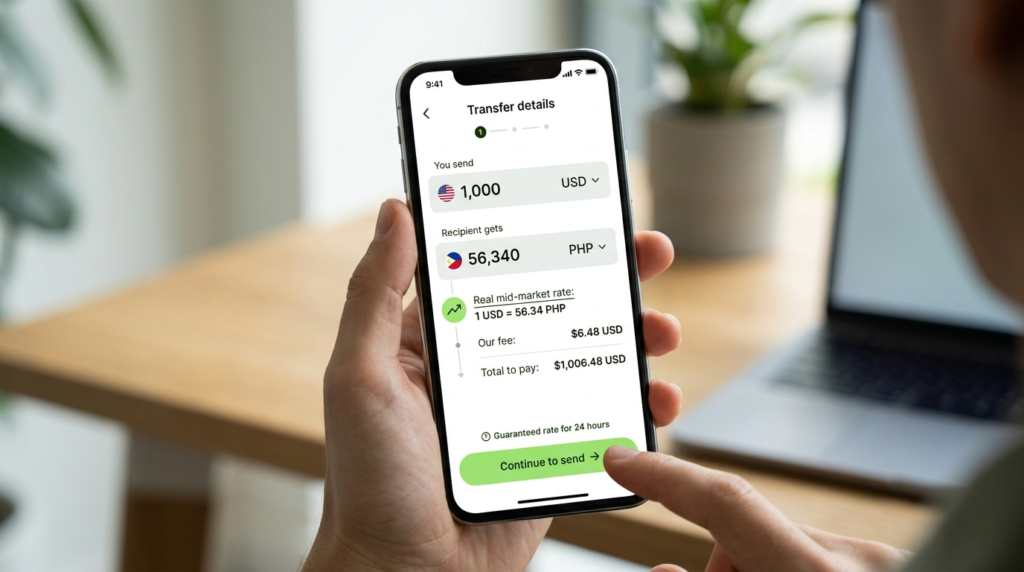
Wise (formerly TransferWise) is consistently ranked among the best international money transfer services for one fundamental reason: it uses the real mid-market exchange rate with no hidden markup, and shows you exactly what you are paying before you confirm. What you see is genuinely what your recipient receives.
Fees start from around 0.41% depending on the currency pair and payment method. When you fund your transfer through your US bank account or US debit card, both of which are tax-exempt payment methods, there is no additional 1% remittance tax applied. Wise supports transfers to over 160 countries in more than 50 currencies, and transfers on major currency pairs often arrive within minutes.
For immigrants who send larger amounts or want complete clarity on exactly how much of their money reaches family, Wise is the most transparent option available. Wise also offers a multi-currency account that lets you hold and convert funds in over 40 currencies, useful if your family’s country has a volatile exchange rate and timing your conversion matters.
Option 2: Remitly – Best for Flexibility and Cash Pickup
Remitly is one of the most widely used remittance apps for personal transfers, and for good reason. It covers over 170 countries in more than 100 currencies, with flexible delivery options that go beyond bank deposits: cash pickup locations, mobile wallets, and even home delivery in select countries.
Remitly is a 100% digital service, and the law specifically exempts transfers funded by electronic means. When you use the Remitly app or website, you pay for your transfer via bank account, debit card, or credit card — and because you are not handing over physical cash, a money order, or a cashier’s check, the Section 4475 excise tax does not apply to your transaction.
Remitly offers two speed tiers: Express (within minutes to the same day, at a higher fee) and Economy (3 to 5 business days at a lower cost). New customers often receive a fee waiver on their first transfer. For families in regions where cash pickup or mobile wallet delivery is more practical than direct bank deposit, Remitly’s flexibility is genuinely hard to match.
Option 3: WorldRemit – Best for Africa and Mobile Money
If you send money to sub-Saharan Africa — Kenya, Nigeria, Ghana, Uganda, Tanzania, and many others — WorldRemit deserves specific attention. It offers strong coverage for M-Pesa, MTN Mobile Money, and other mobile money platforms that are the primary financial tool for millions of recipients across the continent.
WorldRemit is a fully digital service funded through bank accounts and card payments, making all its transfers exempt from the 1% remittance tax under IRC Section 4475. It covers over 130 countries with a range of delivery options including bank deposit, mobile money, cash pickup, and airtime top-up — the last option being uniquely practical for keeping family members connected even when banking infrastructure is limited.
Option 4: Xoom (by PayPal) – Best If You Already Use PayPal
If you already have a PayPal account, Xoom is the fastest way to start sending money internationally without setting up a new service from scratch. As a PayPal company, Xoom draws from your linked bank account or PayPal balance, both of which are digital payment methods that are exempt from the 1% remittance tax.
Xoom covers over 130 countries and offers bank deposits, cash pickup, and home delivery in select markets. Transfer fees and exchange rate markups vary by destination, so comparing Xoom against Wise or Remitly for your specific corridor before sending is worth the two minutes it takes.
Option 5: Your Own Bank – If You Have One With Low Wire Fees
If you have a US bank account and your recipient has a bank account abroad, a direct international wire transfer or ACH bank transfer is one of the most straightforward tax-exempt options available. Transfers funded directly from checking or savings accounts at Bank Secrecy Act-regulated financial institutions are explicitly exempt from the remittance tax.
The downside is cost: traditional bank international wire fees typically range from $25 to $50 per transfer, and exchange rate markups at banks are often 3% to 6% on top of that, far less competitive than dedicated transfer services. If your bank offers a specific international transfer product with transparent pricing, compare the all-in cost against Wise or Remitly before choosing. For most smaller, regular transfers, dedicated remittance apps win on total cost even when accounting for the bank’s tax-exempt status.
SoFi is worth mentioning here as a US banking option for immigrants who do not yet have a traditional bank account. SoFi is beginner-friendly, has no account fees, and is designed for people building their US financial foundation from scratch. Establishing a US bank account, even a basic one, is the single most important step an immigrant who currently sends cash can take to become fully exempt from the 1% remittance tax.
What If You Do Not Have a US Bank Account Yet?

This is the underlying issue for many immigrants who are currently paying the cash tax without realizing there is a better path: they rely on cash because they do not have a US bank account, and they do not have a US bank account because the process of opening one feels complicated or inaccessible.
The reality is that opening a US bank account is significantly more accessible than many newcomers believe. Most banks and many neobanks accept non-citizen residents with a valid passport, an ITIN or Social Security Number, and a US address. Platforms like SoFi are specifically designed to remove the friction from this process.
Once you have a US bank account, every digital transfer service becomes available to you at lower cost, higher speed, and zero remittance tax. The one-time effort of opening an account has long-term financial benefits that compound every single month.
If you are in the process of getting your ITIN or SSN and cannot yet open a traditional bank account, using a US debit card linked to a prepaid account or a digital wallet funded from a verifiable source may also qualify for the exemption, verify the specifics with your transfer provider before relying on this approach.
How the Tax Is Collected: What You Will See on Your Receipt
You do not need to file any extra paperwork with the IRS because of the remittance tax. The remittance provider collects the 1% tax from you at the time of transfer and is then responsible for remitting the tax to the IRS. Providers file quarterly using IRS Form 720 (Federal Excise Tax Return). As a sender, you will simply see the tax reflected on your transaction receipt if you trigger it.
The recommended practice is to keep all remittance transaction receipts showing the 1% tax paid, with a minimum retention period of three years in line with the standard IRS audit period.
There is also a potential credit available: IRC Section 36C may allow a credit against income tax liability for remittance tax paid. As of February 2026, the IRS has not issued guidance on this credit — do not claim it on your return until official instructions are published. This is worth monitoring as the IRS finalizes regulations throughout 2026.
A Practical Comparison: Taxed vs. Tax-Exempt Sending
Here is what the real cost difference looks like over a full year for someone sending $400 per month, roughly $4,800 annually to support family abroad:
Using cash at a retail location (taxed): $4,800 x 1% remittance tax = $48 in annual tax, plus transfer fees, plus exchange rate markup.
Using a bank account or debit card through Wise, Remitly, or WorldRemit (exempt): $0 in remittance tax, plus competitive transfer fees and mid-market or near-market exchange rates.
On top of the tax savings, switching from a retail cash service to a digital transfer app typically saves an additional 1% to 3% in exchange rate markups and transfer fees. The combined difference for a regular sender over a year can easily reach $150 to $250, money that would otherwise reach your family instead of disappearing into fees and taxes.
Quick Reference: Best Tax-Exempt Transfer Options at a Glance
| Service | Best For | Transfer Method (Exempt) | Reaches |
|---|---|---|---|
| Wise | Rate transparency, large amounts | Bank account, debit card | 160+ countries |
| Remitly | Flexibility, cash pickup options | Bank account, debit/credit card | 170+ countries |
| WorldRemit | Africa, mobile money | Bank account, debit card | 130+ countries |
| Xoom | PayPal users | PayPal balance, bank account | 130+ countries |
| Bank wire | One-time or large transfers | US bank account | Worldwide |
All options above are exempt from the 1% remittance tax when funded through the payment methods listed.
The Bottom Line
The 1% remittance tax is real, it is in effect, and for millions of immigrants who still send money home via cash at a retail agent, it is already adding cost to every transfer. But it is also one of the most avoidable taxes in the US tax code.
The exemption is not a loophole. It is a statutory provision written directly into IRC Section 4475 that explicitly excludes bank accounts, US debit cards, US credit cards, and digital wallets. Using any of those payment methods means you pay zero remittance tax, full stop. The switch to digital is the solution — and for most people, it also means sending money faster, with better exchange rates, and with a complete electronic record of every transfer.
Every dollar that does not go to a fee or a tax is a dollar that reaches your family. That has always been the point.
Disclaimer: This article is for educational and informational purposes only and does not constitute tax, legal, or financial advice. Tax regulations and exemption rules may change as the IRS finalizes guidance on IRC Section 4475 throughout 2026. Always verify current rules with your transfer provider and consult a qualified tax professional for advice specific to your situation.
Affiliate Disclosure: Some links in this post are affiliate links. If you sign up or make a transfer through them, I may earn a small commission at no extra cost to you. I only recommend services I have researched and would personally use.