
Green Card vs Work Visa vs Undocumented: What You Can and Cannot Do Financially
One of the most frustrating aspects of navigating money as an immigrant in the United States is that almost no financial advice specifies which immigration status it applies to.
An article tells you to open a Roth IRA. Can you, with your status? It does not say. A blog post recommends applying for an FHA loan. Is that available to you? No mention. A YouTube video explains how to collect unemployment after a job loss. Does that apply if you are on a work visa? Unclear.
The result is that immigrants make financial decisions based on advice written for a generic audience, only to discover later that the product, benefit, or account they were counting on requires documentation or eligibility criteria they did not know they needed to meet.
This article solves that problem directly. It maps the most important financial decisions to the three most common immigration status categories: green card holders, work visa holders, and undocumented immigrants. The goal is to give you a clear, status-specific picture of what is and is not available to you, so that every financial decision you make is based on your actual situation.
Important note: Immigration law is complex and changes frequently. This article provides general educational information, not legal advice. Always verify your specific situation with a qualified immigration attorney before making decisions that could affect your status.
The Three Categories and What Defines Them
Before the comparison, a quick orientation on the three categories this article covers.
Green card holders (Lawful Permanent Residents) hold a Permanent Resident Card, commonly called a green card, which grants the right to live and work in the United States permanently. Green card holders are not US citizens but have most of the same rights and obligations for financial and tax purposes. Naturalization to citizenship is the path forward.
Work visa holders are immigrants authorized to live and work in the US temporarily through a visa category tied to employment or another purpose. Common examples include H-1B (specialty occupations), L-1 (intracompany transfers), TN (Canadian and Mexican professionals under the USMCA), O-1 (extraordinary ability), and F-1 students with Optional Practical Training. Work authorization is typically tied to a specific employer or purpose, and the ability to remain in the US depends on maintaining valid status.
Undocumented immigrants are people who are present in the US without current legal authorization to be here. This includes people who entered without inspection, people whose visas expired, and people awaiting immigration proceedings. DACA recipients occupy a particular status within this category: they have deferred action from removal and work authorization, but no formal legal immigration status.
Banking and Financial Accounts
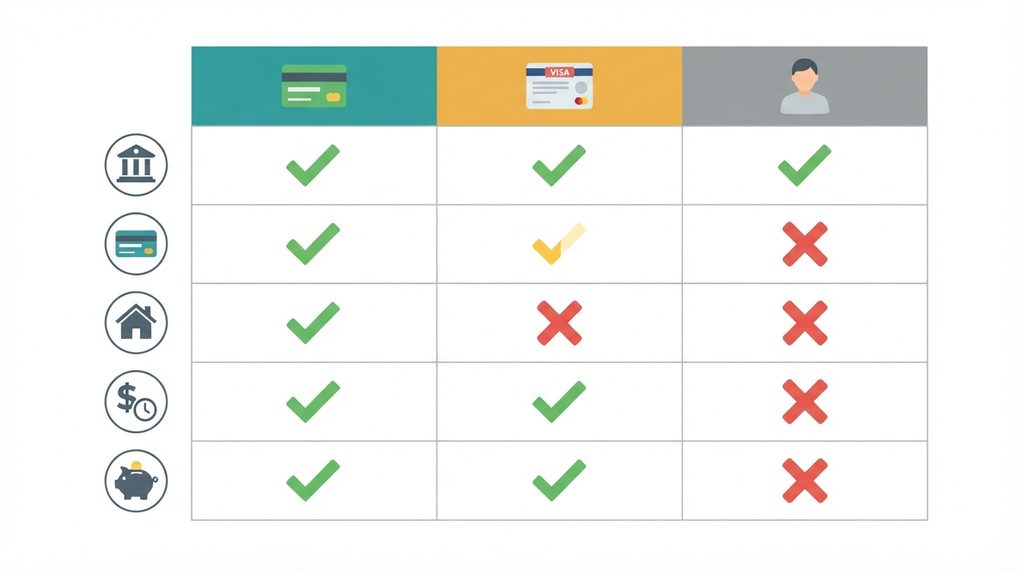
What this image shows: A three-column comparison of banking and financial account access by immigration status. Green card holders have the broadest access across all five categories. Work visa holders have nearly equivalent access but with some limitations on employer-tied accounts. Undocumented immigrants face more restrictions, particularly on credit products and mortgages, though basic banking and savings accounts remain accessible at many institutions through ITIN or consular ID. The chart shows a gradient of access from left to right.
Checking and Savings Accounts
Green card holders: Full access. Open any bank account at any institution using your green card as your primary identification alongside a passport and proof of address. No restrictions.
Work visa holders: Full access. Open any bank account using your passport and visa documentation. Some banks may ask for your I-94 arrival record alongside your visa. No meaningful restrictions.
Undocumented immigrants: Partial access. Cannot open accounts at many traditional banks that require a Social Security Number for all customers. However, a growing number of banks and credit unions accept an ITIN (Individual Taxpayer Identification Number) to open a checking or savings account, including Bank of America, Wells Fargo, and credit unions in the Juntos Avanzamos network. Some banks also accept a Matricula Consular (Mexican consular ID) or equivalent consular identification cards from other countries. A growing number of credit unions and community banks have explicit policies welcoming ITIN holders regardless of documentation status.
Credit Cards
Green card holders: Full access to all credit products available to US residents. Apply for any credit card using your SSN. Build credit the same way any US resident does.
Work visa holders: Full access with an SSN. Most work visa holders receive an SSN with their authorization to work, which enables full credit access. The main limitation is that credit history may be limited if you are new to the US.
Undocumented immigrants: Limited access. Most major credit card issuers require an SSN. However, some credit card products accept an ITIN. Nova Credit’s Credit Passport can translate foreign credit history for use with certain US lenders. Secured credit cards at ITIN-accepting institutions are the most reliable path to building US credit without an SSN.
Employment and Income
Working Legally
Green card holders: Can work for any employer in any industry. No employer sponsorship required. No visa tied to a specific job. Permanent and unrestricted work authorization.
Work visa holders: Work authorization is typically tied to a specific employer, industry, or purpose depending on visa type. An H-1B holder can work only for their sponsoring employer in the approved position. Changing jobs requires a new petition or transfer. Starting a side business or gig work may violate visa terms depending on the visa category.
Undocumented immigrants and DACA: Cannot legally work without work authorization. Undocumented immigrants who work do so without legal authorization, which creates risk. DACA recipients with a valid Employment Authorization Document (EAD) have legal work authorization but only for the duration of their DACA validity and only for standard employment. DACA does not authorize self-employment.
Gig Work and Self-Employment
Green card holders: Full access to gig platforms, self-employment, and business formation. Can work for DoorDash, Amazon Flex, Uber Eats, and any other platform using SSN.
Work visa holders: This is one of the most commonly misunderstood areas. H-1B, L-1, O-1, and most other employment-based visa holders are NOT authorized to work for additional employers beyond their sponsor, including gig platforms. Taking on Uber Eats, DoorDash, or freelance work may constitute unauthorized employment and violate your visa terms. Consult an immigration attorney before beginning any gig work if you are on an employer-sponsored visa. EAD holders have more flexibility.
Undocumented immigrants: Not legally eligible for gig platforms that require SSN and work authorization verification. DACA EAD holders may use gig platforms in markets that accept their work authorization.
Taxes
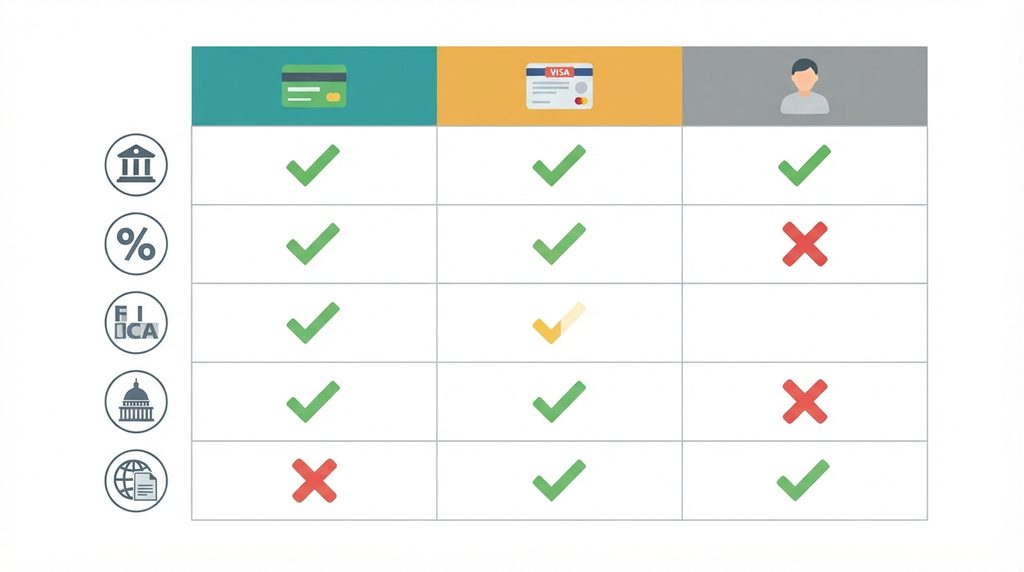
What this image shows: All three immigration status categories have federal income tax obligations on US-sourced income. Social Security and Medicare taxes apply to all workers including undocumented immigrants, even though undocumented workers typically cannot collect those benefits. State income tax applies in states that have it regardless of status. FBAR foreign account reporting applies to all US tax residents including green card holders and work visa holders who meet the Substantial Presence Test, but generally not to undocumented immigrants who are nonresident aliens for tax purposes.
Filing Taxes
Green card holders: File as resident aliens on Form 1040 reporting worldwide income. Same filing requirements as US citizens.
Work visa holders: File as resident aliens (Form 1040) if you meet the Substantial Presence Test (generally present in the US for 183 days or more in a combination of the current and past two years) or the Green Card Test. File as nonresident aliens (Form 1040-NR) if you do not meet either test. H-1B and other long-term work visa holders almost always qualify as resident aliens.
Undocumented immigrants: Have a legal obligation to file US taxes on US-sourced income. File using an ITIN if no SSN is available. Tax filing builds a record of presence and compliance that can be valuable in future immigration proceedings. The IRS maintains strict confidentiality of tax information, though the 2025 IRS-ICE data sharing controversy raised concerns that have been addressed by court orders. For the full current picture on tax privacy, our article on safe tax filing and protecting your privacy covers the latest developments.
Who Pays What
All workers in the US, regardless of immigration status, pay Social Security and Medicare taxes (FICA) on wages. Undocumented immigrants typically cannot collect Social Security retirement benefits from those contributions, though the taxes are still withheld. This represents a significant subsidy from undocumented workers to the broader Social Security system.
Retirement Accounts
401(k)
Green card holders: Full access. Enroll in employer’s 401(k) using SSN. No restrictions.
Work visa holders: Full access. H-1B, L-1, TN, and other work visa holders can enroll in employer-sponsored 401(k) plans. This is one area where work visa holders have the same access as green card holders. The question of what happens to the 401(k) if you eventually leave the US is a separate planning question, covered in depth in our article on what happens to your 401k if you leave the US.
Undocumented immigrants: Cannot contribute to a standard employer-sponsored 401(k) because doing so requires work authorization and an SSN that matches the employer’s records. Some undocumented workers who are on payroll without proper documentation may find 401(k) contributions being made on their behalf, but claiming those funds can be complicated.
Roth IRA and Traditional IRA
Green card holders: Full access. Contribute up to $7,000 per year ($8,000 if 50 or older) to a Roth or Traditional IRA using SSN.
Work visa holders: Full access, with the requirement that you have US earned income. H-1B and most other work visa holders with US employment income can open and fund IRAs. Our full guide on why every immigrant needs a Roth IRA covers eligibility, contribution limits, and how to open one.
Undocumented immigrants: Generally not able to open standard IRA accounts at major brokerages that require an SSN. Some financial institutions accept ITIN for IRA accounts, though this is not universal. This is an area worth researching with ITIN-accepting financial institutions if you are building long-term savings.
Government Benefits
This section has significant nuance and has changed with recent legislation.
Unemployment Insurance
Green card holders: Eligible for unemployment benefits under the same terms as US citizens, as long as you meet your state’s work history and earnings requirements. Receiving unemployment does not affect your immigration status or create public charge concerns for permanent residents.
Work visa holders: Generally not eligible for unemployment benefits because your work authorization is tied to a specific employer and you are typically not considered “able and available” to accept other work. The situation is complex and varies by visa type and state. H-1B holders who lose their job have a 60-day grace period to find new sponsorship but cannot legally work or collect unemployment in most cases during that period.
Undocumented immigrants and DACA: Not eligible for federal unemployment insurance. Some states have separately funded programs, but federal unemployment is not available.
Medicaid and Health Benefits
Green card holders: Eligible for federally funded Medicaid after a five-year waiting period from the date of obtaining permanent resident status. Some categories (refugees, asylees) are exempt from the waiting period. Children and pregnant individuals have more generous eligibility in most states.
Work visa holders: Generally not eligible for federal Medicaid. May qualify for employer-sponsored health insurance, ACA Marketplace coverage, and premium tax credits if income qualifies. The 2025 One Big Beautiful Bill Act significantly changed Marketplace eligibility for certain categories.
Undocumented immigrants: Not eligible for federally funded Medicaid except Emergency Medicaid. Eligible for care at federally qualified health centers regardless of status. Several states (California, New York, Washington, Colorado) have state-funded coverage programs regardless of immigration status. For the complete picture of free and low-cost healthcare options, our article on free and low cost healthcare options for immigrants covers every available pathway.
SNAP (Food Stamps)
Green card holders: Eligible after the five-year waiting period. Some states have eliminated the waiting period using state funds.
Work visa holders: Generally not eligible for federal SNAP.
Undocumented immigrants: Not eligible for federal SNAP. Some states fund their own nutrition programs for additional categories.
Homeownership and Mortgages
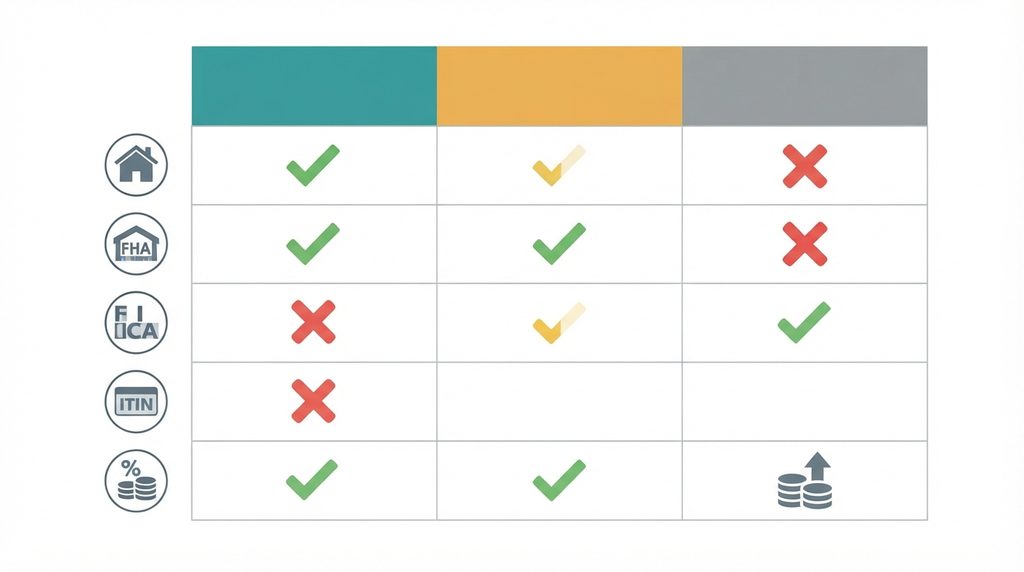
What this image shows: Green card holders have access to both conventional and FHA mortgages on the same terms as US citizens. Work visa holders can access conventional and FHA loans with valid visa documentation, though lender requirements vary. Undocumented immigrants are not eligible for conventional or FHA loans but can access ITIN mortgages through a growing number of community banks and credit unions that specialize in this product, typically with higher down payment requirements.
Green card holders: Eligible for conventional and FHA mortgages on the same terms as US citizens. Present your green card as your primary identification. No special restrictions.
Work visa holders: Eligible for conventional mortgages at most lenders and FHA loans at many. Requirements include a valid visa, an SSN, documented income, and a two-year US work history (or a strong case for exceptions). Some lenders specialize in H-1B and other work visa borrowers. Visa expiration must typically extend beyond the loan closing date.
Undocumented immigrants: Not eligible for conventional or FHA mortgages, which require legal residency. ITIN mortgages are available through a growing number of community banks, credit unions, and specialized lenders. These loans typically require a larger down payment (15% to 30%), a strong alternative credit profile, and documented income. Interest rates are higher than conventional loans. Several credit unions specifically serving immigrant communities offer ITIN mortgage products.
Business Formation
Green card holders: Can form any type of business entity (LLC, corporation, sole proprietorship) without restriction. Can obtain business loans, business credit cards, and business bank accounts.
Work visa holders: Can form a business entity in most states (business formation is a state function, not federal immigration function). However, working in or drawing a salary from that business may constitute unauthorized employment depending on your visa type. Passive investment in a business is generally permitted. Active participation and compensation typically is not, for most work visa categories. Consult an immigration attorney before actively engaging in a business you own while on an employer-sponsored visa.
Undocumented immigrants: Can form an LLC in most states using an ITIN instead of an SSN. Can obtain an EIN (Employer Identification Number) for the business. Can open a business bank account at ITIN-accepting institutions. Cannot employ themselves in the legal sense without work authorization, but operating a business is a complex area where immigration law intersects with business law in ways that vary by situation.
Investing
Green card holders: Full access to brokerage accounts, investment accounts, retirement accounts, index funds, ETFs, stocks, real estate investment platforms, and all other investment vehicles available to US residents.
Work visa holders: Full access to investment accounts with an SSN. No restrictions on standard investing. PFIC rules apply to foreign investment funds purchased after becoming a US tax resident, which is a tax compliance issue rather than an immigration eligibility issue.
Undocumented immigrants: Limited but real access. ITIN holders can open brokerage accounts at some institutions and invest in stocks, ETFs, and index funds. Access varies by brokerage. Real estate investment platforms like Arrived and Fundrise have varying ITIN policies. Our guide on become a landlord with $100 covers the specific platforms and their current documentation requirements.
The Bottom Line by Status
| Financial Activity | Green Card | Work Visa | Undocumented |
|---|---|---|---|
| Bank account | Yes | Yes | Limited (ITIN banks) |
| Credit card | Yes | Yes | Limited (ITIN products) |
| File taxes | Yes (1040) | Yes (1040 or 1040-NR) | Yes (ITIN) |
| 401(k) | Yes | Yes | No |
| Roth IRA | Yes | Yes | Limited (ITIN institutions) |
| Gig work | Yes | No (most visa types) | No |
| Conventional mortgage | Yes | Yes (with conditions) | No |
| ITIN mortgage | N/A | N/A | Yes (specialized lenders) |
| Unemployment benefits | Yes | No (most visa types) | No |
| Medicaid | Yes (after 5 years) | No | Emergency only |
| Social Security | Yes | Yes (if 40 credits) | No |
| Business formation | Yes | Passive only (most visas) | Yes (limited) |
| Stock market investing | Yes | Yes | Limited (ITIN brokerages) |
The Two Things True for Every Status Category
Regardless of which column you are in, two things are universally true.
First, you are required to pay taxes on US-sourced income. Filing a tax return is both a legal obligation and a financial asset: it builds a record of presence, compliance, and income that matters in immigration proceedings, loan applications, and many other contexts. If you are in any status category and have US-sourced income, file.
Second, where there is a limitation, there is usually a workaround or an alternative path. ITIN banking when SSN banking is unavailable. ITIN mortgages when conventional mortgages are inaccessible. Community health centers when Medicaid is out of reach. The financial system has more access points for immigrants of every status than most people realize. The information gap, not the access gap, is often the actual barrier.
This article is one step toward closing that gap.
Disclaimer: This article is for educational and informational purposes only and does not constitute legal, immigration, financial, or tax advice. Immigration law is complex, changes frequently, and the financial rights and restrictions associated with each status category depend on individual circumstances, specific visa types, and state-level variations. Always consult a qualified immigration attorney and financial professional before making decisions based on your immigration status.