
How Much Should You Save for Retirement?

At some point, usually after the survival phase and before the wealth-building phase feels fully real, most immigrants ask the same quiet question.
How much do I actually need to retire?
The internet has an answer. Several of them, in fact. Save 10% to 15% of your income. Have 10 times your salary saved by age 67. The 4% rule. The $1 million target. These numbers come from credible sources and are based on real research, and none of them were calculated with an immigrant in mind.
They do not account for the years you spent in another country, not contributing to a US system. They do not account for the Social Security credits you may have accumulated in a country with a totalization agreement. They do not account for the foreign pension that may supplement your US retirement even if it does not appear in any American retirement calculator. They do not account for the real possibility that you will retire somewhere with a significantly lower cost of living than the US city you currently live in.
The standard benchmarks are a starting point. This article gives you the actual framework for calculating your number, specific to your circumstances.
Why the Standard Rules May Not Apply to You
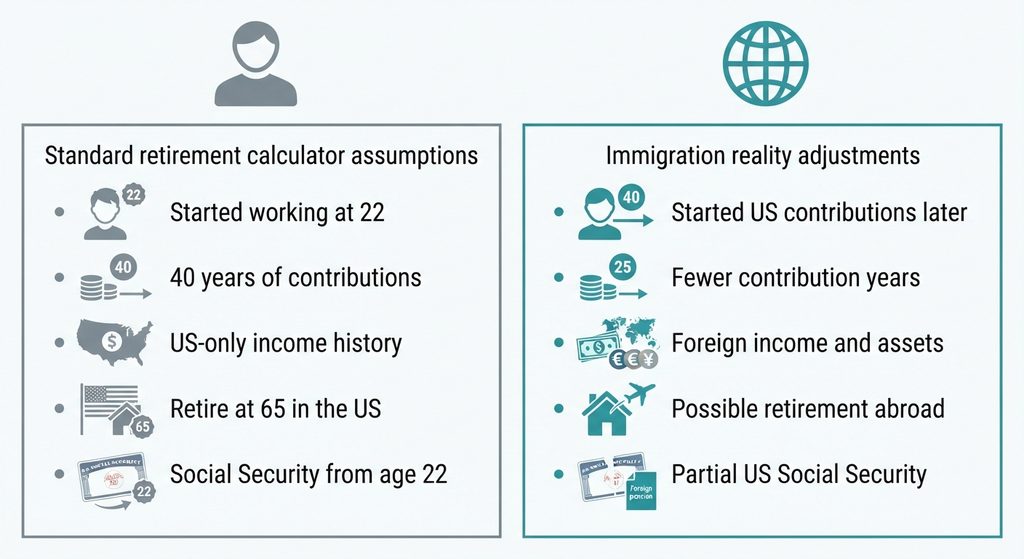
What this image shows: Standard retirement calculators assume a person who started working in the US at age 22, contributed for 40 years, has only US income history, plans to retire in the US at 65, and qualifies for full Social Security. Most immigrants match none of these assumptions. The right column shows the five adjustments that make a retirement calculation accurate for someone who arrived in their 30s or 40s, has foreign assets, and may not retire in the US or at a standard age.**
The most commonly cited retirement benchmark is the Fidelity rule of thumb: save 10 times your salary by age 67. By age 30, have 1 times. By 40, have 3 times. By 50, have 6 times. By 60, have 8 times.
These benchmarks assume you started saving at 22 and have been saving consistently for your entire career. They assume your Social Security benefit reflects 35 years of US earnings. They assume you will retire in the US and live on the same cost structure you currently have.
For an immigrant who arrived at 35 with zero in US accounts, the benchmark at 50 says you should have 6 times your salary. The benchmark does not know that you only had 15 years rather than 28 to reach that number, or that you have a pension from your home country worth $300 per month at retirement, or that you are planning to retire to a country where $2,000 per month is a very comfortable income.
The benchmark is not wrong for what it was designed for. It is simply not designed for you.
Step 1: Calculate Your Retirement Number, Not Someone Else’s
The correct starting point is not a benchmark. It is a question: how much money do you need to spend each month in retirement to live comfortably?
This answer is different for every person and every family, and it is significantly influenced by one question that most American retirement calculators never ask: where do you plan to retire?
If you plan to retire in the United States: A commonly used planning figure is 70% to 80% of your current pre-retirement income. This reflects that in retirement you typically spend less on commuting, work clothing, and certain other work-related costs, while healthcare costs often increase. A household currently living on $70,000 per year might plan for $49,000 to $56,000 per year in retirement.
If you plan to retire in your home country or another lower-cost country: Your required retirement income may be substantially lower. A retiree living comfortably in many Latin American, Caribbean, African, or Southeast Asian countries can do so on $1,500 to $2,500 per month, or $18,000 to $30,000 per year. That is dramatically less than the amount required to maintain the same quality of life in a US city.
Many immigrants plan for a hybrid: spending some years in the US near family they have built here, and eventually relocating to a place with lower costs. This flexibility changes the calculation significantly.
Step 2: Apply the 4% Rule to Find Your Target
Once you know your annual retirement spending target, a widely used planning tool called the 4% rule gives you your savings target.
The 4% rule comes from the Trinity Study, research published in 1998 and subsequently updated, which found that a retirement portfolio withdrawing 4% of its initial value per year, adjusted for inflation, historically lasted 30 years or longer in the vast majority of scenarios tested against US market data.
The math is simple. Divide your annual retirement spending by 0.04 (or multiply by 25).
If you need $40,000 per year in retirement, your target portfolio is $40,000 divided by 0.04 = $1,000,000.
If you need $30,000 per year because you plan to retire to a lower-cost country, your target is $30,000 divided by 0.04 = $750,000.
If you need $25,000 per year because Social Security and a foreign pension cover a meaningful portion of your expenses, your target portfolio may be as low as $25,000 divided by 0.04 = $625,000.
Important note: The 4% rule was developed using US market data and a 30-year retirement horizon. Some financial planners now recommend a slightly lower rate of 3% to 3.5% for people retiring younger or planning for a longer horizon. For a 35-year retirement, $40,000 per year might require $1,143,000 at a 3.5% withdrawal rate.
Step 3: Subtract What You Already Have Coming
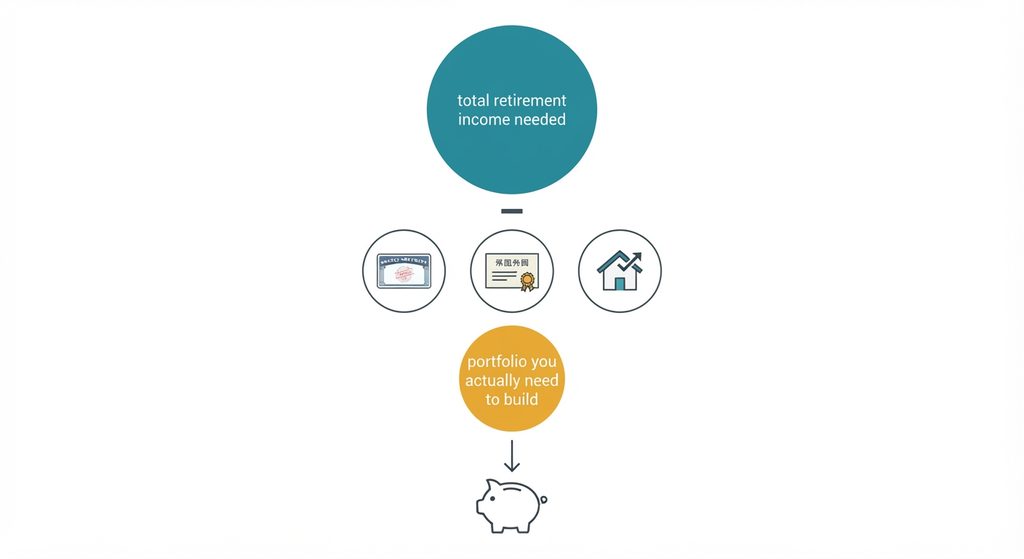
What this image shows: Your required retirement portfolio is not your total retirement spending need. It is your total spending need minus the income you will receive from other sources: US Social Security, any foreign pension or retirement benefit, and any rental income from property you own. The remaining gap after subtracting these income sources is what your investment portfolio needs to cover. For many immigrants, this gap is meaningfully smaller than the gross retirement spending target suggests.
This is where immigrants often discover their situation is better than the standard benchmark implies.
US Social Security: If you have worked in the US for at least 10 years (40 credits), you qualify for Social Security benefits. Your benefit is based on your 35 highest-earning years. If you have fewer than 35 years of US earnings, the missing years are counted as zeros, which reduces your benefit. Request a Social Security statement at ssa.gov to see your current projected benefit at different claiming ages.
If you worked in a country with a US totalization agreement before arriving, those work credits may combine with your US credits toward the 40-credit threshold for eligibility. Countries with totalization agreements include Canada, the UK, Australia, Germany, France, Italy, Japan, South Korea, Mexico, Chile, and more than 30 others. Visit ssa.gov/international to check your country.
Foreign pension or retirement benefit: If you worked in another country long enough to earn a pension or provident fund benefit, that income in retirement reduces how much your US portfolio needs to generate. Get a current projection of that benefit from your home country’s social security or pension agency.
Rental income: If you own property in the US or your home country that you plan to continue renting through retirement, that income reduces your portfolio withdrawal requirement. A rental property generating $800 per month net income reduces your annual withdrawal need by $9,600.
Example: Suppose your retirement spending target is $48,000 per year. Your projected Social Security at age 67 is $14,000 per year. Your foreign pension will pay approximately $4,800 per year. Your total other income is $18,800 per year. Your portfolio only needs to cover $48,000 minus $18,800 = $29,200 per year. At a 4% withdrawal rate, your target portfolio is $29,200 divided by 0.04 = $730,000, not the $1,200,000 a standard calculator might suggest for your spending level.
Step 4: Calculate How Much to Save Monthly to Hit Your Target
With a target portfolio number, you can calculate the monthly savings rate required to reach it by a specific retirement age.

What this image shows: Three scenarios showing how the required monthly savings contribution varies by starting age to reach the same retirement portfolio target. Starting at age 35 requires a smaller monthly contribution than starting at 45, which requires less than starting at 55. The visual demonstrates the mathematical relationship between starting age and required savings rate, reinforcing the central message that starting now, regardless of age, produces better outcomes than waiting.**
Here is a practical savings rate table based on reaching a $750,000 target portfolio by age 65, assuming a 7% average annual return.
Starting at age 35: approximately $785 per month.
Starting at age 40: approximately $1,150 per month.
Starting at age 45: approximately $1,740 per month.
Starting at age 50: approximately $2,800 per month.
Starting at age 55: approximately $5,050 per month.
These numbers clarify the real cost of delay. Every five years of delay roughly doubles the required monthly contribution to reach the same outcome. This is the compound growth dynamic working in reverse.
If the required monthly amount feels out of reach at your current income, that is important information. It means either your retirement target needs to be adjusted, your retirement timeline needs to extend, your expected income from other sources needs to be revised upward, or your current income needs to grow before you can fully close the gap.
None of these adjustments are failures. They are planning inputs that help you make honest decisions rather than ignoring the math until it is too late to change the outcome.
The Accounts to Use and in What Order
Once you know your monthly savings target, the accounts you use to hit it matter enormously because of their tax implications.
Employer 401(k) up to the full match: Always first. The employer match is an immediate guaranteed return that no investment can replicate. If your employer matches 50% of contributions up to 6% of your salary, contribute at least 6%. Our article on what is a 401k and should I actually use mine explains how to enroll and capture the match.
Roth IRA up to the annual limit: After the employer match, max out a Roth IRA ($7,000 per year, or $8,000 if you are 50 or older). The Roth’s tax-free growth is particularly valuable for immigrants who may retire in a lower-income period or who value having tax-free income available in retirement regardless of where they live. Our guide on why every immigrant needs a Roth IRA covers eligibility and the cross-border advantages.
Return to the 401(k): After the Roth IRA is maxed, return to the 401(k) and contribute as much additional as your budget allows, up to the annual limit ($23,500 under 50, $31,000 at 50 or older in 2025).
Taxable brokerage account: Once tax-advantaged accounts are maximized, a regular brokerage account with index fund investments is the next layer. No contribution limits. Full flexibility. Gains are taxable annually, but the flexibility and liquidity are valuable.
The Honestly Uncomfortable Truth About Late Starting
If you are in your 40s or 50s, reading this article, and your current retirement savings are significantly below where you need to be, the honest truth is this: you have real options, but they require real action.
Working longer than you originally planned is one of the most powerful tools available. Every additional year of work means one more year of contributions, one more year of compound growth, and one fewer year of drawing down the portfolio. Working to 68 instead of 65 adds years of compounding on the front end and removes years of withdrawal on the back end. The combined effect is significant.
Reducing retirement spending is the other lever. If you are willing to retire to a lower-cost location, a foreign pension or even Social Security alone may cover more of your needs than a US-based retirement calculator suggests. Many immigrants in their 40s and 50s discover that retiring partially abroad, spending winters in a home country and summers in the US near their children, dramatically changes what is financially required.
For a complete strategy on catching up when you have started late, our article on how to catch up on retirement savings in your 40s and 50s covers the catch-up contribution mechanics, Social Security delay strategies, and the realistic math of closing a significant gap.
A Simple Summary: Your Retirement Number in Five Steps
- Decide where you plan to retire and estimate your annual spending in that location.
- Multiply that number by 25 to find your target portfolio (the 4% rule).
- Subtract projected Social Security, foreign pension, and rental income from your annual spending need, then multiply the remaining gap by 25.
- Use a compound interest calculator to find the monthly contribution required to reach your revised target by your target retirement age.
- Fill your tax-advantaged accounts in order: employer match first, then Roth IRA, then additional 401(k), then taxable brokerage.
This five-step framework will give you a retirement number that is actually yours, not a generic benchmark built for someone whose financial life looks nothing like yours.
Disclaimer: This article is for educational and informational purposes only and does not constitute financial, tax, or legal advice. Retirement planning involves projections and assumptions that may not reflect actual future outcomes. Tax laws, Social Security rules, and investment returns change over time. Consult a qualified financial advisor for advice specific to your situation